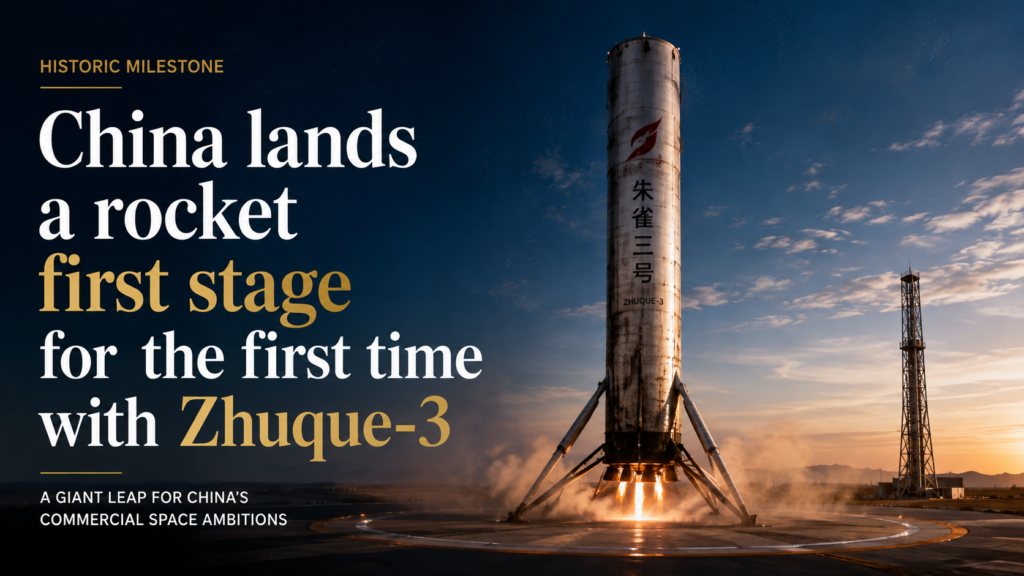
Why in the News
China has recovered the first stage of a rocket on land for the first time, using the reusable rocket Zhuque-3, which was launched on Wednesday morning. It is the country’s second rocket stage recovery overall, after a sea platform recovery in July, and the first to use deployable landing legs. State media described the result as a major breakthrough in the country’s reusable rocket technology.
What is a reusable rocket?
- About: A reusable rocket is a launch vehicle whose stages are recovered intact after flight and flown again, instead of being discarded once the payload is delivered.
- Why it lowers cost: The first stage carries most of the engines and structure, so recovering it avoids rebuilding the most expensive part of the vehicle for every launch.
- How recovery works: The stage separates after boost, reorients, uses engine burns to slow its descent and lands vertically on a pad or on a sea platform.
- What landing legs add: Deployable landing legs stabilise the stage at touchdown on ground, which is why their first use is treated as a distinct technical milestone.
What did the Zhuque-3 flight achieve?
- Launch and recovery: Zhuque-3 was launched on Wednesday morning and its first stage was recovered afterward.
- First on land: This marks China’s first successful recovery of a rocket first stage on land.
- Second overall: It is the second time the country has recovered a rocket stage, following a successful recovery on a sea platform in July.
- New hardware: The recovery marked China’s first use of deployable landing legs.
- Official assessment: The state news agency deemed the result a major breakthrough in the country’s reusable rocket technology.
How does this compare with earlier recoveries?
- China’s July recovery: On 10 July, the first stage of a Long March-10B rocket separated from the second stage after lift off and returned to a platform at sea.
- The difference land makes: A sea platform recovery avoids overflight of populated areas, while a land recovery removes the need for a recovery vessel and shortens the turnaround.
- United States, SpaceX: SpaceX has been recovering rockets since 2015 and has driven down launch costs by reusing hardware that would otherwise be discarded after carrying satellites and other payloads toward space.
- United States, Blue Origin: Blue Origin has likewise been recovering boosters since 2015, establishing vertical landing as a repeatable rather than experimental technique.
- What the comparison shows: China is closing a capability gap that has stood for a decade, and the operator here is a private launch company rather than the state programme.
Why does reusability decide launch economics?
- Cost per launch: Reuse spreads the cost of building a stage across several flights, which is the single largest lever on the price of access to orbit.
- Launch cadence: Recovery shortens the interval between flights, which matters for deploying large satellite constellations.
- The payload penalty: Propellant reserved for the landing burn and the mass of legs and grid fins reduce the payload the same vehicle can carry.
- The break even condition: Reuse pays only when the same stage flies many times, so refurbishment cost and inspection time determine whether the saving is real.
- Strategic consequence: Cheaper and more frequent launch capacity translates directly into faster deployment of communication, navigation and remote sensing assets.
Conclusion
Zhuque-3’s flight gives China its first land recovery of a rocket first stage and its second stage recovery in six weeks, after the Long March-10B sea platform recovery of 10 July. The flight also carried the country’s first use of deployable landing legs, which is the hardware element that makes routine ground landings possible. The state news agency has called it a major breakthrough in reusable rocket technology. The next measure of the achievement is whether the recovered stage is refurbished and reflown, since recovery without reflight does not deliver the cost saving that reusability exists to produce.
“[2016] What is ‘Greased Lightning-10 (GL-10)’, recently in the news?
(a) Electric plane tested by NASA
(b) Solar-powered two-seater aircraft designed by Japan
(c) Space observatory launched by China
(d) Reusable rocket designed by ISRO
