Why in the News
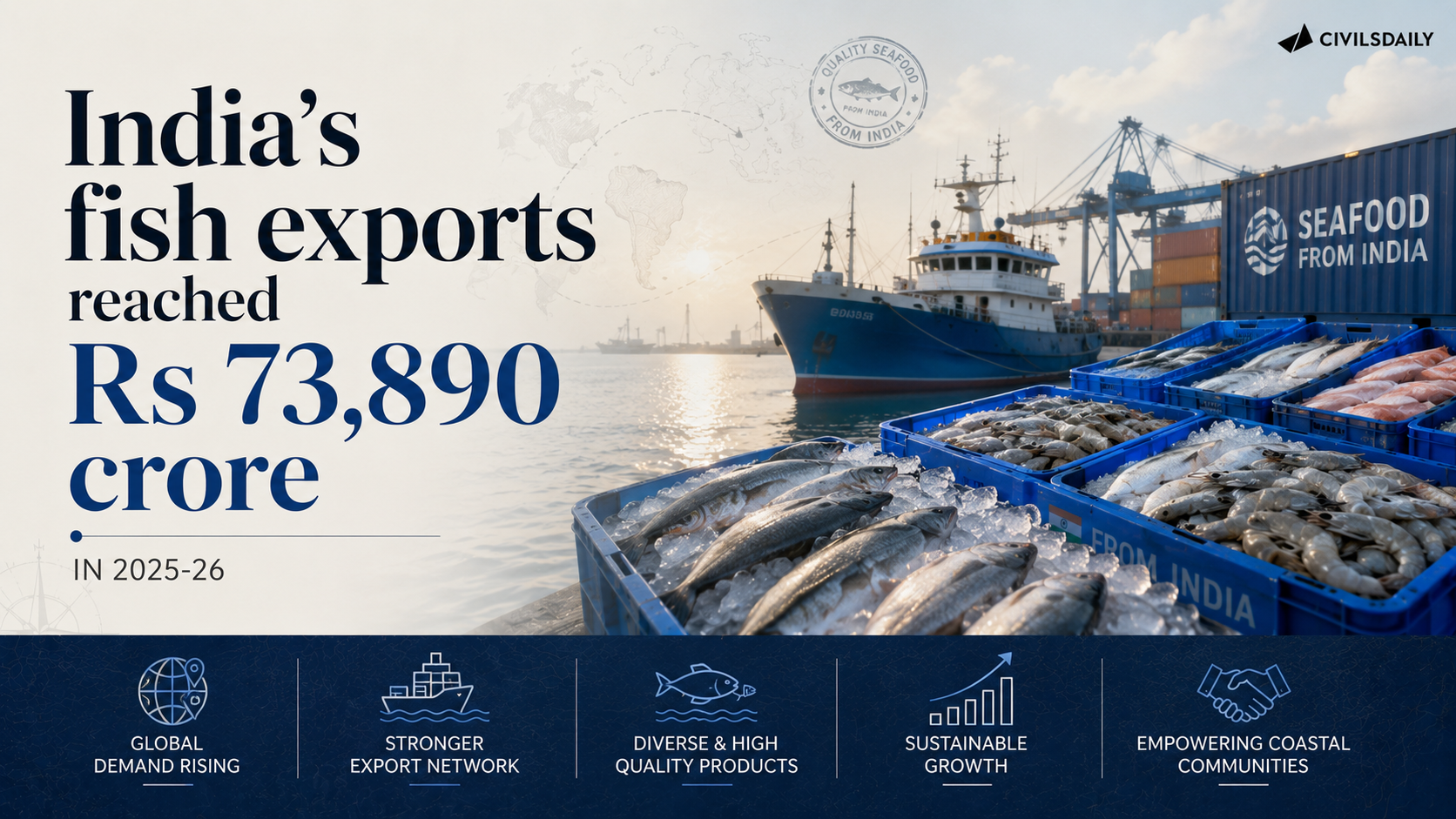
India’s fish exports reached Rs 73,890 crore in 2025-26, an increase of about Rs 11,000 crore over the previous year. The United States imposed a tariff of more than 58 per cent on Indian goods in 2025, and shipments to that market fell by around 19 to 20 per cent. Growth of more than 20 per cent in the European Union and in countries with which India has signed free trade agreements covered the shortfall. The Union Minister for Fisheries, Animal Husbandry and Dairying set out this record alongside the production and infrastructure results claimed for the Blue Revolution, the Pradhan Mantri Matsya Sampada Yojana and the Fisheries and Aquaculture Infrastructure Development Fund. The tension is that the exports absorbing the tariff are marine products, and the production growth being cited is led by inland fisheries, which contribute only about 2 per cent of export earnings.
How has fish production moved since 2013-14?
- Output has more than doubled: Total fish production rose from 95.79 lakh tonnes in 2013-14 to 197.75 lakh tonnes in 2024-25, a growth of 115 per cent.
- Inland fisheries led it: Inland production grew by 147 per cent over the same period.
- What paid for it: More than Rs 39,000 crore was invested through the Blue Revolution launched in 2015, the Pradhan Mantri Matsya Sampada Yojana and the Fisheries and Aquaculture Infrastructure Development Fund.
- The livelihood base: Three crore people work directly as fishers or fish farmers, and about six crore livelihoods depend on the wider value chain.
- An administrative separation: The fisheries department was carved out of the agriculture ministry in 2019 and given a ministry of its own.
What does Bihar’s shift show about inland fisheries?
- A dependence reversed: Around 90 to 95 per cent of the fish sold in Bihar earlier came from Andhra Pradesh, and that share is now about 5 per cent.
- The production jump: Bihar’s output has grown eleven times since 2005 to approximately 10.89 lakh tonnes.
- From buyer to seller: Bihar now sends freshwater fish to Nepal, West Bengal and Jharkhand.
How were export markets rebuilt after the tariff?
- The base being defended: Fish exports had risen from Rs 30,213 crore in 2013-14 to Rs 62,408 crore in 2024-25 before the tariff was imposed.
- Exporters were redirected: The ministry pushed exporters toward new destinations in coordination with the Marine Products Export Development Authority (MPEDA), the statutory body under the commerce ministry that promotes marine product exports.
- The outreach: Round table conferences were held with ambassadors and high commissioners of 49 countries.
- Where the fish now goes: The new markets are the United Kingdom, Japan, China, Thailand and several European Union countries.
- What is actually shipped: Inland and freshwater fish make up only about 2 per cent of exports, so the earnings growth is in marine products.
What did India change to meet importing countries’ requirements?
- Antibiotics were banned: European countries and the United Kingdom refuse fish produced using harmful antibiotics, and India prohibited their use in response.
- Origin travels with the fish: A traceability framework requires the origin of the fish to be established through a QR code.
- A domestic quality problem runs alongside: Farmed mangur is being confiscated in Bihar over its effect on native species and on local livelihoods, and injections used to accelerate its growth carry a health risk.
Why is deep sea fishing being opened around Lakshadweep and the Andamans?
- The loss being addressed: Almost one lakh tonnes of tuna were believed to die naturally in those waters for want of fishing infrastructure.
- The gap in effort: Indian vessels were not fishing in the Exclusive Economic Zone (EEZ), the belt extending 200 nautical miles from the baseline within which a coastal state holds rights over living and non living resources, or on the high seas beyond it.
- What has been put in place: Fishing infrastructure for the islands was announced in the 2024 Budget, guidelines for the Exclusive Economic Zone and the high seas were formulated, and investor meetings were held in both island groups.
- The security condition: Only vessels carrying the national flag will be permitted to fish on the high seas, on the ground that the sea is a national security concern.
- The target species: Tuna is the intended catch, among the most expensive fish in the world and in high global demand.
How are fishing communities being protected against climate risk?
- Transponders on vessels: Fishing vessels are being fitted with transponders connected to satellites.
- Contact and early warning: A fisher at sea for 15 to 20 days can stay in touch with family through an Android phone linked to the transponder, and alerts warn of approaching storms and direct vessels away from danger.
- A fuel saving by product: The same system indicates where fish are likely to be found, which cuts searching time and fuel use.
- The stated limit of the mandate: Rising sea temperatures and changing rainfall are treated as sitting with the environment ministry rather than with the fisheries ministry.
Why does India’s livestock scale not convert into exports?
- The scale: India ranks first in the world in milk production and second in egg production.
- The barrier: Foot and mouth disease and brucellosis in the animal population restrict how much India can export.
- The response: Vaccination campaigns aimed at eradicating foot and mouth disease have brought outbreaks down from 132 in 2019 to 40.
- A domestic standards question: Four States have banned analogue paneer, an artificial product that is not made from milk and that carries a health risk.
How is the stray cattle problem being addressed at source?
- It is a State subject: Management of stray animals sits with State governments rather than with the Centre.
- Sex sorted semen changes the calf ratio: Artificial insemination using sex sorted semen produces around 90 per cent female calves.
- Why the abandoned animals are male: Most animals left on roads are male, since tractors have replaced oxen in farm work.
- The incentive being created: More female calves mean more milk and more income, giving an owner a reason to rear the animal rather than abandon it.
What is the Centre’s role in panchayat finance?
- The constitutional position: Under the 73rd Constitutional Amendment the panchayat is a distinct tier of government, and the laws governing its functioning are State laws.
- On the Panchayats (Extension to the Scheduled Areas) Act, 1996: The Act completes three decades this year and its implementation is delayed in several States. The stated central position is that States hold the power to legislate here, so the Centre does not intervene.
- What the Centre transfers: The Centre releases the grants recommended by the Finance Commission to States in a 90:10 ratio determined by population and geographical conditions.
- The release condition: States must pass the money on to panchayats within 10 days, failing which the second instalment is withheld.
- Performance linked grants: The Sixteenth Finance Commission has recommended that 20 per cent of the grant be performance based, which forces panchayats to develop their own revenue sources.
- Capacity building: Training of elected representatives, including women representatives, is run with trainers drawn from institutions such as the Indian Institute of Management Ahmedabad.
- Bihar’s reservation record: Bihar reserved 50 per cent of seats for women in Panchayati Raj institutions in 2006 and in local bodies in 2007, and women were 53 per cent of those elected in the last panchayat election.
Conclusion
Production was never the constraint here. Exports held up because the ministry found new buyers and met the residue and traceability conditions those buyers impose, which is a compliance achievement rather than a fishing one. The marker to watch is whether the island investor meetings convert into Indian flagged vessels actually working the Exclusive Economic Zone.
Back2Basics
- Administering department: Implemented by the Department of Fisheries under the Ministry of Fisheries, Animal Husbandry and Dairying.
- Launch and outlay: Launched in 2020 with an investment of Rs 20,050 crore, the largest ever committed to the fisheries sector in India.
- Objectives: Raise fish production and productivity, modernise the value chain from harvest to market, and double the incomes of fishers and fish farmers.
- Targeted beneficiaries: Fishers, fish farmers, fish workers and vendors, fisheries cooperatives and fish farmer producer organisations.
Matching Previous Year Question
“[2015, GS3, 12 marks] Livestock rearing has a big potential for providing non-farm employment and income in rural areas. Discuss suggesting suitable measures to promote this sector in India.”
