💥Join UPSC 2027,2028 Mentorship (July Batch) + XFactor Notes & Microthemes PDF

GS Paper: GS3-09.Economics of Animal Rearing

  • [21st November 2025] The Hindu Op-ED: India’s fisheries and aquaculture, its promising course

    PYQ Relevance

    [UPSC 2015] Livestock rearing has a big potential for providing non-farm employment and income in rural areas. Discuss suggesting suitable measures to promote this sector in India.

    Linkage: Same as livestock rearing, fisheries are a key allied sector driving rural non-farm jobs, and are in news due to FAO support and Blue Economy reforms. Hence the topic is highly important for both GS I and GS III. 

    Mentor’s Comment

    India’s fisheries and aquaculture sector is undergoing structural transformation under the Blue Revolution, backed by FAO support and national reforms. This article decodes the sector’s growth drivers, emerging challenges, policy transitions, and global relevance. It is formatted to suit UPSC Mains expectations with subheadings, value additions, PYQs, and micro-themes for GS papers.

    Introduction

    India’s fisheries and aquaculture sector has become one of the fastest-growing food-producing systems, contributing significantly to livelihoods, nutrition, exports, and rural economic diversification. Despite record production levels, challenges such as resource overuse, environmental degradation, weak traceability, and constrained market access continue to limit its full potential. FAO’s renewed commitment during World Fisheries Day 2025 highlights the sector’s strategic importance in India’s transition toward sustainable and climate-resilient aquatic food systems.

    Why in the News?

    The FAO issued a renewed commitment to India’s Blue Revolution on World Fisheries Day (21 November 2025), highlighting India’s rapid rise as a global fisheries powerhouse. India recorded 93.2 million tonnes of capture fisheries and a historic 130.9 million tonnes in aquaculture output, making it the world’s second-largest aquaculture producer. This comes at a time when the sector faces overfishing, habitat degradation, climate stress, and traceability gaps, creating a striking contrast between high growth and mounting ecological pressures. New initiatives, Kisan Credit Card inclusion, Matsya Sampada, Climate-Resilient Coastal Fishermen Villages, and private-sector-led compliance, mark a major shift toward science-based, sustainability-linked governance in fisheries.

    India’s Rapid Growth Trajectory

    1. Record production: India produced 93.2 million tonnes (capture) and 130.9 million tonnes (aquaculture), valued at $313 billion.
    2. Rising sectoral significance: Livestock and aquaculture contribute 23 million tonnes of aquatic animals, creating major employment.
    3. Expansion of inland aquaculture: Inland fish farming rose from 12.4 million tonnes (2008) to 17.54 million tonnes (2022).
    4. Private sector innovation: Investments in hatcheries, exports, feed, digital compliance, and environmental standards have strengthened value chains.

    What Drives Current Reforms?

    1. Blue Revolution initiatives: Schemes like PM Matsya Sampada Yojana (PMMSY) expand climate-resilient freshwater and brackish aquaculture.
    2. Governance improvements: New norms integrate digital licensing, KCC inclusion, and seafood traceability.
    3. Market efficiencies: The government introduced measures for safety, credit, and supply chain upgrades.
    4. Coastal resilience: Projects on Climate-Resilient Coastal Fishermen Villages strengthen vulnerable fishing communities.

    How is FAO Supporting India’s Transition?

    1. Decades-long collaboration: FAO supports small-scale fisheries, sustainability frameworks, and policy strengthening.
    2. BOBP support: FAO’s Bay of Bengal Programme (BOBP) supports governance in small-scale fisheries.
    3. BOBLME and ecosystem-based management: Helps India adopt science-backed conservation, monitoring, and climate adaptation.
    4. Harbour modernisation: Technical Cooperation Programme improves fishing harbours like Vanakbara and Nawabandar.

    What Are the Emerging Challenges?

    1. Overfishing and resource stress: Unsustainable catch levels strain marine ecosystems.
    2. Environmental degradation: Water pollution, habitat decline, and climate-induced variability weaken output.
    3. Traceability deficits: Weak monitoring affects export markets and compliance.
    4. Small-scale fishers’ constraints: Limited technologies, market reach, and safety nets restrict livelihoods.

    How Does Sustainability Shape India’s Future Path?

    1. Science-based stock assessment: Enables evidence-driven management.
    2. Co-managed monitoring: Joint monitoring through MCS tools improves compliance.
    3. Digital and climate-ready practices: Enhance safety, transparency, and resilience.
    4. Ecosystem-based aquaculture: Embedded in guidelines for Sustainable Aquaculture.

    Conclusion

    India’s fisheries and aquaculture stand at a decisive inflexion point, high growth backed by technology and institutional reforms but constrained by ecological and market vulnerabilities. The combined push from FAO, national missions like PMMSY, climate-resilient strategies, and private-sector compliance systems can position India as a global leader in sustainable aquatic food systems.

  • Centre announces National Gopal Ratna Awards

    Why in the News?

    The National Gopal Ratna Awards for 2025 has been announced by the Department of Animal Husbandry and Dairying (DAHD) under the Ministry of Fisheries, Animal Husbandry and Dairying.

    About the National Gopal Ratna Awards:

    • Overview: Established in 2021 under the Rashtriya Gokul Mission to promote excellence in dairy management and indigenous breed conservation.
    • Target Groups: Recognises dairy farmers, Dairy Cooperatives, Milk Producer Companies (MPCs), Dairy FPOs, and Artificial Insemination (AI) Technicians for outstanding performance.
    • Breed Focus: Encourages scientific rearing and genetic improvement of indigenous cattle and buffalo breeds with high productivity and economic value.
    • Regional Inclusion: Contains a special category for North Eastern and Himalayan States to strengthen dairy development and acknowledge regional innovation.
    • Institutional Responsibility: Conferred annually by the Union Ministry of Fisheries, Animal Husbandry and Dairying.
    • Award Categories: Best Dairy Farmer (indigenous breeds), Best Dairy Cooperative Society or MPC or FPO, Best AI Technician, and special regional awards for NER/Himalayan States.
    • Selection Parameters: Based on breed improvement results, milk yield, adoption of scientific practices, cooperative performance, and quality of AI service delivery.
    • Participation Scale: Receives thousands of applications annually (e.g., 2081 entries in the current cycle), reflecting wide national engagement.
    • Commemoration: Awards are presented on National Milk Day (26 November), marking the birth anniversary of Dr. Verghese Kurien.

    Award Components and Cash Prizes:

    • Cash Awards: Given only in the first two categories: Best Dairy Farmer and Best Dairy Cooperative/MPC/FPO.
    • Prize Amounts:
      1. First prize- ₹5,00,000
      2. Second prize- ₹3,00,000
      3. Third prize- ₹2,00,000
    • Regional Prizes: Special NER and Himalayan category winners receive ₹2,00,000.
    • Artificial Insemination (AI) Technicians Category: No cash component; recognition only.
    [UPSC 2025] Regarding the Rashtriya Gokul Mission:

    I. It is important for the upliftment of rural poor as majority of low producing indigenous animals are with small and marginal farmers and landless labourers.

    II. It was initiated to promote indigenous cattle and buffalo rearing and conservation in a scientific and holistic manner.

    Which of the statements given above is/are correct?

    Options; (a) I only (b) II only (c) Both I and II* (d) Neither I nor II


  • [pib] National Beekeeping & Honey Mission (NBHM)

    Why in the News?

    The National Beekeeping and Honey Mission (2020–21 to 2025–26) is set to conclude this fiscal year.

    About National Beekeeping & Honey Mission (NBHM):

    • Overview: A Central Sector Scheme (2020) under Atmanirbhar Bharat Abhiyan, promoting scientific beekeeping and driving a “Sweet Revolution” for rural income enhancement.
    • Implementing Agency: Executed by the National Bee Board (NBB) under the Ministry of Agriculture & Farmers Welfare.
    • Financial Outlay: ₹500 crore for FY 2020–21 to 2025–26.
    • Core Aim: Boost honey production, pollination-based crop productivity, and farmers’ income through structured beekeeping and processing infrastructure.
    • Technology & Quality Focus: Promotes traceability, quality assurance, and digital registration via the Madhukranti Portal.
    • Implementation Structure:
      1. Mini Mission–I: Enhances honey and hive product production through scientific beekeeping and pollination.
      2. Mini Mission–II: Focuses on post-harvest management, collection, processing, storage, marketing, and value addition.
      3. Mini Mission–III: Supports research, innovation, and capacity building for technology-driven solutions.
    • Institutional Network: Coordinated by NBB, involving NDDB, NAFED, TRIFED, ICAR, KVIC, SRLM/NRLM, and MSME bodies at national and state levels.

    Achievements & Progress:

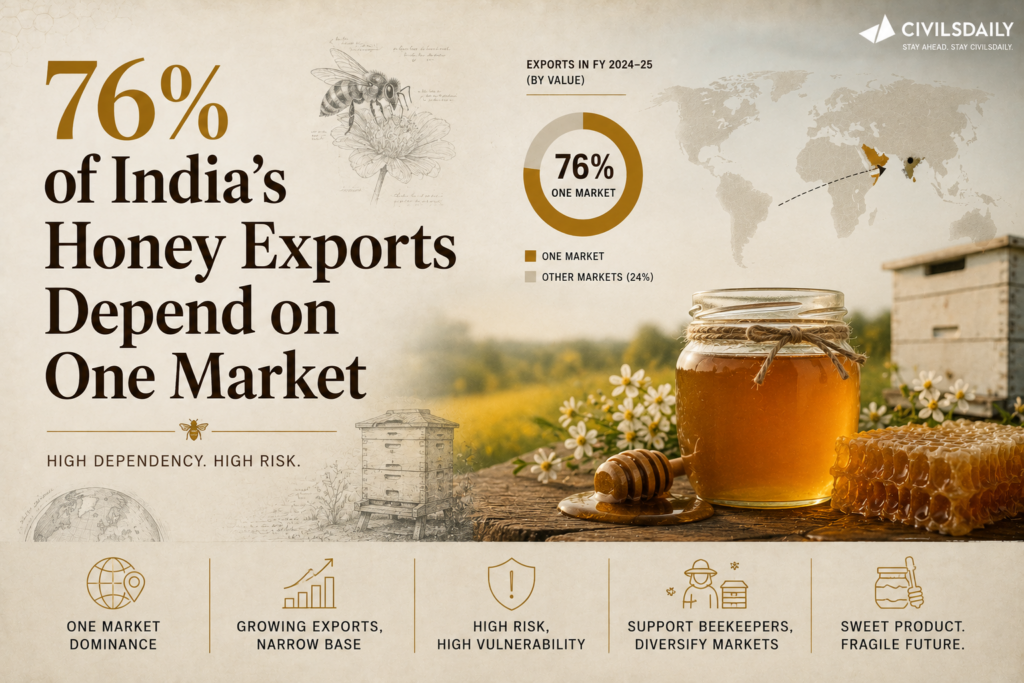
    • Production & Exports: India produced 1.4 lakh MT honey (2024); exported 1.07 lakh MT worth USD 177.55 million (FY 2023–24), rising to 2nd globally from 9th in 2020.
    • Infrastructure Development: Established 6 world-class labs, 47 mini labs, 6 diagnostic labs, 8 hiring centres, 26 processing units, 18 branding units, and 10 cold storages.
    • Research Hub: National Centre of Excellence in Beekeeping set up at IIT Roorkee for innovation and training.
    • Empowerment Initiatives: 167 SHG projects, 97 FPOs, 424 ha demonstrations, and 288 ha bee-friendly plantations sanctioned for livelihood diversification.
    • Digital Integration: Madhukranti Portal hosts 14,859 beekeepers, 269 societies, 206 companies, with blockchain-based traceability for export-grade quality.
    • Policy Support: Minimum Export Price (MEP) of USD 2,000/MT (till Dec 2024) set to curb dumping of inferior honey and safeguard domestic producers.
  • State of the World’s Animal Health Report, 2025 by WOAH

    Why in the News?

    The World Organisation for Animal Health (WOAH) released the first-ever State of the World’s Animal Health report.

    Key Highlights of the Report:

    • India faces high risk from transboundary animal diseases, with 47% of global outbreaks between 2005–2023 being zoonotic, affecting both animals and humans.
    • African Swine Fever (ASF), which jumped 1,800 km to Sri Lanka in 2024, threatens India’s northeast pig-rearing regions already impacted in past years.
    • Avian Influenza (HPAI) saw outbreaks in non-poultry species surpass poultry in 2024; India’s dense poultry population makes cross-species transmission a growing concern.
    • Foot and Mouth Disease (FMD), endemic in India, showed new serotype SAT 3 and SAT 1 activity in other countries, posing vaccine adaptation challenges.
    • Diseases like Lumpy Skin Disease and PPR, both reported in India earlier, are now spreading to new global regions, highlighting potential for reintroduction.
    • WOAH urges global action on vaccine equity, surveillance, and biosecurity, which align with India’s need to safeguard livelihoods, trade, and food security.

    About the World Organisation for Animal Health (WOAH):

    • Establishment: WOAH, formerly known as OIE, was founded in 1924 and is headquartered in Paris, France.
    • Membership: It has 183 member countries, including India, and operates independently from the United Nations.
    • Mandate: WOAH is the global authority on animal health, working to control animal epidemics (epizootics) and improve global animal welfare.
    • Key Functions:
      • Runs the World Animal Health Information System (WAHIS) to track disease outbreaks.
      • Sets international health standards for trade in animals and animal products.
      • Promotes science-based animal welfare policies and transparent disease reporting.
      • Offers technical support to countries, especially developing nations.
    • Global Cooperation: Works with over 70 global partners, including the FAO.
    • India’s Role: India is a member and an active participant through the World Assembly of Delegates.
    [UPSC 2005] Which one of the following diseases of milching animals are infectious?

    1. Foot and Mouth disease

    2. Anthrax

    3. Black Quarter

    4. Cowpox

    Select the correct answer using the codes given below.

    Options: (a) 1, 2 and 3 (b) 2, 3 and 4 (c) 1 and 4 (d) 1, 2, 3 and 4*


  • Ongole Cows

    Why in the News?

    India’s indigenous cattle breed from Ongole is experiencing a sharp decline domestically, even as it has become one of the most prized and expensive cattle breeds in Brazil.

    Ongole Cows

    About Ongole Cows

    • Ongole cattle, also known as Ongolu Gitta, are a native Indian breed originating from Prakasam District, Andhra Pradesh.
    • This Bos indicus breed is historically renowned for its strength, resilience, and disease resistance.
    • It has been widely used for draught power, milk production, and breeding programs.
    • The breed has gained global prominence, especially in Brazil, where it forms the foundation of several superior cattle breeds used for beef production.
    • Though declining in India, they thrive in Brazil, where they form 80% of the cattle population and are used extensively for beef production.
    • LAM Farm, Guntur, is using IVF and embryo transfer for preservation.

    Distinct Features of Ongole Cattle:

    • Heat & Disease Resistance: Naturally adapted to high temperatures and immune to foot-and-mouth and mad cow disease.
    • Strength & Draught Power: Historically used for ploughing, transport, and bull races.
    • A2 Milk Production: Produces high-quality A2 milk, fetching ₹150+ per litre in premium markets.
    • Global Demand & Genetic Superiority: Exported to Brazil, USA, Argentina, and Australia. Used to develop breeds like Brahmana (USA) and Santa Gertrudis (USA).
    • Efficient Feed Conversion: Survives on minimal fodder, ideal for drought-prone regions.
    • High Fertility & Longevity: Strong reproductive lifespan, producing robust calves.
    • Cultural & Historical Importance:  Revered in Indian scriptures and associated with prosperity.

    PYQ:

    [2011] What is/are unique about ‘Kharai camel’, a breed found in India?

    1. It is capable of swimming up to three kilometres in seawater.

    2. It survives by grazing on mangroves.

    3. It lives in the wild and cannot be domesticated.

    Select the correct answer using the codes given below:

    (a) 1 and 2 only

    (b) 3 only

    (c) 1 and 3 only

    (d) 1, 2 and 3


  • [pib] Livestock Health and Disease Control Scheme (LHDCS)

    Why in the News?

    The Union Cabinet has approved the revision of the Livestock Health and Disease Control Programme (LHDCP).

    The revised scheme, with a total outlay of ₹3,880 crore for 2024-25 and 2025-26, includes a new component called “Pashu Aushadhi” to improve the availability of generic veterinary medicines.

    What is LHDC Scheme?

    About
    • Government of India initiative launched in 2022.
    • Aims to improve animal health, control livestock diseases, and enhance veterinary services.
    • Revised with ₹3,880 crore outlay for 2024-25 and 2025-26.
    • Includes “Pashu Aushadhi” for affordable veterinary medicines.
    Features of LHDC
    • Disease Control & Vaccination: Targets FMD, Brucellosis, PPR, CSF, Lumpy Skin Disease. Mass vaccination and eradication.
    • Veterinary Healthcare: Expansion of veterinary hospitals and Mobile Veterinary Units (MVUs).
    • Disease Surveillance: Strengthened disease reporting and monitoring systems.
    • “Pashu Aushadhi”: Affordable, high-quality veterinary medicines with ₹75 crore allocation.

    Sub-Components:

    1. Critical Animal Disease Control Programme (CADCP): Focuses on eradicating high-risk livestock diseases.
    2. Establishment & Strengthening of Veterinary Hospitals and Dispensaries (ESVHD-MVU): Expands mobile veterinary units (MVUs) for better access to veterinary care.
    3. Assistance to States for Control of Animal Diseases (ASCAD): Provides financial support to states for disease prevention and control.
    • Economic Benefits: Prevents livestock mortality and improves milk, meat, and wool production.
    Implementation & Funding Strategy: Coordinated efforts by Central and State Governments; monitoring and assessment mechanisms.

    Funding: ₹3,880 crore for 2024-25 and 2025-26:

    • 100% central funding for CADCP and non-recurring ESVHD components.
    • 60:40 share for other components and ASCAD.
    • 90:10 funding for North Eastern and Himalayan States.
    • 100% Central funding for Union Territories.


    PYQ:

    [2015] Livestock rearing has a big potential for providing non-farm employment and income in rural areas. Discuss suggesting suitable measures to promote this sector in India.

    [2012] Which of the following is the chief characteristic of ‘mixed farming’?
    (a) Cultivation of both cash crops and food crops
    (b) Cultivation of two or more crops in the same field
    (c) Rearing of animals and cultivation of crops together
    (d) None of the above


  • [pib] Animal Welfare Board of India (AWBI)

    Why in the News?

    The Animal Welfare Board of India (AWBI) recently organized Prani Mitra and Jeev Daya Award Ceremony in New Delhi.

    • Prani Mitra Awards were established in 1966 to honor individuals excelling in animal welfare and protection.
      • Since 1966, 54 individuals have received this award for their remarkable service.
    • Jeev Daya Awards, instituted in 2001, acknowledge efforts in animal rescue, rehabilitation, and welfare education.

    About the Animal Welfare Board of India (AWBI)

    • The AWBI is a statutory advisory body under the Ministry of Fisheries, Animal Husbandry, and Dairying.
    • It was established in 1962 under Section 4 of the Prevention of Cruelty to Animals (PCA) Act, 1960, with Rukmini Devi Arundale as its first chairperson.
    • Headquarters: Ballabhgarh, Haryana (previously in Chennai).
    • Composition: 28 members serving for a period of three years.
    • Jurisdiction: Initially under the Ministry of Food and Agriculture, later moved to the Ministry of Environment, Forests, and Climate Change, and is now managed by the Ministry of Fisheries, Animal Husbandry, and Dairying.
    • Functions of AWBI:
      • Recognition of Animal Welfare Organizations (AWOs): Grants recognition to organizations meeting the Board’s guidelines.
      • Financial Assistance: Provides funds for shelters, cattle rescue, ambulances, and birth control programs.
      • Policy and Legal Advocacy: Proposes changes in animal welfare laws and offers guidance to law enforcement agencies.
      • Awareness and Education: Conducts educational programs, workshops, and publications on animal welfare.
      • Monitoring Animals in Research & Entertainment: Instrumental in setting up CPCSEA (Committee for the Purpose of Control and Supervision of Experiments on Animals) and implementing Performing Animals Rules (2001, amended 2005).
      • Activism & Legal Rights for Animals: Successfully fought in 2014 (AWBI vs. Nagaraja case) for recognizing fundamental rights of animals under Article 21 of the Indian Constitution.

    PYQ:

    [2014] Consider the following statements:

    1. Animal Welfare Board of India is established under the Environment (Protection) Act, 1986.

    2. National Tiger Conservation Authority is a statutory body.

    3. National Ganga River Basin Authority is chaired by the Prime Minister.

    Which of the statements given above is/ are correct?

    (a) 1 only

    (b) 2 and 3 only

    (c) 2 only

    (d) 1, 2 and 3


  • [pib] Release of National Livestock Mission Operational Guidelines 2.0

    Why in the News?

    The Ministry of Fisheries, Animal Husbandry & Dairying has released operational guidelines 2.0 for National Livestock Mission (NLM).

    What are the new operational guidelines 2.0 for NLM?

    • It focuses on promoting entrepreneurship, cluster-based development, and sustainable practices in the livestock sector.
    • They emphasize financial assistance through schemes like the Animal Husbandry Infrastructure Development Fund (AHIDF), capacity building, and modern technologies.
    • The launch of the NLM-EDP Dashboard ensures real-time monitoring and transparency.
    • Priority is given to poultry, dairy, and marginalized groups to drive equitable growth.

    About National Livestock Mission (NLM): Summary Table

    Details
    About
    • Launched in 2014-15, realigned in 2021-22 under the White RevolutionRashtriya Pashudhan Vikas Yojana.
    • Aims to enhance livestock production quantity and quality while fostering entrepreneurship.
    • Overseen by the Ministry of Fisheries, Animal Husbandry, and Dairying.
    Structural Mandate and Implementation
    • Comprises 3 sub-missions: (1) Breed Improvement of Livestock and Poultry, (2) Feed and Fodder Development, and (3) Innovation and Extension.
    • Focus on entrepreneurship through financial incentives for individuals, FPOs, SHGs, cooperatives, and startups.
    • Includes 10 activities, such as fodder cultivation and livestock insurance, emphasizing sustainable practices and stakeholder support.
    Features
    • Entrepreneurship Support: 50% subsidy (up to ₹50 lakh) for horse, donkey, mule, and camel conservation.
    • Fodder Seed Processing: Infrastructure eligible for 50% subsidy for private entities and cooperatives.
    • Fodder Cultivation: Assistance to state governments for growing fodder in degraded and non-arable lands.
    • Livestock Insurance: Reduced farmer premiums (15%), expanded animal coverage, and enhanced Centre-State funding (60:40 or 90:10).

    What is the Status of Livestock Sector in India?

    • The livestock sector grew at a CAGR of 7.9% from 2014-15 to 2020-21
    • Contribution to Agricultural GDP increased from 24.3% in 2014-15 to 30.1% in 2020-21
    • Contributes 4.35% to the national GDP in fiscal year 2022-23
    • Total livestock population: Approximately 536.76 million animals
    • Population growth: 4.8% increase since 2012
    • Global Livestock Ownership Highlights:
      • 12.50% of world’s cattle population
      • 56.70% of world’s buffalo population
      • World’s second-largest poultry market
    • Major Schemes and Programmes:
      • Rashtriya Gokul Mission (RGM): Launched in December 2014 for breed development
      • National Animal Disease Control Programme (NADCP): Focuses on controlling Foot & Mouth Disease and Brucellosis
      • Animal Husbandry Infrastructure Development Fund (AHIDF): Approved 116 projects worth INR 3,731.4 crore

    PYQ:

    [2012] Which of the following is the chief characteristic of ‘mixed farming’?

    (a) Cultivation of both cash crops and food crops

    (b) Cultivation of two or more crops in the same field

    (c) Rearing of animals and cultivation of crops together

    (d) None of the above

  • Matsya Seva Kendras

    Why in the News?

    India’s fisheries sector, contributing to the livelihoods of over 3 crore fishers and producing a record 175 lakh tons of fish in 2022-23, is being strengthened through initiatives like Matsya Seva Kendras.

    About Matsya Seva Kendra (MSK)

    • MSKs are one-stop centers established under the Pradhan Mantri Matsya Sampada Yojana (PMMSY) to support fishers and fish farmers.
    • They provide a wide range of technical, advisory, and capacity-building services aimed at modernizing the fisheries sector and ensuring sustainable practices.
    • Role of MSKs:
      • Offer water, soil, and microbial analysis to address disease management and improve aquaculture productivity.
      • Conduct capacity-building programs for fishers, focusing on sustainable practices and advanced aquaculture techniques.
      • Empower women and weaker sections with 60% financial assistance for setting up MSKs.
      • Mobilize start-ups, cooperatives, and fish farmer producer organizations to share best practices.
      • Promote regenerative and conservation practices to tackle challenges posed by climate change.

    About Pradhan Mantri Matsya Samapada Yojana (PMMSY):

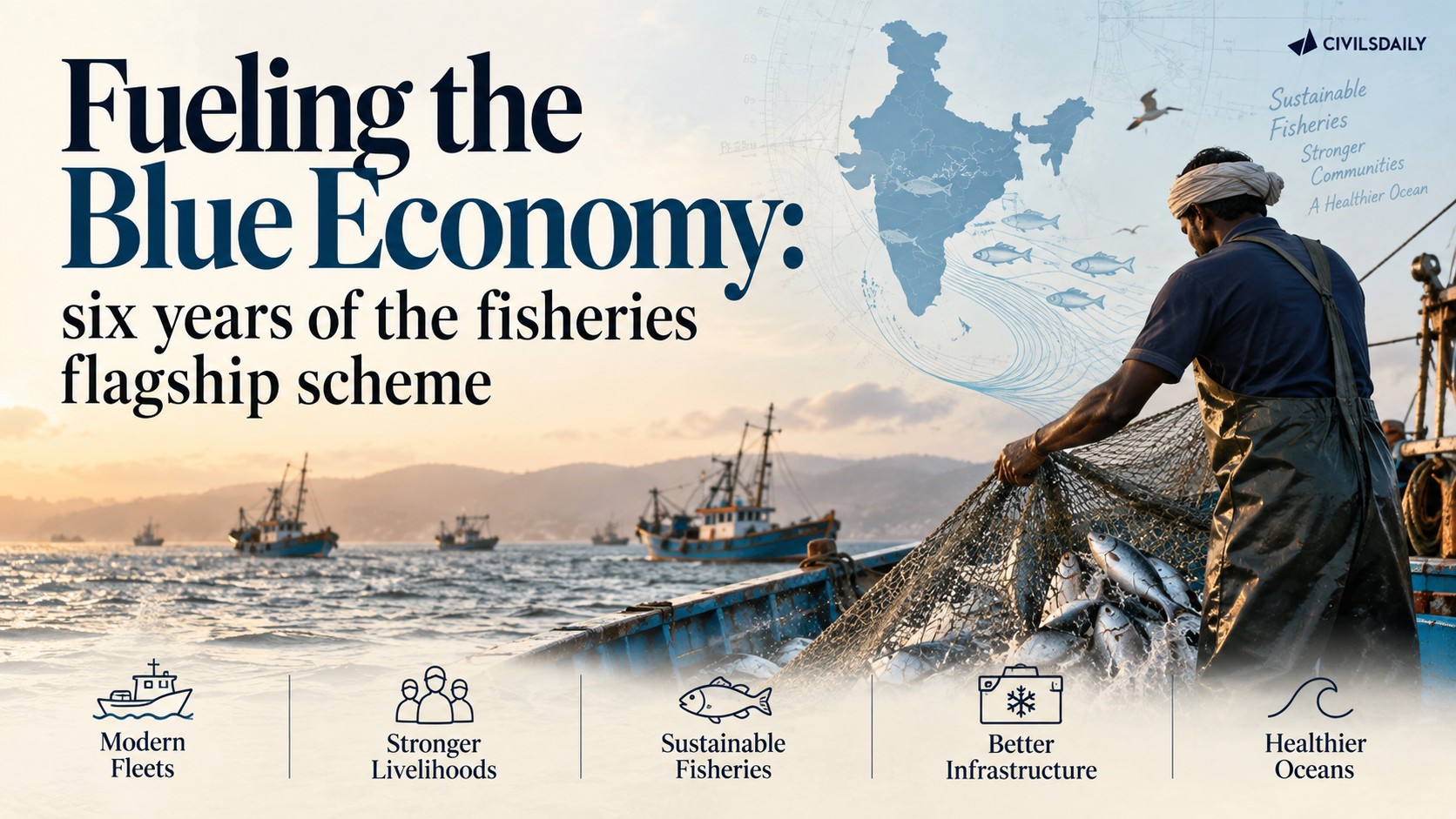
    • The scheme aims to bring about a Blue Revolution through sustainable and responsible development of India’s fisheries sector.
    • It was launched as part of the ‘Atma Nirbhar Bharat’ package with an investment of ₹20,050 crore, the highest-ever allocation for the fisheries sector.
    • It is implemented across all States and Union Territories from FY 2020-21 to FY 2024-25.
    • It provides insurance coverage, financial assistance, and Kisan Credit Card (KCC) facilities to fishers.
    • It is implemented as an umbrella scheme with two components:
      • Central Sector Scheme: Entirely funded by the Central Government.
      • Centrally Sponsored Scheme: Cost shared between the Centre and States/UTs.

    How Do Sagar Mitras Support Fishers?

    • Sagar Mitras act as a vital link between the government and sea-borne fishers, facilitating access to information and resources in coastal regions.
    • Role of Sagar Mitras:
      • Collect data on marine catch, price trends, and market requirements.
      • Provide updates on local regulations, weather conditions, and potential fishing zones.
      • Educate fishers on hygienic fish handling, sustainable fishing techniques, and compliance with regulatory measures.
      • Act as a key contact during emergencies, offering information on natural calamities and safety protocols.

    PYQ:

    [2018] Defining the Blue Revolution, explain the problems and strategies of fisheries in India.