Why in the News
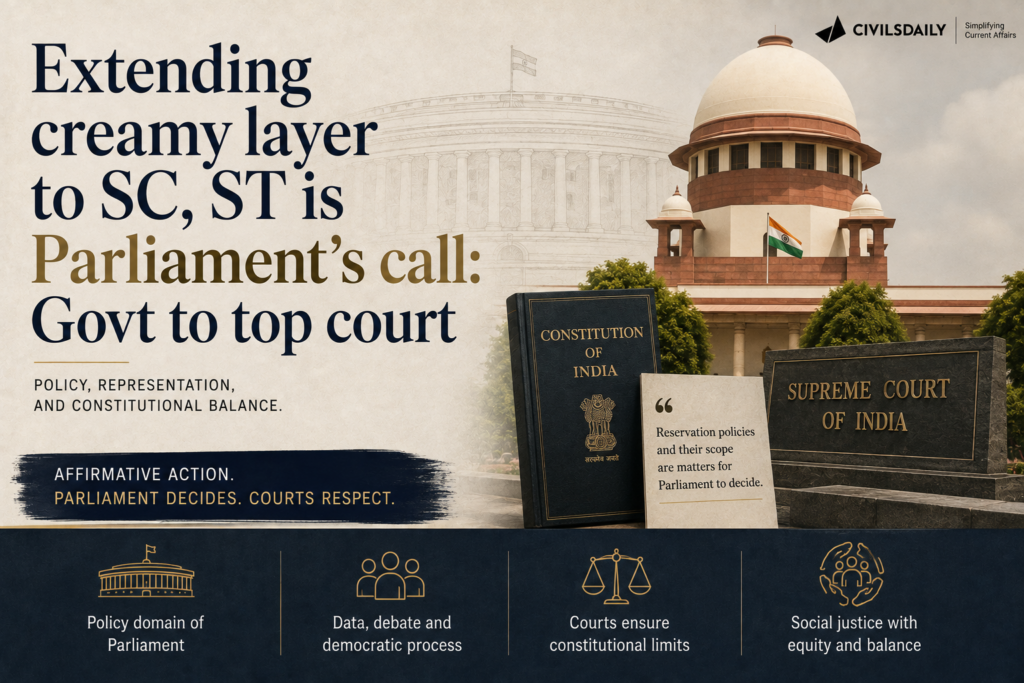
The Centre has told the Supreme Court that the creamy layer principle cannot be extended to Scheduled Castes (SCs) and Scheduled Tribes (STs) through judicial directions. It argued that any such change requires a decision by Parliament, as reservation for SCs and STs is based on historical and social discrimination rather than economic status.
What is the Creamy Layer Principle?
- Definition: Excludes the socially advanced and economically better off members of a reserved category from availing reservation benefits.
- Origin: Introduced for Other Backward Classes (OBCs).
- Current Position: The principle does not apply to SCs and STs, whose reservation is based on historical discrimination and social exclusion.
What did the Centre argue before the Supreme Court?
- Parliament’s Authority: Only Parliament can decide whether to extend the creamy layer principle to SCs and STs.
- Constitutional Basis: Any exclusion must follow the procedure under Article 341(2) (and similarly Article 342 for STs).
- Need for Evidence: Any income based classification should be preceded by a comprehensive empirical study.
- Separation of Powers: Courts should not direct the executive to frame such a policy without legislative backing.
- Reservation Basis: SC and ST identification depends on historical social disadvantage, not merely economic criteria.
Key Judicial Precedents
- State of Punjab v. Davinder Singh (2024): Held that sub classification within SCs and STs for equitable distribution of reservation benefits is constitutionally permissible.
- E.V. Chinnaiah v. State of Andhra Pradesh (2005): Held that altering the SC list requires legislative action under Article 341.
- Ashoka Kumar Thakur v. Union of India (2008): Clarified that the creamy layer principle does not apply to SCs and STs.
What is the core issue?
- Equitable Distribution: Petitioners seek greater benefits for the poorest sections within SCs and STs.
- Social Justice vs Economic Criteria: The Centre maintains that SC/ST reservation addresses historical social stigma, not poverty alone.
- Institutional Question: The case raises the issue of whether such reforms should come through judicial intervention or Parliamentary legislation.