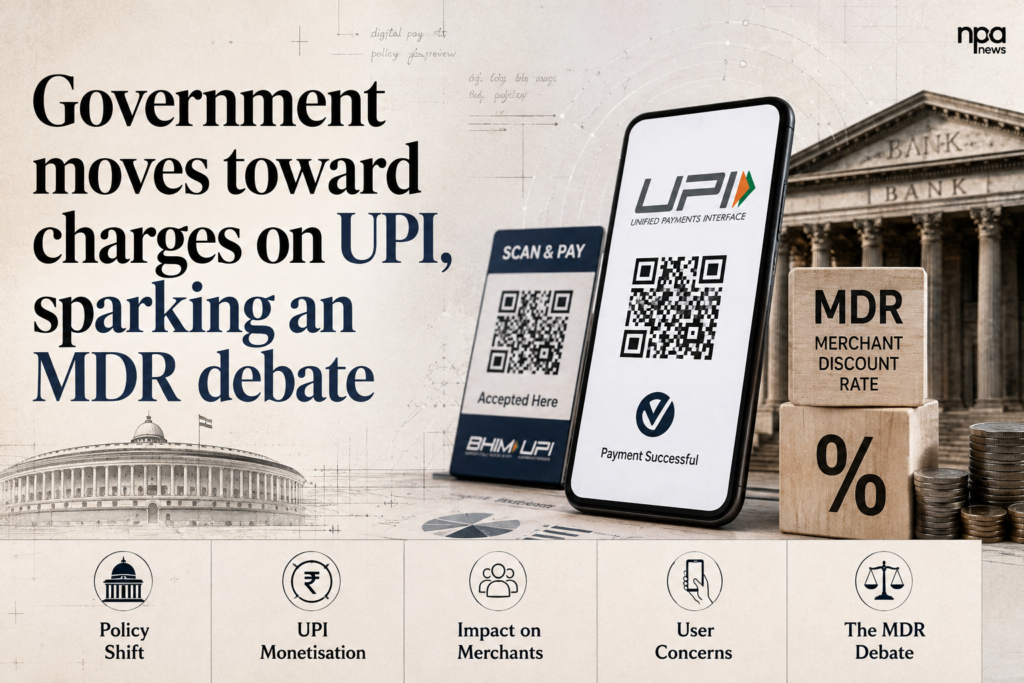
Why in the News
A government move that could permit charges on Unified Payments Interface (UPI) transactions has revived the question of a Merchant Discount Rate (MDR). The tension is between funding the rising cost of a free public payments rail and preserving the zero cost model that drove its mass adoption.
What is the Merchant Discount Rate (MDR)?
- Definition: The MDR is the fee a merchant pays a bank for accepting a digital payment from a customer.
- Current position: MDR on UPI and RuPay debit card payments has been zero since 2020, shifting the settlement cost onto the system.
How would the proposed charge actually work?
- Large merchants only: Any MDR would apply to person to merchant (P2M) payments above a threshold, not to small traders.
- Enabling law: The change is routed through the Taxation and Other Laws (Amendment) Bill 2026.
What is the case against charging for UPI?
- Adoption risk: A fee could push small merchants back toward cash and reverse formalisation gains.
- Alternative funding: The RBI’s surplus could subsidise the payments rail instead of a merchant levy.
What are the pressures forcing the question?
- Scale cost: Processing billions of monthly transactions imposes real infrastructure and settlement costs on banks.
- Sustainability: A permanently free model leaves no revenue to maintain and expand the network.
“[2018] Which one of the following best describes the term ‘Merchant Discount Rate’ sometimes seen in news?
(a) The incentive given by a bank to a merchant for accepting payments through debit cards pertaining to that bank.
(b) The amount paid back by banks to their customers when they use debit cards for financial transactions for purchasing goods or services.
(c) The charge to a merchant by a bank for accepting payments from his customers through the bank’s debit cards.
(d) The incentive given by the Government to merchants for promoting digital payments by their customers through Point of Sale (PoS) machines and debit cards.
