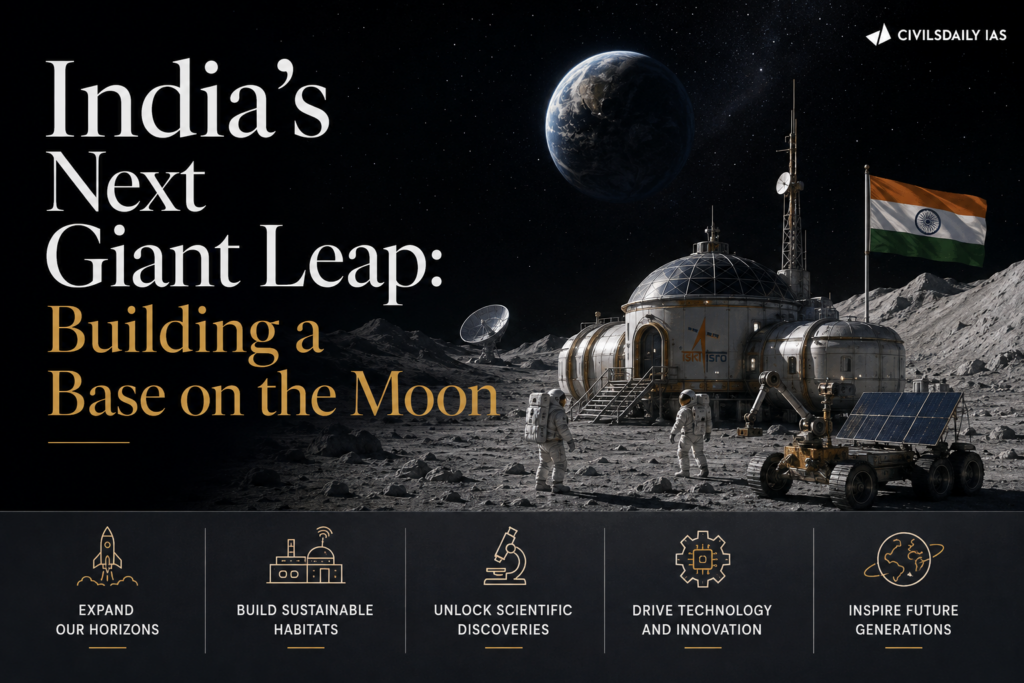
Why in the News
NASA invited ISRO at the ninth India United States Civil Space Joint Working Group meeting to join its Moon Base programme under the Artemis Accords, targeting a facility near the lunar south pole around 2030. A rival International Lunar Research Station led by China and Russia targets the same region by 2035. The tension is between the access a partnership offers and the interoperability standards that would extend terrestrial blocs onto the Moon.
What is the Moon Base programme?
- About: Moon Base is the NASA led programme to establish a permanent crewed facility near the lunar south pole, operating under the Artemis Accords framework.
- Why the south pole: The region offers longer sunlight for power generation and permanently shadowed craters holding water ice.
- Target date: The facility is targeted for around 2030.
- Contracting model: Delivery is contracted to commercial providers rather than built entirely in house.
What are the Artemis Accords?
- About: The Artemis Accords are a set of non binding principles for civil space exploration, covering transparency, interoperability, emergency assistance, registration of objects, release of scientific data, preservation of heritage sites, deconfliction of activities and safe disposal of debris.
- Legal basis: They build on the Outer Space Treaty, 1967 rather than replacing it.
- India’s position: India signed the Accords in 2023.
What is the International Lunar Research Station?
- About: The International Lunar Research Station (ILRS) is the China and Russia led lunar base programme announced in 2021.
- Location and timeline: It targets the lunar south pole, with a stated completion horizon of 2035.
- Participation: It counts 17 countries and organisations and more than 50 institutions.
What contracts define the NASA programme’s shape?
- Terrain vehicles: Astrolab holds a $219 million contract and Lunar Outpost a $220 million contract for lunar terrain vehicles.
- Delivery services: Blue Origin holds $188 million in delivery task orders.
- Robotic missions: Astrobotic, Firefly Aerospace and Intuitive Machines together hold $600 million for four robotic missions.
- Programme restructuring: Under the current NASA leadership, Artemis III becomes a crewed Earth orbit test flight in 2027 and Artemis IV the first landing in 2028.
- Policy driver: The restructuring responds to the December 2025 United States space policy on cislunar space.
Where does the partnership become a constraint?
- Exclusion clause: NASA excluded foreign entities with bilateral ties to China from a payload solicitation.
- Budget framing: The NASA financial year 2027 budget request frames Moon Base as establishing United States superiority on the Moon.
- Consequence for India: Deep integration could let United States objections constrain India’s independent cooperation choices.
- Foreclosure risk: Accepting exclusionary terms now would foreclose future cooperation with the ILRS.
Why do interoperability standards decide the outcome?
- What standards fix: Docking interfaces, power connections, communication protocols and navigation references determine which hardware can work with which.
- Bloc formation mechanism: A closed standard makes participation conditional on political alignment, which transfers terrestrial blocs into cislunar space.
- Open standards alternative: Open international standards preserve sovereign control of hardware and software while permitting cooperation.
- India’s strategic interest: Strategic autonomy on the Moon depends on standards being open rather than on which partnership India joins.
Challenges to India’s lunar ambitions
- Human spaceflight readiness: India has not yet flown a crewed mission. e.g. the Gaganyaan programme still in its uncrewed test flight phase.
- Heavy lift constraint: Lunar cargo delivery requires launch capacity beyond the current fleet. e.g. GSAT-N2 flown abroad because it exceeded LVM-3 capacity.
- Deep space communication: Sustained lunar operations need dedicated deep space network capacity. e.g. the Indian Deep Space Network at Byalalu operating a limited antenna set.
- Dual bloc pressure: Partnering with one programme invites exclusion from the other. e.g. the NASA payload solicitation barring entities with bilateral ties to China.
- Funding scale: India’s space budget is a fraction of the contracted value of individual NASA lunar task orders. e.g. $600 million contracted for four robotic missions against India’s annual space budget.
- Resource law vacuum: The Outer Space Treaty bars national appropriation but does not settle resource extraction rights. e.g. the contested legal status of the Artemis Accords safety zones.
Conclusion
The decisive question for India is not which lunar programme to join but whether interoperability standards stay open, since standards rather than treaties will determine who can operate with whom on the Moon. Joining Moon Base delivers access, and it carries the risk of inheriting an exclusion clause aimed at a third country. The next milestone is whether India secures an explicit open standards position in any agreement arising from the Joint Working Group.
Back2Basics: India’s Decision to Sign the Artemis Accords
- India signed the Artemis Accords in June 2023, becoming among the later major spacefaring signatories.
- The Accords are a United States led set of non binding principles built on the Outer Space Treaty, 1967.
- Core commitments cover peaceful purposes, transparency, interoperability, emergency assistance, registration of space objects, release of scientific data, protection of heritage, deconfliction through safety zones and orbital debris mitigation.
- Signing enabled the joint NASA ISRO Synthetic Aperture Radar (NISAR) mission and the training of Indian astronaut candidates in the United States.
- The Accords do not create binding treaty obligations and operate alongside, not in place of, the Outer Space Treaty.
Constitutional and Treaty Framework Governing Outer Space
- Outer Space Treaty, 1967: Establishes outer space as the province of all mankind and bars national appropriation by claim of sovereignty.
- Rescue Agreement, 1968: Requires assistance to and return of astronauts and space objects.
- Liability Convention, 1972: Makes a launching state absolutely liable for damage caused by its space objects on the surface of the Earth.
- Registration Convention, 1975: Requires states to register objects launched into outer space with the United Nations.
- Moon Agreement, 1979: Declares the Moon and its resources the common heritage of mankind, and has not been ratified by any major spacefaring state.
Way Forward
- Negotiate open standards explicitly: Make interoperability on open international standards a condition of participation rather than an assumption.
- Preserve sovereign control of hardware: Retain control over Indian built systems and their software in any joint architecture.
- Avoid exclusivity clauses: Decline terms conditioning participation on the exclusion of third country cooperation.
- Build deep space capacity: Expand the deep space network and advance the Next Generation Launch Vehicle to support independent lunar operations.
- Use multilateral forums: Press the lunar resource question at the United Nations Committee on the Peaceful Uses of Outer Space, where a universal rule can be built rather than a bloc rule.
“[2023, GS3, 15 marks] What is the main task of India’s third moon mission which could not be achieved in its earlier mission? List the countries that have achieved this task. Introduce the subsystems in the spacecraft launched and explain the role of the Virtual Launch Control Centre at the Vikram Sarabhai Space Centre which contributed to the successful launch from Srihari Kota.”
