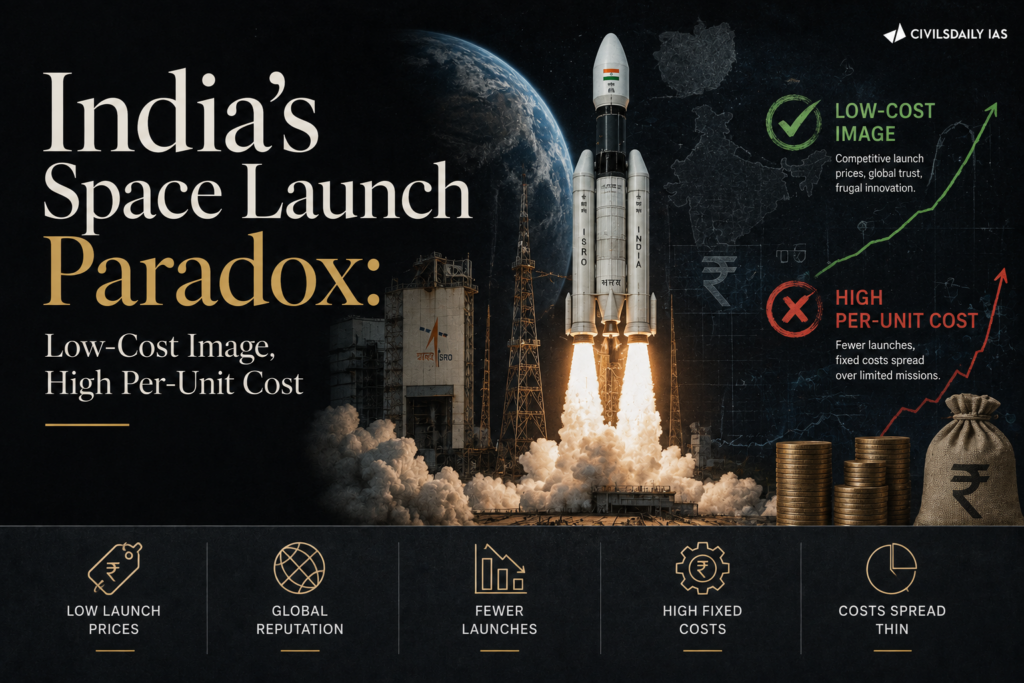
Why in the News
A peer-reviewed study estimates India’s 2025 launch cost to Low Earth Orbit (LEO) at $13,302/kg, the highest among major spacefaring nations and far above the global average of $3,868/kg.
The key distinction is between low mission cost and low cost per kilogram. India is efficient in spacecraft and mission design, but low launch frequency and limited payload capacity raise its per-kg cost.
Cost per kg to LEO
- Meaning: Launch cost divided by payload mass delivered to LEO.
- Why important: A low-cost mission can still have a high per-kg cost if it carries a small payload.
- What it measures: Launch vehicle efficiency and utilisation, rather than spacecraft-design frugality.
Experience Curve
- An experience curve shows declining unit costs as cumulative production or launch volume increases.
- Since 2010, the study finds a significant experience curve mainly for the US and Europe.
- Higher launch frequency allows fixed costs to be distributed across more missions.
Comparative Cost
- India: $13,302/kg, Europe: $9,897/kg, Russia: $6,682/kg, China: $5,809/kg, Japan: $5,287/kg, USA: $3,225/kg, and Global average: $3,868/kg
Why is India’s Cost High?
- Small vehicle bias: Smaller rockets carry limited payloads, increasing per-kg costs.
- Low launch cadence: India recorded only five launches in 2025.
- Heavy-lift gap: The 4,700 kg GSAT-N2 was launched by Falcon 9 in 2024 as it was beyond India’s available launch capability.
- High fixed costs: Launch infrastructure, range and workforce costs remain even with fewer launches.
- Limited demand: Indian satellite operators sometimes depend on foreign rideshare missions.
Private Space Ecosystem
- Around 400 startups have registered with IN-SPACe since 2020.
- Skyroot Aerospace achieved India’s first privately developed orbital launch milestone.
- Pixxel and Digantara have developed private satellite capabilities.
- GalaxEye has booked Falcon 9 launch capacity.
- The emerging pattern is domestic spacecraft development but foreign launch dependence.
“[2026] Consider the following statements about involvement of private entities in India’s space programme:
1. IN-SPACe is an autonomous agency formed to facilitate participation of private entities.
2. Agnikul Cosmos launched the world’s first flight using 3D-printed rocket engine.
3. Skyroot Aerospace has developed liquid fuel for GSLV.
(a) 1 only
(b) 2 and 3 only
(c) 1 and 2 only
(d) 1, 2 and 3
