Why in the News
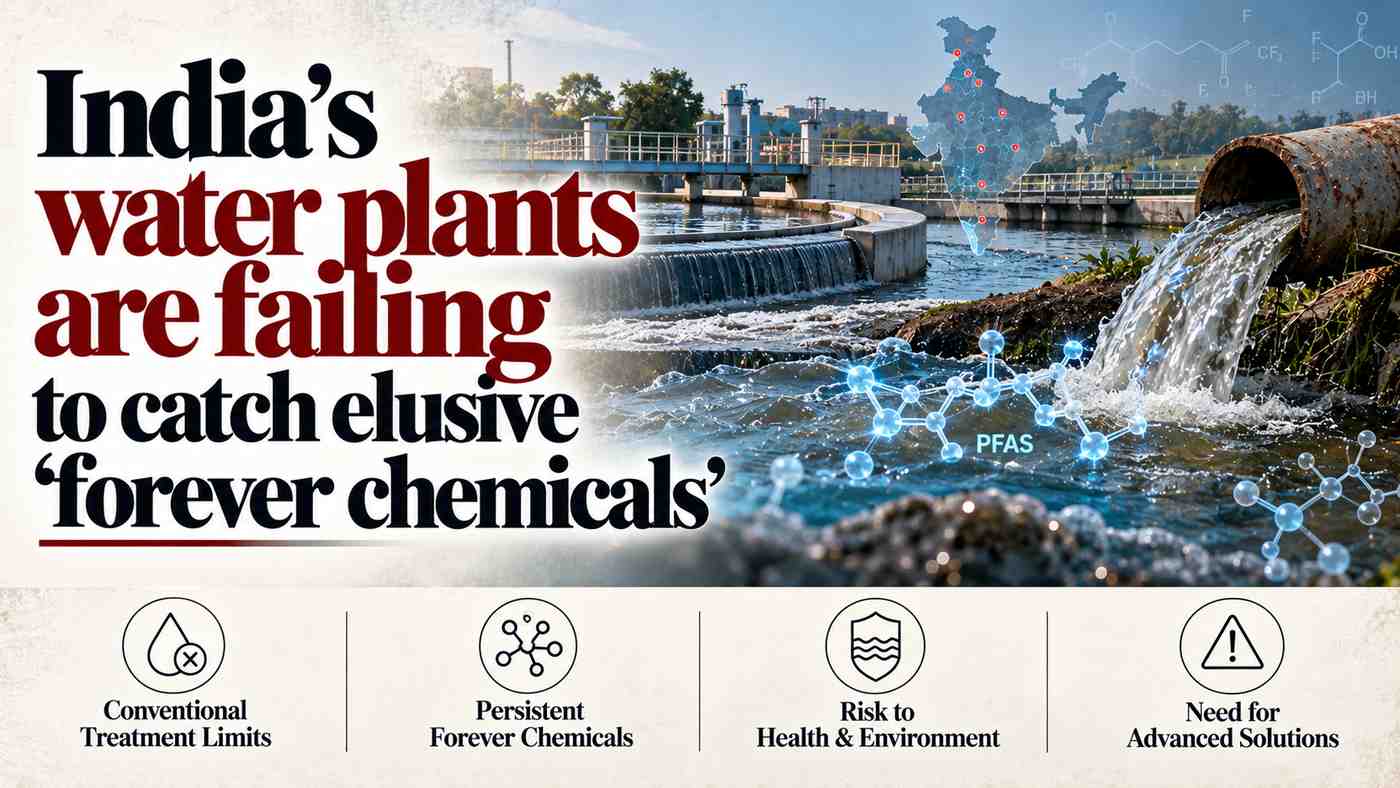
India’s drinking water standard, IS 10500:2012, sets no limit for per and polyfluoroalkyl substances (PFAS), and at one Chennai plant treated water carried more of them than raw water. An Indian Institute of Technology Madras (IIT-Madras) study found all eight target PFAS 5% to 103% higher after treatment, and systems that can remove these “forever chemicals” are not yet commercially available.
What are PFAS, and why are they called forever chemicals?
- What it is: PFAS are synthetic chemicals built on several carbon-fluorine bonds, among the strongest in chemistry, so they barely break down. Like plastic litter, they stay in soil and water long after release.
- Industrial uses: Industry has used PFAS for about 60 years in coatings, textiles and other industrial products.
- Precursors: Some fluorinated compounds are precursors, less stable chemicals that later turn into stable PFAS. A test that looks only for a fixed list of PFAS misses them.
- The takeaway: A chemical that does not degrade and slips past standard tests can build up in drinking water unseen, which is why the missing limit matters.
What have Indian studies found?
- IIT-Madras study (2024): The team analysed 14 samples from groundwater, surface water and successive stages of a Chennai treatment plant. Residential wells near garbage dumps carried the highest PFAS levels.
- Precursor conversion in treatment: The likely cause of the rise is unidentified precursors turning into stable PFAS inside the plant. The study did not measure them.
- Visakhapatnam coast: A GITAM (Deemed to be) University study tested seawater and sewage for 77 PFAS and found 38.
- Sewage as a source: A model estimated sewage supplies about 41% of the median coastal PFAS level. Separating household from factory inputs needs systematic sampling where they mix.
Why is the true scale of contamination unclear?
- No common method: A 2025 review of studies from Gujarat, Maharashtra, Tamil Nadu and West Bengal called PFAS a real concern of unclear extent. Research groups test PFAS differently, so results cannot be compared.
- Fixed lists miss compounds: The eight target PFAS are a fraction of the fluorinated compounds likely present, so testing should go beyond a fixed list.
- Better tools, new errors: High resolution mass spectrometry, a lab screening method, can find PFAS beyond a fixed list. Samples can also pick up stray PFAS during collection.
How harmful are PFAS?
- Risk depends on exposure: Detecting PFAS does not by itself show a health risk, which depends on the type, dose, duration and route of exposure.
- Cancer classification: The International Agency for Research on Cancer (IARC), a World Health Organization body, issued a 2025 monograph. It classed perfluorooctanoic acid (PFOA) as “carcinogenic to humans” and perfluorooctanesulfonic acid (PFOS) as “possibly carcinogenic to humans”.
- Animal evidence: A study published this February found a mix of 24 PFAS delayed zebrafish hatching, slowed growth, built up in blood and lowered heart rates.
How is India regulating PFAS?
- No manufacturing ban: The Union Environment Ministry says no specific regulation bans PFAS manufacturing.
- Standard under revision: A Bureau of Indian Standards (BIS) Working Group on Emerging Contaminants and Forever Chemicals is examining limits. How many PFAS to cover, and how to test them, is not yet final.
- Baseline data: The CSIR-Indian Institute of Toxicology Research (CSIR-IITR), Lucknow, is in a United Nations Environment Programme (UNEP) funded National Implementation Plan to build baseline exposure data. The institute can detect 50 PFAS molecules.
Challenges
- Treatment cannot remove PFAS: Conventional biological wastewater treatment cannot remove PFAS, and low cost adsorption materials that bind them are still undeveloped.
- No penalty pathway: No clear regulatory pathway exists to penalise a source responsible for PFAS contamination.
- Named chemical gaps: Regulating only a named list of chemicals leaves precursors and transformation products outside the law.
- Data gaps as delay: Waiting for complete exposure data can hold up controls even on PFAS whose hazards are well established.
Way Forward
- Precautionary interim limits: BIS should set interim limits for well studied PFAS in the revised standard now.
- Chemical inventory: Establish which PFAS are manufactured, imported and used in India, alongside baseline monitoring and toxicology studies.
- Harmonised monitoring: Adopt one national testing method that also screens for precursors and other fluorinated compounds.
Conclusion
India has evidence of PFAS in its water but a standard that does not yet measure them. Whether BIS adopts interim limits that also reach precursors, or waits for full exposure data, will decide how soon treated water is safe.
Matching Previous Year Question
“[2024] With reference to perfluoroalkyl and polyfluoroalkyl substances (PFAS) that are used in making many consumer products, consider the following statements: 1. PFAS are found to be widespread in drinking water, food, and food packaging materials. 2. PFAS are not easily degraded in the environment. 3. Persistent exposure to PFAS can lead to bioaccumulation in animal bodies. Which of the statements given above are correct? (a) 1 and 2 only (b) 2 and 3 only (c) 1 and 3 only (d) 1,2 and 3* ANSWER: (d)”
