Why in the News
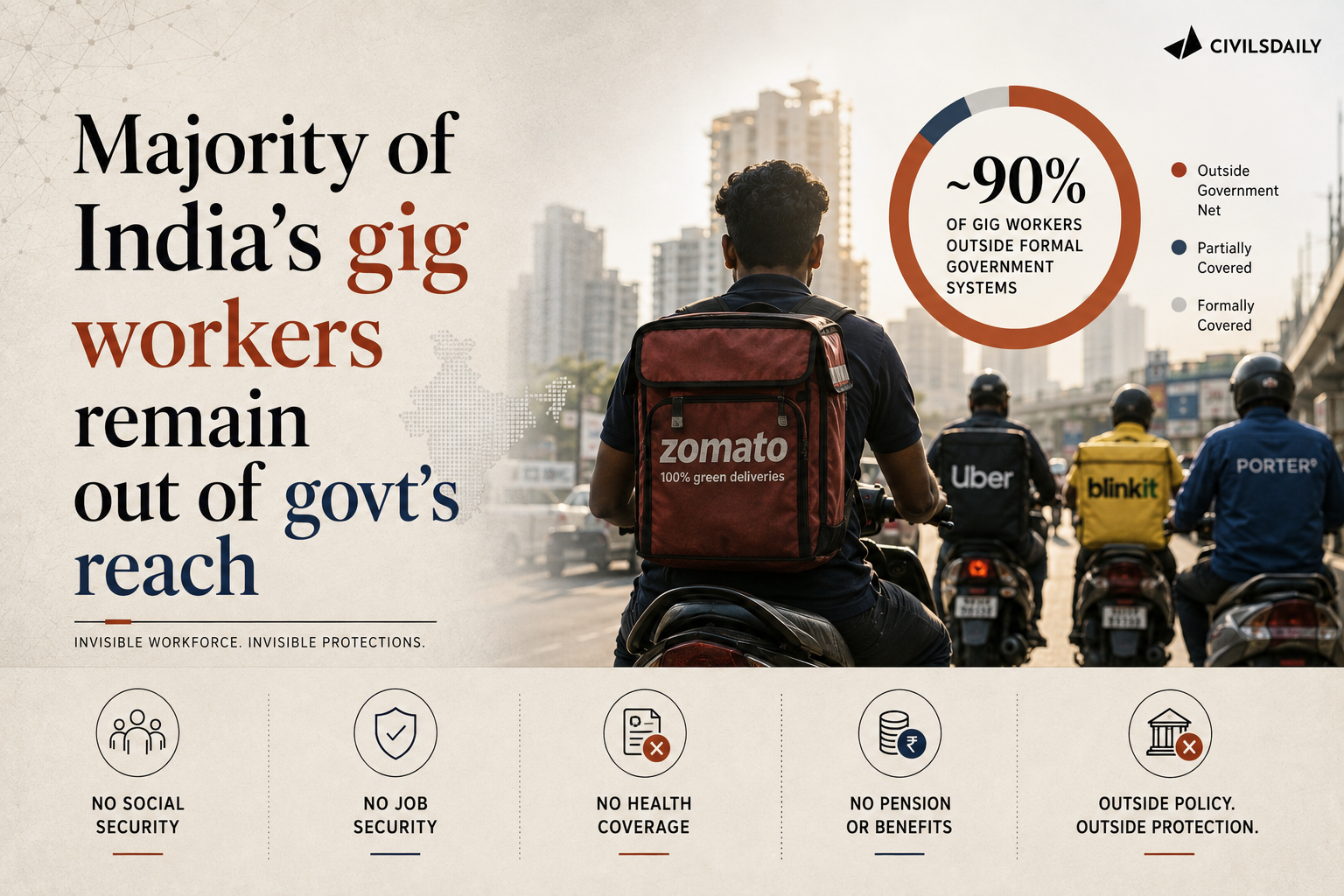
Only 8.58 lakh gig workers stood registered on the e-Shram portal as of the Ministry of Labour and Employment’s reply in the Rajya Sabha in January 2026, the latest publicly available figure.
How far has the Budget’s health cover promise actually reached?
- Registration against the promise: The Budget’s beneficiary figure of over one crore compares with 8.58 lakh registrations on e-Shram, the figure the Ministry gave Parliament in January 2026.
- The optimistic case still falls short: A doubling of registrations since January would still cover only around 15 percent of the estimated gig workforce.
- The promise itself drove enrolment: Registrations of gig workers on e-Shram rose sharply from 2025, and the health cover announcement is the visible cause of that surge.
- Registration is the gate to every benefit: Registration on e-Shram is a prerequisite for availing benefits, so an unregistered gig worker is invisible to the scheme by design.
Why does the government not know how many gig workers India has?
- One source for every estimate: The figure of over one crore gig workers, quoted in many government replies in Parliament last year, comes from a single document, the NITI Aayog report “India’s Booming Gig and Platform Economy” released in June 2022.
- What that report estimated: It put the gig workforce at around 77 lakh in 2020-21 and projected 1.27 crore in 2024-25 and 1.43 crore in the year after.
- No dedicated measurement effort exists: In the absence of any effort to measure the gig workforce, official estimates rely solely on this NITI Aayog report.
- The national labour survey does not count them: The Periodic Labour Force Survey (PLFS) reports do not capture gig workers as a distinct category, even though the estimated gig workforce is about 2 percent of India’s total workforce of 61.6 crore as cited by the 2025 PLFS report.
What has the government built for gig workers, and what has not arrived?
- e-Shram as the single register: The portal, launched in 2021, is conceptualised as an Aadhaar-seeded National Database of Unorganised Workers (NDUW) and has become the unified platform for tracking the unorganised workforce, including gig workers.
- A legal definition came only in 2020: The government officially defined a gig worker only in the Code on Social Security, 2020, which came into force last year.
- The Code’s promises remain largely on paper: The Code promised accident insurance, maternity benefits and a dedicated social security fund for gig workers, and most of these are yet to materialise.
Where are the registered gig workers, by State and by sector?
- Registrations are uneven across States: The ten States with the most registered gig workers as of January 2026 are led by West Bengal (54,734), Delhi (49,479), Andhra Pradesh (39,212), Rajasthan (38,205), Karnataka (37,871), Gujarat (34,756) and Madhya Pradesh (34,351), with Maharashtra, Uttar Pradesh and Bihar completing the list.
- Urbanised southern States are missing from the top ten: Tamil Nadu (31,654), Telangana (29,951) and Keralam (11,219) are not among the ten States with the highest registrations, despite their high urbanisation.
- Twenty one sectors on paper, three in practice: NITI Aayog’s 2022 report listed 21 sectors with gig workers, including agriculture, healthcare, education and retail, but e-Shram registrations concentrate in the food industry, transportation, and domestic and household work.
- The sector shares are lopsided: The largest single sector accounts for 32.8 percent of registered gig workers, and construction (3.6 percent) and agriculture (3.4 percent) are the smallest of the top five sectors.
Challenges to e-Shram as the gateway for gig worker welfare
- Enrolment depends on the worker, not the platform: e-Shram is a self-registration portal, and no aggregator is obliged to enrol the workers it engages. Eg. The Rajasthan Platform Based Gig Workers (Registration and Welfare) Act, 2023 instead makes aggregators register their workers with a State welfare board.
The Fix: Require aggregators to push worker data into e-Shram at onboarding under the Code on Social Security, 2020, so registration stops depending on individual initiative. - No survey category means no target to measure against: Without a gig work module in the labour survey, the government cannot say what share of the workforce any scheme covers. Eg. The Ministry’s January 2026 reply to Parliament could cite portal registrations but no survey count.
The Fix: Add a platform and gig work classification to the PLFS questionnaire so coverage is measured against a surveyed denominator. - The funding source has not been built: The Code provides for aggregator contributions of 1 to 2 percent of annual turnover, capped at 5 percent of payments to workers, and the fund those contributions were to feed has not materialised. Eg. Karnataka’s Platform Based Gig Workers (Social Security and Welfare) Act, 2025 levies its own transaction fee because no central fund is flowing.
The Fix: Notify the contribution rules and the social security fund so central benefits do not depend on Budget-by-Budget announcements. - State schemes fragment portability: State-level gig worker boards create separate registrations and benefits for a workforce that moves across State lines. Eg. A delivery worker registered in Rajasthan gains nothing from Karnataka’s fund on relocating.
The Fix: Make e-Shram the single identifier that State boards read from, so benefits follow the worker across States.
Conclusion
The health cover promise has produced registrations faster than any earlier measure, but the register still holds a fraction of the workforce the promise was made for. The deeper problem is a denominator the state has never measured. The next e-Shram registration figure released to Parliament, and whether the Code’s social security fund is finally notified, are the two markers to watch.
Back2Basics: Gig worker and platform worker under the Code on Social Security, 2020
- Gig worker: A person who performs work or participates in a work arrangement and earns from such activities outside the traditional employer-employee relationship.
- Platform worker: A person in platform work, meaning work arranged through an online platform that connects organisations or individuals with workers to provide specific services for payment.
- Aggregator: A digital intermediary or marketplace through which a buyer or user connects with a seller or service provider, the entity the Code identifies for contributions.
- Why the definitions matter: They are the first statutory recognition of gig work in India, and eligibility for the Code’s social security schemes is tied to them.
[2024, GS3, 15 marks] Discuss the merits and demerits of the four ‘Labour Codes’ in the context of labour market reforms in India. What has been the progress so far in this regard?”
