Why in the News
India holds foreign exchange reserves of $700 billion, including 880 tonnes of gold, on its 80th Independence Day. In early 1991 the same reserves had fallen below $1 billion, and the escape required a Prime Minister formed in socialist politics to pledge the country’s gold to foreign banks.
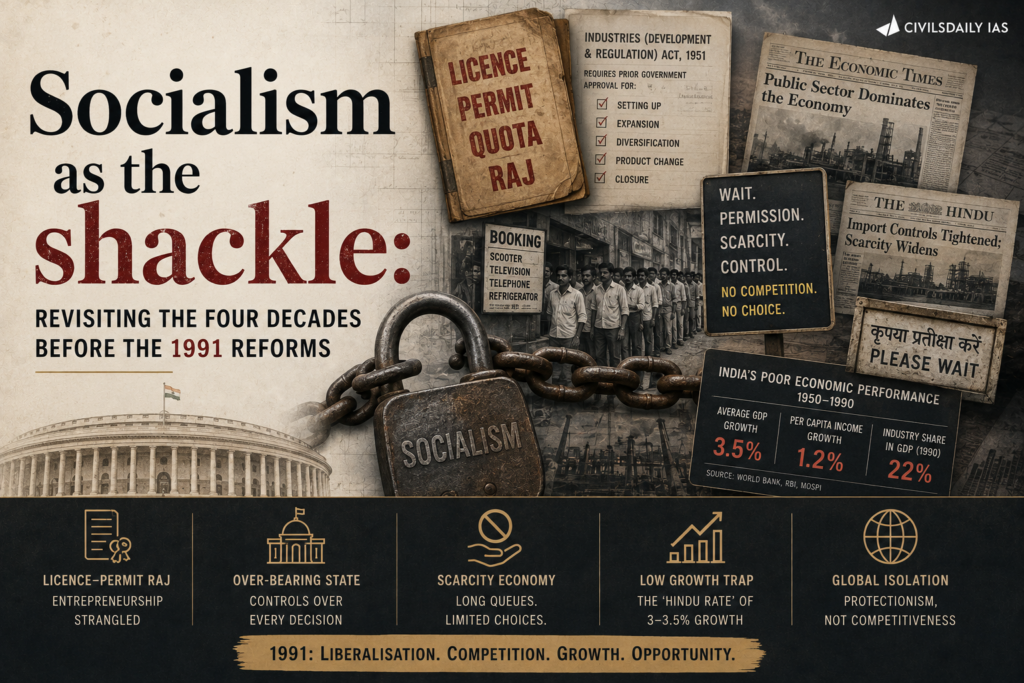
What was the licence permit quota system?
- About: The administrative regime under which a private firm needed a government licence to set up capacity, expand output, change product mix or import inputs.
- Legal basis: The Industries (Development and Regulation) Act, 1951 reserved industrial licensing to the Centre and listed the industries requiring approval.
- Delivery vehicle: Investment was allocated through five year plans, which placed the public sector first in the commanding heights of the economy.
- Effect on entry: Capacity was fixed by the licence rather than by demand, so a firm could not expand even when the market grew.
- Effect on competition: New entrants competed for approvals rather than for customers, which made the licence itself the scarce asset.
What is a balance of payments crisis?
- Definition: A country cannot meet payments for imports and external obligations because its foreign exchange earnings and reserves fall short of what it owes.
- The operative measure: Severity is read in import cover, that is the number of weeks of imports the reserves can finance, not in the absolute size of the reserves.
What was the socialist pattern of society resolution?
- Adoption: The Congress session at Avadi in Tamil Nadu in 1955 passed a resolution declaring a socialist pattern of society to be the goal of government policy.
- Content: It committed the government to state ownership and state direction of the principal means of production.
What is the Bank for International Settlements (BIS)?
- Definition: A Basel based institution owned by central banks that functions as a bank to central banks, with operations that made it one of the two lenders against India’s gold in 1991.
- Function: It accepts deposits and gold from member central banks and extends short term credit against that collateral.
What was the 42nd Constitutional Amendment Act, 1976?
- Preamble change: It inserted the words socialist, secular and integrity into the Preamble of the Constitution.
- Wider effect: It also expanded the protection given to laws implementing Directive Principles and curtailed the scope of judicial review, and much of it was reversed by the 44th Amendment.
Why did the 1991 crisis force India to pledge its gold?
- Reserve collapse: Foreign exchange reserves fell below $1 billion in early 1991, producing a full balance of payments crisis.
- Import cover: The remaining reserves covered only about two weeks of imports.
- The only option left: The Reserve Bank Governor advised that India’s gold be mortgaged to the Bank of England and the Bank for International Settlements in Switzerland, and dollars borrowed against it.
- Quantum pledged: About 67 tonnes of gold moved out in two consignments during 1991.
- Closed markets: A downgrade below investment grade had shut India out of ordinary commercial borrowing, which left collateralised lending as the only route.
How did socialism become the organising idea of Indian economic policy?
- 1927: A visit to Moscow for the decennial celebration of the October Revolution converted Jawaharlal Nehru to socialism.
- 1929: As president of the Indian National Congress he declared that India will have to go the socialist way.
- 1936: A revolt in the Congress Working Committee followed, in which seven senior leaders including Sardar Patel, Rajendra Prasad, C Rajagopalachari, J B Kripalani and Jamnalal Bajaj resigned.
- Gandhi’s condition: Mahatma Gandhi extracted a commitment that socialism would not become the Congress’s official policy, and it was honoured as long as Gandhi and Patel were alive.
- After 1950: The theme returned, and the 1955 Avadi resolution made a socialist pattern of society the declared goal of government.
- Instrumentation: The goal was executed through five year plans and the licence permit quota system, which emphasised state led growth and discouraged individual entrepreneurship.
What did four decades of state led growth actually deliver?
- Poverty rose: Decadal data published in 1965 showed the poverty rate had risen from 52.66 per cent to 58.60 per cent.
- Food rationing persisted: India was the only country still running food rationing two decades after the Second World War.
- Agriculture stagnated: Agricultural productivity remained among the lowest in the world.
- The income floor: In Parliament in 1963 it was asserted that 270 million Indians lived on three annas, that is 19 paise, a day while the Prime Minister’s pet dog cost nearly three rupees a day.
- Enterprise discouraged: Licensing made official approval rather than consumer demand the binding constraint on production.
Where did ideological commitment collide with fiscal solvency?
- The formation: The Prime Minister of 1990 to 1991 had begun his political life under the socialist leaders Acharya Narendra Dev and Ram Manohar Lohia.
- The dilemma: Pledging national gold to foreign banks contradicted the economic doctrine he had held throughout that political life.
- The counter argument: The Reserve Bank Governor’s case was that the country ranked above the doctrine, and it prevailed.
- Who acted: A lame duck government running on a thin majority took the decision that kept India solvent until a reform government could be formed.
- Who is credited: The turnaround is attributed to the Prime Minister and Finance Minister who followed, not to the government that pledged the gold.
How much of the 1991 collapse can be attributed to socialism alone?
- Oil shock: The Gulf conflict of 1990 raised crude prices and cut worker remittances from West Asia at the same time.
- Deposit flight: Non resident deposits were withdrawn rapidly as confidence in repayment fell.
- Fiscal position: The fiscal deficit had reached about 8.4 per cent of gross domestic product in 1990 to 1991, financed by borrowing.
- Political instability: Three governments in two years delayed every corrective decision.
- Model exhaustion: The licensing system had already produced four decades of low growth, so an external shock met an economy with no buffer.
What did other countries do when the same model failed?
- China: The Four Modernisations introduced by Deng Xiaoping in 1978 opened agriculture, industry, defence and science and technology to market incentives, with special economic zones as the entry point for foreign capital.
- Soviet Union: The planned economy did not reform in time and collapsed along with the state itself in the early 1990s.
- Vietnam: The Doi Moi programme from 1986 replaced collective farming with household production and legalised private enterprise.
- Poland: The stabilisation programme of 1990 freed prices and made the currency convertible in a single step rather than in stages.
Challenges to the post 1991 reform model
- Manufacturing share stagnation: Industry has not absorbed labour at the expected scale, e.g. manufacturing has remained near 17 per cent of gross value added against the 25 per cent target set under Make in India.
- Factor market reform stalled: Land and agricultural marketing reform remain politically blocked, e.g. the three farm laws enacted in 2020 were repealed in 2021 after a year of protest.
- Labour codes unimplemented: Consolidation of labour law has not translated into uniform practice, e.g. the four labour codes passed by 2020 waited years for States to notify matching rules.
- Disinvestment slippage: Public sector exits are announced faster than they are completed, e.g. the sale of Air India concluded in 2022 after two decades of failed attempts.
- Credit cycle damage: Directed and concentrated lending has repeatedly produced stress, e.g. the asset quality review of 2015 exposed non performing assets built up in infrastructure and power lending.
- Policy predictability: Retrospective changes deter long term capital, e.g. the retrospective tax amendment of 2012 triggered the Vodafone and Cairn arbitrations and was withdrawn only in 2021.
Conclusion
The crisis of 1991 was the terminal cost of a model in which official approval, not consumer demand, set the limit on production. The decisive moment came when a Prime Minister formed in socialist politics accepted that solvency outranked doctrine. Liberalisation removed the licence, but factor markets, manufacturing scale and policy predictability remain unresolved three decades later.
What is Economic Liberalisation?
- About: Economic liberalisation is the removal of state controls on entry, capacity, prices and trade so that market signals rather than administrative permission allocate resources.
- Rationale: It addresses the shortages, rent seeking and low productivity that follow when output is capped by licence rather than by demand.
- Liberalisation: The first element removes industrial licensing, price controls and import restrictions on domestic producers.
- Privatisation: The second element transfers ownership or management of state enterprises to private hands and opens reserved sectors to private entry.
- Globalisation: The third element integrates the domestic economy with world markets through trade, investment and currency convertibility.
Key Concerns Regarding Economic Liberalisation
- Jobless growth: Output growth has not produced proportionate formal employment, leaving a large workforce in low productivity informal work.
- Regional divergence: Investment concentrates in States with existing infrastructure, widening the gap with lagging States.
- Concentration of market power: Deregulation without strong competition enforcement allows dominant firms to entrench themselves.
- External vulnerability: Open capital accounts transmit global shocks quickly through portfolio flows and the exchange rate.
- Weak social protection: Removal of administered prices raises the burden on households where targeted transfers are incomplete.
Constitutional Framework Governing Economic Policy in India
- Preamble: The word socialist, inserted by the 42nd Amendment in 1976, declares a normative economic orientation without prescribing a specific model.
- Article 19(1)(g): Guarantees the freedom to practise any profession or carry on any occupation, trade or business.
- Article 19(6): Permits reasonable restrictions on that freedom, including the creation of a complete or partial state monopoly in any trade.
- Article 39(b): Directs that ownership and control of material resources be distributed to best subserve the common good.
- Article 39(c): Directs that the operation of the economic system not result in concentration of wealth to the common detriment.
- Article 31C: Protects laws made to give effect to Articles 39(b) and 39(c) from challenge on specified fundamental rights grounds.
- Article 246 with Union List Entry 52: Places industries whose control by the Union is declared expedient in the public interest within Parliament’s exclusive competence, which is the basis of central industrial licensing.
- Article 301: Guarantees freedom of trade, commerce and intercourse throughout the territory of India.
Laws and Rules Governing Industrial Policy in India
- Industries (Development and Regulation) Act, 1951: Created the licensing system for industrial capacity; it remains in force but licensing now applies to only four industries.
- Industrial Policy Resolution, 1956: Classified industries into three schedules and reserved the commanding heights for the public sector.
- Monopolies and Restrictive Trade Practices Act, 1969: Restricted expansion by large firms above an asset threshold, and was repealed and replaced by the Competition Act, 2002.
- Foreign Exchange Regulation Act, 1973: Capped foreign equity and criminalised exchange violations, and was replaced by the Foreign Exchange Management Act, 1999, which shifted violations from crime to civil penalty.
- New Industrial Policy, 1991: Abolished industrial licensing except for a short list, opened reserved sectors and raised the automatic route for foreign investment.
- Competition Act, 2002: Shifted regulation from restricting size to prohibiting anti competitive agreements and abuse of dominance.
- Insolvency and Bankruptcy Code, 2016: Created a time bound resolution process, which supplied the exit mechanism the licence era economy never had.
Back2Basics: The 1991 New Economic Policy
- Trigger: Foreign exchange reserves below $1 billion and import cover of about two weeks.
- Gold pledge: About 67 tonnes of gold were pledged to the Bank of England and to a Swiss bank across two consignments in 1991.
- Devaluation: The rupee was devalued in two steps on 1 and 3 July 1991, by roughly 9 per cent and 11 per cent.
- External support: India drew on an International Monetary Fund standby arrangement, conditioned on fiscal correction and structural reform.
- Industrial delicensing: Licensing was abolished for all but 18 industries, a list since reduced to four.
- Trade and investment: Import tariffs were cut sharply and foreign direct investment up to 51 per cent was permitted through an automatic route in listed industries.
Government Initiatives for Industrial Growth
- Make in India: Launched to raise manufacturing’s share of output and employment through sector specific facilitation.
- Production Linked Incentive schemes: Pay incentives on incremental sales in named sectors such as electronics, pharmaceuticals and solar modules.
- National Single Window System: Consolidates central and State approvals for a new industrial project into one application portal.
- PM GatiShakti National Master Plan: Coordinates infrastructure planning across ministries to reduce logistics cost for industry.
- Jan Vishwas (Amendment of Provisions) Act, 2023: Decriminalised a large number of minor business offences to reduce compliance risk.
- Startup India: Provides tax benefits, a fund of funds and simplified compliance for recognised new enterprises.
Key Facts about the 1991 Reforms
- The Budget of 1991: The reform Budget was presented in July 1991 and paired fiscal correction with trade liberalisation.
- Licensing today: Only four industries still require an industrial licence, including alcoholic drinks, tobacco products, defence and aerospace equipment, and industrial explosives.
- Reserve position now: Foreign exchange reserves stand at about $700 billion, with gold holdings of 880 tonnes.
- Rate of change: Reserves more than doubled over the last twelve years.
- Preamble litigation: The presence of the word socialist in the Preamble has been repeatedly challenged, and the Supreme Court has declined to read it as mandating a specific economic model.
Challenges in India’s Industrial Economy
- Scale deficit in manufacturing: Firms stay small to retain benefits tied to size, e.g. the majority of registered manufacturing units remain micro enterprises with fewer than ten workers.
- Import dependence in key inputs: Assembly has grown faster than component making, e.g. India still imports the bulk of active pharmaceutical ingredients and advanced electronic components from China.
- Logistics cost: Freight moves disproportionately by road, e.g. rail’s share of freight traffic has fallen steadily since the 1950s, raising delivered cost for bulk industry.
- Land acquisition friction: Project land remains slow and contested to assemble, e.g. the Nandigram and Singur episodes in West Bengal ended two large industrial projects outright.
- Skills mismatch: Formal training does not match employer requirements, e.g. employability surveys repeatedly report that a minority of engineering graduates are job ready without retraining.
- Power reliability and cost: Industrial tariffs cross subsidise other consumers, e.g. energy intensive units in several States run captive diesel or solar capacity to avoid grid interruption.
Way Forward
- Complete factor market reform: Move on land assembly, tenancy and labour rule notification instead of amending statute without implementation.
- Tie incentives to competitiveness: Structure production incentives to expire on a fixed schedule so that supported sectors face world prices.
- Deepen component ecosystems: Extend support beyond final assembly to component, material and capital goods manufacturing.
- Cut logistics cost: Shift bulk freight to rail and coastal shipping through dedicated corridors and multimodal terminals.
- Stabilise tax and regulatory expectations: Rule out retrospective taxation by statute and publish advance rulings to reduce litigation.
- Align skilling with employers: Fund apprenticeships tied to firm level hiring rather than to enrolment targets.
“[2017, GS3, 15 marks] “Industrial growth rate has lagged behind in the overall growth of Gross-Domestic-Product (GDP) in the post-reform period” Give reasons. How far the recent changes is Industrial Policy are capable of increasing the industrial growth rate?”
