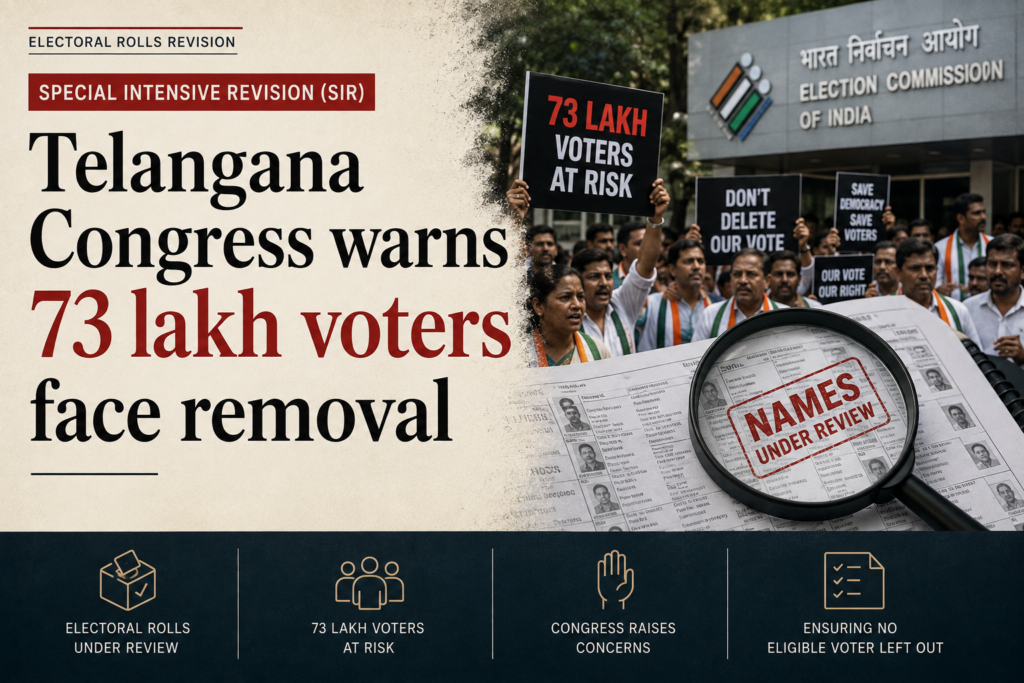
Why in the news?
The Telangana Pradesh Congress Committee urged the Election Commission to re verify the 73 lakh voters proposed for deletion under the ongoing Special Intensive Revision (SIR) in the State. The controversy has exposed a tension between an inclusion driven history of the franchise and a revision that critics say works on a presumption of exclusion. The draft voters’ list is due on 17 August.
What is the Special Intensive Revision (SIR)?
- Definition: The Special Intensive Revision is an exercise by the Election Commission to intensively update and verify electoral rolls, involving field verification of existing electors.
- Deletion mechanism: Electors flagged as ineligible or unverified are proposed for deletion and published in a draft roll for objection.
- Onus on the elector: The revision requires electors to establish continued eligibility, which critics read as a presumption of exclusion.
What is the Election Commission of India?
- Constitutional authority: The Election Commission of India is the constitutional body under Article 324 responsible for superintendence, direction and control of the preparation of electoral rolls and the conduct of elections.
- Composition: It presently functions as a multi member body of the Chief Election Commissioner and Election Commissioners.
- Roll preparation: It prepares and periodically revises the electoral rolls on which the franchise depends.
What is the current status of the franchise and roll revision in India?
- Universal adult franchise: Every citizen aged 18 and above is entitled to be registered as a voter, an entitlement extended from age 21 originally.
- Historical inclusion drive: In the first election of 1952 the Commission worked to register 80 million eligible women, though 2.8 million were struck off for refusing to be recorded by name rather than as the wife or daughter of a man.
- Gender gap closed: The gender gap in voting closed by 2019, marking the maturation of electoral equality into lived equality.
- Draft roll timeline: In Telangana the draft roll is scheduled for 17 August, with 73 lakh electors proposed for deletion under the SIR.
Constitutional provisions related to elections and the electoral roll:
- Article 324: Vests superintendence, direction and control of elections and roll preparation in the Election Commission.
- Article 325: Bars exclusion from the electoral roll on grounds of religion, race, caste or sex, and provides one general roll for every constituency.
- Article 326: Establishes elections to the House of the People and State Assemblies on the basis of adult suffrage.
- Article 327: Empowers Parliament to make provision on all matters relating to elections, including preparation of electoral rolls.
What are the concerns raised in Telangana?
- Scale of proposed deletion: The Telangana Congress flagged 73 lakh voters proposed for deletion and sought detailed re verification before any removal.
- Genuine electors at risk: It maintained that genuine electors should not be removed without thorough scrutiny.
- Opportunity to establish eligibility: It demanded that every genuine voter be given a chance to establish eligibility before deletion.
- Draft roll deadline pressure: With the draft list due on 17 August, the window to correct wrongful deletions is compressed.
Why does the revision reopen the inclusion versus exclusion tension?
- Presumption of exclusion: The current SIR appears to work on the presumption of exclusion, in contrast to the 1952 drive that worked to include the eligible.
- Own name weaponised: Ownership of one’s own name, which historically announced gender electoral equality, has been turned against women in online attacks on female protesters.
- Gendered doxxing: Women who joined recent protests were doxxed, with names, numbers and addresses uploaded and abuse directed at them.
- Paternalistic framing: Public remarks singling out the conduct of women protesters divided the participants along gendered lines while ignoring identical conduct by men.
- Erosion of an old promise: The revision and the online abuse together strain the founding promise of equality regardless of gender.
What are the major debates surrounding electoral roll revision?
- Purity versus inclusion: A roll must exclude ineligible entries while not disenfranchising genuine electors, and the SIR is contested on which side it errs.
- Burden of proof: Placing the onus on the elector to prove eligibility risks excluding the poor, the mobile and the marginalised.
- Timeline adequacy: A compressed objection window after a large proposed deletion raises due process concerns.
- Federal and political friction: State units allege that mass deletions fall unevenly, injecting the revision into electoral competition.
Conclusion: The SIR in Telangana has proposed 73 lakh voters for deletion, and the State Congress has demanded re verification before any removal. The dispute turns on whether the revision presumes inclusion or exclusion of the eligible voter. The draft rolls are due on 17 August, after which the objection and correction process will determine the final deletions.
Back2Basics: Election Commission of India
- Constitutional basis: Article 324, with the Commission established on 25 January 1950.
- Composition: Chief Election Commissioner and such number of Election Commissioners as the President fixes, currently a multi member body.
- Tenure and removal: The Chief Election Commissioner is removable only by the process applicable to a Supreme Court judge, securing independence.
- Functions: Superintends roll preparation, conducts elections to Parliament, State legislatures and the offices of President and Vice President, and resolves disputes on splits and mergers of recognised parties.
- Statutory backing: The Representation of the People Acts of 1950 and 1951 govern roll preparation and the conduct of elections.
Way Forward:
- Verification before deletion: Require field verification and notice to the elector before any name is struck off.
- Accessible appeal: Provide accessible objection and appeal mechanisms with adequate time after the draft roll.
- Protect vulnerable electors: Design safeguards so that the poor, migrants and women identified by their own names are not wrongly excluded.
- Transparency of criteria: Publish the deletion criteria and category wise data to allow public scrutiny.
- Grievance redress: Establish a time bound grievance channel for wrongful deletions before the final roll.
“[2017] Consider the following statements:
1. The Election Commission of India is a five-member body.
2. Union Ministry of Home Affairs decides the election schedule for the conduct of both general elections and bye-elections.
3. Election Commission resolves the disputes relating to splits/mergers of recognized political parties.
(a) 1 and 2 only
(b) 2 only
(c) 2 and 3 only
(d) 3 only
