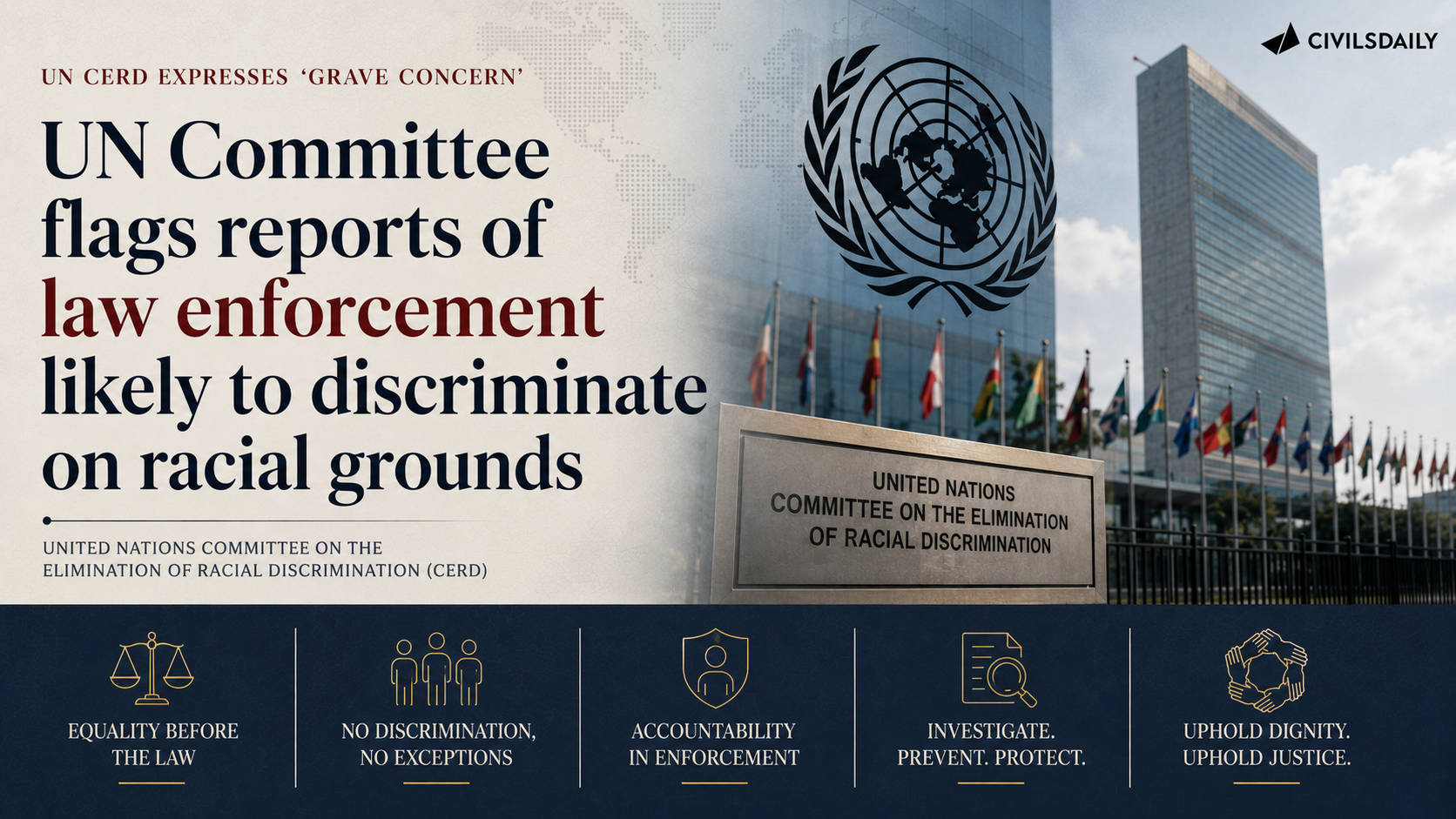
Why in the News
The United Nations Committee on the Elimination of Racial Discrimination (CERD) has expressed “grave concern” at reports of the law enforcement apparatus resorting to violence, physical and otherwise, against minority ethnic and ethno religious groups, Dalits and non citizens. This is India’s first review by the Committee since 2007, and India ratified the International Convention on the Elimination of All Forms of Racial Discrimination (ICERD) in 1968. The Committee also recorded that India has not provided detailed and updated information on the state’s inquiries and sanctions arising from allegations of such violence. The government’s position before the Committee is that caste bias falls outside Article 1 of the Convention because caste is not synonymous with race. The Committee has read the Convention as covering all forms of discrimination based on inherited status. The tension is between a state defending a definitional boundary to keep caste a domestic matter and a treaty body reading descent into the Convention to bring caste inside international scrutiny.
What is the Committee on the Elimination of Racial Discrimination?
- A treaty body: CERD is a body of independent experts that monitors how states that have ratified ICERD implement it.
- Periodic review: States file periodic reports and the Committee issues concluding observations recording its concerns and its recommendations.
- No enforcement power: Concluding observations are not binding and carry no sanction, so their effect runs through the reporting obligation and reputational exposure.
Why does the caste and race question decide the Committee’s jurisdiction?
- The government’s reading: Article 1 of ICERD defines racial discrimination by race, colour, descent, and national or ethnic origin, and the government argues that caste is not race and therefore sits outside that definition.
- The Committee’s reading: The Committee treats discrimination based on inherited status as covered, which brings caste within the Convention through the descent limb rather than the race limb.
- What actually turns on it: If caste falls outside Article 1, India owes the Committee no account of caste discrimination at all, so the argument is jurisdictional rather than semantic.
- The scale of what the technicality would exclude: The position would place the situation of 200 million Dalits beyond the reach of international review. The underlying facts would remain undisputed.
What specific practices did the Committee flag?
- Manual cleaning of sewers: The practice continues despite a law prohibiting it.
- Treatment of Rohingya Muslims: Hate speech against them, their poor living conditions, and their mass refoulement, meaning return to a territory where they face persecution.
- Citizenship deprivation: Mass deprivation of citizenship through the National Register of Citizens (NRC).
- Electoral roll deletions: Large scale deletions arising from the Special Intensive Revision (SIR) of electoral rolls.
- Statutes used against civil society: Use of the Foreign Contribution (Regulation) Act, 2010, the Unlawful Activities (Prevention) Act, 1967, the Armed Forces (Special Powers) Act, 1958 and the Prevention of Money Laundering Act, 2002 to hamper the work of civil society organisations.
- A gap in the criminal code: The Bharatiya Nyaya Sanhita, 2023 does not expressly criminalise racist hate speech.
- Exemptions in forest law: The Forest (Conservation) Amendment Act, 2023 exempts “national security” projects from consultative decision making.
Why is the data gap the enabling condition?
- Enumeration is overdue: A much delayed Census means suitably disaggregated data on disenfranchised communities does not exist in current form.
- Crime data arrives late: Slow release of National Crime Records Bureau (NCRB) data delays any independent check on recorded offences against Scheduled Castes and Scheduled Tribes.
- Special measures run on stale figures: Affirmative action is being implemented on 2011 Census data, which can mask a regression in the socioeconomic status of Scheduled Tribes and Adivasis.
- The effect is no longer administrative: The absence of data has moved past lethargy into actively impeding independent verification of the state’s own claims about fighting caste and faith based discrimination.
What has happened to the domestic accountability machinery?
- Accreditation at risk: The Global Alliance of National Human Rights Institutions (GANHRI), the peer body that accredits national human rights institutions against the Paris Principles, recommended a downgrade of the National Human Rights Commission (NHRC) last year.
- The stated grounds: The appointment of police officers to investigative roles within the Commission, and a lack of pluralism in its composition.
- The consequence: With the domestic institution weakened, a treaty body review becomes the surviving external check rather than a supplement to a working domestic one.
Domestic matter or international accountability?
- The sovereignty claim: The government treats the caste question as an internal matter and has dismissed the Committee’s concerns as politically motivated.
- The counter position: A definitional objection raised at the treaty body removes an entire class of discrimination from review without disputing that the discrimination occurs.
- Who is left carrying it: With the state contesting jurisdiction, the work of raising these issues in multilateral fora falls to civil society organisations, which are themselves the subject of the Committee’s concern about the use of regulatory and criminal law against them.
What does the road ahead require?
- Institutional independence: Restoring the independence of the NHRC, beginning with the composition and appointment concerns that triggered the accreditation review.
- Criminal law: Expressly criminalising racist hate speech, which the current code does not do.
- Affirmative action: Supportive affirmative action, extended rather than narrowed, for the communities the measures are meant to reach.
- Data: Collecting and publishing disaggregated data on the affected communities.
- Electoral process: Improving the transparency of electoral roll revisions.
- Enforcement: Strengthening enforcement of existing protective law overall.
Challenges to treaty body review as a check on caste discrimination
- No individual complaint route: India has not made the declaration under Article 14 of ICERD, so an individual or a group in India cannot petition the Committee directly. Eg. States that have made the Article 14 declaration allow individual communications, and India’s absence from that list leaves domestic courts as the only forum. Fix. Make the Article 14 declaration, which is a unilateral act requiring no amendment to the Convention.
- The evidence base is state controlled: The Committee reviews what the state chooses to report, so a gap in official data becomes a gap in the review itself. Eg. Shadow reports by non governmental organisations are the main corrective, which is why restrictions on their foreign funding directly shape what the Committee sees. Fix. Require the state report to be tabled domestically before submission, so its omissions are contested at home first.
- Long reporting gaps defeat periodicity: The Convention requires reports every two years and states file many years late with no consequence. Eg. Several states parties carry reports overdue by more than a decade on the Committee’s own schedule. Fix. Apply the review in the absence of a report procedure on a fixed timetable, so a missing report does not postpone scrutiny.
- Recommendations have no domestic legal effect: A concluding observation creates no right enforceable in an Indian court, since a treaty requires enabling legislation under Article 253 of the Constitution to become domestic law. Eg. Courts have used unincorporated treaty obligations as an interpretive aid rather than as a source of enforceable rights, as in Vishaka v. State of Rajasthan (1997). Fix. Route the recommendations through the NHRC’s statutory annual report to Parliament, so each produces a documented government response.
Conclusion
The dispute is not over whether the discrimination occurs but over whether an international body may examine it, and the two positions cannot both hold: a Convention read to cover inherited status, and a state reading that places caste outside its scope. What keeps the disagreement unresolvable is that the evidence which would settle either claim is the same disaggregated data the state has not produced.
Back2Basics
- Statutory basis: It was constituted under the Protection of Human Rights Act, 1993.
- Composition: It is chaired by a former Chief Justice of India or a former judge of the Supreme Court, with members including a serving or former Chief Justice of a High Court and persons with knowledge of human rights.
- Powers: It inquires into complaints of human rights violation, exercises the powers of a civil court during inquiry, and may visit places of detention.
- Recommendatory character: Its findings are recommendations to the government concerned, which must report the action taken, and the Commission cannot enforce them itself.
“[2023, GS1, 15 marks] Why is caste identity in India both fluid and static?”
