Why in the News
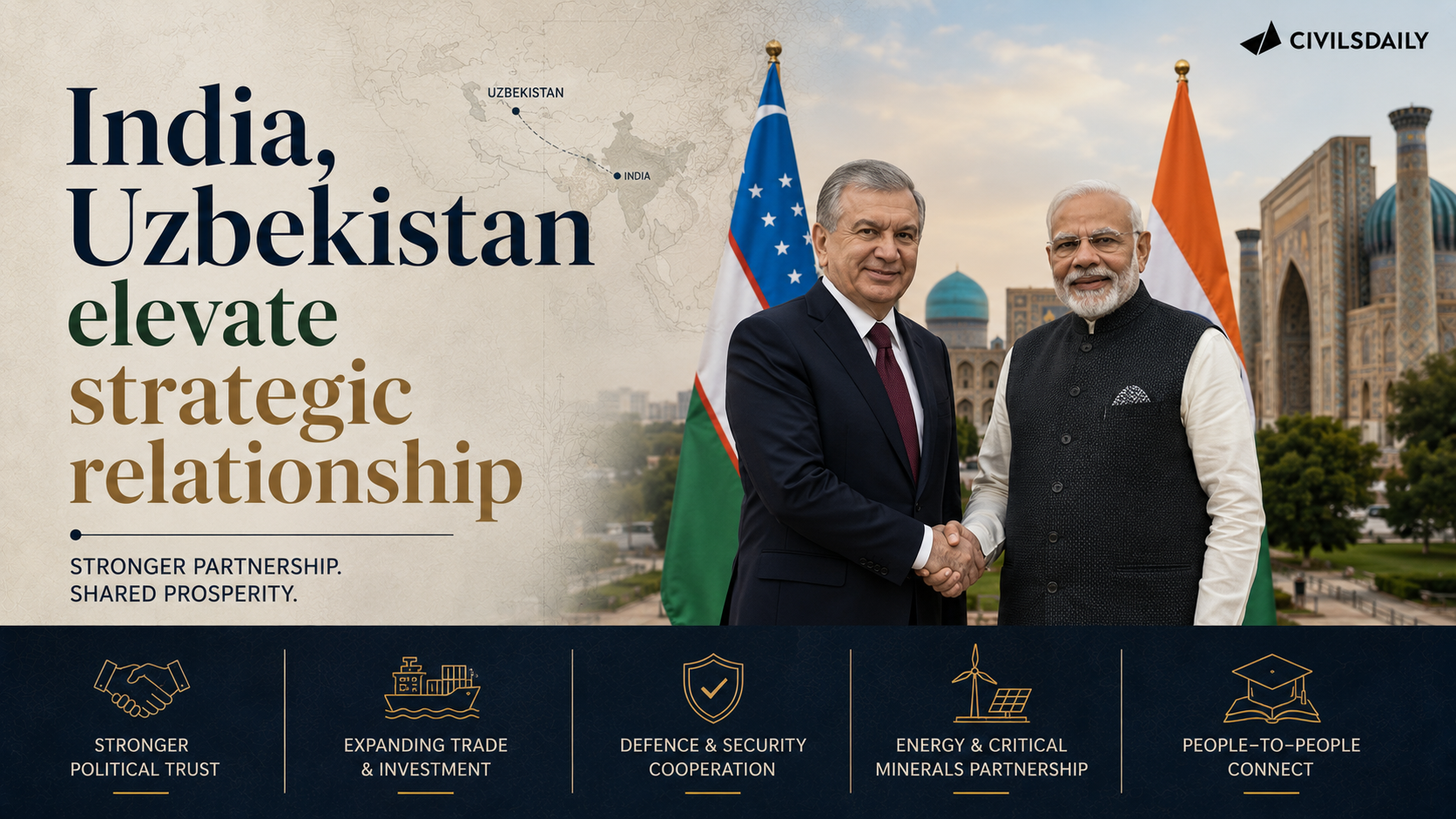
India and Uzbekistan have elevated their ties to a Comprehensive Strategic Partnership and set a target of 5 billion dollars in annual trade by 2030.
What is a Comprehensive Strategic Partnership?
- The top tier: It is the highest category in India’s graded system of bilateral partnerships, above a strategic partnership, and it signals cooperation across security, economic and technology domains rather than in a single sector.
- What it actually commits: The designation carries no treaty obligation, and it works by creating standing institutional machinery and periodic political level review.
What was actually signed?
- Eleven agreements: The instruments cover mining, culture, education, tourism and ayurveda among other areas.
- A payments link: A commercial pact between National Payments Corporation of India (NPCI) International Payments Limited (NIPL), the international arm of the operator of India’s Unified Payments Interface (UPI), and Uzbekistan’s National Interbank Processing Centre JSC will let Indian UPI applications scan Uzbekistan’s national QR code, the UZQR, for merchant payments.
- Buddhist heritage: A Letter of Intent covers restoration and conservation of the Fayaz Tepa and Kara Tepa Buddhist sites in southern Uzbekistan, ancient monasteries marking the spread of Buddhism along the Silk Road.
- An environmental grant: India announced a grant of 1 million dollars for afforestation in the Aral Sea region.
- Education instruments: 100 Lal Bahadur Shastri scholarships for Hindi language study and an Indian Council for Cultural Relations (ICCR) Sanskrit Chair at the Tashkent State University of Oriental Studies were announced.
Why does the resource agenda dominate the package?
- Uranium supply: The two sides agreed to establish a framework for the long term supply of uranium from Uzbekistan to India, with the agreement stated to be close to signature.
- Why the fuel matters: India’s domestic uranium is limited in quantity and grade, so fuel for its pressurised heavy water reactors depends on imported supply arrangements.
- Critical minerals: Both agreed to expand cooperation through joint projects in geological exploration, mining, mineral processing and the development of integrated value chains.
- What joint exploration changes: An equity route into a deposit is different from a purchase contract, since it converts a buyer into a part owner of the supply.
What economic base does the trade target rest on?
- Current volume: Bilateral trade stood close to 1 billion dollars in 2025-26.
- The gap to be closed: The 5 billion dollar goal by 2030 requires roughly a fivefold increase in under five years.
- India’s standing: India is among the top 10 trading partners of Uzbekistan.
- Sectors named for expansion: Trade and investment, infrastructure, innovation, agriculture, pharmaceuticals, health, information technology, digital public infrastructure and education.
How is the partnership being institutionalised?
- The joint commission is upgraded: The existing joint commission moves from the level of secretaries to ministerial level.
- A new council: A Coordination Council at the level of Foreign Ministers will provide direction across all aspects of the cooperation.
- The regional format: Both reaffirmed engagement within the Central Asia-India format at the level of Heads of State.
- A stated order preference: Both stressed the need for a free, open and rules based international order, built on their existing multilateral cooperation.
What is the security content of the elevation?
- Defence industries, not procurement: Both sides will promote direct linkages, co-production and co-development between their defence industries rather than a buyer and seller relationship.
- Named threats: Terrorism, extremism and separatism were identified as serious challenges to the entire region, with zero tolerance stated as the shared position.
Challenges to India’s partnership with Uzbekistan
- No usable overland route: India has no land access to Central Asia, since the direct corridor runs through Pakistan, which does not permit transit trade towards Afghanistan and beyond. Eg. Indian cargo to the region moves through Iran’s Chabahar port and then by road, lengthening both transit time and cost. Fix. Complete the Chabahar to Zahedan rail link and operationalise the International North South Transport Corridor (INSTC) with an Uzbek transit agreement attached.
- Chinese economic primacy in the region: China is Uzbekistan’s largest trading partner and infrastructure financier, so an Indian trade target competes for market share already held. Eg. The China-Kyrgyzstan-Uzbekistan railway under construction gives Chinese goods a shorter route into the region. Fix. Concentrate on segments where India holds a cost advantage, pharmaceuticals, information technology services and digital public infrastructure, rather than on generalised volume.
- A supply framework is not a delivery route: Uranium supply still needs a transport corridor and safeguards arrangements acceptable to the supplier before a contract means anything. Eg. Consignments from Central Asia reach India by sea after long overland movement, which raises both cost and handling risk. Fix. Tie the supply agreement to a designated transit corridor and a fixed price formula rather than negotiating logistics consignment by consignment.
- Settlement frictions cap small trade: The Uzbek som is thinly traded and correspondent banking links between the two countries are limited, so settlement costs weigh heavily on modest volumes. Eg. Indian exporters to Central Asia routinely settle through third country banks in the Gulf. Fix. Extend the rupee vostro account arrangement to Uzbek banks alongside the retail payments pact.
- Russian primacy narrows the defence agenda: Uzbekistan’s military procurement, training and doctrine remain oriented towards Russia, which limits the room for co-development with a third partner. Eg. Uzbekistan suspended its Collective Security Treaty Organization membership in 2012 and retained its bilateral defence relationship with Russia. Fix. Focus co-production on segments Russia does not supply, such as light armoured vehicles, small arms and unmanned systems.
Conclusion
What to watch is the signature of the uranium supply agreement and the first meeting of the new Coordination Council, since these are the two commitments that either produce a document or do not. The wider test is whether an announced trade target survives without a preferential trade instrument or a working transit route behind it.
Back2Basics
- Doubly landlocked: It is one of only two doubly landlocked countries in the world, along with Liechtenstein, so its exports must cross at least two international borders to reach a seaport.
- Neighbours: It borders Kazakhstan, Kyrgyzstan, Tajikistan, Afghanistan and Turkmenistan.
- Resource base: It is among the world’s leading uranium producers and holds substantial gold, natural gas and copper reserves.
- The Aral Sea: The Aral Sea, shared with Kazakhstan, shrank drastically after Soviet era diversion of the Amu Darya and Syr Darya rivers for cotton irrigation.
“[2024, GS2, 10 marks] Critically analyse India’s evolving diplomatic, economic and strategic relations with the Central Asian Republics (CARs) highlighting their increasing significance in regional and global geopolitics.”
