Why in the News
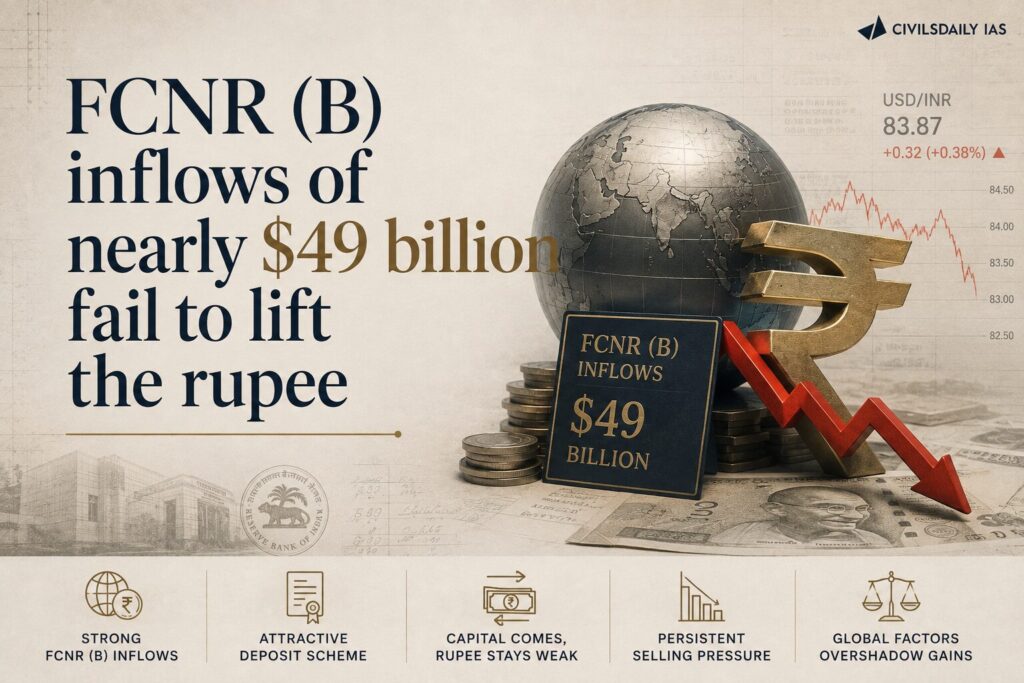
India received nearly USD 49 billion during June-July 2026 through the Foreign Currency Non Resident (Bank) [FCNR(B)] swap window, foreign loans, and bond investments. However, the Indian Rupee (INR) remained stable at around ₹95.38/USD, unlike the sharp appreciation seen under a similar scheme in 2013.
What are FCNR(B) Deposits and the Swap Window?
FCNR(B) Deposits
- Foreign currency term deposits maintained by Non-Resident Indians (NRIs) with Indian banks.
- Protect depositors from exchange rate risk.
- Tenure: 1-5 years.
Swap Window
- A facility by the Reserve Bank of India (RBI) where banks swap FCNR(B) dollar deposits for rupees.
- Since dollars go directly to the RBI, they do not increase dollar supply in the forex market.
Why Didn’t the Rupee Strengthen?
- Dollar inflows bypassed the open forex market.
- RBI sold dollars to stabilize the rupee amid global uncertainty.
- Banks hedged future foreign currency liabilities.
- Higher crude oil prices and a stronger US dollar offset the impact of inflows.
Challenges
- Strong US dollar and geopolitical risks.
- Lower Foreign Direct Investment (FDI) inflows.
- Rising crude oil prices widening the Current Account Deficit (CAD).
- Risk of reversal of FCNR(B) deposits after the swap window ends.
Value Addition
- Spot Market: Immediate currency exchange.
- Forward Market: Currency exchange at a future date and predetermined rate.
- Foreign Exchange Reserves comprise:
- Foreign Currency Assets (FCA) (largest component)
- Gold
- Special Drawing Rights (SDRs)
- IMF Reserve Position
Back2Basics:
- FCNR(B): Foreign Currency Non Resident (Bank) Deposit.
- Eligible: NRIs and Overseas Citizens of India (OCIs).
- Tenure: 1-5 years.
- Exchange Rate Risk: Borne by the bank/RBI, not the depositor.
“[2017] Which of the following has/have occurred in India after its liberalization of economic policies in 1991?
1. Share of agriculture in GDP increased enormously.
2. Share of India’s exports in world trade increased.
3. FDI inflows increased.
4. India’s foreign exchange reserves increased enormously.
(a) 1 and 4 only
(b) 2, 3 and 4 only
(c) 2 and 3 only
(d) 1, 2, 3 and 4