Why in the News
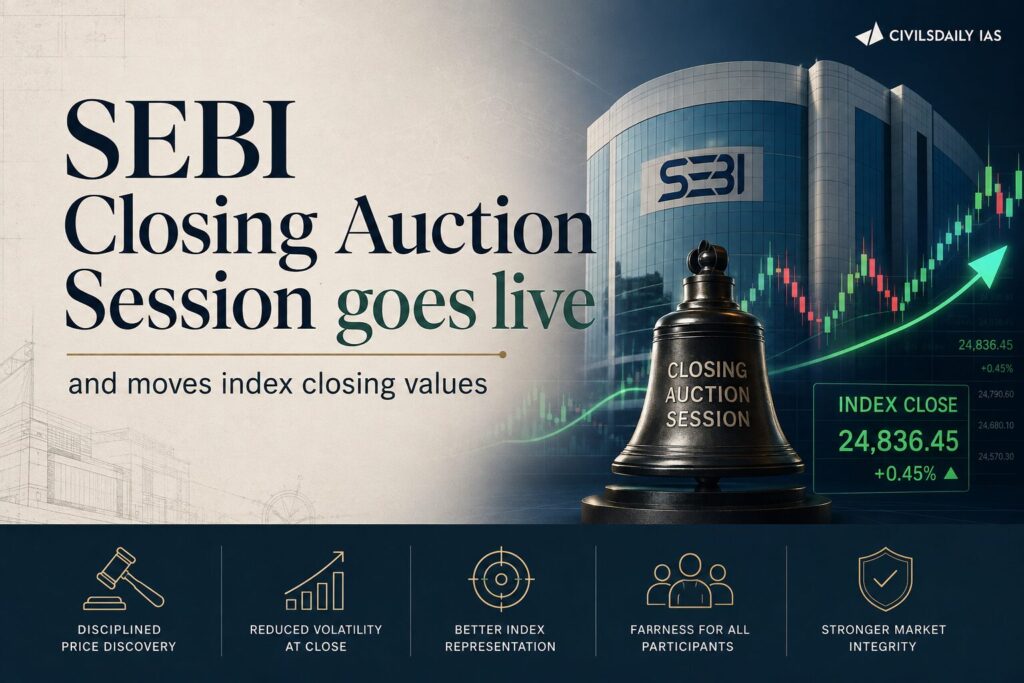
The Closing Auction Session (CAS) became operational from 3 August 2026 for stocks with Derivative Contracts. During its initial days, the National Stock Exchange (NSE) Nifty 50 and Bombay Stock Exchange (BSE) Sensex recorded unusually large differences in their closing values.
What is the Closing Auction Session (CAS)?
- The Closing Auction Session (CAS) is a dedicated 20-minute trading block (3:15 PM to 3:35 PM) introduced by SEBI on August 3, 2026.
- It pools end-of-day buy and sell orders for eligible stocks to discover a single equilibrium closing price, replacing the final 30-minute VWAP method.
What is Volume Weighted Average Price (VWAP)?
- The Volume Weighted Average Price (VWAP) is the average price of a stock weighted by the trading volume, giving greater importance to prices with higher traded volumes.
Why did Nifty and Sensex Diverge?
- Separate CAS order books on the NSE and BSE.
- Different index composition (Nifty 50: 50 stocks; Sensex: 30 stocks).
- Different weightages of constituent stocks.
- Initial adjustment to the new auction mechanism.
Challenges
- Temporary benchmark divergence.
- Higher tracking error for Exchange Traded Funds (ETFs) and index funds.
- Residual risk of price manipulation.
- Liquidity concerns in less-traded stocks.
- Operational adaptation by brokers and investors.
Key Concept:
- Equilibrium Price: The price at which the maximum quantity of buy and sell orders can be matched during the auction.
- Derivative Contracts: Financial instruments whose value is derived from an underlying asset such as stocks or indices. Examples: Futures Contracts and Options Contracts
- Collectively known as the Futures and Options (F&O) segment.
Securities and Exchange Board of India (SEBI)
- Established: 1988 (Statutory status in 1992).
- Governing Act: Securities and Exchange Board of India Act, 1992.
- Headquarters: Mumbai.
- Functions: Protect investors. Regulate and develop the securities market. Regulate stock exchanges, mutual funds, and market intermediaries.