Why in the News
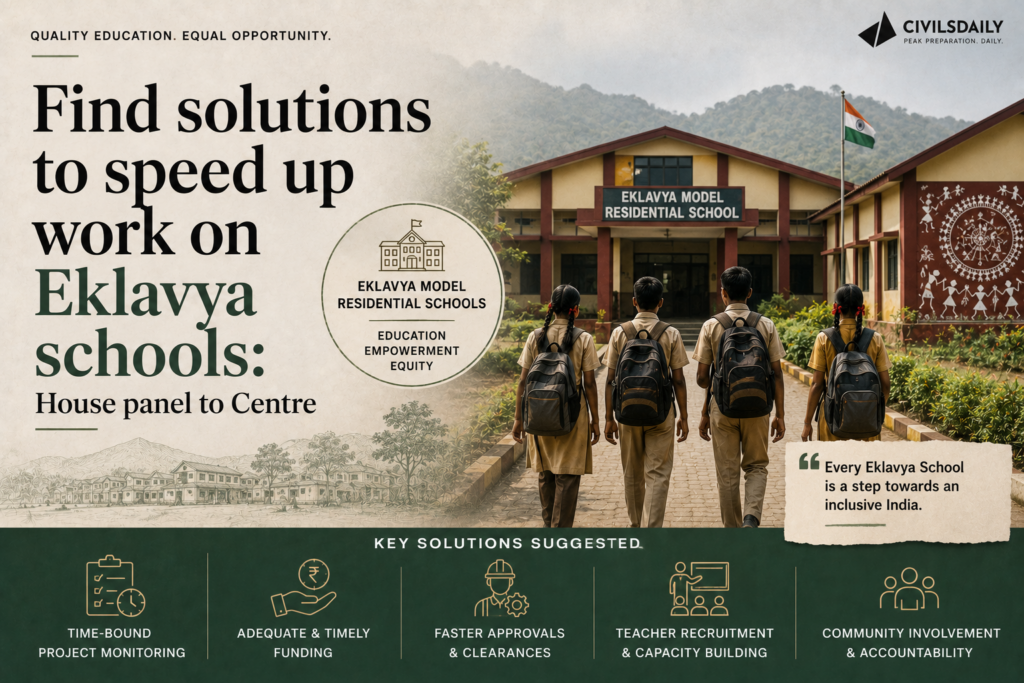
The Parliamentary Standing Committee on Social Justice and Empowerment flagged delays in constructing and operationalising Eklavya Model Residential Schools (EMRS). Only 428 of 728 sanctioned schools have been completed, while 118 continue from government or rented buildings.
What is EMRS?
- EMRS: Eklavya Model Residential Schools.
- Provides free residential education from Classes 6 to 12 to Scheduled Tribe (ST) students in tribal-majority and remote areas.
- Nodal Ministry: Ministry of Tribal Affairs.
- Managing body: National Education Society for Tribal Students (NESTS).
- Aim: Improve educational access while preserving tribal cultural identity.
What did the Panel Find?
- 428/728 schools completed.
- 249 under construction.
- 51 at pre-construction stage.
- 118 schools operate from temporary government/rented buildings.
- Delays have caused construction cost escalation.
- Panel suggested an independent monitoring agency and an alternative implementation mechanism.
Scholarship Concerns
- Scholarship funds are often released in the next academic year due to delays in State/Union Territory verification.
- The Committee criticised the repeated explanation that States need more time for verification.
- It also recommended reviewing the ₹8 lakh annual income ceiling for the free coaching scheme for Scheduled Castes (SCs) and Other Backward Classes (OBCs).
- Government accepted 14 of 25 recommendations; the panel rejected responses on four issues.
Why is Implementation Weak?
- Federal dependence: Central schemes depend on States for construction and verification.
- Weak monitoring: Delays accumulate without independent oversight.
- Cost escalation: Delays increase construction costs and budget requirements.
- Portal mismatch: Scholarship portals and State verification timelines do not align well.
Constitutional Framework
- Article 15(4): Enables special provisions for advancement of socially and educationally backward classes and STs.
- Article 46: Directs the State to promote educational and economic interests of STs.
- Article 275(1): Provides Central grants for tribal welfare and Scheduled Areas.
- Article 342: Specifies Scheduled Tribes.
- Fifth & Sixth Schedules: Provide special arrangements for administration of Scheduled and tribal areas.
Back2Basics: EMRS
- Full form: Eklavya Model Residential Schools.
- Nodal Ministry: Ministry of Tribal Affairs.
- Implementing body: NESTS, National Education Society for Tribal Students.
- Classes: 6 to 12.
- Target: ST students in tribal-majority and remote areas.
- Purpose: Quality residential education with cultural preservation.
Key Government Initiatives
- Pre-Matric & Post-Matric Scholarships: Financial support for ST students.
- National Fellowship and Scholarship for Higher Education of ST Students: Supports higher education.
- PM-JANMAN: Pradhan Mantri Janjati Adivasi Nyaya Maha Abhiyan, focused on Particularly Vulnerable Tribal Groups (PVTGs).
- Dharti Aaba Janjatiya Gram Utkarsh Abhiyan: Development of tribal villages.
- Vanbandhu Kalyan Yojana: Umbrella framework for tribal development.
