💥Mains Ready By December. Smash Mains & Smash PYQ Admissions Open

GS Paper: GS2-13.Issues relating to development and management of Social Sector/Services relating to Health, Education, Human Resources.

  • Our healthcare boom hides a public-system deficit

    Why in the News

    The most revealing number in India’s healthcare record is government health expenditure at 1.43 per cent of GDP in 2022 to 2023, against the 2.5 per cent target set by the National Health Policy 2017. Almost every visible measure of healthcare has expanded, with medical colleges and seats multiplied, the footprint of the All India Institute of Medical Sciences (AIIMS) network widened, and Ayushman Bharat established as one of the world’s largest publicly funded health insurance programmes. The latest report of the Parliamentary Standing Committee on Health and Family Welfare finds a system still struggling with basic capacity, affordability and regulation. The tension is that expansion has been measured in inputs the state can count, while the outcome that decides the result, whether a family is less exposed when illness strikes, is set by financing the state has not provided.

    What does government health expenditure as a share of GDP measure?

    1. What the ratio counts: It measures spending on health by the Centre, the states and local bodies, set against the size of the economy, so it rises only when health spending grows faster than output does.
    2. Why the share and not the amount: An absolute figure grows every year with prices and with the economy, so only the share shows whether health is gaining or losing ground against competing claims on public money.
    3. The benchmark it is read against: The National Health Policy 2017 fixed 2.5 per cent of GDP as the target, and the distance between that and the actual figure is what the public system’s shortfall is measured by.

    Why has expanding medical education not fixed the distribution of care?

    1. The expansion is real: The number of medical colleges has risen to 818, and undergraduate medical seats have reached 1,28,875.
    2. The problem was never the count of doctors: It was where they practise, who can afford them, and whether the system has the infrastructure to use them.
    3. Specialists are missing where they are most needed: The Committee finds specialist shortages at rural community health centres of roughly 70 to 80 per cent.
    4. Facilities without a building: There are 17,788 sub centres with no building of their own.
    5. Education as a commercial sector: Medical education has itself become a major commercial sector, with private and public private partnership models playing an important role, and once medical seats become valuable commercial assets the integrity of the regulator becomes the live question.

    What does the private sector’s share of care cost a patient?

    1. Where care actually happens: Citing the National Sample Survey Office (NSSO) 80th round of 2025, more than 60 per cent of hospitalisations and around 70 per cent of outpatient care are serviced by the private sector.
    2. The price difference: Average hospitalisation expenditure is approximately Rs 6,631 in government hospitals, against Rs 50,508 in private hospitals.
    3. How the state imposes a cost without charging one: The state does not have to bill a patient to place the cost of private treatment on them, and only has to fail to provide a realistic public alternative.

    Why does insurance leave both prices and the missing middle unaddressed?

    1. What insurance has delivered: Ayushman Bharat has helped millions of families obtain hospital care they might otherwise have been unable to afford.
    2. Insurance pays the bill without controlling the price: If treatment costs Rs 5 lakh and insurance pays that amount, the patient is protected from immediate financial ruin while the healthcare system has still consumed the same sum.
    3. Someone eventually pays: If prices continue rising, the cost falls somewhere, on the government, the insurer, the employer or the patient.
    4. The missing middle: More than 40 crore Indians remain outside comprehensive financial protection, being too well off for the scheme and too poor for private cover.
    5. Out of pocket spending stays high: Such spending has fallen substantially and still accounted for 43.4 per cent of total health expenditure in 2022 to 2023.

    What is private capital buying, and what should the test of it be?

    1. Where the capital is going: Major transactions involving Manipal Health Enterprises, CARE Hospitals, KIMS, Rainbow Children’s Hospital and several diagnostic chains illustrate the growing appetite for healthcare assets.
    2. What attracts investors: Recurring demand, consolidation opportunities and the ability to build scalable chains.
    3. Capital is not the problem: India needs enormous investment, and the open question is what that investment actually produces.
    4. The tests to apply: Whether it creates capacity in under served districts, makes treatment cheaper and strengthens primary care, or instead acquires existing businesses, consolidates markets and pursues the most profitable segments.
    5. The standard proposed: The 2026 Lancet Commission Report on a Citizen-Centred Health System for India argues for a stronger publicly financed and publicly provided health system as the foundation of universal healthcare.

    Challenges to a publicly financed health system

    1. Spending is stuck below the policy’s own target: The share of public money reaching health has not moved to the level the policy set, so every other reform runs into a financing ceiling. Eg. Only around 40 per cent of public health funds go to primary care, against the National Health Policy 2017 target of two thirds.
      The Fix: Ring fence a rising share of the health budget for primary and preventive care, with an annual reporting requirement against the two thirds target.
    2. Health is a State subject and capacity varies sharply: Delivery depends on the state, so a single national design lands on very different administrative systems. Eg. Kerala’s decentralised public health system and Tamil Nadu’s doorstep care programme for the elderly and for patients with non communicable diseases have no counterpart in many states.
      The Fix: Tie central health transfers to state level outcome indicators rather than to expenditure alone, so building capacity is what gets rewarded.
    3. Public beds sit where the patients are not: Public capacity is concentrated in cities while most of the population is rural, so proximity rather than price decides who reaches care. Eg. 73 per cent of public hospital beds are in urban areas.
      The Fix: Make rural service a condition of subsidised medical education, with the posting tied to the district that lacks that specialty.
    4. Money collected for health does not reach health: A cess raised for a stated purpose does not arrive in the fund built for it, so the shortfall persists even where the revenue exists. Eg. The Comptroller and Auditor General has reported a gap of over Rs 43,000 crore in the transfer of health cess to the Pradhan Mantri Swasthya Suraksha Nidhi.
      The Fix: Make the transfer of the health cess to that fund automatic, and report the closing balance in the annual budget documents.
    5. Regulation of a commercialised sector is weak: Where private providers deliver most of the care, the state’s only lever over price and quality is a regulatory capacity it has not built. Eg. There is no national mechanism that caps the cost of high cost private procedures.
      The Fix: Enforce the Clinical Establishments (Registration and Regulation) Act, 2010 across states, with published standard treatment guidelines and rate ranges.

    Conclusion

    The expansion is real and it is being measured against the wrong thing. Counting colleges, seats, cards and institutions records what the state has built, and records nothing about whether a household can reach care it can pay for. The unresolved tension is that the public system is being asked to carry a universal promise on a share of national income that has not risen to meet it, while the private system it defers to sets the price. What to watch is whether that financing share moves, because every other reform in this area sits downstream of it.

    Public Healthcare System in India

    1. Constitutional placement: Public health and hospitals are a State subject in the Seventh Schedule, with the Centre acting through centrally sponsored schemes and coordination rather than direct delivery.
    2. How delivery is organised: Rural care runs in three tiers, the sub centre, the primary health centre and the community health centre, with district hospitals and medical college hospitals above them.
    3. Where the disease burden now sits: Non communicable diseases account for around 66 per cent of total deaths, with cardiovascular disease and chronic respiratory disease the leading causes.
    4. Scale of the primary care network: More than 1,85,000 Ayushman Arogya Mandirs, formerly health and wellness centres, are operational.

    Government Initiatives for Public Healthcare

    1. National Health Mission: It is the umbrella programme funding rural and urban public health delivery through the states, and it created the Accredited Social Health Activist (ASHA) cadre in 2005.
    2. Pradhan Mantri Swasthya Suraksha Yojana: It addresses regional imbalance in tertiary care by setting up new AIIMS institutions and upgrading existing government medical colleges.
    3. Ayushman Bharat Digital Mission: It builds the digital health record layer, with Ayushman Bharat Health Accounts giving each person a portable health identifier.
    4. eSanjeevani: The national telemedicine service links primary health facilities to specialists on a hub and spoke model, extending specialist advice to remote and tribal areas.
    5. Pradhan Mantri Bhartiya Janaushadhi Pariyojana: Its Janaushadhi Kendras supply quality generic medicines at low prices, reducing the medicines share of household health spending.

    Back2Basics

    1. What it is: The Committee on Health and Family Welfare is one of the 24 department related standing committees of Parliament.
    2. Composition: Each such committee has 31 members, 21 from the Lok Sabha and 10 from the Rajya Sabha, all nominated rather than elected, for a tenure of one year.
    3. Origin: The system of 17 such committees was constituted with effect from 8 April 1993, and was restructured in July 2004 to the present 24.
    4. Weight of its reports: It examines the ministry’s demands for grants, bills and policy, and its recommendations are advisory rather than binding on the government.

    Matching Previous Year Question

    “[2024, GS2, 15 marks] In a crucial domain like the public healthcare system, the Indian State should play a vital role to contain the adverse impact of marketisation of the system. Suggest some measures through which the State can enhance the reach of public healthcare at the grassroots level.”

  • SC seeks clarity on FSSAI’s warning label norms

    Why in the News

    The Supreme Court has questioned the Food Safety and Standards Authority of India (FSSAI), the statutory food regulator, on how it proposes to determine whether a packaged food is “high” in sugar, salt or fat for the purpose of front of pack warning labels. The regulator had proposed such labels a month earlier, after the Court questioned its reluctance to introduce them. Its affidavit sets the thresholds by reference to the Dietary Guidelines for Indians, 2024 issued by the ICMR National Institute of Nutrition, without stating the triggering level itself. The Court described food safety as a cause of “national interest” and said it would pass a detailed order seeking further information from stakeholders. A warning label operates entirely through the number that switches it on, and that number is the one part of the proposal not yet on record.

    What is a front of pack warning label?

    1. Where it sits, and why that matters: It is a mark printed on the front of a package rather than inside the nutrition panel on the back, so a purchaser sees the risk before choosing to read anything.
    2. The form proposed: A red hexagonal warning would appear on the front of the pack.
    3. The trigger proposed: It would apply where a product is found to be high in two or more of the specified nutrients of concern, namely added fat, added sugar and salt.

    What did the Court ask that the affidavit does not answer?

    1. The threshold question: A two judge Bench asked how the regulator would fix the level beyond which a packaged food is classified as high in sugar, salt or fat.
    2. Whether any standard exists at all: The Bench asked directly whether guidelines had been laid down for making that determination.
    3. The answer on record: The Additional Solicitor General, appearing for the Centre and the regulator, said the regulator was adhering to the guidelines issued by the ICMR National Institute of Nutrition.
    4. A dietary guideline is not a labelling standard: Those guidelines advise individuals on what to eat. A labelling rule needs a numeric limit stated per unit of food, which a manufacturer can apply and an inspector can test.

    How did the case reach this point?

    1. The petition behind it: The proceeding is a public interest litigation filed by non profit organisations seeking warning labels that indicate high levels of salt, sugar and saturated fats.
    2. The regulator moved only under scrutiny: The proposal for prominent red warnings marked a regulatory pivot, and it arrived after judicial questioning rather than from the regulator’s own standard setting cycle.
    3. The Court’s stated ground: The Bench said it had undertaken its own study, asked the regulator to treat its directions seriously, and grounded its concern in the health of the population and of growing children in particular.

    Challenges to front of pack warning labels

    1. The threshold decides the policy, and it is the contested part: Industry attention concentrates on the cut off rather than on the label, because a lenient limit leaves most products unmarked. Eg. An earlier Indian proposal offered an Indian Nutrition Rating awarding stars, which public health bodies criticised for rewarding marginal reformulation instead of warning about risk.
      The Fix: Notify numeric limits per 100 g for solids and per 100 ml for liquids, separately for each nutrient, so the standard is testable rather than advisory.
    2. A two nutrient trigger lets single nutrient products pass: A food extremely high in one nutrient alone would carry no mark at all. Eg. A sugar sweetened beverage low in fat and salt escapes a label that requires two breaches.
      The Fix: Apply one warning mark for each nutrient breached, so the label scales with the risk rather than with the count of risks.
    3. Enforcement reaches only the packaged segment: Loose and unbranded food sold without a package falls outside any labelling rule. Eg. Fried snacks and sweets sold by weight carry no nutrition declaration whatsoever.
      The Fix: Pair the label with mandatory menu and point of sale declarations for chain food outlets, where the product is standardised and traceable.
    4. A label changes purchase only if it is understood: Nutrient information fails where the reader cannot convert a figure into a judgement. Eg. Chile adopted a black octagonal mark carrying the words “high in” in 2016 precisely because numeric panels were going unread.
      The Fix: Test the mark for comprehension among low literacy consumers before notification, and pair it with restrictions on marketing such products to children.

    Conclusion

    The regulator has conceded the principle and left the operative part open. A warning is a binary statement, so it cannot be issued out of advice about balanced diets, it needs a limit written per unit of food. What follows is that the useful output of this litigation is not a further affidavit accepting labels but a notified numeric standard, with a compliance date and a named enforcement authority behind it. Until that exists, the label is a design and not a rule.

    Matching Previous Year Question

    “[2016] With reference to pre-packaged items in India, it is mandatory to the manufacturer to put which of the following information on the main label, as per the Food Safety and Standards (Packaging and Labelling) Regulations, 2011? 1. List of ingredients including additives 2. Nutrition information 3. Recommendation, if any, made by the medical profession about the possibility of any allergic reactions 4. Vegetarian/non-vegetarian Select the correct answer using the code given below. (a) 1, 2 and 3 (b) 2, 3 and 4 (c) 1, 2 and 4 (d) 1 and 4 only ANSWER: (c)”

  • PM-SETU clears three State Implementation Plans worth ₹735.70 crore

    Why in News

    1. Fifth committee meeting: The fifth National Steering Committee of PM-SETU approved three State Implementation Plans (SIPs) worth ₹735.70 crore on 8 September 2026.

    Core facts

    1. Full name: PM-SETU is the Pradhan Mantri Skilling and Employability Transformation through Upgraded ITIs scheme.
    2. Administering body: The Ministry of Skill Development and Entrepreneurship (MSDE) runs it.
    3. Model: It uses an industry led, cluster based design. A Hub Industrial Training Institute (ITI) supports a network of Spoke ITIs.
    4. Cumulative investment: Approved investment now totals ₹2,171 crore across 9 ITI clusters.
    5. Rajasthan plan: Value ₹241 crore. Industry partner H.G. Infra Engineering Limited. Hub is Government ITI Bhiwadi. Rajasthan is the first state to execute a shareholders agreement.
    6. Telangana plan: Value ₹254.30 crore. Industry partner ZEN Technologies Limited. Hub is Government ITI Medchal.
    7. Uttar Pradesh plan: Value ₹240.40 crore. Partner is the National Skill Development Corporation (NSDC). Hub is Government ITI Saket, Meerut.

    Static Context

    1. Industrial Training Institutes are post school vocational training centres. They fall under the Directorate General of Training.
    2. The National Skill Development Corporation is a public private partnership body that funds and scales skilling.
    3. Demographic dividend refers to growth potential from a rising working age share of the population. Skilling converts this potential into productive employment.

    Prelims angle

    1. Nodal ministry: Ministry of Skill Development and Entrepreneurship.
    2. Structure: Hub and Spoke ITI model, industry led clusters.
    3. Distinguish schemes: PM-SETU against Pradhan Mantri Kaushal Vikas Yojana and the Recognition of Prior Learning scheme.

    Mains angle

    1. GS2 and GS3: A question can assess how industry linked ITI upgrades strengthen the link between education, skilling and employability.

    Matching Previous Year Question

    “[2018] With reference to Pradhan Mantri Kaushal Vikas Yojana, consider the following statements :
    1. It is the flagship scheme of the Ministry of Labour and Employment.
    2. It, among other things, will also impart training in soft skills, entrepreneurship, financial and digital literacy.
    3. It aims to align the competencies of the unregulated workforce of the country to the National Skill Qualification Framework.
    Which of the statements given above is/are correct?
    (a) 1 and 3 only
    (b) 2 only
    (c) 2 and 3 only
    (d) 1, 2 and 3
    Final answer: (c)”

    “[2023, GS2, 15 marks] Skill development programs have succeed in increasing human resources supply to various sectors. In the context of the statement analyze the linkages between education, skill and employment.”

  • India has to act on its ‘sugar’ problem

    Why in the News

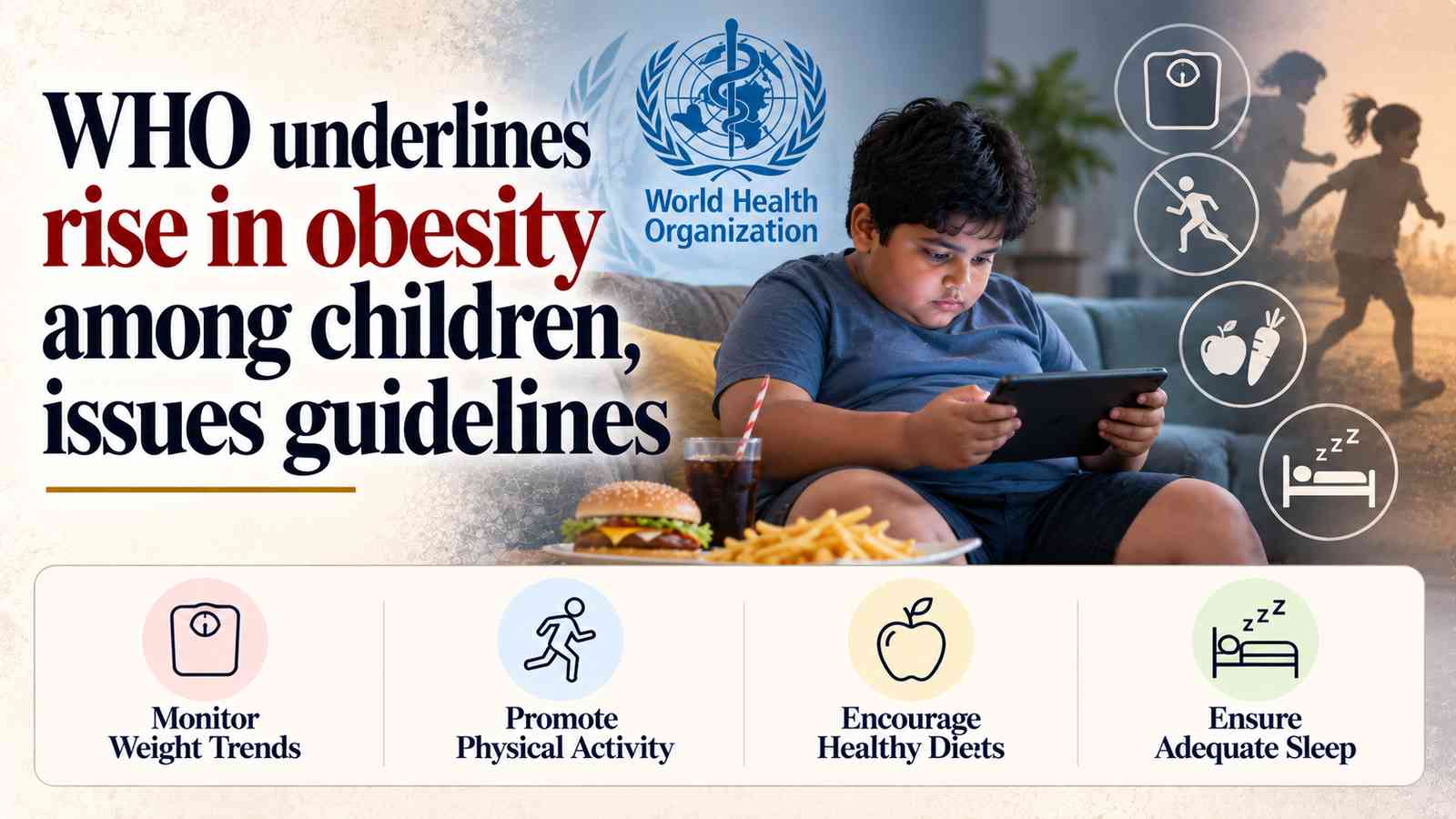
    The Food Safety and Standards Authority of India (FSSAI), the statutory food regulator, has proposed that packaged foods high in fat, salt or sugar carry a bold red warning on the front of the pack rather than in fine print on the back. The proposal follows prodding by the Supreme Court. It arrives against a childhood disease load that the World Obesity Atlas 2026 puts at 41 million overweight or obese Indians aged 5 to 19. The tension is that a warning label works on disclosure. The demand it targets is set by price, and India’s tax design currently charges a sugared drink and its zero sugar counterpart the same rate.

    What is the proposed front-of-pack warning label?

    1. What it marks: A bold red warning is placed on the front of a pack that is high in fat, salt or sugar, so the classification is visible at the point of choosing.
    2. What it replaces: The same information currently sits in the back of pack nutrition declaration, which is read after purchase rather than before it.
    3. What it is for: A person picking up instant noodles, a breakfast cereal or a health drink is told at a glance that the product is not as wholesome as its advertising claims.

    How large is the childhood problem?

    1. The headline count: 41 million Indian children and adolescents aged 5 to 19 are now overweight or obese.
    2. The clinical trend: The number of children presenting with morbid obesity and diabetes has climbed sharply within a few years.
    3. The driver is composition, not appetite: The rise is not only a matter of children eating more, it is a matter of what they are being sold.

    How is the market shaping what children eat?

    1. Products are sold as filling a dietary gap: Breakfast cereals, sweetened yoghurts and health drinks are marketed to parents as making up shortfalls in a child’s diet, emphasising energy and vitamins while saying little about sugar content.
    2. The same product is formulated differently by market: In 2024 a leading multinational was found adding sugar to infant food sold in India and other lower income countries, with sugar left out of the same product in Europe.
    3. Correction came from publicity, not regulation: A health drink popular in Indian homes turned out to be flavoured sugar syrup, and it took a social media storm rather than a regulator to force a 15 per cent cut in its added sugar.
    4. Unhealthy calories are priced to pocket money: An energy drink popular among teenagers is priced at Rs 20 and packs close to 17 grams of sugar, caffeine and artificial colour into a single bottle, and its label saying it is not meant for children stops nobody from buying it.
    5. Proximity to schools compounds it: Studies show that around schools and colleges the cheapest and most easily available snacks are also the least healthy.

    Where does the label stop short?

    1. School canteen norms are advisory: The FSSAI and the Central Board of Secondary Education (CBSE) have long recommended what schools should not sell, optional rules get treated as optional, and canteens stock whatever sells cheapest.
    2. The rule ends at organised retail: Most of India’s sugar, salt and trans fat is eaten unbranded from street stalls, dhabas and sweet shops, none of which is required to declare anything.
    3. The unregulated half of the plate is untouched: A red label on a biscuit packet does nothing about the jalebi sold loose beside it.
    4. Enforcement, not knowledge, is the missing input: A red warning label works only if it is actually enforced, and none of the underlying evidence about these products was ever secret.

    What does the United Kingdom’s levy show that India’s Goods and Services Tax slab does not?

    1. The United Kingdom taxed in tiers by sugar content: The soft drinks industry levy set thresholds by sugar concentration, so a manufacturer could lower its tax bill by changing the product.
    2. The response was reformulation, not repricing: Manufacturers reformulated their drinks to slip below the tax threshold rather than raise prices, and sugar consumption fell among both children and adults.
    3. India taxes the category, not the sugar: Since September 2025 aerated and sweetened beverages, sugar free versions included, have been folded into one 40 per cent Goods and Services Tax (GST) slab.
    4. The design removes the incentive it should create: A normal cola and its zero sugar counterpart pay the same tax, so a manufacturer has no reason to cut sugar.

    Does the objection that a sugar tax hits the poor hardest hold?

    1. The objection is not wrong: A consumption tax on a cheap product takes a larger share of a poorer household’s spending, and that is the standard case against it.
    2. It is only half the argument: Unregulated cheap sugar already extracts a heavy price from the poor, who bear the brunt of the diabetes, hypertension and childhood obesity that sugar heavy diets drive, with the least means to treat it.
    3. Inaction is itself a charge: Doing nothing is not neutral, it is a slower and costlier tax paid in ill health rather than in rupees at the till.
    4. The design answers the objection: A tax calibrated to sugar content nudges reformulation, and part of the revenue set aside to make healthy food cheaper offsets the burden on the households least able to absorb it.

    Challenges to the front-of-pack warning label

    1. A binary threshold invites formulation just below the line: A single high in fat, salt or sugar cut off rewards a product that sits marginally under it as much as one that is genuinely reformulated. Eg. The United Kingdom’s tiered levy was designed precisely to reward movement between bands rather than a single pass or fail.
      The Fix: Publish the underlying nutrient values on the front of the pack alongside the warning, so the distance from the threshold is visible rather than collapsed into one mark.
    2. Loose and cooked food carries no declaration duty: The disclosure obligation attaches to a package, so the food sold without one falls outside the rule entirely. Eg. Sweet shops, dhabas and street stalls supply a large share of India’s added sugar and declare nothing.
      The Fix: Extend a simplified menu board declaration to registered food service outlets above a turnover threshold, starting with chains that already standardise recipes.
    3. Advisory school norms carry no consequence: A recommendation to schools on what not to sell creates no liability for a canteen that ignores it. Eg. FSSAI and CBSE guidance on school canteens has stood for years without changing what canteens stock.
      The Fix: Make the school canteen standards a condition of affiliation, so non compliance is enforced by the board that already inspects the school.
    4. Marketing to children is not restricted alongside the label: A warning on the pack competes with advertising that positions the same product as a nutritional supplement for a growing child. Eg. Health drinks and sweetened cereals are advertised to parents on energy and vitamin content.
      The Fix: Set enforceable limits on the promotion of products carrying the warning mark to audiences under eighteen, rather than relying on industry self regulation.

    Conclusion

    A warning label changes what a buyer knows and leaves untouched what a buyer pays. The regulator is correcting a disclosure failure, and the tax code is holding the composition incentive flat; the two are pulling against each other inside the same policy. What has to change is the tax base: calibrating the levy to sugar content is what turns a consumer nudge into a producer obligation, and the label alone will not do it. The markers to watch are whether the labelling regulation is notified as mandatory rather than advisory, and whether the single beverage slab is broken into sugar linked tiers.

    Non-Communicable Diseases in India

    1. What they are: Non communicable diseases are long duration conditions such as cardiovascular disease, diabetes, cancer and chronic respiratory illness, driven by diet, tobacco, alcohol and physical inactivity rather than by infection.
    2. Their share of mortality: They account for about 66 per cent of total deaths in India, with cardiovascular diseases at 28 per cent and chronic respiratory diseases at 12 per cent.
    3. The scale and the age profile: An estimated 6.1 million Indians die of a non communicable disease each year, and roughly one in four Indians faces the risk of dying from one before the age of 70.
    4. The economic cost: India is projected to lose 4.58 trillion dollars by 2030 to non communicable diseases and mental health disorders.

    Laws and Rules Governing Non-Communicable Disease Prevention

    1. Food Safety and Standards Act, 2006: It replaced the Prevention of Food Adulteration Act, 1954 and created a single regulator for food standards, labelling and safety across the food chain.
    2. Food Safety and Standards (Labelling and Display) Regulations, 2020: They set the mandatory nutrition declaration and per serve information that the front of pack proposal is built on top of.
    3. Cigarettes and Other Tobacco Products Act, 2003: It bans advertising, restricts sale to minors and mandates pictorial health warnings, and it is the domestic precedent for a graphic warning driving consumption behaviour.

    Government Initiatives for Non-Communicable Disease Prevention

    1. Eat Right India: An FSSAI campaign to promote safe, healthy and sustainable food, working through certification of workplaces, campuses and eateries.
    2. National Programme for Prevention and Control of Non-Communicable Diseases: It funds population level screening for hypertension, diabetes and common cancers through district and community health centres.
    3. Fit India Movement and POSHAN Abhiyaan: The first targets physical inactivity through schools and workplaces, the second targets undernutrition and anaemia in children and mothers.

    Challenges in Non-Communicable Disease Prevention

    1. Surveillance is event based rather than predictive: Data for communicable disease, non communicable disease and animal health is collected in separate vertical silos, so a risk trend is visible only after it becomes a caseload. Eg. Childhood obesity data reaches policy through a periodic survey rather than a continuous registry.
      The Fix: Merge the vertical disease reporting streams into a single district level dashboard with a fixed reporting cycle.
    2. Primary care cannot sustain lifelong treatment: A non communicable disease requires uninterrupted medication, and the network closest to the patient is the least reliably supplied. Eg. Only 60 per cent of Ayushman Arogya Mandirs reported a dependable supply of essential non communicable disease drugs.
      The Fix: Tie the facility’s drug budget to its registered patient load rather than to a flat allocation, so supply scales with the panel it serves.
    3. Three disease burdens compete for the same budget: India simultaneously carries infectious disease, rising non communicable disease and emerging zoonotic threats, and health spending is allocated against outbreaks first. Eg. Prevention programmes are routinely reprioritised when an epidemic draws staff and funds.
      The Fix: Ring fence a fixed share of the health budget for prevention that cannot be reallocated to outbreak response within the year.
    4. Fiscal tools are used on tobacco but not on diet: Higher taxation is accepted as a public health instrument for tobacco and is treated as a revenue question for sugar and salt. Eg. India’s beverage taxation was reorganised in September 2025 without any sugar content differential.
      The Fix: Earmark a defined share of any diet related levy for subsidising fruit, vegetables and pulses, so the instrument is visibly a health measure rather than a revenue measure.

    Matching Previous Year Question

    “[2018] Consider the following statements: 1. The Food Safety and Standards Act, 2006 replaced the Prevention of Food Adulteration Act, 1954. 2. The Food Safety and Standard Authority of India (FSSAI) is under the charge of Director General of Health Services in the Union Ministry of Health and Family Welfare. Which of the statements given above is/are correct? (a) 1 only (b) 2 only (c) Both 1 and 2 (d) Neither 1 nor 2 ANSWER: (a)”

  • Govt. not in favour of treating English as ‘native’ language

    Why in the News

    The Union government has told the Supreme Court that it “has an issue” with treating English as an indigenous language. It has assured the court that it will move quickly on consultations to grant the current Class 6 batch a one-time reprieve from the mandatory third-language paper in the Central Board of Secondary Education (CBSE) Class 10 examination. The court had earlier asked the CBSE to consider that relief. The petitioners want English moved out of the indigenous category into the “non-native” or foreign language category, and the Centre has reserved its submissions on that question. The court has also issued notice on petitions filed by minority schools on the three-language scheme. The dispute is about classification rather than count, because what counts as an indigenous language decides how many Indian languages a student must carry.

    What is the three-language formula under the National Education Policy, 2020?

    1. What it requires: The National Education Policy, 2020 continues the three-language formula in school education. At least two of the three languages taught must be native to India.
    2. Why classification decides the burden: A language treated as indigenous can fill one of the two mandatory Indian-language slots. English placed outside that category cannot, so a student carries an additional Indian language alongside it.
    3. Choice rests with States and students: The policy states that no language will be imposed on any State. The three languages are chosen by States, regions and students themselves.

    What has the Centre now told the Supreme Court?

    1. The petitioners’ ask: Counsel for the petitioners sought an order shifting English into the “non-native” or foreign language category.
    2. The Centre’s objection: The Centre said it “has an issue” with that, and asked to make its submissions before any order is passed.
    3. The assurance on the reprieve: The Centre told a Bench headed by the Chief Justice of India that a meeting with the officials concerned would be arranged within a day or two to decide on the one-time reprieve for Class 6 students.

    Why does the current Class 6 batch sit at the centre of the case?

    1. One batch faces full implementation: Under the CBSE guidelines, students in Classes 7 to 9 were exempted from the third-language requirement. The current Class 6 batch was slated for full implementation of the scheme.
    2. The examination date: Full implementation carries a mandatory Class 10 Board examination in the third language by 2031.
    3. The court’s earlier direction: At an earlier hearing the court asked the CBSE to consider relieving Class 6 students of writing the third-language examination in Class 10.
    4. The Bench on sequencing: A judge on the Bench said time is needed for students and for infrastructure to reach parity across education boards. Starting with the mother tongue, then an indigenous language, then another indigenous or foreign language works only where it begins in a lower class.

    What else is now before the court?

    1. The minority schools’ challenge: The court issued notice to the government on petitions filed by minority schools on the implementation of the three-language scheme.
    2. The English question is undecided: No order was passed on shifting English out of the indigenous category, because the Centre asked to be heard on it first.
    3. Timeline pressure from the petitioners: Counsel for the petitioners said parents were anxious and urged the court against further adjournments. The hearing stands adjourned to 17 September.

    Challenges to the three-language formula

    1. Political resistance where the formula reads as imposition: A centrally set language requirement collides with State language policy. Eg. Tamil Nadu has followed a two-language policy of Tamil and English since 1968, after the anti-Hindi agitations of 1965, and has refused the three-language formula since.
      The Fix: Make the third language a State-notified choice, and tie central funding to teacher recruitment for whichever language a State selects rather than to adoption of the formula itself.
    2. Teacher availability limits real choice: A school cannot offer a language for which no trained teacher is posted. Eg. UDISE+ returns record over one lakh single-teacher schools in the country.
      The Fix: Sanction language-specific posts and permit a shared language teacher across a cluster of schools before the subject becomes examinable.
    3. Foundational reading is the prior constraint: A third language added at the middle stage assumes reading fluency that many students do not have. Eg. The ASER 2024 survey found under half of Class 5 students in rural India able to read a Class 2 level text.
      The Fix: Sequence the third language behind a measured foundational literacy benchmark in the mother tongue, rather than behind a fixed grade.
    4. Minority institutions’ autonomy is engaged: Article 30(1) gives minorities the right to establish and administer educational institutions of their choice, and a prescribed set of languages touches that right. Eg. In T.M.A. Pai Foundation v. State of Karnataka (2002), an eleven-judge Constitution Bench held that regulation of such institutions is permissible for standards and not for control of administration.
      The Fix: Frame the language requirement as an attainment standard rather than as a prescribed language set, so minority institutions retain the choice of which languages meet it.

    Conclusion

    The case turns on a classification question rather than on the number of languages taught. Whether English is treated as indigenous decides whether a student carries two Indian languages or three. The Centre has reserved its position on that and has offered relief only to one batch of students. What remains unresolved is what happens to every batch that follows it.

    Matching Previous Year Question

    “[2020, GS2, 15.0 marks] National Education Policy 2020 is in conformity with the Sustainable Development Goal-4 (2030). It intends to restructure and reorient education system in India. Critically examine the statement.”

  • Reclaiming universities through trust, student voice

    Why in the News

    The Supreme Court has stayed the Bar Council of India (BCI)’s order against the graduating batch of the National Academy of Legal Studies and Research (NALSAR), Hyderabad. The same intervention quashed all first information reports (FIRs) against the protesting students. It declared that the BCI has no disciplinary control over students. It also reduced the three year practice condition for writing the judicial services examination to one year. The order follows a protest by law students seeking a say in their own convocation, widely attributed to an oral remark by the Chief Justice of India that was quickly clarified. The contest is over whether campus unrest is a failure of student discipline or a failure of a governance model that leaves students out of the decisions binding them.

    What is academic freedom?

    1. The freedom to teach, research and question: Academic freedom is the entitlement of those engaged in scholarly teaching and research to decide what to study, what to teach and what to challenge, without direction from the government or the university administration.
    2. No express Indian guarantee: The Constitution of India does not mention academic freedom. Article 5(3) of the German Basic Law guarantees scientific freedom (Wissenschaftsfreiheit) as a right of everyone engaged in scholarly teaching and research.
    3. A recognised right elsewhere: The Constitutions of Japan, South Africa, Portugal and Spain contain a comparable freedom. Article 137 of the Basic Law of Hong Kong provides that educational institutions may retain autonomy and enjoy academic freedom.
    4. Its limit is conduct, not speech: The freedom carries no right to defame or to engage in anti-national activity. Where an academic activity involves conduct rather than speech, the state is entitled to regulate that conduct.

    Why is curriculum the sharp edge of the dispute?

    1. Curriculum is set without the people it binds: University curriculum should be decided by the stakeholders, including students. Eg. Delhi University dropped a paper on the Delhi Sultanate along with some other papers.
    2. Students read such changes as political: Curriculum changes of this kind are seen as having ideological reasons rather than academic ones, which turns an academic decision into a governance grievance.
    3. The direction of restraint runs both ways: Government is not to dictate to universities what to teach, how to teach and what not to teach. Universities owe the same freedom to their departments and faculties.
    4. The campus exists for the contested question: Universities are meant to be a special place for reflection, inquiry and discussion, which is the function a closed curriculum process removes.

    What do experiences abroad show about academic freedom under pressure?

    1. The United States has used funding as leverage: Federal funding has been weaponised to reshape campus culture. Diversity programmes have been dismantled and research funding in areas such as climate change has been reduced.
    2. Permitting protest has itself invited pressure: Universities have faced pressure for allowing student protests, including those over Gaza.
    3. Neither ideological side is exempt: Right wing and left wing regimes have both, at times, sought to control universities.
    4. The pattern is old: Arnold Toynbee resigned from King’s College London in 1924 over his writings on the Greek army’s atrocities. Professors were persecuted during the McCarthy era.
    5. Funders now shape the research agenda: Declining public funding has left research agendas increasingly influenced by funders, corporations and pharmaceutical companies.

    What is the control model of university governance?

    1. Authority sits in one office: Most universities remain Vice-Chancellor centric. Students, who are the reason universities exist, have little say in their governance.
    2. Grievances have no route upward: Vice-Chancellors rarely hold open houses and are often inaccessible to ordinary students. Unaddressed grievances leave students feeling ignored, and some then take extreme steps.
    3. Control substitutes for dialogue: Administrations adopted the control model as governments increasingly sought to control universities. A community of highly educated faculty and young people requires dialogue, trust and openness rather than surveillance.
    4. Knowledge creation needs the opposite conditions: Universities exist to innovate and create knowledge, which requires the freedom to question everything and challenge existing ideas.

    How does under-investment compound the control problem?

    1. The policy target has not been met: The National Education Policy 2020 promises public investment of 6 per cent of Gross Domestic Product (GDP) in education. Public investment has steadily declined and hovers around 4 to 4.1 per cent.
    2. Higher education gets the smallest share: Within that spending, higher education receives the smallest allocation, so the system is over-regulated and grossly underfunded at the same time.
    3. Autonomy is not alien to the system: The ancient Gurukul system was entirely autonomous, and the present arrangement regulates far more and funds far less.
    4. The shortfall is visible on campus: Public university infrastructure has deteriorated and hostels are in acute shortage, which produced the recent deaths in New Delhi. Faculty positions remain vacant and guest faculty are poorly paid.
    5. Teaching and examinations both fail the student: Poor teaching frustrates students. Repeated examination paper leaks add to their stress.

    What do Vice-Chancellor appointments reveal?

    1. Natural justice is overlooked: In one case a Vice-Chancellor changed the composition of the selection committee, chaired it and voted in the selection of his wife. She was appointed as Vice-Chancellor.
    2. The courts did not correct it: The judiciary declined to follow its own precedents of quashing such appointments.
    3. An adverse record is not a bar: Individuals with questionable records and adverse Central Vigilance Commission (CVC) reports have been appointed, and some State universities face allegations of bribery.
    4. Recruitment rewards leaning over merit: Faculty recruitment over-emphasises ideological leanings rather than merit. Ideological governments may prefer candidates with particular leanings, and merit should not be completely undermined on that account.
    5. Examination integrity follows appointment integrity: No examination system can be foolproof where paper setters, moderators or testing officials are appointed for reasons other than absolute merit and integrity.

    Who actually absorbs the blame for campus unrest?

    1. The anger travels past the administration: Student frustration erupts against the government rather than against university administrations. The government received the criticism for the actions of the Vice-Chancellor in the appointment case.
    2. Much of it is avoidable on campus: The backlash could largely be avoided where administrations engage students in meaningful dialogue and provide timely relief.
    3. The government is not a bystander either: Administrations adopted the control model because governments sought control of universities, so the incentive that produced the model is a governmental one.

    What does the liberty model change?

    1. Trust is the operative mechanism: The liberty model of governance was implemented across three universities over 16 years. Students who are trusted act more responsibly in turn.
    2. Access without gatekeeping: Students met the Vice-Chancellor without appointments and raised personal concerns and difficulties. That access made frank conversations possible when difficult or unpopular decisions had to be taken.
    3. Unpopular ideas are protected: The model treats the university as a space where even the most unpopular ideas can be freely debated, which is the opposite of the top-down model.
    4. Students sit inside the decisions: Students are given a meaningful role in academic, administrative and financial decisions, including faculty appointments, procurement, curriculum design and the drafting of university regulations.
    5. A statutory precedent already exists: Students at Aligarh Muslim University have a statutory role in selecting the Vice-Chancellor.

    Challenges to the liberty model of university governance

    1. Participation rights can be captured by party politics: Campus unions aligned to national parties can convert a participation right into a channel for external political control. Eg. Delhi University Students’ Union elections are contested by the student wings of national parties.
      The Fix: Tie student participation to reserved seats on academic and finance bodies with fixed terms, so it runs through statutory channels rather than street mobilisation.
    2. A Vice-Chancellor cannot devolve powers that are not his: Faculty appointments and university finances are governed by University Grants Commission (UGC) regulations and State legislation, so student participation in them rests on the incumbent’s discretion. Eg. The Vice-Chancellor is himself selected by the Chancellor or Visitor from a search committee panel.
      The Fix: Amend university statutes to create student membership on selection and finance committees, so participation has a legal basis rather than a personal one.
    3. The model lapses with the person who ran it: A governance style adopted by one Vice-Chancellor ends when that office changes hands, since nothing in the statute compels a successor to continue it. Eg. Open house access is an administrative practice and not a rule.
      The Fix: Write grievance redressal timelines and open house frequency into university ordinances so the practice survives a change of office.
    4. Trust cannot supply what money supplies: Dialogue does not create hostel seats, permanent faculty or laboratory funding, which are the material grounds of much campus unrest. Eg. Sanctioned faculty posts in central and State universities stay vacant regardless of the governance style adopted.
      The Fix: Link central grants to filled sanctioned posts and audited hostel capacity, so funding follows the deficits that generate protest.

    Conclusion

    The Supreme Court’s order settles who may discipline a law student. It does not settle who governs a campus. Curriculum decisions, convocation arrangements and appointments all turn on whether students hold any formal seat in university decision making, and at present they hold almost none. The measure worth watching is whether university statutes are amended to give students standing on academic and selection bodies, since a governance practice resting on the person in office leaves with that person.

    Higher Education in India

    1. Second largest system in the world: Total enrolment is estimated at 4.65 crore in 2026, up from 3.42 crore in 2014-15.
    2. Institutional spread: India hosts over 1,168 universities and 45,473 colleges, against 760 universities in 2014-15.
    3. Participation is short of the target: The Gross Enrolment Ratio in higher education, meaning enrolment at that stage as a share of the population in the corresponding age group, stands at 28.4 per cent against the National Education Policy 2020 target of 50 per cent by 2035.
    4. Women now enrol marginally more than men: The Gender Parity Index stands at 1.01, indicating slightly higher female than male participation for the first time.

    Constitutional Framework Governing Higher Education

    1. Entry 25, List III: Education, including technical and medical education and universities, is a Concurrent List subject after the Constitution (Forty-second Amendment) Act, 1976.
    2. Entry 66, List I: Coordination and determination of standards in institutions of higher education and research is reserved to the Union.
    3. Entry 63, List I: Banaras Hindu University, Aligarh Muslim University and Delhi University are institutions of national importance under Union competence, along with any other so declared by Parliament.
    4. Article 30(1): Religious and linguistic minorities have the right to establish and administer educational institutions of their choice.
    5. Article 19(1)(a): Free speech on campus is protected, subject only to the restrictions Article 19(2) itself permits.

    Laws and Rules Governing Higher Education

    1. University Grants Commission Act, 1956: Establishes the UGC to coordinate and determine standards in university education and to disburse grants to universities and colleges.
    2. All India Council for Technical Education Act, 1987: Creates the statutory regulator for technical education, covering planning, norms and approval of technical institutions.
    3. National Council for Teacher Education Act, 1993: Creates the regulator for teacher education programmes and the institutions that run them.
    4. Anusandhan National Research Foundation Act, 2023: Establishes the National Research Foundation to seed and fund research across higher educational institutions, including State universities.

    Government Initiatives for Higher Education

    1. National Education Policy 2020: Replaces the National Policy on Education, 1986, and is built on access, equity, quality, affordability and accountability.
    2. Academic Bank of Credits: A digital repository holding course credits, which enables multiple entry and exit within a degree programme.
    3. Automated Permanent Academic Account Registry (APAAR): A single student identifier linking academic records, skills and transfers in one portal.
    4. Prime Minister’s Research Fellowship: Doctoral fellowships for research scholars, expanded to award 10,000 new fellowships.

    Challenges in Higher Education Governance

    1. Fragmented regulatory structure: Multiple bodies issue overlapping and sometimes conflicting guidelines to the same institution, which delays academic decisions. Eg. A technical department inside a university answers to the All India Council for Technical Education and the UGC at the same time.
      The Fix: Consolidate approvals under a single higher education regulator with separate verticals for funding, standard setting and accreditation.
    2. Quality is unmeasured across much of the system: Over 30 per cent of Indian higher educational institutions remain unaccredited as of early 2026. Eg. Accreditation by the National Assessment and Accreditation Council is not a precondition for most colleges to award degrees.
      The Fix: Make one completed accreditation cycle a condition for degree granting status and for central grants.
    3. Research spending is stagnant: Research and development expenditure stands at 0.64 per cent of GDP, against about 2.4 per cent in China and 3.4 per cent in the United States. Eg. India contributes under 5 per cent of global research publications.
      The Fix: Route National Research Foundation funding towards State universities, which carry most enrolment and almost none of the research grant.
    4. Employability does not follow the degree: Curricula are not aligned to hiring requirements, so enrolment growth does not convert into work. Eg. Only about 4 per cent of higher education carries formal skill training.
      The Fix: Embed apprenticeship credits inside degree programmes under the National Credit Framework.

    Back2Basics: Bar Council of India

    1. A statutory body under the Advocates Act, 1961: It regulates the legal profession and legal education in India.
    2. Standard setting: It lays down standards of professional conduct and etiquette for advocates, and prescribes the conditions on which a law degree is recognised for enrolment.
    3. Composition: Its members are elected by the State Bar Councils, with the Attorney General of India and the Solicitor General of India as ex officio members.

    Matching Previous Year Question

    “[2014, GS2, 12.5 marks] Should the premier institutes like IITs/IIMs be allowed to retain premier status, allowed more academic independence in designing courses and also decide mode/criteria of selection of students. Discuss in light of the growing challenges.”

  • Antibiotic-resistant infections: Risks, costs

    Why in the News

    Infections caused by antibiotic resistant bacteria are more likely to kill hospitalised patients in India and cost more to treat than infections caused by drug susceptible strains. A surveillance study by the Indian Council of Medical Research (ICMR) records higher mortality, longer hospital stays and higher antibiotic costs where the bacteria resist carbapenems, the broad spectrum antibiotics doctors hold in reserve for serious infections. The study links laboratory resistance results to what then happened to the patient, which Indian resistance surveillance had not previously done at this scale. Most of the severe infections it recorded began inside the hospital rather than in the community. The tension it sets up is between the search for the next antibiotic and the routine work of preventing infection in the first place.

    What is antimicrobial resistance?

    1. Bacteria survive the drugs meant to kill them: Resistant bacteria continue to grow and reproduce in the presence of antibiotics designed to stop them. Treatment narrows to whatever the organism still responds to.
    2. Resistance spreads sideways, not only down generations: Resistant bacteria pass resistance genes to their offspring. They also transfer those genes to unrelated bacteria through the exchange of DNA.
    3. Carbapenem resistance closes the reserve line: Carbapenems are held back for serious infections where other antibiotics have already failed. Resistance to them leaves few effective options behind.

    What did the ICMR surveillance study cover?

    1. Scale and period: The ICMR antimicrobial resistance (AMR) surveillance network studied 159,336 hospitalised patients across 20 tertiary care hospitals between April 2022 and April 2025.
    2. Two of the four bacteria tracked: Escherichia coli causes urinary tract infections. Klebsiella pneumoniae triggers both urinary and lung infections.
    3. The other two: Acinetobacter baumannii causes ventilator associated pneumonia, bloodstream infections, wound and surgical site infections, urinary tract infections and sometimes meningitis. Pseudomonas aeruginosa causes bloodstream, eye and ear infections.
    4. Resistance was the majority finding: Almost 61.1 percent of the patients studied carried infections resistant to carbapenem antibiotics.

    How much does carbapenem resistance raise the risk of death?

    1. Escherichia coli: 24.4 percent of patients with carbapenem resistant infections died, against 17.3 percent of those with susceptible infections. That is a 41 percent higher relative risk of death.
    2. Klebsiella pneumoniae: Mortality was 31.2 percent in the resistant group against 23.5 percent in the susceptible group, a 33 percent higher relative risk.
    3. Acinetobacter baumannii: Mortality was 37.9 percent against 32.8 percent, a 16 percent higher relative risk.
    4. Pseudomonas aeruginosa: Mortality was 28.9 percent against 20.2 percent, a 43 percent higher relative risk.
    5. Bloodstream infections carry the heaviest toll: Among patients with carbapenem resistant bloodstream infections, mortality ran from 39.3 percent for E. coli to 50.8 percent for A. baumannii. It was 44.8 percent for K. pneumoniae and 46.4 percent for P. aeruginosa.

    What does resistance add to the cost of treatment?

    1. Escherichia coli: Antibiotic cost averaged about Rs 39,846 per patient for resistant infections against Rs 20,034 for susceptible ones.
    2. Klebsiella pneumoniae: The corresponding figures were about Rs 55,688 and Rs 47,918.
    3. Acinetobacter baumannii: Treatment cost about Rs 62,150 for resistant infections against Rs 41,372 for susceptible ones.
    4. Pseudomonas aeruginosa: Treatment cost about Rs 66,599 for resistant infections against Rs 48,392 for susceptible ones.
    5. The costing is deliberately conservative: Only antibiotics priced under the Jan Aushadhi scheme were counted. Intensive care, bed and room charges, diagnostic investigations, procedures, supportive care and consultation were all left out, so the real burden on patients and the health system is larger.

    Why does the study point to infection control rather than antibiotic overuse?

    1. The severe infections began in the hospital: More than 85 percent of bloodstream infections across the four bacteria were classified as healthcare associated.
    2. The named failure points are procedural: Healthcare associated transmission, invasive devices, recent surgery and gaps in infection prevention and timely diagnosis are what the study identifies. Reducing the problem to antibiotic overuse alone misplaces it.
    3. Antibiotics cannot substitute for prevention: The measures named are hand hygiene, device associated infection prevention, appropriate insertion and early removal of invasive devices, environmental cleaning, surgical infection prevention and surveillance of healthcare associated infections. Prevention stops the reserve antibiotics from being needed at all.
    4. Diagnostics decide whether prescribing is targeted: Timely diagnostics let a doctor identify the resistant organism and select a narrow, appropriate antibiotic. Without them, broad spectrum drugs are used by default.
    5. Surveillance has to reach the patient, not stop at the isolate: Integrated surveillance connecting laboratory results with mortality and treatment outcomes is what produced these findings. Prescribing data alone would not have shown them.

    What the study could not establish

    1. A tertiary hospital population is not a national average: These hospitals manage referred and often critically ill patients, so the level of resistance found there cannot be read as the level in the country.
    2. Key clinical variables were absent: The data carried no patient level information on how sick each patient was, how quickly appropriate treatment began, the source of the infection or the specific resistance mechanism involved.
    3. The findings describe practice, not drug superiority: The results reflect real world treatment patterns in India. They do not prove that one drug is universally better than another.

    Challenges to containing antimicrobial resistance in India

    1. Antibiotics move without a prescription: Schedule H1 of the Drugs and Cosmetics Rules, 1945 requires a prescription and a separate sales register for named antibiotics, and compliance at the retail counter is weak. Eg. The Red Line campaign marks such medicines with a red stripe on the pack precisely because the schedule alone was not restricting sales.
      The Fix: Link Schedule H1 sales to an electronic prescription record, so the register is generated by the transaction instead of written up after it.
    2. Non human antibiotic use applies constant selection pressure: Antibiotics used for growth promotion and disease prevention in poultry and aquaculture select for resistant bacteria outside any clinical setting. Eg. India banned colistin, a last resort human antibiotic, in food producing animals in 2019 after its use in poultry farming was documented.
      The Fix: Replace single drug bans with a positive list of permitted veterinary antibiotics, enforced through residue testing at the point of procurement.
    3. Manufacturing effluent breeds resistance in the environment: Antibiotic residues discharged from pharmaceutical plants expose environmental bacteria to sub lethal drug concentrations, which is the condition in which resistance develops. Eg. Water bodies receiving effluent from the pharmaceutical cluster at Patancheru near Hyderabad have recorded high antibiotic concentrations.
      The Fix: Notify enforceable antibiotic residue limits for pharmaceutical effluent and make compliance a condition of the plant’s consent to operate.
    4. Infection prevention has no staffing floor: Most Indian hospitals run no dedicated infection control team to conduct hand hygiene and device audits, so prevention has no one accountable for it. Eg. National Accreditation Board for Hospitals and Healthcare Providers (NABH) accreditation requires an infection control programme, and it covers a small share of India’s hospitals.
      The Fix: Make a minimum infection prevention and control staffing norm a condition of hospital empanelment under Ayushman Bharat Pradhan Mantri Jan Arogya Yojana.
    5. Diagnostic delay forces empirical prescribing: Culture and sensitivity testing capacity sits mainly in large hospitals, and results take days, so smaller facilities start broad spectrum therapy blind. Eg. Rapid molecular testing is routine for drug resistant tuberculosis under the National Tuberculosis Elimination Programme, with no equivalent programme for bacterial bloodstream infections.
      The Fix: Fund rapid molecular resistance testing at district hospital level and tie its use to the hospital’s antibiotic prescribing audit.

    Conclusion

    India’s resistance response has been organised around what is prescribed, because prescribing is what the system can already count. This study relocates the problem to where the infection is acquired, which is a different task with a different owner inside the hospital. The unresolved part is that prevention carries no staffing norm, no dedicated budget line and no measurable output of its own, while prescribing has a surveillance network behind it. The marker to watch is whether prevention starts being counted the way prescribing already is.

    Back2Basics: Jan Aushadhi scheme

    1. What it is: The Pradhan Mantri Bhartiya Janaushadhi Pariyojana supplies quality generic medicines at prices well below their branded equivalents.
    2. Who runs it: It is implemented by the Department of Pharmaceuticals under the Ministry of Chemicals and Fertilizers, through the Pharmaceuticals and Medical Devices Bureau of India.
    3. How it reaches patients: Medicines are sold through dedicated Janaushadhi Kendras rather than through ordinary retail pharmacies.

    [2019] Which of the following are the reasons for the occurrence of multi-drug resistance in microbial pathogens in India?

    1. Genetic predisposition of some people

    2. Taking incorrect doses of antibiotics to cure diseases

    3. Using antibiotics in livestock farming

    4. Multiple chronic diseases in some people

    Select the correct answer using the code given below.

    (a) 1 and 2

    (b) 2 and 3 only

    (c) 1, 3 and 4

    (d) 2, 3 and 4

  • What flu surge can teach us about next pandemic

    Why in the News

    Different parts of India have reported 2 to 10 times more influenza cases this year than last year. The official position is that the circulating strain has not changed, and public advisories ask people to remain vigilant without becoming alarmed. That instruction states no action a reader can take. The detection layer built after Covid-19 is working, and the layer that must convert a detection into a decision is not. A surge of this size is the period in which that gap can be closed, since a pandemic is the worst time to learn.

    Pillars of outbreak management

    1. Surveillance: The ability to detect an outbreak early and to initiate action on that detection. For influenza it also covers genomic surveillance to identify the strain or variant behind the rise, which is what allows its virulence and the population’s susceptibility to be gauged.
    2. Prevention: Issuing advisories to high-risk individuals to avoid crowded places, promoting mask use, and vaccinating high-risk individuals and health workers.
    3. Control: Ensuring that those already infected receive proper medical care.

    What does the current surge actually show?

    1. The size of the rise: Reported influenza cases across different parts of the country are 2 to 10 times last year’s level.
    2. Hospital positivity has risen: Among patients admitted with severe acute respiratory infection (an acute respiratory illness severe enough to require hospitalisation), the positivity rate in selected hospitals was 16 per cent this year against 12 per cent last year.
    3. An unchanged strain is not by itself the answer: A well-established virus does not warrant serious concern on virological grounds alone. The scale of transmission still decides how many avoidable deaths occur.

    Why does surveillance not convert into action?

    1. No alert threshold is defined: A rise in influenza positivity past a defined threshold should trigger an alert. No such thresholds exist.
    2. The data is not public: There is no publicly available dashboard on which positivity trends can be seen, so no one outside the system can tell when a threshold would have been crossed.
    3. Responsibility is split three ways: Laboratory surveillance sits with the Indian Council of Medical Research (ICMR), response coordination with the National Centre for Disease Control (NCDC), and implementation with State health systems.
    4. No one holds authority to act on the signal: No integrated command structure exists with clear authority to coordinate and implement a response during a disease upsurge. This was the specific lesson Covid-19 offered and it was not learnt.

    Where is the line between an appropriate response and one that causes panic?

    1. The stated fear is panic: Governments hesitate to issue advisories on the ground that a public warning will itself cause alarm.
    2. The line is genuinely thin: Governments across the world struggle to place it, and the WHO has itself been accused of overreacting.
    3. The asymmetry decides it: Where the primary concern is to save lives, overreaction is the better error of the two.
    4. The current position sits on the wrong side: The response is too cautious and too bureaucratic for the scale of the surge.
    5. This is a professional capability, not a temperament: Situations of this kind require trained risk communication and named experts speaking, rather than a general advisory.

    Why does influenza vaccine use stay low even among high-risk groups?

    1. Poorly perceived threat: Influenza is treated as an ordinary seasonal illness, so the risk it carries for the elderly and the immunocompromised is discounted.
    2. Non-affordability: The vaccine is largely an out-of-pocket purchase for those outside institutional programmes.
    3. Doubtful effectiveness: Protection varies by season and by strain match, which weakens the case a physician can make for it.
    4. The annual injection requirement: Immunity does not carry over, so the decision has to be taken and paid for again every year.

    What should the response to this surge prioritise?

    1. Preventing avoidable deaths: At the current scale the objective is not to stop transmission but to keep high-risk people out of severe illness.
    2. A specific advisory rather than a general one: The advisory should tell high-risk people to avoid crowded places and to wear masks, in those terms.
    3. Immunising high-risk groups during the surge: The case for routine immunisation is debatable and the case during a major seasonal surge is not. Skipping it leaves the system unpractised for the next pandemic.
    4. Low antiviral use needs examination: Antiviral use stays low even in peak influenza season, which calls for a relook at the influenza management guidelines.
    5. The private sector has to be inside the response: Private providers and professional bodies deliver most outpatient care and cannot be reached through public system instructions alone.

    Challenges to India’s outbreak surveillance and response system

    1. Influenza carries no statutory duty to notify: Reporting rests on administrative instruction rather than legal obligation, so private-sector cases stay outside the national count. Eg. Most States have no public health Act listing notifiable conditions, and the Kerala Public Health Act, 2023 is among the few that do.
      The Fix: Enact a public health law fixing the list of notifiable conditions and placing the reporting duty on private providers as well as public ones.
    2. Vaccine composition is set for the wrong season: Supply follows the Northern Hemisphere formulation while influenza in much of India peaks with the monsoon. Eg. The WHO issues separate Northern and Southern Hemisphere composition recommendations each year.
      The Fix: Procure the Southern Hemisphere formulation for monsoon-peak States and fix the public procurement calendar to that cycle.
    3. Surveillance is an additional charge, not a post: District surveillance duties are given to serving clinical or programme officers on top of their own work, so analysis is done last. Eg. Rural Community Health Centres run at about an 80 per cent shortfall of specialists, which is the pool such officers are drawn from.
      The Fix: Create a separate public health cadre with dedicated district epidemiologist posts filled on their own recruitment line.
    4. Antiviral supply is not pre-positioned: Oseltamivir was moved from Schedule X to Schedule H1 in 2017, and the prescription-record duty that follows keeps retail stocking low outside declared alerts. Eg. Shortages appear at the retail counter in the same weeks that hospital positivity rises.
      The Fix: Stock antivirals at district hospitals ahead of the seasonal peak rather than relying on retail availability during the surge.
    5. Sequencing capacity is concentrated in a few laboratories: Sequencing volumes are set by laboratory capacity rather than by case load, so variant detection lags the epidemic curve. Eg. Sequencing effort fell sharply between Covid-19 waves and had to be rebuilt each time activity rose.
      The Fix: Fix a minimum sequencing share of positive samples per State per week as a standing requirement rather than an outbreak-time instruction.

    Conclusion

    An outbreak response is judged by the interval between a signal and a decision. India has built the layer that produces the signal and has not built the layer that must act on it, which is a governance problem rather than a scientific one. The next seasonal peak will test the same gap. The markers to watch before it arrives are whether a numeric alert threshold has been fixed and whether positivity data is published where the public can see it.

    Outbreak Surveillance and Pandemic Preparedness in India

    1. About: Disease surveillance is the continuous collection and analysis of health data to detect unusual disease activity early enough to act on it. Preparedness is the standing capacity to respond once that detection is made.
    2. The zoonotic load: Over 60 per cent of emerging infectious diseases in India are zoonotic, so animal and human surveillance cannot be run separately. Eg. Nipah virus, avian influenza, rabies and brucellosis.
    3. The triple burden: India faces infectious disease, rising non-communicable disease and emerging zoonotic threats at the same time.
    4. The standing weakness: Surveillance remains event-based rather than predictive, with communicable disease, non-communicable disease and animal health data held in separate vertical silos.

    Government Initiatives for Outbreak Surveillance and Pandemic Preparedness

    1. Integrated Disease Surveillance Programme: Collects district-level disease data and has been upgraded to carry animal health indicators for integrated surveillance.
    2. National One Health Mission: A cross-ministerial effort involving 13 departments to coordinate pandemic preparedness across human, animal and environmental health.
    3. National Institute for One Health, Nagpur: The anchor institution for research, training and policy integration on zoonotic disease.
    4. National Joint Outbreak Response Team: A multi-disciplinary team of human, animal and wildlife experts constituted for rapid outbreak investigation.
    5. BSL-3 and BSL-4 laboratory network: A national grid of high-security biosafety laboratories, with a new BSL-4 facility in Gujarat foundation-laid in January 2026.
    6. One Health Governance Framework: Released in December 2025 as a roadmap for States and Union Territories to set up State One Health Cells.

    Matching Previous Year Question

    “[2024, GS2, 15 marks] In a crucial domain like the public healthcare system, the Indian State should play a vital role to contain the adverse impact of marketisation of the system. Suggest some measures through which the State can enhance the reach of public healthcare at the grassroots level.”

  • NAMASTE Cards distributed to waste pickers in Najafgarh zone

    NAMASTE Cards distributed to waste pickers in Najafgarh zone

    Why in News

    The Ministry of Social Justice and Empowerment (MoSJE) inaugurated distribution of NAMASTE Cards to waste pickers in the Municipal Corporation of Delhi (MCD) Najafgarh Zone on 4 September 2026.

    Core facts

    1. Scheme name: NAMASTE stands for National Action for Mechanised Sanitation Ecosystem. It is a central scheme for the safety and dignity of sanitation workers.
    2. Implementing bodies: The scheme is run jointly by the MoSJE and the Ministry of Housing and Urban Affairs (MoHUA).
    3. Event substance: Profiled waste pickers received NAMASTE identity cards. The cards formally recognise the worker and link the worker to scheme benefits.
    4. Officeholder: The distribution was inaugurated by the Union Minister of State for Social Justice and Empowerment. The individual identity is not material to the policy content.

    Static Context

    1. Objective: NAMASTE targets zero fatalities in sanitation work in India. It seeks to end direct human contact with faecal matter in sewer and septic tank cleaning.
    2. Coverage expansion: NAMASTE originally covered sewer and septic tank workers (SSWs). The scheme was later extended to enumerate and cover waste pickers. A national digital application for profiling waste pickers was launched on World Environment Day 2025.
    3. Benefits design: The scheme provides occupational profiling, Personal Protective Equipment (PPE) kits, Ayushman Bharat health cover, and a capital subsidy for sanitation related livelihoods.
    4. Predecessor: NAMASTE subsumed the earlier Self Employment Scheme for Rehabilitation of Manual Scavengers (SRMS).
    5. Governing law: Manual scavenging is prohibited under the Prohibition of Employment as Manual Scavengers and their Rehabilitation Act, 2013.

    Prelims angle

    1. Scheme full form and nodal ministries: NAMASTE is run by the MoSJE with the MoHUA. Expect a purpose or ministry match question.
    2. Beneficiary categories: Sewer and septic tank workers, and waste pickers. The waste picker inclusion is the newest hook.
    3. Benefit bundle: PPE, Ayushman Bharat health cover, capital subsidy, occupational profiling.
    4. Predecessor scheme: SRMS. Governing Act: Manual Scavengers Act, 2013.

    Mains angle

    GS Paper 2, welfare schemes for vulnerable sections. A question can frame the shift from a rehabilitation model (SRMS) to a mechanisation and formalisation model (NAMASTE), and ask whether profiling and card based inclusion secures the rights of informal sanitation workers.

    “[2016] Rashtriya Garima Abhiyaan’ is a national campaign to

    (a) rehabilitate the homeless and destitute persons and provide them with suitable sources of livelihood

    (b) release the sex workers from their practice and provide them with alternative sources of livelihood

    (c) eradicate the practice of manual scavenging and rehabilitate the manual scavengers

    (d) release the bonded labourers from their bondage and rehabilitate them.

  • Missing: boundary walls, bathrooms, blackboards

    Why in the News

    Government schools across Bihar, Rajasthan, Uttar Pradesh and Madhya Pradesh are running without boundary walls, functional wash rooms, sufficient classrooms or electricity. Children in several of them sit on verandas, under trees, or in a single room shared with storage almirahs and meal utensils. A citizen audit campaign called ‘School thik karo’, run by the Cockroach Janta Party (CJP) since 15 August, asks residents to download a checklist, audit their local school and post the findings, covering drinking water, boundary walls, wash rooms and midday meals. These schools have sanctioned buildings, sanctioned teaching posts and an annual maintenance head in the budget. What is absent is the capacity to convert those into a room a child can sit in. State attention has meanwhile moved to a small tier of flagship institutions.

    What did the four State ground reports find?

    1. Bihar, schools operating without a facility of any kind: Three schools in Muzaffarpur and Vaishali districts run without a boundary wall, a wash room or storage for midday meal supplies.
    2. A primary school of 119 students, established in 1982, has plaster falling from the corridor its two classrooms open onto. Its six teachers use neighbours’ bathrooms and the children go in the open.
    3. A middle school of 283 students has two rooms, so Class 8 sits on the veranda and Classes 1 and 2 sit under a tree behind the kitchen.
    4. A primary school in Vaishali has no building of its own. It runs 91 students across Classes 1 to 5 in a single room of a community centre, alongside department almirahs and meal utensils.
    5. Rajasthan, the approach to the school is itself the barrier: In Unchki village of Deeg district there is no public road to the school, so students walk through a graveyard and a muddy path to reach it.
    6. Corridors serve as classrooms in three schools of the district, and one teacher takes Classes 4 and 5 together for want of rooms or electricity.
    7. None of the three has functional wash rooms, so children walk home in the middle of the school day and return.
    8. The district falls within the National Capital Region and lies 165 km from Delhi.
    9. Uttar Pradesh, the cost of a dirty wash room: A cab driver in Lucknow is moving his 11 year old daughter out of a government primary school after a prolonged urinary tract infection that the family attributes to the school’s wash room.
    10. The transfer costs an additional Rs 4,000 a month, which the household is meeting by cutting other spending.
    11. Drinking water at the school arrives intermittently and the wash room’s water supply is often dysfunctional, so students fetch water from nearby houses.
    12. Madhya Pradesh, buildings condemned and services withdrawn: A middle school in Hirapur village of Sehore district runs eight classes in three rooms, after the primary block on the same premises was abandoned six months ago.
    13. Its 22 students sit on mats without benches, in rooms with dim lighting, broken almirahs, fans that do not work and rainwater seeping through the roof.
    14. One of the two student wash rooms is functional, so girls and boys use the same toilet.
    15. The self help group contracted to cook the midday meal stopped three months ago, and the school in charge is buying ration himself while awaiting reimbursement.
    16. A second school 20 km away, of 104 students, has had its electricity connection cut because water leaking through the ceiling was reaching the wiring.

    Where does the teaching itself break down?

    1. Attendance runs at roughly half the roll: Teachers at the three Rajasthan schools say 50 to 60 percent of enrolled students come on a given day, and they attribute part of that absence to the infrastructure.
    2. Posted teachers are absent or shared: At one Rajasthan school neither of the two teachers came on the day of the visit, and a teacher posted elsewhere visits only after finishing his own school day.
    3. Senior classes go unstaffed: At the Madhya Pradesh school of 104 students, all three teachers for Classes 6 to 8 were on leave and the principal was away at a training exercise, leaving two primary teachers in charge.
    4. The commute eats the school day: One headmaster travels 15 km each way and a teacher 40 km daily by motorcycle to reach schools in rural Bihar.
    5. Staff are under orders not to speak: Teachers in the Rajasthan schools said their supervisors had instructed them not to speak to the media, so their complaints surface only anonymously.

    Why do repairs not happen even when schools ask for them?

    1. The annual grant cannot fund a repair: One Madhya Pradesh school receives Rs 25,000 a year for miscellaneous works, which is spent on hiring a worker once a month to clean the wash rooms.
    2. Proposals go unanswered for years: That school has sent annual repair proposals for five years without a response, over the same period its building has been in poor condition.
    3. The panchayat fills the gap the department leaves: Its floor, boundary wall and gate were built by the village panchayat after a school alumnus became its head.
    4. Budget is the stated reason given to schools: Rajasthan teachers say district authorities answer requests for more classrooms by citing the absence of budget, while the District Magistrate’s position is that complaints are acted on quickly and vacancies filled regularly.
    5. Attention has moved to a flagship tier: A State School Education Department official says the focus in Madhya Pradesh has been on Sandipani Schools, earlier called CM Rise, and Excellence schools, so small rural schools have struggled for basic infrastructure.

    Who stays in these schools, and who leaves?

    1. The exit has a price: A private school near the Rajasthan cluster costs about Rs 18,000 a year, which a grandparent says rules out sending all his grandchildren to one.
    2. Enrolment collapses where an alternative exists: The Madhya Pradesh middle school runs eight classes for fewer children than a single functioning class would hold, and the school in charge says dominant communities in the village send their children to private schools.
    3. Those who remain are the poorest: Most of the students left at that school are from marginalised communities, and its neglect tracks who is left in it.
    4. Residents read the neglect as targeted: Locals around the Rajasthan schools allege that their requests are ignored because they live in predominantly Muslim areas.
    5. The reason parents give is not academic: The Lucknow parent cites a peaceful atmosphere in which a child can concentrate, not examination results, as what the private school offers.

    Conclusion

    A school counts as functioning in the record when it has a building, a sanctioned staff strength and a maintenance head in the budget. None of those three states whether a child can sit in a lit room, use a toilet, or eat a cooked meal that day. The forward move is to make the release of school funds conditional on periodic physical verification of those conditions, rather than on the return the school files about itself. Until that link exists, the audit is being done by residents with a downloaded checklist while departmental records show nothing wrong.

    Back2Basics: Sandipani Schools, earlier CM Rise Schools

    1. What they are: A Madhya Pradesh government programme creating a tier of well resourced composite schools, running from the pre primary stage to Class 12 on a single campus.
    2. What they provide: Selected schools receive upgraded buildings, laboratories, libraries, digital classrooms and transport for students drawn from surrounding villages.
    3. How they differ from an ordinary school: They are a small, high investment tier rather than a universal upgrade, so a district holds a handful of them alongside its regular government schools.
    4. Why the name changed: The schools were launched as CM Rise Schools and were later renamed Sandipani Vidyalaya.

    [2022, GS2, 15 marks] The Right of Children to Free and Compulsory Education Act, 2009 remains inadequate in promoting incentive-based system for children’s education without generating awareness about the importance of schooling. Analyse.”