Why in the News
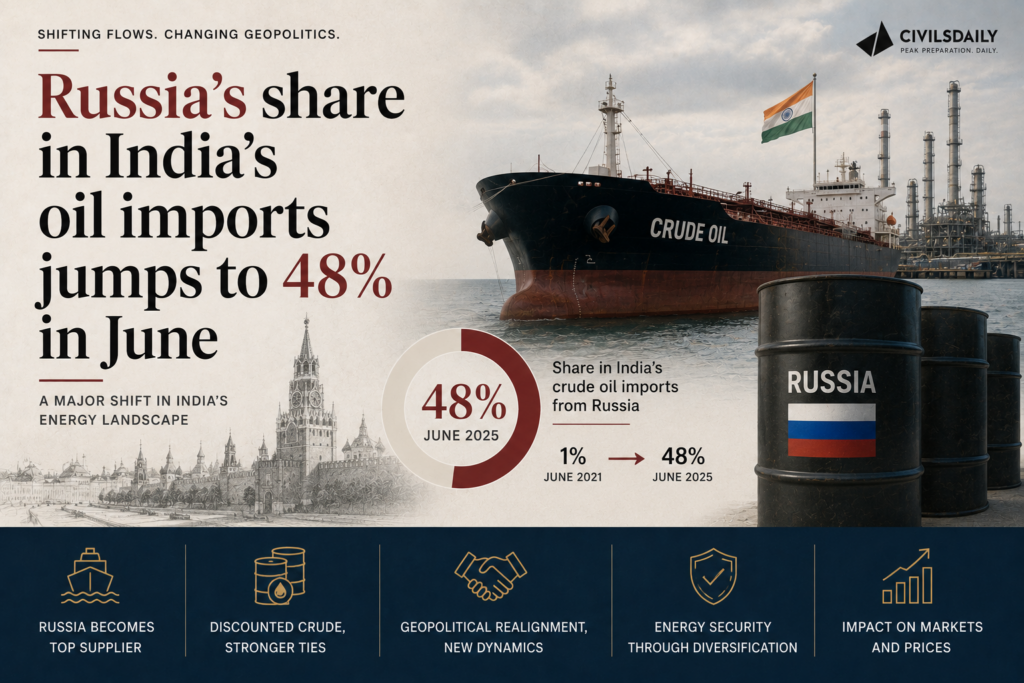
Russia’s share in India’s crude oil imports rose to an all-time high of 48 percent in June 2026, even as India cut its total crude imports. This comes as the US Senate has passed a bill to levy tariffs of up to 100 percent on the top buyers of Russian oil and gas, placing India’s energy security and its trade exposure to the United States in direct tension.
What is the Sanctioning Russia and Iran Act of 2026?
- Definition: The Lindsey O. Graham Sanctioning Russia and Iran Act of 2026 is a US bill that authorises secondary tariffs of up to 100 percent on countries that continue to buy Russian oil and gas. It targets the largest purchasers of these products from Russia.
- Status: The bill was passed by the US Senate and still requires passage by the US House of Representatives before it becomes law.
What are the tariff triggers under the bill?
- Top-buyer test: Tariffs apply to a country that was among the five largest importers of Russian crude oil or natural gas in the 12 months preceding the Act’s enactment.
- Continuation test: The tariff applies if that country continues to import Russian oil or gas beyond 30 days after enactment.
- Sanctions-evasion clause: Tariffs can also be imposed on countries found to have helped Russia evade sanctions.
- India’s exposure: India, alongside China, is one of the top two importers of Russian oil, so it qualifies under these criteria.
What do the June import figures show?
- Fall in total imports: June crude oil imports of 18.2 million metric tonnes (MMT) were 16.5 percent lower than in May 2026 and 13 percent lower than in June the previous year.
- Import bill still high: The June oil import bill was 22 percent lower than in May but still 40 percent higher than in June last year, due to elevated crude prices.
- Russian purchases held up: India imported 8.7 MMT of Russian oil in June, only 1 percent lower than May and 25 percent higher than a year earlier.
- Record Russian share: Russia’s share reached 48 percent by quantity and 48.6 percent by value, rising every month since March.
- UAE at a high: The United Arab Emirates (UAE) supplied 17.5 percent of imports by volume and 18 percent by value, its highest share so far.
- Concentration: Russia and the UAE together accounted for nearly two-thirds of India’s oil imports in June, the highest combined share from any two countries.
- Shrinking discount: The premium Russia charged India rose from a discount as recently as February 2026 to a premium of $10.6 per tonne in June, down from $77.7 per tonne in April.
How has India pre-empted sanctions exposure?
- Ship-to-ship transfers: The Ministry of Petroleum and Natural Gas said exposure was pre-empted through ship-to-ship transfer operations in international waters via the Red Sea route through Yanbu and Fujairah.
- Avoiding a single choke point: The aim was to ensure that no single choke point or sanctions regime could halt India-bound cargo.
- Refinery flexibility: Indian refineries spent a decade acquiring the flexibility to switch between crude grades and shipping routes when disruption struck.
Why does the record Russian share expose India?
- Energy security dependence: India cannot quickly cut back on Russian oil while supplies through the Strait of Hormuz remain constrained by the West Asia conflict.
- Trade and tariff risk: Continued high Russian purchases place India within the top-buyer criteria of the US bill, risking tariffs of up to 100 percent.
- Ambiguity on evasion: It is unclear whether India’s ship-to-ship arrangements would be treated as helping Russia evade sanctions.
Conclusion
India’s rising dependence on discounted Russian crude has hit a record 48 percent share, secured through diversified shipping routes even as total imports fell. This leaves India balancing its energy security against the risk of secondary tariffs under the US bill. The immediate milestone is the bill’s fate in the US House of Representatives, which will determine whether the tariff threat becomes law.
Back2Basics:
Strait of Hormuz
- Designation: A narrow strait linking the Persian Gulf to the Gulf of Oman and the Arabian Sea.
- Bordering states: Bordered by Iran to the north and Oman and the UAE to the south.
- Significance: One of the world’s most critical oil transit choke points, carrying a large share of seaborne crude.
What is Energy Security? (Foundational Context)
- About: Energy security is the uninterrupted availability of energy sources at an affordable price.
- Rationale: It matters because India imports the bulk of its crude oil, leaving growth and prices exposed to external supply shocks.
- Core dimensions: It rests on availability, affordability, accessibility, and diversification of both sources and supply routes.
Key Facts about India’s Oil Imports
- Import dependence: India imports over 85 percent of its crude oil requirement.
- Global standing: India is among the world’s largest crude oil importers and consumers.
- Key choke point: The Strait of Hormuz, between the Persian Gulf and the Arabian Sea, carries a large share of India’s West Asian crude.
Challenges to India’s Energy Security
- High import dependence: Reliance on imports for most crude exposes the economy to price and supply shocks.
- Geopolitical concentration: A large combined share from Russia and the UAE concentrates supply risk in two sources.
- Choke-point vulnerability: Disruption at the Strait of Hormuz can constrain West Asian supply.
- Sanctions exposure: Purchases from sanctioned suppliers risk secondary tariffs and financial penalties.
- Price volatility: War-driven crude price spikes inflate the import bill and widen the current account deficit.
Way Forward
- Diversify sources: Expand purchases from a wider set of suppliers to reduce concentration.
- Build strategic reserves: Enlarge strategic petroleum reserves to cushion supply shocks.
- Accelerate clean energy: Scale up renewables, biofuels, and electric mobility to cut import dependence over time.
- Secure shipping routes: Maintain logistical flexibility across grades and routes to withstand choke-point disruption.
PYQ Relevance
[UPSC 2025] Energy security constitutes the dominant kingpin of India’s foreign policy, and is linked with India’s overarching influence in Middle Eastern countries. How would you integrate energy security with India’s foreign policy trajectories in the coming years?
Linkage: The PYQ examines the integration of India’s energy security with its foreign policy. India’s record 48% dependence on Russian crude highlights the geopolitical dimension of energy security. The article shows the need to diversify suppliers and routes while balancing ties with Russia, the US and West Asia.
