Why in the news?
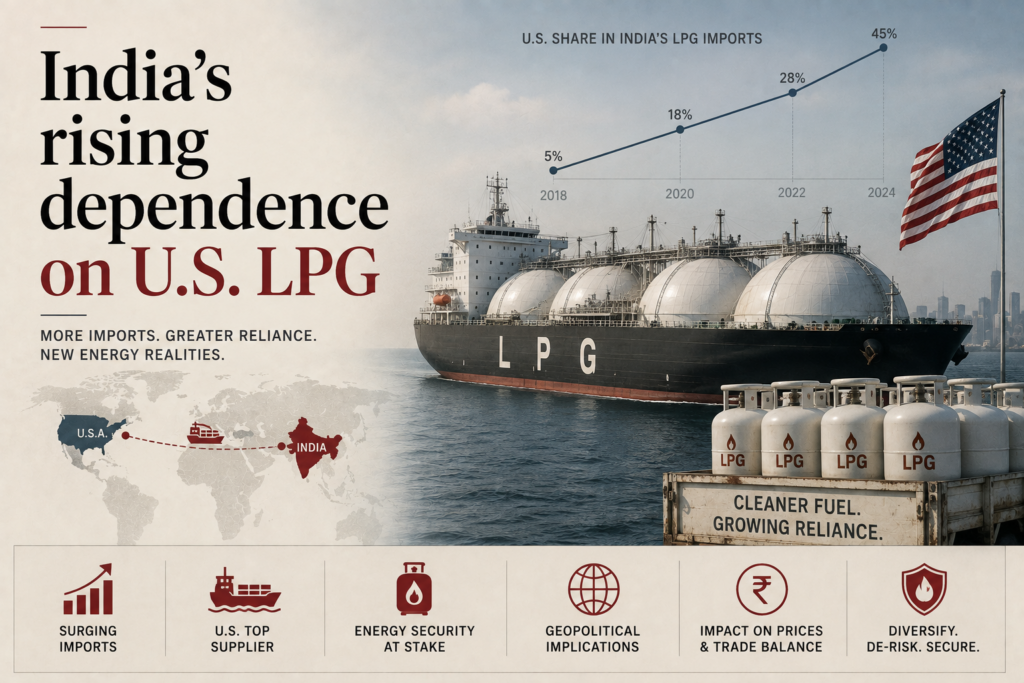
The Union Minister of Petroleum and Natural Gas stated that 67 per cent of India’s liquefied petroleum gas (LPG) now comes from the United States, a drastic shift from an earlier decision to source about 10 per cent of cooking gas there. The pivot, driven by the crisis in the Strait of Hormuz, exposes that LPG security cannot be anchored to a single geography while dependence on the United States carries risks of its own.
What is Liquefied Petroleum Gas (LPG) and how is India’s supply structured?
- What it is: LPG is a mix of propane and butane used mainly as cooking gas in India. It is a politically volatile fuel because shortages carry direct social and political consequences.
- Import dependence: India, the world’s second largest importer of LPG, imports about 60 per cent of the LPG it consumes, with nearly 90 per cent of that passing through the Strait of Hormuz.
- Sourcing shift: State run refiners signed a long term deal for 2.2 million tonnes of United States LPG in 2026, raising the United States share to two thirds of imports.
Why did India pivot to United States LPG?
- Hormuz disruption: Disruptions in the narrow Strait of Hormuz threatened the Gulf supply route through which most Indian LPG passes.
- Collapse in West Asian flows: India’s LPG imports from West Asia fell almost 85 per cent between February and June 2026.
- Partial offset: India replaced the lost flows by lifting imports from other sources, including the United States, from where June imports reached 0.77 million metric tonnes.
- Availability over price: Because cooking gas is politically sensitive, the priority is making it available rather than optimising cost, so costlier United States cargoes became attractive during the crisis.
Why is overdependence on the United States risky?
- Energy as leverage: Relying more on a partner that views ties through the lens of national interest risks energy being used as a bargaining tool in bilateral trade talks.
- History of coercive tools: The United States has historically used financial sanctions, export controls, and technology denial as foreign policy tools, seen in Iran, Iraq, Cuba, North Korea, Syria, Russia, Venezuela, Myanmar, Libya, Sudan, and Afghanistan.
- Third country reach: The Lindsey O. Graham Sanctioning Russia and Iran Act of 2026, proposing tariffs of up to 100 per cent on the top five buyers of Russian oil and natural gas, is a non tariff trade barrier that can influence third country transactions.
- Monetary spillover: Import dependence complicates monetary policy, as elevated United States inflation could keep the Federal Reserve’s rates higher for longer, strengthening the dollar and raising the rupee cost of each cargo.
Why does proximity pricing matter?
- Definition: Proximity pricing is a market benefit where goods cost less when bought from a nearby place. Shorter travel distance means lower shipping costs and faster delivery.
- Loss of distance advantage: United States shipments take 25 to 35 days against 5 to 10 days from the Gulf, so India loses the advantage of proximity pricing.
- Two price benchmarks: United States LPG is Mont Belvieu propane based, while West Asian supply follows the Saudi Aramco Contract Price, and the Gulf fuel is usually cheaper at the disembarking point due to the shorter distance.
- Temporary reversal: Geopolitical risk has temporarily inflated West Asian supply costs, with the Saudi Contract Price rising from about 543 dollars per tonne in February to around 790 dollars in June, making United States cargoes competitive despite the longer voyage.
How does India balance availability with cost optimisation?
- The core trade off: For a politically volatile fuel, ensuring supply outweighs cost optimisation, so India accepted higher priced United States cargoes to cut supply risk.
- Residual exposure: India may have cut Hormuz risk, but remains exposed to commodity price, dollar, and freight risks.
- Under recovery pressure: If domestic prices are held down while global prices rise amid rupee depreciation, oil companies’ under recoveries expand, worsening fiscal and external sector stress.
What are the challenges to India’s LPG security?
- Single supplier concentration: Two thirds reliance on one country recreates the concentration risk the pivot was meant to solve.
- Stagnant domestic output: LPG production has stayed nearly flat while consumption grows, widening the import gap.
- Chokepoint vulnerability: Heavy dependence on the Strait of Hormuz leaves Gulf sourced volumes exposed to any regional conflict.
- Fiscal drain: Accumulated under recoveries of state oil marketing companies exceeded Rs 59,000 crore as of 31 July 2026.
- Currency and freight risk: Dollar denominated pricing and long shipping routes expose landed costs to exchange rate and freight swings.
- Thin strategic reserves: India lacks large dedicated LPG strategic reserves to buffer sudden supply shocks.
Conclusion
Energy security is not about replacing one supplier with another but ensuring no single player holds all the cards. India must strengthen local production, bolster multiple supply chains, and build more strategic reserves. Australia offers a shorter Indo Pacific route outside Hormuz, though its export volumes remain small.
Back2Basics
Energy Security and LPG in India (Foundational Context)
- About: Energy security means assured availability of energy at affordable prices with resilience against supply shocks. LPG security is a subset covering cooking gas access for households.
- Scale: Public sector oil marketing companies serve 33.14 crore active domestic LPG customers, growing at a compound annual growth rate of 7.6 per cent between 2015 and 2026.
- Consumption gap: LPG production was 4.3 million metric tonnes against consumption of 6.5 million metric tonnes in the first quarter of FY27, with the 2026-27 consumption estimate at 34,692 thousand metric tonnes.
Key Facts about India’s LPG Sector
- Oil marketing companies: Indian Oil, Bharat Petroleum, and Hindustan Petroleum are the three public sector oil marketing companies distributing LPG.
- PPAC: The Petroleum Planning and Analysis Cell tracks LPG consumption, customer base, and pricing data.
- Crisis production ramp up: At the peak of the crisis, oil marketing companies raised cumulative daily LPG production from 34,000 metric tonnes to 55,000 metric tonnes.
- Output jump: First quarter FY27 LPG production rose 35.73 per cent year on year to 4.26 million metric tonnes after refineries diverted propane and butane streams into the LPG pool.
Government Initiatives for LPG and Energy Security
- Pradhan Mantri Ujjwala Yojana: Provides free LPG connections to women from below poverty line households to promote clean cooking.
- PAHAL (DBTL): Directly transfers LPG subsidy to beneficiary bank accounts to curb diversion.
- Strategic Petroleum Reserves: Underground crude storage to cushion supply disruptions.
- Ethanol Blending Programme: Reduces import dependence in the broader energy basket.
- Long term supply agreements: State refiner contracts diversifying LPG sourcing across geographies.
Way Forward
- Boost domestic output: Maximise refinery LPG yield and invest in production capacity to narrow the import gap.
- Diversify suppliers: Spread sourcing across the Gulf, the United States, Australia, and others to avoid single supplier dependence.
- Expand strategic reserves: Build dedicated LPG storage to buffer sudden shocks.
- Hedge price and currency risk: Use financial instruments to manage commodity, dollar, and freight exposure.
- Secure alternate routes: Develop supply chains outside the Strait of Hormuz to reduce chokepoint vulnerability.
PYQ Relevance
[UPSC 2025] “Energy security constitutes the dominant kingpin of India’s foreign policy, and is linked with India’s overarching influence in Middle Eastern countries.” How would you integrate energy security with India’s foreign policy trajectories in the coming years?
Linkage: The PYQ directly relates to energy security as a key driver of India’s foreign policy, especially in West Asia. India’s shift to US LPG highlights the need for supplier diversification, alternate routes and strategic autonomy in energy diplomacy.
