Why in the News
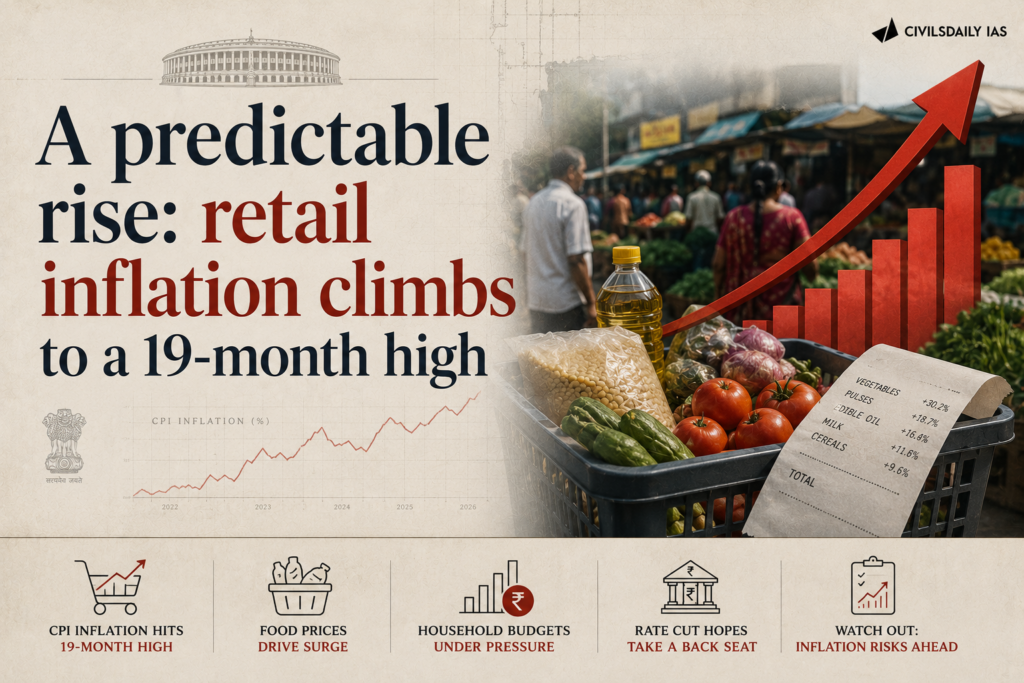
Retail inflation rose to 4.45% in July 2026, its highest reading in 19 months. The number stayed above the Reserve Bank of India (RBI) target of 4% for a second straight month, even as the central bank held its policy rate.
What is the Consumer Price Index (CPI) inflation target framework?
- Flexible inflation targeting: The RBI is mandated to keep CPI inflation at 4%, within a tolerance band of 2% to 6%.
- Monetary Policy Committee (MPC): A six-member committee sets the repo rate to steer inflation toward that target.
- Mandate basis: The framework flows from the amended Reserve Bank of India Act, 1934, and a 2016 agreement between the government and the RBI.
What is driving the price rise?
- Food inflation: Vegetables led the increase, with sharp jumps in onion, garlic and ginger prices.
- Fuel and transport: Higher energy costs fed into the headline number.
- Rural stress: Rural food inflation ran ahead of the national average.
- Imported pressure: A depreciating rupee and disrupted West Asian crude supply raised input costs.
Why does core inflation tell a calmer story?
- Core below 3%: Inflation excluding food and fuel stayed under 3%, showing weak underlying demand pressure.
- Divergence: The gap between headline and core inflation points to a supply-side food shock rather than broad overheating.
Why did the RBI hold the repo rate?
- Rate on hold: The MPC kept the repo rate at 5.25% for a fourth straight meeting.
- Balancing act: A food-driven spike is not easily controlled by interest rates, so the RBI avoided tightening into a supply shock.
Conclusion
Headline inflation is being pushed by food and fuel, not by demand. The RBI has chosen to hold rates, and the trajectory depends on whether the monsoon eases vegetable prices in the coming months.
Back2Basics
What is Fiscal versus Monetary control of inflation?
- Monetary tools: Repo rate, cash reserve ratio, and open market operations, used by the RBI to manage demand-side inflation.
- Fiscal and supply tools: Buffer stocks, import duty cuts, and export curbs, used by the government to tackle food-supply shocks.
Types of Inflation
- Headline Inflation: Overall CPI inflation, including food and fuel.
- Core Inflation: Inflation excluding volatile food and fuel prices.
- Food Inflation: Rise in prices of food items such as cereals, vegetables, pulses and edible oils.
- Demand-Pull Inflation: Caused by aggregate demand growing faster than supply.
- Cost-Push Inflation: Results from rising input costs such as fuel, wages and raw materials.
- Imported Inflation: Domestic prices rise due to higher global commodity prices or currency depreciation.
- Built-in Inflation: Persistent inflation arising from wage-price expectations and indexation.
Why Food Inflation Matters in India
- Policy Challenge: Food inflation is largely supply-driven, limiting the effectiveness of monetary policy alone.
- High CPI Weight: Food has a large weight in the CPI basket, making food-price changes strongly influence headline inflation.
- Household Impact: Food inflation directly erodes purchasing power, especially for low-income households.
- Rural Vulnerability: Rural households spend a larger share of income on food, making them more exposed to food-price shocks.
- Inflation Expectations: Persistent food inflation can raise wage and price expectations, creating second-round effects. (Secod Round Effect: Persistent food inflation can spill over into wages, input costs and inflation expectations, turning a temporary supply shock into broader inflation.)
PYQ Relevance
[UPSC 2024] What are the causes of persistent high food inflation in India? Comment on the effectiveness of the monetary policy of the RBI to control this type of inflation.
Linkage: The PYQ talks about food inflation and limits of RBI monetary policy. Current inflation shows how supply-side food shocks can persist despite subdued core inflation.
