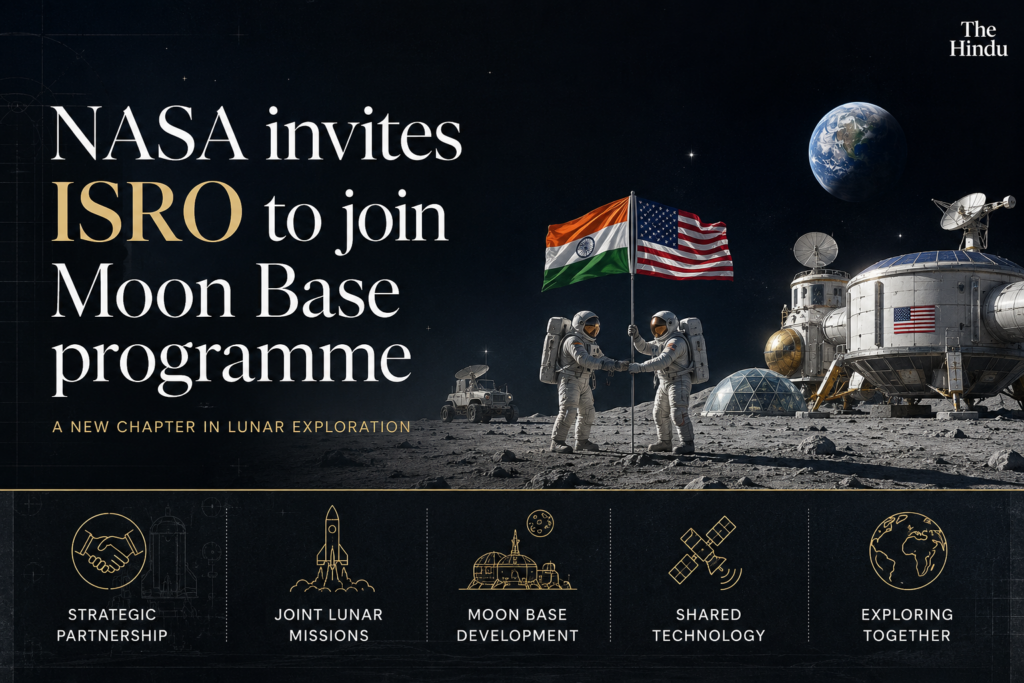
Why in the news?
The National Aeronautics and Space Administration (NASA) has asked the Indian Space Research Organisation (ISRO) to join its Moon Base programme, a project to establish a permanent research station on the Moon. The offer exposes a tension between the chance to accelerate ISRO’s own crewed-mission goals and the risk of locking India into another agency’s technology ecosystem. Space cooperation has continued to progress even amid the volatility of India-US relations.
What is the Moon Base programme?
- About: An ambitious project to establish a permanent research station on the Moon where astronauts can live, work, and carry out experiments for extended periods.
- Sequence: It is the logical follow-up to landing humans on the Moon, aimed at preparing the ground for longer stays.
What is the Artemis programme?
- About: A US-led programme that aims to land humans on the Moon before 2028, the first crewed return since 1972.
- Purpose: It is spearheaded by the United States and is designed to move faster and more efficiently by bringing in partner countries and private companies.
What are the Artemis Accords?
- About: A US-led coalition of spacefaring countries setting principles for cooperative and sustainable lunar exploration, which India has already signed.
- Contested feature: The Accords sidestep and seek to replace the 1979 Moon Agreement, a framework for multilateral governance of lunar resources.
What is the 1979 Moon Agreement?
- About: An international agreement that seeks to develop a multilateral governance framework for the use of lunar resources.
- Relevance: The Artemis Accords are seen as an alternative that the Moon Agreement’s supporters view as bypassing multilateral governance.
What does India gain from joining?
- Crewed-mission experience: ISRO, which plans to land humans on the Moon by 2040, would gain hands-on experience in executing complex crewed missions.
- Technology access: Participation offers access to technologies relevant to sustained lunar operations.
- Existing commitments: India has signed the Artemis Accords and agreed with the US to develop a strategic framework for human spaceflight cooperation.
- Strategic stakes: Over coming decades the Moon could become strategically and economically important as countries begin to extract lunar resources.
What are the risks of joining? (the central tension)
- US-led alliance perception: The Artemis Accords are increasingly seen as a US-led alliance, and two major space powers, China and Russia, are not part of it.
- Technology lock-in: It is important that ISRO does not get locked into NASA’s technology ecosystem, which would make it vulnerable to technology denial.
- Goal displacement: Cooperation should help ISRO achieve its own goals faster, not lead it to abandon or delay them in the service of someone else’s goals.
- Wariness of structures: India has been wary of joining such international structures, and signing the Accords already represented a choice.
Government Initiatives in the Space Sector
- Gaganyaan: India’s human spaceflight programme to send astronauts to low-Earth orbit.
- Bharatiya Antariksh Station: India’s planned space station for sustained microgravity research.
- IN-SPACe: The body enabling private participation in the space sector.
Challenges for India’s Lunar Cooperation
- Technology denial: Dependence on foreign systems risks future denial.
- Alliance optics: Alignment with a US-led coalition affects ties with other space powers.
- Governance gap: Competing frameworks leave lunar resource rules unsettled.
- Cost and capability: Crewed deep-space missions demand large, sustained investment.
- Autonomy risk: Partner timelines may divert ISRO from its own priorities.
“[2025] Consider the following space missions:
I. Axiom-4
II. SpaDeX
III. Gaganyaan
How many of the space missions given above encourage and support microgravity research?
(a) Only one
(b) Only two
(c) All the three
(d) None
