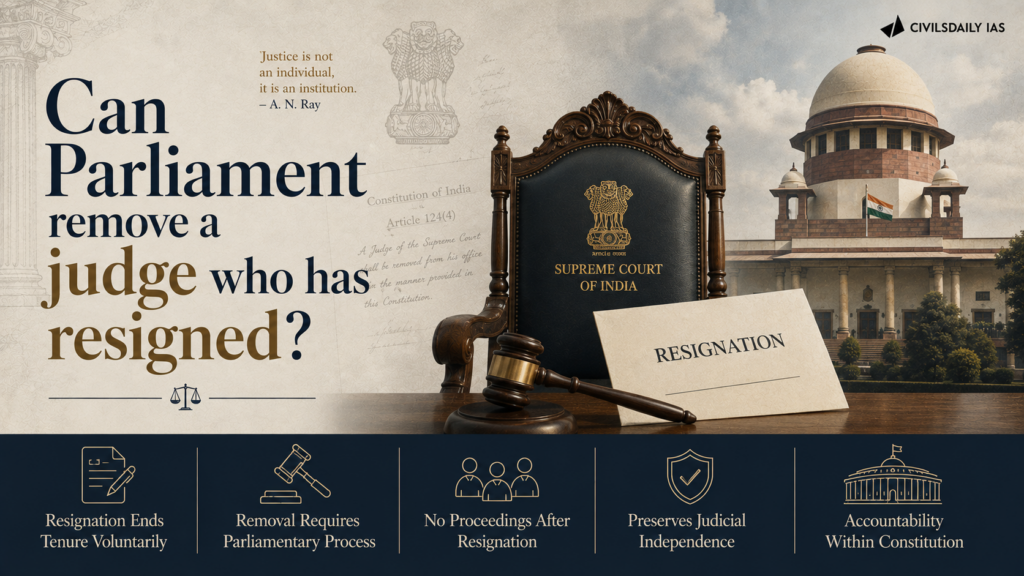
Why in the News
A parliamentary inquiry committee found all three charges proved against a former High Court judge, including failure to explain cash recovered from his residence and interference with evidence. The issue is whether the removal process can continue after his resignation.
Removal of Judges: Constitutional Framework
- Article 124(4): Supreme Court judges can be removed only for proved misbehaviour or incapacity.
- Article 217: Deals with the tenure and removal of High Court judges.
- Judges (Inquiry) Act, 1968: Provides the inquiry mechanism and formulation of charges.
- Parliamentary approval: Removal requires a special majority in each House, in the same session.
- Final step: After Parliament passes the address, the President issues the removal order.
What did the Inquiry Committee Find?
- All three charges were proved.
- The judge failed to satisfactorily explain the cash recovered from his residence.
- The committee found attempts to interfere with evidence.
Key Constitutional Issue After Resignation
- Removal is primarily linked to holding judicial office.
- Resignation ends the judge’s tenure, creating a question about whether Parliament can still complete the removal process.
- Possible consequences involving pension or future disqualification make the issue constitutionally significant.
- There is no settled precedent on completing the removal process against a judge who has already resigned.
Prelims Facts
- Ground for removal → Proved misbehaviour or incapacity
- High Court judge → Article 217
- Supreme Court judge → Article 124
- Inquiry procedure → Judges (Inquiry) Act, 1968
- Removal requires → Special majority in both Houses
- Final removal order → President
- Policy disagreement → Not a ground for removal
- Historical fact → No Indian judge has so far been removed after completion of the parliamentary removal process.
“[2025, GS2, 15] “Constitutional morality is the fulcrum which acts as an essential check upon the high functionaries and citizens alike…” In view of the above observation of the Supreme Court, explain the concept of constitutional morality and its application to ensure balance between judicial independence and judicial accountability in India.”
[2021] With reference to Indian Judiciary, consider the following statements:
1. Any retired judge of the Supreme Court of India can be called back to sit and act as a Supreme Court judge by the Chief Justice of India with prior permission of the president of India.
2. A High Court in India has the power to review its own judgement as the Supreme Court does.
Which of the statements given above is/are correct?
[A] 1 only
[B] 2 only
[C] Both 1 and 2
[D] Neither 1 nor 2
