đŸ’„Join UPSC 2027,2028 Mentorship (July Batch) + XFactor Notes & Microthemes PDF

Subject: Judiciary

  • [13th July 2026] The Hindu OpED: Five crore Indians wait when the courts take a break

    Mentor’s Comment

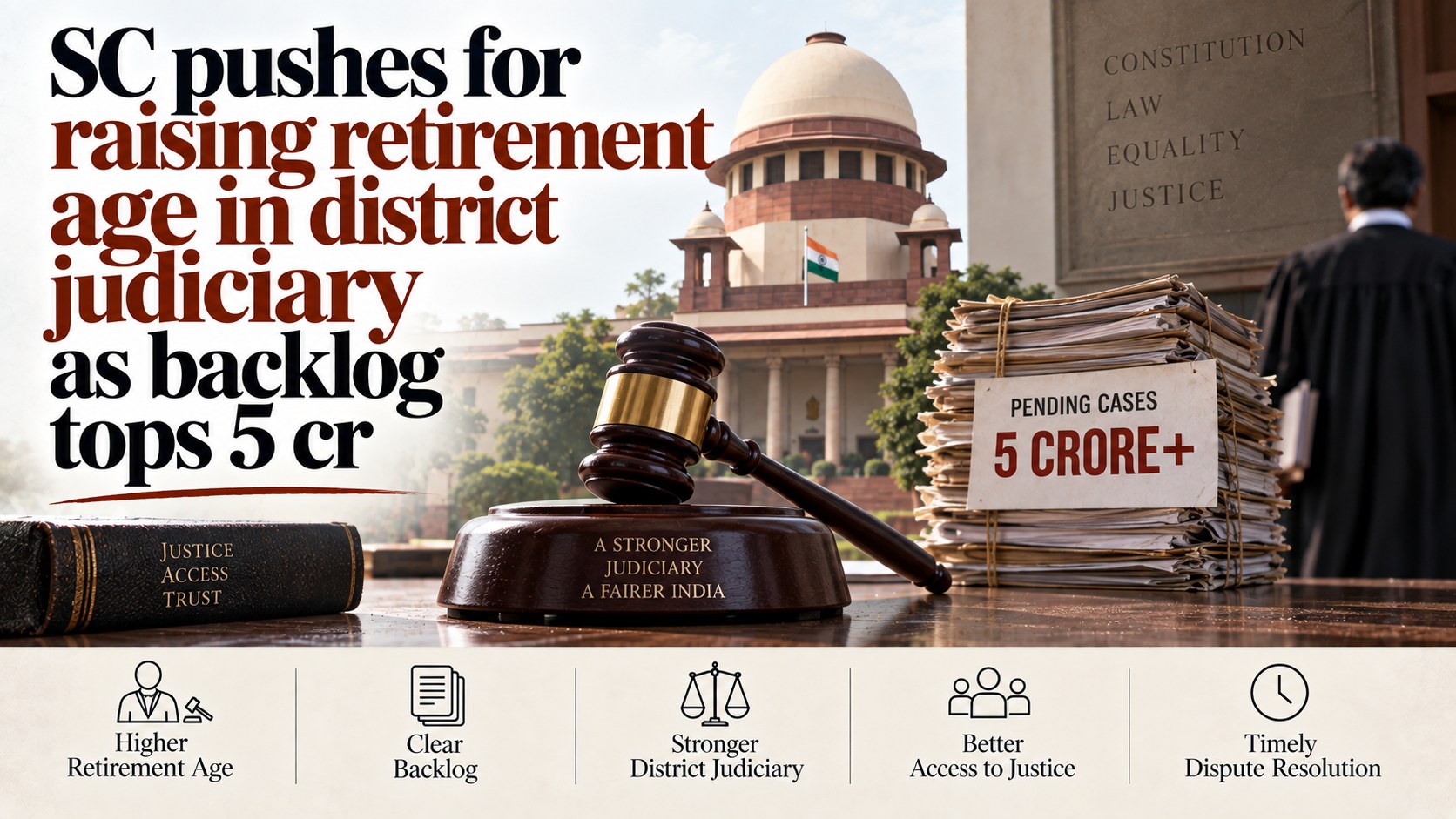
    The Supreme Court’s six-week summer break (June 1 to July 12) coincides with a record 5.39 crore pending cases across Indian courts, the Supreme Court’s heaviest load in over 30 years. This has sharpened the debate on whether collective, en masse judicial recess is defensible when nearly three in four prisoners in India are undertrials awaiting the completion of their own trials.

    What does the coexistence of a record case backlog and a mass judicial vacation reveal about court functioning in India?

    1. Scale of pendency: More than 5.39 crore cases were pending in Indian courts as of the last day of 2025.
    2. Distribution of the backlog: District courts held over 4.76 crore cases, High Courts held 63.6 lakh cases, and the Supreme Court held more than 92,000 cases, its heaviest load in over 30 years.
    3. Undertrial burden: Roughly three in four prisoners in India are undertrials. They are unconvicted and presumed innocent, yet some serve longer in custody than the sentence they would have received had they pleaded guilty.
    4. Institutional asymmetry: Hospitals, police stations, markets, and government offices continue functioning through individual staff leave. The Supreme Court and High Courts instead shut down collectively for six weeks.
    5. Clearance timeline: A government study calculated that clearing the existing backlog at the present pace would take three centuries.

    Why does an individual judge’s right to rest not justify the institution’s collective closure?

    1. Workload reality: Indian judges are among the most overworked in the world. The recess period is when reserved judgments finally get written.
    2. Continuity is achievable: Last year the Chief Justice of India and the four senior-most judges worked through the first week of the break.
    3. The actual design flaw: The problem is not that judges rest. It is that almost all of them rest together, so the institution goes quiet for six-plus weeks every year.
    4. Colonial origin: The current calendar traces to a practice built for English judges. They withdrew to cooler climates during the Indian summer and took long Christmas holidays in winter.

    Why did the 2024 renaming of the summer vacation fail to reduce the backlog?

    1. Rebranding without substance: In 2024, the Supreme Court renamed the “summer vacation” as “partial court working days.”
    2. No change in working days: The actual number of sitting days remained at approximately 190 days a year.
    3. Litigant impact unaddressed: A litigant whose case is stalled is unaffected by the label given to the recess. What matters is whether the matter is heard and disposed of.

    What administrative reform has been repeatedly recommended to keep courts continuously functional, and why has it not been adopted?

    1. Staggering as the core proposal: The judiciary’s own watchdogs have long recommended not abolishing judicial rest but staggering it, rotating leave so Benches remain full.
    2. Parliamentary recommendation: A 2023 parliamentary standing committee objected to “the entire court going on vacation en masse” and proposed rotating leave to keep courts running continuously.
    3. Earlier precedent: The Law Commission of India and the Justice Malimath Committee made the same recommendation earlier. They were not opposing the courts; they were trying to protect them from themselves.
    4. Institutional analogy: A hospital does not empty its wards because doctors are owed time off. It builds a roster instead.
    5. Status: Despite three separate recommending bodies, this reform remains unimplemented.

    Is the crisis in India’s courts one of vacations or of vacancies? 

    1. The standard objection: Critics argue that vacations are a sideshow and the real disease is judicial vacancies, not recess.
    2. Vacancy scale: Up to a third of High Court seats lie vacant.
    3. The rebuttal: A Bench already running at half strength is thinned further for six weeks every summer. This makes the recess a stronger case against itself, not a defence of it.
    4. Distinct accountability: Filling vacancies depends on the government and the collegium, and will take years to resolve.
    5. Distinct reform lever: The vacation calendar is the judiciary’s own to fix. It needs only institutional will, not external permission.

    Beyond staggering leave, how can India reduce the flow of disputes into its courts?

    1. Symptom versus deeper fix: Staggering leave treats only the symptom. Courts were never meant to be the first stop for every dispute, only the last.
    2. Lok Adalat performance: Lok Adalats settled more than 2.59 crore cases in a single national sitting last December, and over 23.5 crore cases in three years.
    3. Mediation Act, 2023: This Act nudges parties to attempt settlement before approaching a court.
    4. Arbitration: Arbitration can remove commercial disputes entirely from judges’ hands. This route remains badly underused.
    5. Retired judges as an untapped resource: India has a reservoir of retired judges who step down at 62 or 65, still in full command of their expertise. Many already head quasi-judicial bodies and tribunals.
    6. Proposed use: A dedicated corps of former judges, freed from daily dockets, could identify where cases pile up, set public disposal targets, and report progress openly.

    Conclusion

    Collective judicial recess, an inherited colonial practice, is defensible for individual judges but indefensible as an institutional design when 5.39 crore cases and undertrial prisoners are held hostage to it. Cosmetic fixes such as renaming the vacation do not alter the actual working calendar. Staggering leave to keep Benches continuously functional is a reform within the judiciary’s own control, unlike the filling of vacancies, which depends on the executive and the collegium. The unresolved question is whether the judiciary will exercise this available reform, or continue mistaking cosmetic change for structural correction.

  • HC Halts Byelections in 5 Tamil Nadu Constituencies

    Why in the News?

    The Madras High Court restrained the Election Commission from notifying byelections to five Tamil Nadu Assembly constituencies whose sitting members resigned after the 2026 Assembly election, since election petitions challenging their victories remain pending. The interim order raises the question of whether a resignation-created vacancy is legally “clear” enough to trigger fresh polls when the same seat’s original result is still under judicial challenge.

    What is the factual and procedural backdrop of the Madras High Court’s interim order?

    1. Interim restraint: The Madras High Court restrained the Election Commission from notifying byelections to Tiruchi East, Perundurai, Ambasamudram, Viralimalai, and Karur Assembly constituencies until July 31.
    2. Trigger for vacancy: All five sitting MLAs resigned after winning the 2026 Assembly election.
    3. Core contention: The petitioner argued that byelections before disposal of pending election petitions could create an anomalous situation of dual representation for a single constituency.
    4. Deadline set: The court granted the respondents time till July 31 to file counter-affidavits.

    On what legal doctrine did the petitioner challenge the Election Commission’s power to notify byelections?

    1. Statutory basis challenged: The petitioner argued the Election Commission cannot treat these vacancies as a “clear vacancy” under Section 151A of the Representation of the People Act, 1951. Section 151A: provision requiring the Election Commission to fill a vacancy in a House through byelection within six months of its occurrence.
    2. Precedent cited: Sanjeevayya vs Election Commission of India (1967) held that byelections cannot proceed while an election petition relating to that constituency remains pending.
    3. Precedent cited: Election Commission of India vs Telangana Rashtra Samithi (2011) reinforced the same bar on byelections during pending adjudication.
    4. Precedent cited: Pramod Laxman Gudadhe vs Election Commission of India (2018) extended the same principle.
    5. Consequential prayer argument: All five election petitions sought not only to invalidate the winning candidates’ victory but also to declare the petitioners themselves as winners.
    6. Risk of dual mandate: A byelection conducted before these petitions are decided could produce a second declared winner for a seat where a court may later declare a different winner from the original contest.

    Does the timing of an MLA’s resignation relative to the election petition alter the vacancy’s legal status?

    1. Distinguishing principle raised: The Advocate-General argued that a distinction must be drawn between MLAs who resigned before an election petition was filed and those who resigned after.
    2. Chief Minister’s case: The Chief Minister resigned from Tiruchi East on May 10, before his rival candidate filed the election petition.
    3. Other MLAs’ case: Several other MLAs resigned before the election petitions challenging their victory were filed.
    4. Implication for vacancy classification: A resignation preceding the petition may create a genuinely clear vacancy. A resignation following the petition may not.
    5. Unresolved legal question: The Bench agreed that this timing distinction required deeper examination before final orders could be passed.

    What procedural objections did the respondents raise against the maintainability of the PIL?

    1. Locus standi challenge: Senior counsel representing the Chief Minister, questioned the PIL petitioner’s standing to direct the Election Commission’s conduct. Locus standi: the legal right of a party to bring a case before a court.
    2. Prematurity argument: The petition was argued to be premature since the Election Commission had not yet taken any decision on conducting byelections in the five constituencies.
    3. No notification issued: No notification on byelections had been issued at the time the PIL was heard.
    4. Distinct roles of respondents: The Advocate-General represented the Legislative Assembly Secretary. Separate counsel represented the Election Commission and the Chief Minister.

    How did the Bench reconcile the competing claims in its interim order?

    1. Rejection of narrow standing objection: The Bench held that a narrow and pedantic interpretation of locus standi cannot be applied in matters touching the purity of the democratic process.
    2. Acceptance of AG’s nuance: The Bench agreed that the Advocate-General’s argument on the timing of resignations relative to petition filing required deeper examination.
    3. Deferred decision: The court decided to pass final orders only after notice was issued to all respondents and counter-affidavits were filed.
    4. Interim balance struck: The Bench restrained byelection notification without ruling on the merits of either side’s substantive claim.

    Conclusion

    The order establishes that a resignation-created vacancy is not automatically a “clear vacancy” under Section 151A of the Representation of the People Act, 1951, when the underlying election result is under judicial challenge. The unresolved question is whether the timing of resignation relative to the filing of an election petition changes this classification. Until the High Court examines the Advocate-General’s distinction between pre-petition and post-petition resignations, five Tamil Nadu constituencies remain without elected representation. The case will determine whether electoral finality doctrine can override the Election Commission’s statutory duty to fill vacancies promptly.

    PYQ Relevance

    [UPSC 2022] Discuss the procedures to decide the disputes arising out of the election of a Member of the Parliament or State Legislature under The Representation of the People Act, 1951. What are the grounds on which the election of any returned candidate may be declared void? What remedy is available to the aggrieved party against the decision? Refer to the case laws.

    Linkage: The PYQ asks directly about election petition procedure and remedies under the RP Act. The article’s central dispute is precisely about how pending election petitions interact with byelection notification under this Act.

  • AI Use by the Judiciary: SC’s Draft AI Regulations, 2026

    Why in the News?

    The Supreme Court released the Draft Regulations for Use of Artificial Intelligence in Courts, 2026 last month, inviting public comments till July 15. The draft permits AI for administrative and research functions in courts but places an absolute, non-derogable bar on any AI role in decisions affecting bail, recidivism (a critical metric used to measure the effectiveness of the justice and rehabilitation systems.), witness credibility, or personal liberty.

    What does the Draft Regulations permit AI to do in courts?

    1. Administrative and assistive functions: AI use is permitted for case management, transcription, translation, legal research, document summarisation, accessibility, and court administration.
    2. Approval requirement: Every permitted use requires prior written approval from the Apex Body for the Supreme Court, or the AI Committee of the concerned High Court or tribunal.
    3. Human supervision: Officers nominated by the court must supervise and verify AI-assisted outputs before use.
    4. Scope boundary: Permission covers efficiency-enhancing functions only. It does not extend to any function that produces or contributes to a judicial outcome.

    Why has the SC opted for a staggered, court-wise implementation instead of a uniform rollout?

    1. SC-specific notification: Provisions apply to the Supreme Court only from a date notified by the Chief Justice of India.
    2. High Court autonomy: Provisions for High Courts and the courts and tribunals under their jurisdiction come into force separately, on dates notified by the respective High Court Chief Justice.
    3. Provision-wise phasing: Different provisions can be brought into force on different dates within the same court.
    4. Rationale: Phasing allows each court to adopt AI at a pace suited to its own infrastructure, caseload, and readiness.

    Why is human judicial authority made non-negotiable in adjudicative outcomes?

    1. Categorical bar on algorithmic outcomes: No judicial outcome can be reached through algorithmic decision-making alone, or solely on the basis of AI-generated information.
    2. Determinative human authority: Human judicial authority is determinative in all adjudicative decisions, regardless of AI input.
    3. Advisory-only role: Where AI is used anywhere in a decision-making process, its role is only advisory.
    4. Independent evaluation mandate: Any AI-assisted input is subject to independent human judicial evaluation before use.

    What functions has the SC placed beyond regulatory reach altogether, and why?

    1. Risk scoring barred: AI cannot be used for ‘risk scoring’ to assess flight risk.
    2. Recidivism prediction barred: AI cannot be used to predict recidivism.
    3. Bail eligibility barred: AI cannot be used to evaluate bail eligibility.
    4. Witness credibility barred: AI cannot be used to determine the credibility of witnesses.
    5. Profiling barred: AI cannot be used to predict, profile, or infer the future conduct or behaviour of parties, accused persons, witnesses, or legal representatives.
    6. Undisclosed AI evidence barred: AI-generated output cannot be submitted as independent evidence without full disclosure of its AI-generated character.
    7. Blackbox AI barred in liberty matters: Unexplainable AI systems cannot be used in matters affecting personal liberty.
    8. Non-derogable status: These prohibitions are absolute. No authority can permit them later under the Regulations.

    Does the disclosure mechanism for litigants adequately safeguard their right to know?

    1. Material assistance trigger: Litigants must be informed only when an AI tool “materially assists” case management, document analysis, or judicial administration.
    2. Timely and accessible disclosure: Disclosure to litigants and their counsel must be made in a timely and accessible manner.
    3. Threshold-based, not blanket disclosure: Litigants are not informed of every instance of AI use in their case, only instances that meet the material assistance standard.
    4. Undefined threshold: The Regulations do not define what constitutes “material assistance,” leaving the disclosure trigger to case-by-case determination by courts.

    What institutional architecture will govern AI use in courts?

    1. Apex Body: An Apex Body at the Supreme Court will set minimum mandatory standards for AI systems and issue implementation guidelines.
    2. Composition: The Apex Body comprises sitting Supreme Court and High Court judges, an official of the Ministry of Electronics and Information Technology, and experts in finance and cybersecurity.
    3. Specialised committees: The Apex Body will function through five specialised committees.
    4. Court-level AI Committees: The Supreme Court and each High Court will constitute their own AI Committees, backed by an AI Secretariat.
    5. Dedicated research body: The Centre of Research and Excellence on Artificial Intelligence (CoRE-AI) will evaluate AI tools and track technological developments to support the Apex Body.

    How are private AI vendors regulated to prevent capture of judicial data and infrastructure?

    1. Prior written approval: Private companies can supply AI tools only with written approval from the relevant court authority.
    2. Mandatory contract terms: Vendor agreements must include a mandatory list of contract terms set out by the Regulations.
    3. Data ownership and access: Contracts must specify ownership of, and access rights to, court data and AI outputs.
    4. Bar on sensitive data use: Vendors are barred from using sensitive judicial data.
    5. No unauthorised model training: Vendors cannot retain or fine-tune models using court data without the AI Committee’s written approval.
    6. IP restriction: Vendors cannot claim exclusive intellectual property rights over tools built substantially using public resources.

    Conclusion

    The Draft Regulations construct a two-tier framework for judicial AI: broad permission for administrative efficiency, and an absolute prohibition on AI’s role in outcome-determinative and liberty-affecting functions. This boundary, not the list of permitted uses, is the framework’s operative safeguard against algorithmic opacity compromising due process. The undefined “material assistance” threshold for litigant disclosure remains its weakest link, leaving courts significant discretion over what litigants get to know. Effective implementation will depend on how the Apex Body and CoRE-AI operationalise this boundary as AI adoption scales across courts.

    PYQ Relevance

    [UPSC 2024] Explain the reasons for the growth of public interest litigation in India. As a result of it, has the Indian Supreme Court emerged as the world’s most powerful judiciary?”

    Linkage: The PYQ discusses expansion of judicial power through institutional self-assertion. The Draft AI Regulations are another instance of the SC using its institutional authority to self-regulate its own processes.

  • Discuss the desirability of greater representation to women in the higher judiciary to ensure diversity, equity and inclusiveness.

    “Indian Judiciary is not only guardian of the Constitution but also Active Participants in the Social Revolution.” – J.L. Nehru. Greater women representation in the judiciary is essential for this vision.

    Desirability of Greater Representation

    Constitutional Imperative – Fulfils Articles 14, 15(3), and 39A, ensuring equal opportunity and access to justice for all.

    Corrects Historical Imbalance- Addresses structural and institutional barriers in legal and judicial careers.

    Diversity of Perspective – Women judges bring unique social insights, empathy, and lived experiences, enriching judicial reasoning and deliberation.

    Gender-Sensitive Adjudication – Enhances sensitivity in matters of sexual violence, family law, and gender rights. Eg- Justice Indu Malhotra’s dissent in Sabarimala (2018).

    Enhances Legitimacy and Public Trust – A judiciary reflective of society’s diversity strengthens citizen confidence in judicial impartiality.

    Democratization of Judiciary – Promotes inclusive representation across gender, class, and region, aligning with democratic ideals.

    Global Democratic Benchmark – Countries like Canada and the UK have achieved near gender parity, improving judicial balance and inclusivity.

    Role-Model Effect – Inspires women in the legal profession, helping address underrepresentation in senior judicial positions.

    “There is no better test of the excellence of government than the working of its judicial system.” – Lord Bryce. The true measure of that excellence lies in Gender Equality in Judiciary.

  • Explain the reasons for the growth of public interest litigation in India. As a result of it, has the Indian Supreme Court emerged as the world’s most powerful judiciary?

    Public Interest Litigation (PIL) is a judicial mechanism that allows any public-spirited individual or organization to approach the court on behalf of others for the enforcement of fundamental or legal rights. It evolved in India as a tool of “social action litigation”, expanding the reach of justice under Article 32 and 226.

    Objectives PIL

    Accessibility of Justice

    Government Accountability

    Judicial Oversight

    Rule of Law and Balance

    Reasons for the Growth of PIL in India

    Historical Reasons- Postcolonial India witnessed deep social inequality and poverty. PIL emerged as a tool for social transformation and distributive justice.

    Liberalization of Locus Standi- Shift from “personally aggrieved” to “any public-spirited citizen” can file a case.

    Judicial Activism- Post-Emergency judiciary reasserted itself as the guardian of rights and liberties. Eg- Justice Krishna Iyer first introduced the idea of public interest litigation in India in Mumbai Kamagar Sabha v. Abdul Thai in 1976.

    Decline of Parliament- Legislative inefficiency and lack of responsiveness to social issues. Eg- Visaka Guidelines

    Rise of Civil Society Activism- Growth of NGOs, media, and human rights groups. Began using PILs to advance environmental, social, and human rights causes. Eg- Right to livelihood under Article 32 in Bandhua Mukti Morcha judgment

    Executive Overreach and Inaction- Bureaucratic corruption, maladministration, and policy failures prompted the judiciary to step in as a corrective mechanism. Eg- Vineet Narain v. Union of India (1997) – CBI accountability case.

    Global Factors- Comparative judicial trends (e.g., U.S. public interest litigation) inspired Indian legal activism.

    Constitutional Powers and Design- Directive Principles of State Policy (Part IV) provided moral backing for socio-economic justice through judicial intervention.

    Expansion of Fundamental Rights- Courts interpreted Article 21 broadly – including right to livelihood, education, health, and clean environment (Olga Tellis, 1985; M.C. Mehta, 1986).

    Indian Supreme Court as the world’s most powerful judiciary

    Arguments in Favour

    Widest Judicial Review Powers- Can strike down laws, executive actions, and even constitutional amendments under Articles 13, 32, and 226. Eg- NJAC verdict

    Suo Motu Jurisdiction- Eg- SC took suo motu cognizance of COVID-19 Migrant Crisis (2020).

    Epistolary Jurisdiction- Allows letters/postcards as petitions, widening access to justice. Eg- Sunil Batra v. Delhi Administration (1978) – Letter treated as habeas corpus.

    Expansion of Fundamental Rights- Eg- Puttaswamy (2017) – Right to Privacy recognized as a Fundamental Right.

    Judicial Oversight on Policy- Eg- Vishaka Guidelines (1997) – Workplace sexual harassment norms framed by the SC.

    Legislative powers under Article 141 and Executive powers under Article 142. Eg- SC judgment on government’s veto power

    Moral and Institutional Legitimacy- Eg- Navtej Johar (2018) – Decriminalized homosexuality on grounds of dignity and liberty.

    Arguments Against

    Judicial Overreach- Encroachment into executive and legislative domains. Eg- SC ban on firecrackers was criticized for overreach.

    Weak Enforcement Capacity- Eg- Prakash Singh Police Reforms (2006) – Non-compliance by most states.

    Frivolous or Politically Motivated PILs increase pendency (more than 5Cr cases pending) Eg- Misuse in Election-related PILs delaying legitimate processes.

    Lack of Judicial Accountability- Eg- In-House Inquiry (Justice Ramaswamy case) exposed inadequacies in judicial discipline.

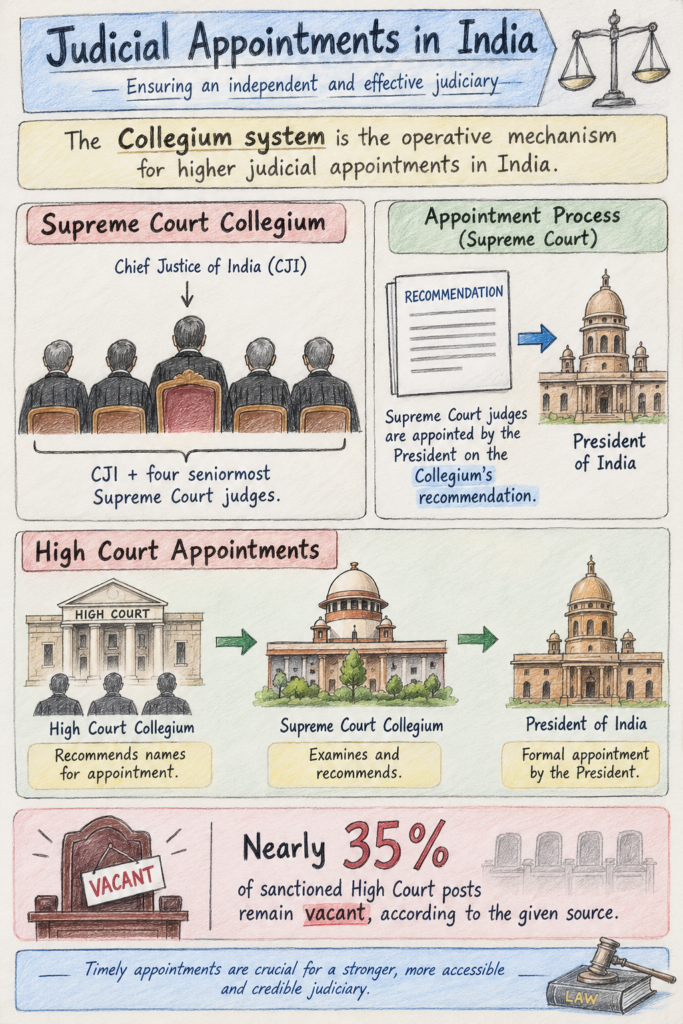
    Opaque Collegium System- criticised for lack of transparency and nepotism. Eg- uncle judge syndrome (law commission)

    Inconsistency and Selective Intervention- Uneven judicial response to similar issues affects credibility. Eg- Contrasting stances in Bail cases.

    Frequent judicial intrusion weakens separation of powers.

    Way Forward

    Institutional Restraint- Judiciary must uphold separation of powers

    Enforce strict scrutiny of PILs to prevent misuse for personal, political, or publicity motives.

    Develop a judgment-monitoring mechanism to ensure effective execution of court orders

    Promote constitutional literacy and encourage responsible use of judicial remedies by citizens.

    Dedicated PIL Cells in High Courts

    As Justice J.S. Verma cautioned, “Judicial activism must not become judicial adventurism.” Thus, judicial activism must be balanced with Judicial Restraint.

  • Consider the following statements

    Consider the following statements :
    1. The Advocate General of a State in India is appointed by the President ot India upon the recommendation of the Governor of the concerned State.
    2. As provided in Civil Procedure Code, High Courts have original, appellate and advisory jurisdiction at the State level.
    Which of the statements given above is/are correct ?

  • Consider the following statements

    Consider the following statements:

    1. The- motion to impeach a Judge of the Supreme Court of India cannot be rejected by the Speaker of the Lok Sabha as per the Judges (Inquiry) Act, 1968.
    2. The Constitution of India defines and gives details of what Constitutes ‘incapacity and proved misbehaviour’ of the Judges of the Supreme Court of India.
    3. The details of the process of impeachment of the Judges of the Supreme Court of India are given in the Judges (Inquiry) Act, 1968.
    4. If the motion for the impeachment of a Judge is taken up for voting, the law requires the motion to be backed by each House of the Parliament and supported by a majority of total membership of that House and by not less than two-thirds of total members of that House present and voting.

    Which of the statements given above is/are correct?

  • Consider the following statements

    Consider the following statements:
    1. The Constitution of India defines its ‘basic structure’ in terms of federalism, secularism, fundamental rights and democracy.
    2. The Constitution of India provides for ‘judicial review’ to safeguard the citizens’ liberties and to preserve the ideals on which the Constitution is based.
    Which of the statements given above is/are correct?