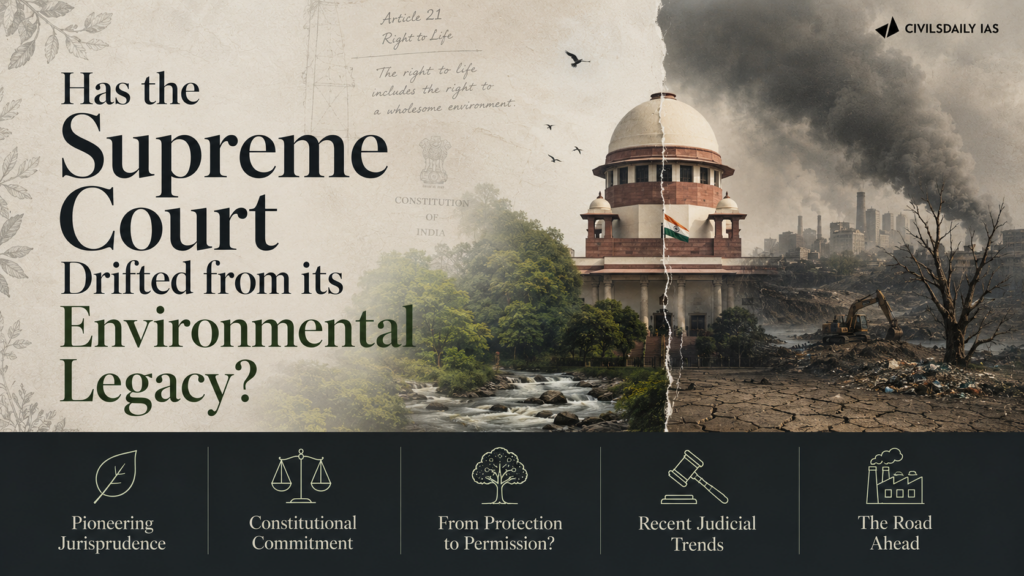
Why in the News
A recent reflection has revisited the Supreme Court’s four-decade legacy of environmental jurisprudence. This raises questions over whether recent rulings are departing from its established environmental doctrines.
What are the core doctrines of Indian environmental law?
- Absolute liability: An enterprise engaged in a hazardous activity is fully liable for harm, established after the Bhopal disaster.
- Polluter pays principle: The cost of pollution and remediation falls on the polluter.
- Precautionary principle: Lack of scientific certainty is no reason to defer measures against environmental harm.
- Public trust doctrine: The state holds natural resources as a trustee for the public.
Where do these doctrines come from constitutionally?
- Article 48A: Directs the state to protect and improve the environment.
- Article 51A(g): Makes environmental protection a fundamental duty of citizens.
- 42nd Amendment, 1976: Inserted both provisions into the Constitution.
- Article 21: Read to include the right to a clean environment.
What is the tension?
- Development pull: Recent rulings are read as leaning toward clearing infrastructure over precaution.
- Amnesty concern: Environmental amnesty for past violations is questioned as inconsistent with the polluter pays principle.
- Consistency critique: The Court is charged with applying its own doctrines unevenly across cases.
Conclusion
The central claim is that the Court built strong environmental doctrine but now applies it inconsistently. What remains unresolved is whether the Court restores precaution as the default in development disputes.
Back2Basics
Foundational Context: environmental jurisprudence in India
- Judicial origin: Much of Indian environmental law is judge-made through public interest litigation.
- Landmark cases: M.C. Mehta cases, Vellore Citizens’ Welfare Forum, and the Bhopal litigation shaped the doctrines.
- Sustainable development: The Court fused environmental protection with development as a constitutional balance.
- Expansion of Article 21: The Supreme Court progressively interpreted the right to life to include the right to a clean, healthy and pollution-free environment
Landmark Cases
- M.C. Mehta cases: Developed principles of environmental liability and protection.
- Vellore Citizens’ Welfare Forum v. Union of India (1996): Recognised the precautionary principle and polluter pays principle as essential features of sustainable development.
- M.C. Mehta v. Union of India (Oleum Gas Leak, 1987): Established the doctrine of absolute liability.
- M.C. Mehta v. Kamal Nath (1997): Strengthened the public trust doctrine.
PYQ Relevance
“[2010] Sustainable development is described as the development that meets the needs of the present without compromising the ability of future generations to meet their own needs. In this perspective, inherently the concept of sustainable development is intertwined with which of the following concepts?
(a) Social Justice and Empowerment
(b) Inclusive Growth
(c) Globalization
(d) Carrying capacity
