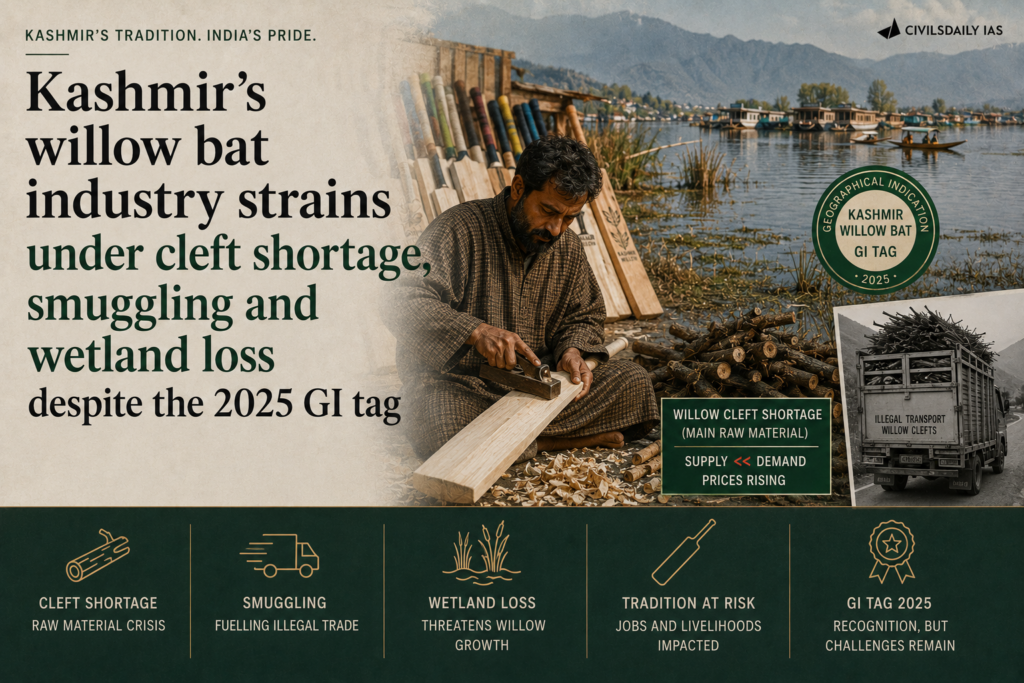
Why in the News
Kashmir’s ₹700 crore cricket bat industry supports around 50,000 livelihoods, but faces a shortage of quality willow. English willow prices have risen from ₹300 to ₹4,250 per foot since 2021.
Key Facts
- Raw material: Mainly Salix alba (English willow).
- Industry: 195 registered manufacturers and around 150 cleft dealers.
- Production: Around 30 lakh bats annually.
- Trees: Nearly 1.2 lakh mature trees are felled annually.
- Maturity: Willow requires about 12 to 15 years to reach harvest maturity.
- Smuggling: Over 25 lakh clefts are reportedly smuggled out annually.
- GI Tag: Kashmir willow bats received a GI tag in 2025.
Why is the industry facing a crisis?
- Scarcity of quality willow
- Wetland and spring degradation
- Smuggling of clefts
- Long 12 to 15 year plantation cycle
- Inconsistent timber quality
What does the GI Tag do?
- Protects the Kashmir willow name from misuse.
- Enhances product reputation and market value.
- Provides legal protection to registered producers.
- Does not increase willow supply or shorten the growth cycle.
Government Response
- Plantation of 2.2 lakh willow trees across 200 hectares.
- Introduction of improved willow clones.
- Identification of new plantation sites.
- Greater farmer participation and scientific plantation management.
Prelims Pointers
- GI Act: Geographical Indications of Goods (Registration and Protection) Act, 1999.
- First Indian GI: Darjeeling Tea, 2004.
- GI validity: 10 years, renewable indefinitely.
- GI ownership: Collective, not individually transferable.
- Kashmir willow species: Salix alba.
[2018] India enacted The Geographical Indications of Goods (Registration and Protection) Act, 1999 in order to comply with the obligations to
(a) ILO
(b) IMF
(c) UNCTAD
(d) WTO
