Why in the news?
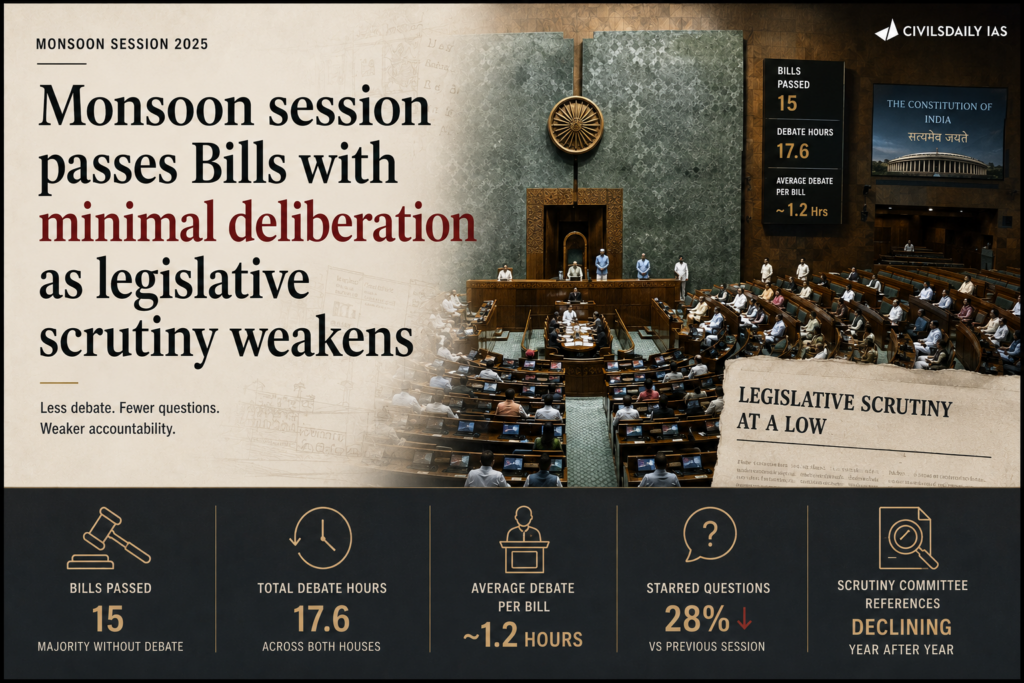
The monsoon session that began on 20 July passed nine of its eleven Bills with only the minister in charge speaking, and recorded a productivity rate of 15 per cent. Legislation that redraws Centre State powers over minerals therefore cleared Parliament without the examination the House exists to provide. Two further proposals, on delimitation and on foreign contributions, were stalled rather than scrutinised, and both remain alive.
What is the Pre-Legislative Consultation Policy, 2014?
- About: It is a policy of the Department of Legal Affairs requiring every department to place a draft Bill in the public domain before it is introduced in Parliament.
- What must be disclosed: The draft, an explanatory note in simple language, the financial implications, and an estimate of the impact on the environment, fundamental rights and livelihoods.
- Consultation period: A minimum of thirty days is to be given for public feedback, and a summary of the responses received is to be published.
- Link to the House: The summary of feedback is to be placed before the departmentally related standing committee that examines the Bill.
- Status: The policy is executive and not statutory, so it carries no enforcement mechanism and departments comply selectively.
What is a Joint Parliamentary Committee?
- About: It is an ad hoc committee constituted by a motion adopted in one House and concurred in by the other, carrying members from both Houses.
- Function: It examines a specific Bill or subject, takes evidence from officials, experts and the public, and reports its recommendations to Parliament.
- Composition: Membership is proportional to party strength, which gives the ruling party a majority within the committee.
- Binding force: Its recommendations are advisory, and the government may accept or reject them when the Bill returns to the House.
What is delimitation?
- About: It is the redrawing of the boundaries and the allocation of parliamentary and Assembly constituencies to reflect population change.
- Machinery: A Delimitation Commission constituted under a law made by Parliament carries it out, and its orders cannot be called in question in any court.
- The freeze: The 42nd Amendment froze seat allocation on the 1971 Census, and the 84th Amendment, 2001 extended that freeze until the first Census taken after 2026.
- Why it is contested: States that reduced fertility fastest stand to lose relative weight in the Lok Sabha once the freeze lapses, which makes the design of the exercise a federal question.
What is the Foreign Contribution (Regulation) Act, 2010?
- About: It regulates the acceptance and use of foreign contributions and foreign hospitality by persons, associations and companies in India.
- Mechanism: It requires registration or prior permission from the Ministry of Home Affairs, and after the 2020 amendment every contribution must first be received in a designated State Bank of India, New Delhi account.
- Restrictions: The 2020 amendment barred the transfer of foreign contributions to any other person and capped administrative expenses at 20 per cent.
- Why it recurs: Cancellations and refusals of renewal have repeatedly been challenged as a control on civil society rather than a check on funding.
How is parliamentary productivity measured?
- About: It is the ratio of the time a House actually transacts its listed business to the time for which it was scheduled to sit.
- What lowers it: Adjournments caused by disruption, sittings cut short, and business dropped without being taken up.
- What it does not capture: A Bill passed in minutes without discussion raises legislative output while reducing scrutiny, so productivity and deliberation can move in opposite directions.
What did the monsoon session pass and what did it leave pending?
- Session dates: The session began on 20 July.
- Volume and debate: Nine of the eleven Bills passed had only the minister concerned speaking on them.
- Productivity: The session recorded a productivity rate of 15 per cent.
- National song Bill: A Bill was passed facilitating the operation of a February guideline of the Ministry of Home Affairs on mandatory singing of the full version of Vande Mataram, the national song, at state functions.
- Mines and minerals: The Mines and Minerals (Development and Regulation) Amendment Bill was passed amid Opposition protests.
- Examinations: The session legislated stronger measures against malpractices in examinations, in an effort to address student anger.
- Delimitation: An attempt to rush through a new architecture for the delimitation process did not entirely materialise.
- Foreign contributions: The Bill to amend the law on foreign contributions was not passed and stands referred to a Joint Parliamentary Committee.
- Both alive: Neither the delimitation proposal nor the foreign contribution amendments have lapsed, and both can be brought back.
Why did the session’s political context override its legislative function?
- The trigger: The student protest demanding the resignation of the Union Education Minister gathered momentum just as the session began.
- The governing party’s expectation: The ruling party entered the session with the context and the confidence to make it a theatre of triumph, powered by its victory in the West Bengal Assembly election.
- What reversed it: Public reaction to the crackdown on the protesting students by the Delhi Police, with police personnel filmed assaulting and attempting to sexually abuse young people.
- Accountability gap: No accountability has yet been fixed for those blatant violations of the law by police personnel.
- Absent leadership: The Prime Minister and the Union Home Minister barely attended the proceedings.
- The one resolution: The Union Education Minister eventually resigned during the session.
What does hurried lawmaking do to federalism?
- The specific Bill: The mineral law amendment was passed without addressing its potential to undermine federalism.
- Whose rights were skipped: The concerns of those living on resource rich land were not examined during its passage.
- The pattern: Hurried lawmaking has accompanied a continuing expansion of the powers of the central government at the cost of States and local communities.
- Why deliberation matters here: A Bill that redistributes power between the Union and the States requires the States to be heard, which only committee examination provides.
- The missing step: No all party meeting and no consultation with State Chief Ministers preceded either this Bill or the delimitation proposal.
Why does a single minister speaking on a Bill amount to a scrutiny failure?
- What passage then means: The House records its assent without testing the Bill against any competing view or amendment.
- Whose loss it is: The electorate is deprived of its representatives’ scrutiny, which is the service a legislature exists to deliver.
- Disruption as an alibi: Disruption is routinely blamed, but a 15 per cent productivity rate points to a structural failure rather than an episodic one.
- Committee substitution: Referral to a committee is the standard remedy for a truncated floor debate, and it was used for only one of these Bills.
- Consequence for the statute: A Bill passed without debate leaves no legislative record from which courts can read its purpose when it is later challenged.
Is a stalled Bill a win for parliamentary scrutiny?
- The case for the Opposition: It prevented passage of the delimitation architecture and the foreign contribution amendments without examination.
- The case against triumph: Blocking a Bill is not the same as examining it, and both proposals remain alive for reintroduction on the same terms.
- The committee risk: The Joint Parliamentary Committee on the foreign contribution Bill can be reduced to a mere numbers game in which the majority records its own view.
- The reversibility point: Political circumstances turn rapidly, as the governing party discovered within this very session.
- What is actually needed: An all party meeting, circulation of draft legislation and consultation with State Chief Ministers, none of which a stalling tactic delivers.
- The framing error: Treating the House as a gladiatorial arena where one side vanquishes the other removes the possibility of a collective solution.
What would genuine consultation on these two proposals look like?
- All party meeting: The Centre convening a meeting of all parties before introducing the delimitation architecture.
- Draft in the public domain: Circulation of the draft legislation so that affected parties can respond before introduction rather than after passage.
- Consulting the States: Consultation with State Chief Ministers, since delimitation redistributes representation between States.
- Substance in committee: The Joint Parliamentary Committee on the foreign contribution Bill taking evidence from affected organisations rather than voting on party lines.
- Transparency of feedback: Publication of the responses received and the reasons for accepting or rejecting each substantive objection.
Challenges to Parliamentary Scrutiny of Legislation
- Falling committee referrals: The share of Bills sent to departmentally related standing committees has collapsed, e.g. about 16 per cent of Bills were referred in the 16th Lok Sabha against 71 per cent in the 15th.
- Passage without debate: Bills clear the House in minutes when it is in disorder, e.g. nine of the eleven Bills of this monsoon session were passed with only the minister in charge speaking.
- The Money Bill route: Certifying a Bill as a Money Bill removes the Rajya Sabha’s power to amend it, e.g. the Aadhaar Act, 2016, whose certification was referred to a larger Bench in Rojer Mathew v. South Indian Bank (2019).
- Ordinance dependence: The executive legislates between sessions and seeks ratification later, e.g. the Supreme Court in Krishna Kumar Singh v. State of Bihar (2017) held that repeated re promulgation of ordinances is a fraud on the Constitution.
- Shrinking sitting days: The House now sits far fewer days than in its early decades, e.g. average annual sittings have fallen from over 120 days in the 1950s to around 60 days in recent years.
- Anti defection chill: The Tenth Schedule ties a member’s vote to the party whip, which removes the incentive to argue a case on the floor, e.g. a member voting against a party direction on a Bill faces disqualification.
- No review after enactment: No standing mechanism examines whether an enacted law achieved its stated purpose, e.g. the Pre-Legislative Consultation Policy, 2014 carries no compliance audit and is bypassed routinely.
Conclusion
A session that passed nine of eleven Bills with a single speaker each and closed at 15 per cent productivity did not fail merely because of disruption; it failed because passage was decoupled from examination. Blocking two proposals gave the Opposition a tactical result without restoring scrutiny, since both remain available for reintroduction unchanged. What must change is procedure rather than temper: mandatory committee referral, circulation of draft legislation, and consultation with the States before any Bill that alters their powers is introduced.
What is Executive Accountability to the Legislature?
- About: It is the principle that the council of ministers holds office only while it retains the confidence of the popularly elected House and must answer to it for every executive act.
- Rationale: In a parliamentary system the executive is drawn from the legislature, so scrutiny by the House is the only continuous check between two elections.
- Collective responsibility: Article 75(3) makes the council of ministers collectively responsible to the Lok Sabha, which is the constitutional root of the principle.
- Question Hour and Zero Hour: Members question ministers on administrative action, and raise urgent matters without prior notice.
- Motions: Adjournment motions, calling attention notices, censure motions and the no confidence motion allow the House to force a discussion or remove the government.
- Financial control: Cut motions, the demands for grants, and the Comptroller and Auditor General’s reports examined by the Public Accounts Committee control the executive’s use of money.
- Committee scrutiny: Departmentally related standing committees, joint committees and select committees examine Bills, budgets and departmental performance away from the floor.
Key Concerns Regarding Legislative Oversight
- Guillotine on budget scrutiny: Most demands for grants are voted without discussion when the guillotine is applied at the end of the budget session.
- Truncated Question Hour: Question Hour is frequently lost to disruption or curtailed by the presiding officer, which removes the routine accountability mechanism.
- Committee reports without follow up: Recommendations are advisory, and no mechanism tracks whether the government acted on them.
- Weak research support: Individual members lack dedicated legislative research staff to interrogate a technical Bill.
- Party control over speech: The whip system converts a member’s vote into a party decision, which removes the incentive to examine a Bill independently.
- Declining sittings: Fewer sitting days compress every function of oversight into a shorter window each year.
Constitutional Framework Governing Parliamentary Lawmaking and Oversight
- Article 75(3): Makes the council of ministers collectively responsible to the House of the People.
- Article 79: Constitutes Parliament as the President, the Council of States and the House of the People.
- Article 85: Requires that six months not elapse between two sittings, and governs prorogation and dissolution.
- Article 93: Provides for the Speaker and Deputy Speaker of the House of the People.
- Article 100: Governs voting, the quorum of one tenth of the total membership, and the effect of vacancies.
- Article 105: Confers freedom of speech in Parliament and the privileges of the Houses and their members.
- Article 107: Governs the introduction and passing of Bills in both Houses.
- Article 108: Provides for a joint sitting of both Houses to resolve a deadlock over a Bill.
- Articles 109 and 110: Define a Money Bill and confine the Rajya Sabha to recommendations on it.
- Article 111: Governs assent, withholding of assent and the return of a Bill by the President.
- Article 117: Requires the President’s recommendation for financial Bills.
- Article 118: Empowers each House to make rules of procedure for the conduct of its business.
- Article 122: Bars courts from inquiring into proceedings of Parliament on the ground of irregularity of procedure.
- Article 82: Requires readjustment of seats and constituencies after every Census, which is the basis of delimitation.
- Article 148: Establishes the Comptroller and Auditor General, whose reports anchor financial oversight.
- Tenth Schedule: Provides for disqualification on the ground of defection, which binds a member to the party whip.
Back2Basics: Parliamentary Committees in India
- Constitutional basis: Article 105 and Article 118 supply the privileges and the rule making power under which committees function.
- Two broad types: Standing committees, which are permanent and reconstituted every year, and ad hoc committees, which cease to exist once they report.
- Financial committees: The Public Accounts Committee, the Estimates Committee and the Committee on Public Undertakings.
- Public Accounts Committee: Constituted in 1921, it has 22 members and is chaired by convention by a member of the Opposition.
- Departmentally related standing committees: Introduced in 1993, now 24 in number, each with 31 members drawn from both Houses.
- Ad hoc committees: Select committees of one House and joint committees of both Houses, constituted to examine a particular Bill or subject.
- Nature of reports: Committee recommendations are recommendatory and do not bind the government.
- Value of the forum: Committees work outside the glare of the House, which allows cross party agreement that floor debate rarely produces.
Government Initiatives for Legislative Process and Transparency
- Pre-Legislative Consultation Policy, 2014: Requires publication of draft Bills with an explanatory note and a minimum thirty day window for public feedback.
- National e-Vidhan Application (NeVA): Makes legislatures paperless by digitising notices, questions, bulletins and Bills for members.
- One Nation One Application initiative: Brings all State legislatures and Parliament onto a common digital platform for legislative business.
- Digital Sansad: Provides public access to debates, member profiles, questions and legislative documents in searchable form.
- Parliamentary Research and Information Support to Members (PRISM): Supplies research responses to members on subjects of their choice through the Parliament Library.
- Parliamentary Research and Training Institute for Democracies (PRIDE): Trains members and legislature staff in parliamentary procedure and legislative drafting.
Key Facts about the Parliament of India
- Composition: The President, the Rajya Sabha with a maximum of 250 members and the Lok Sabha with a maximum of 550 members drawn from States and Union Territories.
- Sessions: Three sessions each year by convention, namely budget, monsoon and winter, with the six month rule set by Article 85.
- Quorum: One tenth of the total membership of the House, under Article 100.
- Joint sitting: Provided by Article 108 and used three times, for the Dowry Prohibition Bill in 1961, the Banking Service Commission Repeal Bill in 1978 and the Prevention of Terrorism Bill in 2002.
- Departmentally related standing committees: Introduced in 1993 and now numbering 24.
- Anti defection law: Introduced by the 52nd Amendment, 1985 through the Tenth Schedule, and amended in 2003 to remove the split exemption.
- New building: Parliament shifted to the new building in September 2023, with the Lok Sabha chamber seating 888 members.
Challenges in Ensuring Legislative Scrutiny in India
- Disruption as a strategy: Both sides use disorder to avoid a debate they expect to lose, e.g. the monsoon session of 2026 closed at 15 per cent productivity with the presiding officers unable to restore order.
- Budget passed without discussion: The guillotine forces demands for grants through in a single vote, e.g. most ministry demands are guillotined every year with only a handful discussed on the floor.
- Weak private member legislation: Private member Bills are rarely taken up and almost never passed, e.g. only fourteen private member Bills have become law since 1952.
- Vacancy in the Deputy Speaker’s office: Article 93 requires the post to be filled, and prolonged vacancies weaken the presiding structure, e.g. the office remained vacant through the entire 17th Lok Sabha.
- Thin State legislature calendars: Many State Assemblies sit for a fraction of the days Parliament sits, e.g. several State Assemblies have recorded fewer than twenty sitting days in a year.
- Limited member capacity: Members lack dedicated legislative staff to examine technical Bills, e.g. a data protection or nuclear liability Bill reaches the floor with no independent member analysis available.
- Delayed committee constitution: Committees are reconstituted late in the parliamentary year, which shortens the time available to examine Bills referred to them.
Way Forward
- Mandatory referral rule: Amend the rules of procedure so that every Bill stands referred to a committee unless the House expressly resolves otherwise, with reasons recorded.
- Statutory pre legislative consultation: Convert the 2014 policy into a binding requirement, with introduction barred until the consultation summary is tabled.
- Fixed legislative calendar: Adopt a minimum number of sitting days each year, fixed in advance, so that the executive cannot compress the session.
- Independent scheduling authority: Vest the power to convene sittings in a business advisory committee rather than in the executive alone.
- Automatic budget scrutiny: Require at least a fixed number of ministries’ demands to be discussed before the guillotine can be applied.
- Action taken discipline: Require the government to table a reasoned response to every committee recommendation within a fixed period.
- Strengthen member research: Fund dedicated legislative research staff for members and expand the Parliament Library’s analytical output on pending Bills.
- Federal consultation before federal Bills: Institutionalise consultation with State Chief Ministers through the Inter State Council before any Bill that alters State powers is introduced.
“[2021, GS2, 10 marks] To what extent, in your view, the Parliament is able to ensure accountability of the executive in India?”
