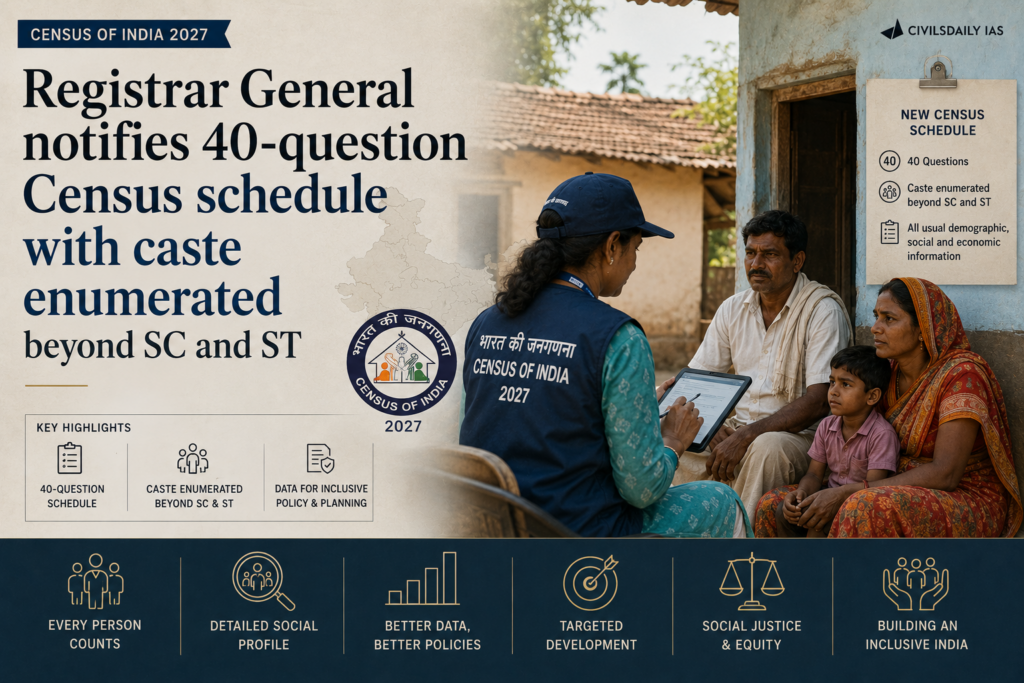
Why in the News
The Registrar General and Census Commissioner of India has notified the 40 question schedule for the population enumeration phase of Census 2027, with caste recorded as an open declaration for the first time in independent India outside the Scheduled Castes and Scheduled Tribes. The notification exposes two tensions. An open caste column stands against the State wise lists prepared in advance for recent State caste surveys, and eight identity fields drawn from the 2020 National Population Register schedule now sit inside an exercise conducted under the Census Act, 1948.
What is the population enumeration schedule of Census 2027?
- About: The schedule is the questionnaire that census officers are legally authorised to put to every person residing in their assigned area.
- Issuing authority: It was notified by the Ministry of Home Affairs under the Census Act, 1948, on the authority of the Registrar General and Census Commissioner of India.
- Instrument of collection: Information is gathered through the household schedule, which records the particulars of every person residing in a household.
- Size: Census 2027 carries 40 questions against the 29 questions of the Census 2011 questionnaire.
- Placement in the exercise: The Census runs in two phases, Housing and House Listing Operations followed by Population Enumeration, and this schedule governs the second phase.
- The caste field: Question number 10 reads Scheduled Caste (SC), Scheduled Tribe (ST), Caste, and the enumerator records the caste as declared by the respondent.
What is the National Population Register (NPR)?
- About: The NPR is the register of usual residents of the country, which is distinct from a register of citizens.
- Legal basis: It is prepared under the Citizenship (Registration of Citizens and Issue of National Identity Cards) Rules, 2003, framed under the Citizenship Act, 1955.
What is the National Register of Indian Citizens?
- About: It is a register of citizens prepared by verifying the entries already recorded in the Population Register.
- Local tier: The Local Register of Indian Citizens holds the verified particulars of persons within the jurisdiction of a Local Registrar.
What is the Socio Economic and Caste Census (SECC) 2011?
- About: The SECC was a household survey of socio economic status and caste conducted alongside Census 2011.
- Statutory position: It was run as a survey outside the purview of the Census Act, 1948, carried no statutory backing, and its caste data were never released by the government.
What are Housing and House Listing Operations?
- About: This is the first phase of the Census, which lists every building and household and records housing conditions and household assets.
- Current status: The phase is due to end on 30 September and has been completed in most States except West Bengal, Assam and Manipur.
What is a reference date in a Census?
- About: The reference date is the fixed instant to which every entry relates, so a person is counted by their situation at that moment rather than on the day the enumerator visits.
- Dates notified: It is 12 a.m. on 1 October for the areas enumerated early and 12 a.m. on 1 March 2027 for the rest of the country.
What is self enumeration in the Census?
- About: Self enumeration allows a household to fill its own schedule through a digital application before any enumerator visit.
- Window notified: The option is available from 17 to 31 August, before house to house population enumeration begins.
Who is the Registrar General and Census Commissioner of India (RG&CCI)?
- About: The RG&CCI is the authority under the Ministry of Home Affairs that conducts the Census and notifies the questions census officers are authorised to ask.
- Other charge: The same office runs the Civil Registration System and the Sample Registration System.
What are the new or modified questions in the Census 2027 schedule?
- Spouse name: The name of the respondent’s spouse is recorded for the first time.
- Nationality as declared: Nationality is recorded as stated by the respondent.
- Father’s particulars: Details of the respondent’s father are recorded.
- Mother’s particulars: Details of the respondent’s mother are recorded.
- Scheduled Caste, Scheduled Tribe, Caste: The existing SC and ST question is modified to add an open caste field.
- Literacy and digital literacy: Digital literacy is added to the existing literacy question.
- Highest educational level attained and stream or discipline: The stream or discipline of study is recorded along with the level attained.
- Place of COVID 19 vaccination: The place where the person received a COVID 19 vaccine is recorded.
- Total number of bank accounts: The count of bank accounts held is recorded.
- Mobile number: The mobile telephone number is recorded where available.
- Aadhaar number: The Aadhaar number is recorded where available.
- Voter ID number: The voter identity card number is recorded where available.
- Passport number: The passport number is recorded for Indian passport holders.
- Availability of driving licence: Whether the person holds a driving licence is recorded.
- Permanent residential address: The permanent residential address is also listed among the fields added for the first time.
- Scale of the change: Thirteen questions or data fields are entirely new against the 29 question Census 2011 schedule, and 14 questions are new or modified when the caste field is counted as a modification.
Which of these questions were also part of the 2020 NPR schedule?
- Nationality as declared: Declared nationality was sought in the NPR schedule notified in 2020.
- Father’s particulars: Particulars of the father were part of the same NPR schedule.
- Mother’s particulars: Particulars of the mother were part of the same NPR schedule.
- Mobile number: The mobile number was collected under the NPR schedule.
- Aadhaar number: The Aadhaar number was collected under the NPR schedule.
- Voter ID number: The voter identity card number was collected under the NPR schedule.
- Passport number: The passport number was collected under the NPR schedule.
- Driving licence: Availability of a driving licence was collected under the NPR schedule.
Why does an open caste column divide opinion against a list prepared in advance?
- The method notified: The enumerator records the caste as declared by the respondent, because the field is an open column with no fixed set of options.
- Evidence from the pre test: The pre test for population enumeration ran from 1 to 20 July in 16 States and Union Territories, where respondents outside the reserved categories recorded caste in an open column.
- The alternative sought: The Congress general secretary stated that the caste question was widely expected to carry a State wise list prepared in advance, as in the Bihar and Telangana caste surveys, with the response merely ticked.
- Charge on intent: The absence of such a list has been described as raising serious doubts on intent.
- Record of the open column: The same method in the 2011 SECC returned over 46 lakh different caste names, largely owing to differences in what people understand by caste.
- Historical benchmark: The 1931 Census, the last to enumerate caste, recorded 4,147 castes.
- Government position: The 2011 SECC caste data have been held over the last decade to be unreliable because of errors in data collection.
How does the overlap with the NPR schedule reopen the citizenship question?
- Statutory link: The Citizenship Rules, 2003 provide for preparation of a Population Register and envisage its verification for preparation of the National Register of Indian Citizens.
- Doubtful entries: Rule 4 provides for marking the particulars of individuals whose citizenship is considered doubtful during verification, for further inquiry.
- Parental birth details: The 2020 NPR schedule sought the date and place of birth of a person’s father and mother, including district and State, and the country of birth where they were born outside India.
- The earlier controversy: Opposition parties and civil society groups argued in 2019 and 2020 that the NPR was a precursor to a nationwide NRC and that parental birth details could later be used to determine citizenship.
- State resistance: Several Opposition ruled States passed resolutions opposing the NPR exercise.
- Political amplification: The Union Home Minister had repeatedly spoken of a nationwide NRC and sought to link it with the Citizenship Amendment Act through a stated chronology.
- Assurance on record: The Prime Minister said in December 2019 that the government had not taken any decision to conduct the NRC, and the Home Ministry reiterated that position on several occasions.
- Present position: The Census questions return without any notification for an NPR and without any announced decision to undertake a nationwide NRC.
What is the current status of the NPR exercise?
- First collection: NPR data were first collected in 2010, along with the houselisting phase of the 2011 Census.
- Update: The register was updated through a door to door exercise in 2015.
- Revival: The Registrar General revived the NPR through a notification in August 2019, to be carried out with the houselisting phase of the 2021 Census.
- Postponement: That exercise was postponed because of the COVID 19 pandemic.
- Budget provision: The Union Budget 2026 to 2027 allocated Rs 6,000 crore under the head Census, Survey and Statistics and Registrar General of India, for Census 2027 and the NPR.
- No fresh notification: The houselisting phase was notified for 1 April to 30 September and made no mention of the NPR, and no fresh NPR exercise has been notified.
- Official explanation: A Home Ministry official stated that the allocation followed provisions made in previous budgets since 2020, to keep funds available if and when the government decides to conduct the NPR.
How is Census 2027 being sequenced across the country?
- Early start: Population enumeration begins on Monday in Ladakh and the snow bound areas of Jammu and Kashmir, Uttarakhand and Himachal Pradesh.
- Rest of the country: Enumeration in the remaining States and Union Territories will take place in February 2027.
- Self enumeration window: The self enumeration option runs from 17 to 31 August, before house to house enumeration starts.
- Reference dates: The count relates to 12 a.m. on 1 October for the early areas and to 12 a.m. on 1 March 2027 for the rest of the country.
- First phase status: Housing and House Listing Operations end on 30 September and are complete in most States except West Bengal, Assam and Manipur.
- Historical marker: This is the first Census since 1931 to enumerate caste and the first in independent India to record caste beyond the Scheduled Castes and Scheduled Tribes.
Challenges to caste enumeration in Census 2027
- Uncontrolled caste nomenclature: An open column accepts whatever name a respondent offers, so sub castes, gotras, sect names and surnames enter the record as separate castes. e.g. the 2011 SECC returned over 46 lakh caste names against the 4,147 castes recorded in the 1931 Census.
- No mapping to State lists: Names collected without a State list cannot be matched to State Other Backward Classes schedules that decide reservation benefits. e.g. Bihar’s 2023 caste survey worked from a fixed list of 214 castes, which allowed direct tabulation of shares.
- Enumerator discretion in the field: Recording is left to a field enumerator, usually a school teacher, with limited training in caste classification. e.g. the 2011 SECC required years of post survey classification by an Expert Group and still yielded data the government declined to release.
- Privacy exposure of identity numbers: Aadhaar, voter identity, passport and mobile numbers create a single linked identity record collected by a field officer. e.g. the Supreme Court in K.S. Puttaswamy versus Union of India (2017) required legality, legitimate aim and proportionality for any state collection of personal data.
- Association with citizenship verification: Eight fields repeat the NPR schedule that triggered protests in 2019 and 2020, which raises the risk of non response in minority and migrant households. e.g. several Opposition ruled State assemblies passed resolutions against the NPR in 2020.
- Operational strain of a longer schedule: Forty questions against 29 lengthens every household visit and raises enumerator fatigue and transcription error. e.g. the first phase is still incomplete in West Bengal, Assam and Manipur with six weeks left on the notified deadline.
- Contestation of the published count: Caste totals feed directly into claims on reservation, so each figure becomes a subject of political dispute. e.g. Bihar’s survey finding that Extremely Backward and Backward Classes form about 63 percent of the State’s population immediately produced demands to breach the 50 percent ceiling.
Conclusion
The notification settles the method of the caste count and leaves its reliability open. An open column repeats the design that produced 46 lakh caste names in 2011, and eight identity fields carry the NPR schedule into a statutory Census that no NPR notification accompanies. Population enumeration begins on Monday in the snow bound areas, with the rest of the country following in February 2027.
Population Data Systems in India
- About: India measures its population through one complete decennial count, one continuous registration system, and a set of large sample surveys that fill the years between counts.
- Census: The Census is a complete headcount conducted since 1872 and synchronously since 1881, and it has run every ten years without interruption until the 2021 round was postponed.
- Civil Registration System: The system continuously records births and deaths under the Registration of Births and Deaths Act, 1969, through State registrars.
- Sample Registration System: This large scale sample survey supplies annual estimates of birth rate, death rate and infant mortality rate between two Censuses.
- National Population Register: The NPR is a register of usual residents maintained under the Citizenship Rules, 2003, and is not a statistical product.
- Sample surveys: The National Sample Survey and the National Family Health Survey supply consumption, employment and health estimates that draw their sampling frames from the Census.
- Digital shift: Census 2027 is the first Census to be conducted digitally, using a mobile application for enumerators and a self enumeration portal for households.
Statutory and Constitutional Framework Governing the Census and Population Registers
- Article 246: Distributes legislative power between the Union and the States through the three lists of the Seventh Schedule.
- Entry 69 of the Union List: Places Census exclusively within the legislative competence of Parliament.
- Census Act, 1948: Provides the legal basis for conducting the Census and for the appointment, powers and duties of census officers.
- Section 3 of the Census Act, 1948: Empowers the Central Government to take a census whenever it considers necessary and to notify its intention.
- Section 8 of the Census Act, 1948: Obliges every occupier and every person to answer the questions put by a census officer.
- Section 15 of the Census Act, 1948: Makes census records confidential, keeps them out of public inspection and bars their use as evidence.
- Section 14A of the Citizenship Act, 1955: Empowers the Centre to compulsorily register every citizen, issue national identity cards and maintain a National Register of Indian Citizens.
- Rule 3(4) of the Citizenship Rules, 2003: Allows the Centre to fix a date by which the Population Register is to be prepared, by collecting information on all persons usually residing within a Local Registrar’s jurisdiction.
- Rule 3(5) of the Citizenship Rules, 2003: Provides that the Local Register of Indian Citizens will contain the details of persons after verification from the Population Register.
- Rule 4 of the Citizenship Rules, 2003: Provides for marking the particulars of individuals whose citizenship is considered doubtful during verification, for further inquiry.
Laws and Rules Governing Census and Population Data
- Census Act, 1948: Governs the conduct of the Census, the powers of census officers and the confidentiality of individual returns.
- Census Rules, 1990: Provide the operational detail for appointment of census officers, forms, schedules and the handling of census records.
- Registration of Births and Deaths Act, 1969: Makes registration of births and deaths compulsory and establishes the Civil Registration System.
- Registration of Births and Deaths (Amendment) Act, 2023: Makes the birth certificate a single document for admission, employment and voter registration, and provides for national databases of registered births and deaths.
- Citizenship Act, 1955: Governs acquisition and determination of citizenship, and carries the registration mandate in Section 14A.
- Citizenship (Registration of Citizens and Issue of National Identity Cards) Rules, 2003: Provide for the Population Register, the Local, Sub District, District, State and National Registers of Indian Citizens, and the marking of doubtful citizenship.
- Aadhaar (Targeted Delivery of Financial and Other Subsidies, Benefits and Services) Act, 2016: Governs the collection and use of Aadhaar numbers and restricts their use to notified purposes.
- Digital Personal Data Protection Act, 2023: Governs the processing of digital personal data and allows the Centre to exempt State instrumentalities from specified obligations.
- Collection of Statistics Act, 2008: Governs the collection of statistics on economic, demographic and social matters by the Centre, States and local bodies.
Back2Basics: Census of India
- First census: The first census was taken in 1872 in a non synchronous manner during the tenure of Viceroy Lord Mayo.
- First synchronous census: The first synchronous census was held in 1881 under Viceroy Lord Ripon.
- Frequency: The Census has been conducted every ten years without a break since 1881, and Census 2011 was the fifteenth national census and the seventh since Independence.
- Administering office: The Office of the Registrar General and Census Commissioner of India was created in 1949 and functions under the Ministry of Home Affairs.
- Legal basis: The exercise is conducted under the Census Act, 1948, and Census is Entry 69 of the Union List.
- Last caste count: The 1931 Census was the last to enumerate caste in full, recording 4,147 castes.
- Census 2011 headline figures: Population stood at 121.09 crore, decadal growth at 17.7 percent, density at 382 persons per square kilometre, sex ratio at 943 and literacy at 74.04 percent.
- Census 2027 markers: It is the first digital Census, the first to enumerate caste since 1931, and it carries two reference dates, 1 October 2026 for snow bound areas and 1 March 2027 for the rest of the country.
Government Initiatives Related to Population Data
- Census 2027 digital application: Enumerators record household and personal particulars on a mobile application instead of paper schedules.
- Self enumeration portal: Households can complete their own schedule online ahead of the enumerator’s visit.
- Civil Registration System portal: Births and deaths are registered online through a centralised portal, with certificates issued digitally.
- Sample Registration System: Provides annual vital rate estimates for States and districts between Censuses.
- National Population Register: Maintains a register of usual residents under the Citizenship Rules, 2003.
- Aadhaar: Provides a unique identity number used to authenticate beneficiaries of subsidies and services.
- National Data and Analytics Platform: A NITI Aayog platform that puts government datasets in a standardised, machine readable form for public use.
Key Facts about the Census of India
- First post Independence census: The first census of independent India was conducted in 1951.
- Phases of Census 2011: House Listing Operations ran from April to September 2010 and Population Enumeration from 9 to 28 February 2011.
- Population recorded in 2011: The count stood at 121,08,54,977 persons.
- State extremes in 2011: Uttar Pradesh was the most populous State, Sikkim the least populous, Kerala recorded the highest literacy and Bihar the lowest.
- Density extremes in 2011: Bihar recorded the highest density among States at 1,106 persons per square kilometre and Arunachal Pradesh the lowest at 17.
- Frozen delimitation: Lok Sabha seat allocation remains fixed on the 1971 Census until the first census taken after 2026.
- Observance: World Population Day is observed on 11 July every year.
Challenges in India’s Population Data System
- Delay in the decennial count: A postponed Census leaves the country without a fresh headcount for far longer than the ten year cycle allows. e.g. the 2021 Census was deferred and the next reference date is 1 March 2027, a gap of sixteen years.
- Outdated policy denominators: Welfare entitlements are calculated on population shares that are more than a decade old. e.g. National Food Security Act, 2013 coverage still rests on 2011 population, and estimates placed before the Supreme Court in 2021 put the excluded number at about 10 crore people.
- Under registration of births and deaths: Incomplete civil registration prevents the Census from being cross checked against a continuous record. e.g. excess mortality during the COVID 19 pandemic could not be settled because registration completeness varied sharply across States.
- Weak measurement of migration: The Census captures migration by last residence and misses seasonal and circular movement. e.g. the 2011 Census counted about 45.6 crore internal migrants, yet in 2020 no State held a usable register of returning migrant workers.
- Caste data gap: The absence of a modern caste count forces policy to rely on pre Independence figures. e.g. the Mandal Commission derived its estimate of Other Backward Classes at about 52 percent from the 1931 Census.
- Data privacy architecture: Collection of identity numbers by a field officer proceeds without an independent oversight body in place. e.g. the Digital Personal Data Protection Act, 2023 permits the Centre to exempt State instrumentalities from key obligations by notification.
- Delayed release and access: Long gaps between collection and release reduce the value of the data for planning. e.g. SECC 2011 caste data were never released at all.
Way Forward
- Publish a State wise caste directory: Prepare and release a standardised caste list for each State before tabulation, so open column returns can be mapped consistently.
- Legislate a fixed census calendar: Amend the Census Act, 1948 to bind the Centre to a stated reference date and a stated release schedule for each decennial round.
- Separate the statistical count from citizenship registers: Notify expressly that data collected under the Census Act, 1948 will not be used to prepare or verify any register under the Citizenship Rules, 2003.
- Strengthen the Civil Registration System: Raise registration completeness to near universal levels so annual vital statistics reduce dependence on a ten year count.
- Constitute an independent data audit: Route quality assurance of the caste and identity fields through the National Statistical Commission before publication.
- Release anonymised unit level data: Publish anonymised microdata on a fixed timetable so researchers can test tabulations rather than accept them.
- Train enumerators on caste recording: Run a dedicated module for enumerators on recording caste responses and on handling refusals, before the February 2027 round.
“[2009] Consider the following statements :
1. Between Census 1951 and Census 2001, the density of the population of India has increased more than three times.
2. Between Census 1951 and Census 2001, the annual growth rate (exponential) of the population of India has doubled.
Which of the statements given abova is/are correct ?
(a) 1 only
(b) 2 only
(c) Both 1 and 2
(d) Neither 1 nor 2
