Why in the News
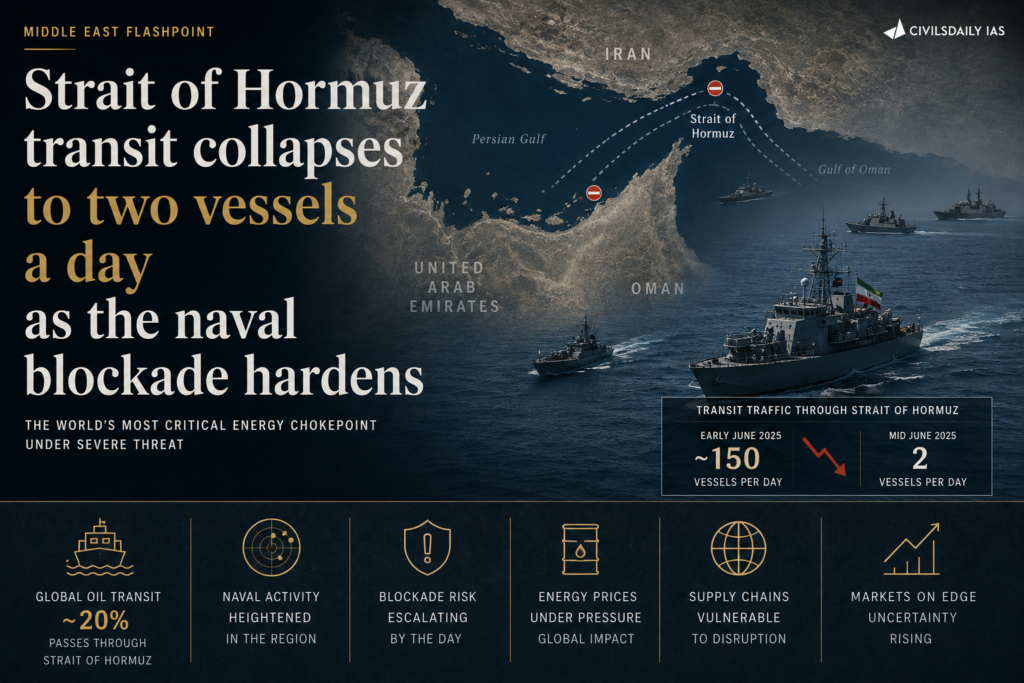
Transit through the Strait of Hormuz fell to two vessels on Friday after two more ships were attacked in the waterway, against more than 130 crossings a day before the war began in February. The near standstill has turned Iran’s ability to close the strait into the decisive bargaining instrument of the war, and has pushed the United States to place cheaper fuel above nuclear denial as its first stated war aim.
What is the Strait of Hormuz?
- Location: The strait connects the Persian Gulf to the Gulf of Oman and the Arabian Sea, with Iran on the northern shore and Oman’s Musandam peninsula and the United Arab Emirates on the southern shore.
- Dimensions: It narrows to about 21 nautical miles, with inbound and outbound traffic separated into lanes about two nautical miles wide each.
- Volume carried: About a fifth of global petroleum liquids consumption passes through it, along with a large share of the world’s seaborne liquefied natural gas.
- Why it cannot be bypassed: Gulf producers hold limited pipeline capacity that avoids the strait, so most Gulf crude has no alternative route to the open ocean.
- Legal position of the lanes: The shipping lanes lie inside the territorial seas of Iran and Oman, so passage rests on the transit passage regime rather than on high seas freedom of navigation.
What is a maritime chokepoint?
- About: A chokepoint is a narrow channel on a high volume shipping route where traffic must converge and cannot be economically rerouted.
- Why it matters: Closure at a chokepoint raises freight and insurance costs across an entire trade, because the alternative is a far longer voyage or no voyage at all.
What is a naval blockade?
- About: A naval blockade is the use of warships to prevent vessels from entering or leaving an adversary’s ports or coastline.
- Its object here: The United States blockade is aimed at stopping Iran from selling oil and at inflicting economic damage rather than at seizing territory.
Who is the Abu Dhabi National Oil Company (ADNOC)?
- About: ADNOC is the state owned oil and gas company of the United Arab Emirates and one of the largest producers in the Gulf.
- Its role in the news: Two vessels affiliated to ADNOC were attacked while transiting the strait, and the UAE government blamed Iran for the attack.
What is going dark on the Automatic Identification System?
- About: Merchant ships broadcast their identity and position through a transponder, and switching it off removes them from public tracking.
- Effect on the count: Vessel counts drawn from tracking data understate real traffic, because ships moving with transponders off are not recorded.
How far has traffic through the strait actually fallen?
- Friday count: Two vessels passed through the waterway, a grain ship entering Iranian waters and an empty dry bulk ship moving in the opposite direction.
- A third movement: A separate empty liquefied petroleum products tanker was sailing into the Gulf through the strait on the same day.
- No crude at all: No crude oil shipments were visible on Friday.
- Preceding days: Nine vessels passed through on Thursday, up from five on Wednesday.
- Benchmark for the month: The August average stands at 12 vessels a day.
- Pre war benchmark: More than 130 ships traversed the strait daily before the war launched by the United States and Israel on Iran in February.
- Measurement caveat: Some ships may pass undetected with their transponders switched off, so the recorded figures are a floor rather than a full count.
Why is control of the strait Iran’s main leverage?
- Analyst assessment: The principal Middle East analyst at a risk intelligence firm assessed that Iran’s ability to restrict shipping through the strait is its main source of leverage in negotiations, alongside the threat to regional energy infrastructure.
- A permission regime at sea: Iran has resumed attacks on ships it accuses of trying to transit the strait without its permission.
- Talks stalled: A senior Iranian source stated on Wednesday that there had been no progress in talks to build on the June agreement to end the war.
- Collapse of the ceasefire: The ceasefire renewed under the June deal has broken down, which preceded the resumption of attacks on shipping.
- Conditions for reopening: Iran has said it will not allow the waterway to reopen until economic sanctions are removed and frozen Iranian assets are released.
- Legislative backing: An Iranian parliamentary committee approved a plan for the strait on Thursday that bans the transit of United States, Israeli and other hostile countries’ assets and equipment.
- Attack on Emirati vessels: ADNOC said two of its vessels were attacked while transiting the strait on Thursday evening, and Iran made no immediate comment on the Emirati accusation.
How has the closure reordered United States war aims?
- Stated reversal of priorities: The Vice President stated that goal number one is to keep oil and gas cheap for Americans and that goal number two is to ensure Iran never gets a nuclear weapon.
- The original justification: Preventing Iran from obtaining a nuclear weapon had been the consistently stated main reason for the war.
- Domestic pressure: The war is unpopular, the President’s approval rating is falling and midterm elections are due in November.
- Party calculation: Republicans fear that the war and the gasoline prices it has driven up will cost them control of Congress.
- Military constraint: The United States military burned through stockpiles of costly high technology missiles and is running low, which limits the option of resuming large scale attacks.
- Blockade endurance: The Defence Secretary stated that the navy can maintain the blockade indefinitely by rotating ships in and out of the region.
- Negotiating posture: The President described the approach as low keying it and only semi negotiating, days after saying an agreement to reopen the strait was imminent.
- Economic track: The Treasury Secretary announced measures of economic isolation without precedent, with further announcements expected next week.
What do the positions of the other parties show about the cost of the closure?
- United Arab Emirates: Its state oil company had two vessels attacked in the strait and the government publicly blamed Iran, which shows that Gulf producers outside the war are absorbing its shipping costs.
- Iran: Its parliamentary committee converted the closure into a formal transit ban on the assets and equipment of hostile states, which shows the closure is now settled policy rather than episodic reprisal.
- United States: It has moved from strikes to a naval blockade of Iranian ports and a bar on Iranian oil sales, which shows the war has become an economic siege rather than a military campaign.
- Israel: It launched the war jointly with the United States in February and is named in Iran’s transit ban, which shows the strait is being used to impose costs directly on the belligerents.
- Limits of the evidence: These are the only national positions the reporting supplies, so the effect on Asian importers is documented through prices rather than through stated country positions.
How exposed is India to a prolonged closure of the strait?
- Crude dependence: India imports over 85 percent of the crude oil it consumes and is the third largest crude importer in the world.
- Route concentration: Iraq, Saudi Arabia, the United Arab Emirates and Kuwait are among India’s largest suppliers, and cargoes from all four leave the Gulf through Hormuz.
- Gas contracts: Qatar supplies close to half of India’s liquefied natural gas under long term contracts, and every one of those cargoes transits the strait.
- Fertiliser inputs: Urea, ammonia and phosphatic raw material contracted from Oman, Saudi Arabia and Qatar move on the same route, which links the strait directly to the fertiliser subsidy bill.
- Seafarers: Indians form a large share of the global seafaring workforce and crew a substantial part of Gulf trade, so attacks on merchant shipping place Indian crews directly at risk.
- Price transmission: A sustained rise in crude prices widens the current account deficit, raises the oil import bill and feeds into domestic fuel and freight costs.
- Insurance and freight: War risk premiums on Gulf voyages rise sharply during a closure, which adds a cost to every cargo that does move.
- Remittances and diaspora: About nine million Indians live and work in the Gulf, so a prolonged war in the region carries an employment and remittance risk alongside the energy risk.
Challenges to keeping the Strait of Hormuz open
- Narrow lanes inside territorial waters: The shipping lanes run through Iranian and Omani territorial seas, which lets a littoral state interfere with passage at short notice. e.g. Iranian forces seized the container ship MSC Aries near the strait in April 2024.
- Mines and fast attack craft: Sea mines and small armed boats can close a channel at very low cost against far more expensive warships. e.g. the mining of the frigate USS Samuel B. Roberts in 1988 triggered Operation Praying Mantis.
- Limited bypass pipeline capacity: Existing pipelines that avoid the strait can carry only a fraction of Gulf export volumes. e.g. Saudi Arabia’s East West pipeline to Yanbu and the Emirati line to Fujairah together fall well short of normal Hormuz throughput.
- Insurance and crew availability: War risk premiums and crew refusal can halt trade even where warships keep a route physically open. e.g. attacks on shipping in the Red Sea from late 2023 pushed premiums up several fold and diverted traffic around the Cape of Good Hope.
- Attribution difficulties in attacks at sea: Limpet mines and drones leave little evidence, which delays any collective response. e.g. the 2019 attacks on tankers near Fujairah were denied by Iran and never conclusively attributed.
- Escalation risk from convoy operations: Naval escorting draws external navies into direct contact with a littoral state’s forces. e.g. the reflagging of Kuwaiti tankers under Operation Earnest Will in 1987 led to repeated armed clashes.
- Thin strategic buffers for importers: Importing countries hold limited emergency stocks, so a closure of a few weeks becomes a fiscal event. e.g. India’s strategic petroleum reserves hold about 5.33 million tonnes, close to nine to ten days of imports.
Conclusion
Control of the Strait of Hormuz, and not the nuclear programme, now sets the terms of the war. Iran has converted a waterway into a bargaining instrument, and the United States has answered with a blockade it says it can sustain indefinitely and sanctions it says will be without precedent. Transit stands at two vessels a day against more than 130 before February, and reopening rests on sanctions relief and the release of frozen assets that neither side has conceded.
Maritime Chokepoints and Global Energy Security
- About: A small number of narrow sea passages carry most of the world’s traded oil and gas, which makes energy security a function of a few points on the map.
- Strait of Hormuz: It carries roughly 20 million barrels of oil a day and the bulk of Qatari liquefied natural gas, and it has no adequate bypass.
- Strait of Malacca: It links the Indian Ocean to the South China Sea and carries a comparable volume of oil, mostly bound for China, Japan and South Korea.
- Bab el Mandeb: It connects the Gulf of Aden to the Red Sea and is the approach to the Suez Canal for Asia to Europe trade.
- Suez Canal and the SUMED pipeline: Together they move Gulf and Red Sea crude to the Mediterranean without the Cape route.
- Turkish Straits: The Bosphorus and the Dardanelles carry Russian and Caspian crude out of the Black Sea.
- Cape of Good Hope: It is the fallback route when Suez or Bab el Mandeb is unusable, adding roughly two weeks to an Asia to Europe voyage.
- India’s position: India is the third largest oil consumer and importer in the world, and its imports pass through Hormuz on the western side and Malacca on the eastern side.
Legal Framework Governing Transit Through International Straits
- Article 3 of UNCLOS, 1982: Allows a coastal state a territorial sea of up to 12 nautical miles, which is why the Hormuz lanes fall within national waters.
- Article 37 of UNCLOS, 1982: Applies the transit passage regime to straits used for international navigation between one part of the high seas or an exclusive economic zone and another.
- Article 38 of UNCLOS, 1982: Grants all ships and aircraft the right of transit passage, which shall not be impeded.
- Article 39 of UNCLOS, 1982: Requires ships in transit passage to proceed without delay and to refrain from any threat or use of force against the bordering state.
- Article 44 of UNCLOS, 1982: Bars states bordering straits from hampering transit passage and from suspending it.
- Article 45 of UNCLOS, 1982: Applies non suspendable innocent passage to straits excluded from the transit passage regime.
- SUA Convention, 1988: Criminalises seizure of and violence against ships and obliges parties to prosecute or extradite offenders.
- Article 51 of the United Nations Charter: Preserves the right of individual and collective self defence against an armed attack, which is the ground invoked for naval action.
Back2Basics: Strait of Hormuz
- Type: It is a maritime chokepoint and the only sea route from the Persian Gulf to the open ocean.
- Connects: It joins the Persian Gulf with the Gulf of Oman and further with the Arabian Sea and the Indian Ocean.
- Littoral states: Iran lies to the north, and Oman and the United Arab Emirates lie to the south.
- Width: Its narrowest point is about 21 nautical miles, roughly 39 kilometres.
- Key islands: Qeshm, Hormuz and Larak are Iranian, and Abu Musa and the Greater and Lesser Tunbs are held by Iran and claimed by the United Arab Emirates.
- Peninsula on the southern shore: The Musandam peninsula belongs to Oman and is separated from the rest of the country by Emirati territory.
- Users: Saudi Arabia, Iraq, the United Arab Emirates, Kuwait, Qatar, Bahrain and Iran export their oil and gas through it.
- Volume: It handles roughly a fifth of the world’s petroleum liquids consumption and about a fifth of global liquefied natural gas trade.
Government Initiatives for India’s Energy Security
- Indian Strategic Petroleum Reserves: Underground caverns at Visakhapatnam, Mangaluru and Padur hold about 5.33 million tonnes of crude for emergency use, with a second phase planned at Chandikhol and Padur.
- Diversification of crude sources: Refiners have expanded purchases from Russia, West Africa, the United States and Latin America to reduce dependence on Gulf cargoes.
- Chabahar port and the International North South Transport Corridor: These provide a route to Central Asia and Russia that avoids the Suez and Hormuz corridors.
- India Middle East Europe Economic Corridor: A rail and shipping corridor announced in 2023 to link India to the Gulf and Europe with reduced maritime dependence.
- National Green Hydrogen Mission: Targets 5 million tonnes of annual green hydrogen production by 2030 to displace imported fossil fuel in industry and transport.
- Ethanol Blended Petrol Programme: Raises the ethanol share in petrol to cut crude import volumes and the import bill.
- Open Acreage Licensing Policy and the Hydrocarbon Exploration and Licensing Policy: Expand domestic exploration acreage to raise indigenous production.
- Maritime India Vision 2030 and Sagarmala: Expand port capacity, coastal shipping and shipbuilding to strengthen India’s own maritime logistics.
Key Facts about World Maritime Chokepoints
- Hormuz volume: Roughly 20 million barrels of oil a day pass through the Strait of Hormuz.
- Malacca volume: The Strait of Malacca carries a comparable oil volume and is the shortest route between the Indian Ocean and the Pacific.
- Suez Canal: Opened in 1869 and nationalised in 1956, it links the Red Sea to the Mediterranean.
- Panama Canal: Opened in 1914, it links the Atlantic and the Pacific and is constrained by fresh water availability at Gatun Lake.
- Bab el Mandeb: Its name means the Gate of Tears, and it separates Yemen from Djibouti and Eritrea.
- Turkish Straits regime: Transit is governed by the Montreux Convention of 1936, which regulates warship passage into the Black Sea.
- India’s maritime footprint: About 95 percent of India’s trade by volume and 70 percent by value moves by sea.
- Observance: World Maritime Day is observed by the International Maritime Organization in the last week of September.
Challenges in India’s Energy Security
- Import dependence in crude: More than four fifths of consumption is met by imports, so any supply shock transmits straight to the fiscal position. e.g. the oil import bill crossed 130 billion dollars in a single year when Brent averaged above 100 dollars a barrel in 2022 and 2023.
- Concentration of gas supply: A single supplier accounts for close to half of contracted liquefied natural gas imports. e.g. the long term Qatari contracts renewed in 2024 run to 2048 and all of that volume transits Hormuz.
- Thin emergency stocks: Strategic reserves cover only a few days of consumption against the 90 day norm followed by International Energy Agency members. e.g. India’s reserves at Visakhapatnam, Mangaluru and Padur total about 5.33 million tonnes.
- Payment and sanctions exposure: Sanctions on suppliers disrupt settlement channels and shipping insurance for Indian refiners. e.g. tightened sanctions on Russian crude in 2025 forced refiners to switch cargoes and payment routes at short notice.
- Fertiliser and petrochemical linkage: Gas priced off oil raises the urea subsidy and petrochemical feedstock costs at the same time. e.g. imported urea contracted at 390 dollars a tonne this year illustrates how a Gulf disruption reaches farm input prices.
- Domestic production stagnation: Crude and gas output from ageing fields has not risen with demand. e.g. Mumbai High and the Krishna Godavari basin have seen declining production profiles despite repeated bid rounds.
- Renewable intermittency and storage gap: Solar and wind capacity growth is not matched by storage, which keeps thermal and imported fuel in the base load. e.g. peak evening demand in northern States is still met largely by coal and imported gas.
Way Forward
- Expand strategic petroleum reserves: Complete the Chandikhol and Padur phase two caverns and move coverage towards the 90 day international norm.
- Diversify supply and routes: Extend term contracts to non Gulf suppliers and build storage and refuelling arrangements outside the Hormuz corridor.
- Invest in bypass connectivity: Operationalise Chabahar, the International North South Transport Corridor and the India Middle East Europe Economic Corridor so a single chokepoint does not carry all trade.
- Strengthen naval escort and maritime domain awareness: Sustain deployments and the Information Fusion Centre for the Indian Ocean Region to protect Indian flagged and Indian crewed shipping.
- Support seafarers and shipping insurance: Extend war risk cover arrangements and evacuation protocols for Indian crews on Gulf routes.
- Accelerate demand substitution: Raise ethanol blending, electric mobility and green hydrogen use to cut the volume of crude that must be imported at all.
- Build a price shock buffer in the Budget: Maintain an explicit fiscal cushion for the fuel and fertiliser subsidy so a chokepoint closure does not force mid year expenditure cuts.
“[2026] Ships from which of the following countries have to cross the Strait of Hormuz to reach out to the Indian Ocean?
1. Bahrain
2. Syria
3. Qatar
4. Egypt
(a) 1 and 2
(b) 1 and 3
(c) 2 and 3
(d) 3 and 4
