Why in the News
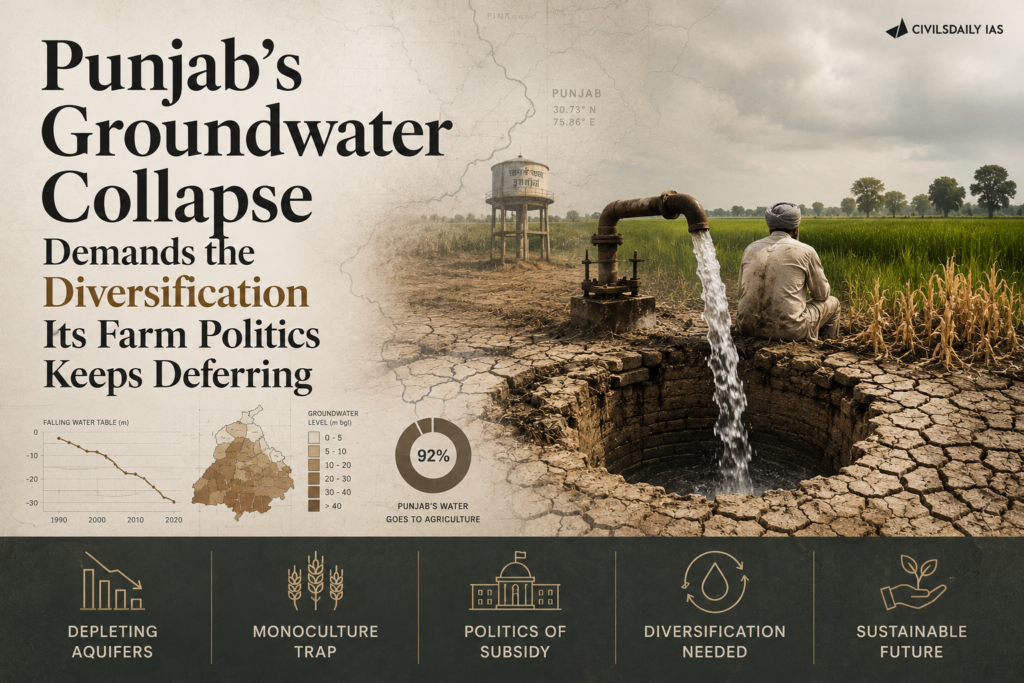
The acreage under water intensive paddy in Punjab touched a record high this year, even as the water table continues to fall and experts warn of impending desertification. The State that built its agrarian success on assured irrigation is now consuming the resource that made it possible, while governments across party lines keep supplying free water and power rather than executing the diversification plans already drafted.
What is crop diversification?
- About: Crop diversification is the shift of cropped area away from one or two dominant crops toward a wider mix of crops within the same season or rotation.
- How it works: A cultivator replaces part of the area under a water intensive or soil depleting crop with pulses, oilseeds, maize, cotton or horticulture.
- Rationale: It reduces the drawdown on a single natural resource and spreads market and weather risk across several crops.
- The precondition: It requires an assured market or procurement for the replacement crop, since the displaced crop already has one.
Who was Ajit Singh?
- About: Ajit Singh was a peasant leader of colonial Punjab and the uncle of Bhagat Singh, and one of the main architects of the Pagdi Sambhal Jatta agitation against British agricultural laws.
- Exile and return: Hounded by the British, he spent nearly four decades abroad, engaging with revolutionaries including Lala Har Dayal and Subhas Chandra Bose, and was imprisoned in Germany after the Second World War before Jawaharlal Nehru secured his release in early 1947.
- Death: He died at Dalhousie at about 3.30 am on 15 August 1947, aged 66, his last words recorded as “Jai Hind”.
What were the canal colonies of western Punjab?
- About: The canal colonies, known locally as the Baar, were settlements created in western Punjab after the British built an extensive canal network in the late nineteenth and early twentieth centuries.
- Why they were created: Large parts of western Punjab had remained uncultivated for centuries for want of irrigation, and the canals made cultivation possible for the first time.
What is a murabba?
- About: A murabba is a square land allotment of 25 acres, the standard unit granted to settlers in the canal colonies.
- Who received them: Cultivators from what is now Indian Punjab, including retired soldiers, were moved into the colonies and allotted murabbas.
What is abiana?
- About: Abiana is the water charge levied on cultivators for the use of canal irrigation.
- Why it mattered: A hike in abiana was one of the three grievances that triggered the 1907 Pagdi Sambhal Jatta agitation.
What was the Pagdi Sambhal Jatta movement?
- About: Pagdi Sambhal Jatta was a peasant agitation of 1907 in colonial Punjab against three British laws that threatened farmers’ rights over their land and raised the water charge.
- How it got its name: Lala Banke Dayal’s poem of that title was recited at a rally in Lyallpur in March 1907, giving the movement its name and its anthem.
What is desertification?
- About: Desertification is the degradation of land in dry, semi dry and dry sub humid areas, driven by climatic variation and human activity, until it loses its biological productivity.
- How it applies to Punjab: Sustained groundwater extraction beyond the recharge rate turns irrigated land progressively unproductive, which is the process experts have warned of in Punjab.
What is Vibhajan Vibhishika Smriti Diwas?
- About: Vibhajan Vibhishika Smriti Diwas, or Partition Horrors Remembrance Day, is observed on 14 August each year since 2021.
- Purpose: It commemorates the displacement and loss suffered during the Partition of 1947.
How did canal irrigation create Punjab’s agrarian identity?
- Arid land before irrigation: Large parts of western Punjab stayed uncultivated for centuries for want of irrigation.
- The canal network was the first input: The British built an extensive canal system across the region in the late nineteenth and early twentieth centuries.
- Settlers were the second input: Water alone was not enough, so cultivators from what is now Indian Punjab, including retired soldiers, were moved into the new tracts.
- Land allotted as murabbas: Each settler household received a murabba of 25 acres in the colonies.
- Settlements numbered, not named: New colonies were given administrative numbers such as Chak 8, Chak 20 and Chak 503, often carrying the name of the migrants’ original village, as in Chak 503 Narangwal.
- Reclamation took years: The land was arid and took years of sustained work before it turned fertile, which is why its loss at Partition was felt as the loss of built capital.
What does Punjab’s tradition of agrarian resistance consist of?
- The 1907 movement: Ajit Singh led the Pagdi Sambhal Jatta agitation alongside Lala Lajpat Rai against three British laws that threatened farmers’ rights and hiked the water charge or abiana.
- Scale of mobilisation: Ajit Singh addressed 19 of the 33 meetings recorded by British intelligence.
- The anthem: Lala Banke Dayal’s poem was recited at a rally in Lyallpur in March 1907 and gave the movement its name.
- The outcome: The British withdrew the farm laws, and both leaders were imprisoned in Mandalay, Burma.
- Recognition: Bal Gangadhar Tilak hailed Ajit Singh as the “king of Punjab peasantry” on his return.
- The tradition carried forward: The same slogan was raised during the 2020-21 farmers’ agitation against the since repealed central farm laws.
Why has the adversary shifted from colonial law to resource depletion?
- The threat is now internal: The challenge today is not colonial rule but the depletion of the resource that made Punjab’s agrarian success possible.
- Warnings are long standing: Experts have warned of impending desertification in Punjab for years.
- The trend is worsening, not stabilising: Acreage under water intensive paddy cultivation touched a record high this year.
- The water table keeps falling: The aquifer continues to drop even as extraction expands with every additional paddy season.
- The cost is deferred, not avoided: Groundwater does not recharge at the rate at which it is being pumped, so each season transfers the shortfall to a later one.
Why has a known diagnosis not produced action?
- The solutions are already documented: Economist S S Johl outlined diversification measures during the tenure of the previous Congress government in the State.
- Later plans exist as well: The current State government has also prepared plans on the water issue.
- Implementation is the gap: Execution of both sets of plans remains negligible.
- The problem is not knowledge: Punjab knows precisely what has to be done and consistently fails to do it, which makes this an execution failure rather than a policy vacuum.
Why do free water and assured paddy procurement keep expanding the crop that is emptying the aquifer?
- The case for the free provision: Free water and free power for tubewells lower the cash cost of cultivation for a farm sector carrying heavy debt.
- The political arithmetic: State governments cutting across party lines have continued the free provision for political reasons, since withdrawing it carries an immediate electoral cost.
- Assured procurement completes the lock in: Paddy and wheat carry guaranteed purchase at a minimum support price, and no alternative crop offers comparable certainty.
- The other side of the ledger: Free power removes the price signal on extraction, so pumping continues well past the rate at which the aquifer can recharge.
- Two legitimate claims in conflict: Farm income security and aquifer survival both carry a genuine claim, and current policy settles the question entirely in favour of the first.
- The cost appears nowhere: The support shows up as a power subsidy line in the State budget, while the depletion appears in no account until wells begin to fail.
Why have farmer unions’ priorities not tracked the water crisis?
- Attention directed at trade: Farmer unions have mobilised strongly against free trade agreements.
- The nearer threat is unaddressed: The same unions have overlooked aquifer depletion as a looming calamity of comparable scale.
- Individual adaptation is happening: Some individual farmers have adopted alternatives to paddy on their own initiative.
- Collective adaptation is not: Most cultivators remain caught within an unsustainable farming model that no organised body is challenging.
What does the stated way forward require?
- Reduce paddy dependence: Cut the area under water intensive paddy cultivation.
- Guarantee markets for the substitutes: Ensure assured markets for diversified crops so that the switch is not a loss of income.
- Invest in micro irrigation: Move field irrigation from flood delivery to drip and sprinkler systems.
- Build food processing capacity: Create processing demand that gives non paddy crops a committed buyer.
- Align policy with ecology: Set agricultural policy against ecological limits rather than electoral compulsions.
Challenges to crop diversification in Punjab
- Absence of assured procurement for alternative crops: Only paddy and wheat carry guaranteed purchase, so any switch transfers price risk to the farmer. e.g. maize in Punjab routinely selling below its minimum support price for want of a procurement agency.
- Free power removes the cost of extraction: Zero marginal cost pumping eliminates any incentive to economise on water. e.g. blocks in Sangrur, Barnala and Moga classified as over exploited by the Central Ground Water Board while tubewell use continues unchecked.
- Sunk investment in the paddy and wheat rotation: Farm assets are built around a single cycle and cannot be repurposed. e.g. combine harvesters, paddy transplanters and laser levelled fields configured for that rotation alone.
- Labour and machinery calendar locked to paddy: The seasonal labour supply arrives for a specific operation window. e.g. migrant labour arriving in June for transplanting, a cycle no substitute crop matches.
- Groundwater regulation limited to sowing dates: Existing law delays transplanting without reducing total irrigated area. e.g. the Punjab Preservation of Subsoil Water Act, 2009, which shifted the transplanting date later but left acreage untouched.
- Weak processing and cold chain for horticulture: Perishable substitutes fail without storage and processing capacity nearby. e.g. kinnow growers in Abohar and Fazilka facing distress sales in glut years.
- Residue burning tied to the compressed paddy to wheat window: The delayed transplanting date leaves too little time between harvest and the next sowing. e.g. the October and November stubble fires across Sangrur, Bathinda and Patiala every year.
Conclusion
Punjab’s crisis is not the absence of a diversification plan but the presence of a policy structure that pays cultivators to keep growing paddy. Free water and power remove the cost of extraction while assured procurement removes the risk of continuing, so a record paddy acreage now coexists with a falling water table and warnings of desertification. Diversification will begin only when an alternative crop carries the same market certainty that paddy already has. Until then the tradition of agrarian resistance will keep facing outward while the aquifer empties.
Groundwater Irrigation in India
- About: Groundwater irrigation is the extraction of water from aquifers through wells and tubewells for crop cultivation, as distinct from surface canal irrigation.
- India’s standing: India is the largest user of groundwater in the world, extracting more than the United States and China combined.
- Share of irrigation: Groundwater accounts for roughly 60 per cent of irrigated area and about 85 per cent of rural drinking water supply.
- The assessment system: The Central Ground Water Board and State agencies jointly assess blocks annually and classify them as safe, semi critical, critical or over exploited.
- Regional concentration of stress: Punjab, Haryana, Rajasthan, western Uttar Pradesh and parts of Tamil Nadu carry the highest proportion of over exploited units.
- The energy link: Subsidised or free electricity for agricultural pumping is the single largest driver of extraction, since it removes the marginal cost of drawing water.
Constitutional Framework Governing Water in India
- Entry 17, State List, Seventh Schedule: Places water supply, irrigation, canals, drainage, embankments and water storage under State legislative competence.
- Entry 56, Union List, Seventh Schedule: Empowers Parliament to regulate inter State rivers and river valleys where it declares such regulation expedient in the public interest.
- Article 262: Allows Parliament to provide for adjudication of inter State river water disputes and to bar the jurisdiction of courts in such disputes.
- Article 21: Interpreted by the Supreme Court to include the right to clean and adequate water as part of the right to life.
- Article 48A: Directs the State to protect and improve the environment, which courts have read as covering groundwater conservation.
- Article 243G and the Eleventh Schedule: Assign minor irrigation, water management and watershed development to panchayats.
Laws and Rules Governing Groundwater Use
- Indian Easements Act, 1882: Treats groundwater as attached to land ownership, which is the legal root of unrestricted extraction by landowners.
- Environment (Protection) Act, 1986: Provides the authority under which the Central Ground Water Authority was constituted to regulate and control groundwater development.
- Water (Prevention and Control of Pollution) Act, 1974: Governs the quality dimension of water resources through the pollution control boards.
- Punjab Preservation of Subsoil Water Act, 2009: Bars paddy nursery sowing and transplanting before notified dates, in order to shift the crop’s peak water demand closer to the monsoon.
- Model Bill for Conservation, Protection and Regulation of Groundwater, 2016: Circulated to States to establish groundwater as a public trust and to create local level groundwater security plans.
- Electricity Act, 2003: Governs agricultural power tariffs and the State subsidy mechanism that determines the cost of pumping.
- Guidelines for groundwater extraction, 2020: Prescribe the no objection certificate regime for industrial, infrastructure and mining users of groundwater.
Back2Basics: Central Ground Water Board
- What it is: The Central Ground Water Board (CGWB) is the national apex agency for groundwater assessment, exploration, monitoring and management.
- Year established: Constituted in 1970, on the reorganisation of the Exploratory Tubewells Organisation.
- Parent ministry: It functions under the Department of Water Resources, River Development and Ganga Rejuvenation, Ministry of Jal Shakti.
- Headquarters: Faridabad, Haryana, with regional offices across the country.
- Mandate: It develops and disseminates technologies and monitors and implements national policies for the scientific and sustainable development of groundwater.
- Key outputs: It publishes the annual Dynamic Ground Water Resource Assessment and the groundwater year book, and it categorises assessment units by stage of extraction.
- Regulatory arm: The Central Ground Water Authority, constituted under Section 3(3) of the Environment (Protection) Act, 1986, exercises the regulatory powers over extraction.
Government Initiatives for Groundwater and Crop Diversification
- Atal Bhujal Yojana: A community led groundwater management scheme in water stressed blocks across seven States, with incentives linked to measured improvement in the water table.
- Pradhan Mantri Krishi Sinchayee Yojana, Per Drop More Crop: Funds drip and sprinkler micro irrigation to raise water use efficiency at the farm level.
- Crop Diversification Programme: Operates in the original Green Revolution States of Punjab, Haryana and western Uttar Pradesh to shift area from paddy to alternative crops.
- Pani Bachao Paisa Kamao: A Punjab scheme paying farmers for electricity saved against a benchmark, converting free power into a metered incentive to pump less.
- Direct Seeded Rice incentive: A per acre payment in Punjab for sowing paddy directly rather than transplanting into puddled fields, cutting water use substantially.
- Jal Shakti Abhiyan, Catch the Rain: A national campaign for rainwater harvesting and recharge structure creation in water stressed districts.
- National Food Security Mission and the National Mission on Edible Oils: Support pulses and oilseeds as area substitutes for paddy through seed, input and market interventions.
Key Facts about Groundwater and Punjab Agriculture
- Extraction stage: Punjab has the highest stage of groundwater extraction among Indian States, exceeding the annual recharge by a wide margin.
- Over exploited units: A large majority of Punjab’s assessment blocks are classified as over exploited by the Central Ground Water Board.
- Tubewell density: Punjab operates well over a million agricultural tubewells, nearly all running on subsidised or free power.
- Paddy water requirement: Transplanted paddy consumes several thousand litres of water per kilogram of grain, the highest among Punjab’s field crops.
- Procurement share: Punjab and Haryana together account for a dominant share of central wheat procurement and a large share of rice procurement.
- Green Revolution origin: Punjab was the first State where high yielding wheat varieties were introduced in the mid 1960s, establishing the wheat and paddy rotation.
- The 2009 legal shift: The Punjab Preservation of Subsoil Water Act, 2009 pushed paddy transplanting to mid June to align it with the monsoon onset.
Challenges in Groundwater Management in India
- Legal treatment of groundwater as private property: Ownership attached to land under the Indian Easements Act, 1882 makes extraction limits hard to enforce. e.g. the absence of any cap on the number of tubewells a landowner may sink in most States.
- Free or heavily subsidised farm power: Zero marginal cost pumping removes the economic brake on extraction. e.g. Punjab, Haryana and Tamil Nadu supplying agricultural power free or at a nominal flat rate.
- Minimum support price incentives skewed to water intensive crops: Assured procurement concentrates in paddy and wheat and pulls area toward them. e.g. paddy area in Punjab reaching a record high in 2026 despite falling water tables.
- Weak metering and monitoring of extraction: Without volumetric measurement, regulation cannot be calibrated. e.g. the very small share of agricultural connections in the northern States that carry functioning energy meters.
- Aquifer contamination alongside depletion: Falling water tables concentrate geogenic contaminants and draw in poor quality water. e.g. arsenic in the Gangetic plains and fluoride in parts of Rajasthan and Telangana.
- Fragmented institutional responsibility: Water is a State subject while the regulatory authority is central, producing overlapping mandates. e.g. Central Ground Water Authority notifications applying to industry while agricultural extraction stays outside their reach.
- Poor uptake of micro irrigation: Capital cost and small holding size limit the spread of drip and sprinkler systems. e.g. micro irrigation covering only a small fraction of Punjab’s net sown area despite years of subsidy.
Way Forward
- Extend assured procurement to substitute crops: Guarantee purchase of maize, pulses and oilseeds in Punjab at announced prices so the switch out of paddy carries no income penalty.
- Convert free power into a measured entitlement: Scale the Pani Bachao Paisa Kamao model, paying farmers for unused power rather than withdrawing the subsidy outright.
- Meter agricultural extraction: Install energy or volumetric meters on tubewells to make regulation and incentive design possible.
- Fund micro irrigation at scale: Raise the subsidy and credit support for drip and sprinkler systems to cover small holdings.
- Build processing and cold chain capacity: Locate processing units for maize, kinnow, potato and dairy in Punjab to create local demand for diversified output.
- Enact a groundwater law based on public trust: Adopt the Model Bill for Conservation, Protection and Regulation of Groundwater so extraction rights derive from a shared resource rather than land title.
- Link central assistance to measured water table outcomes: Extend the Atal Bhujal Yojana incentive design, so State transfers respond to verified improvement in the aquifer.
“[2021, GS3, 15 marks] What are the present challenges before crop diversification? How do emerging technologies provide an opportunity for crop diversification?”
