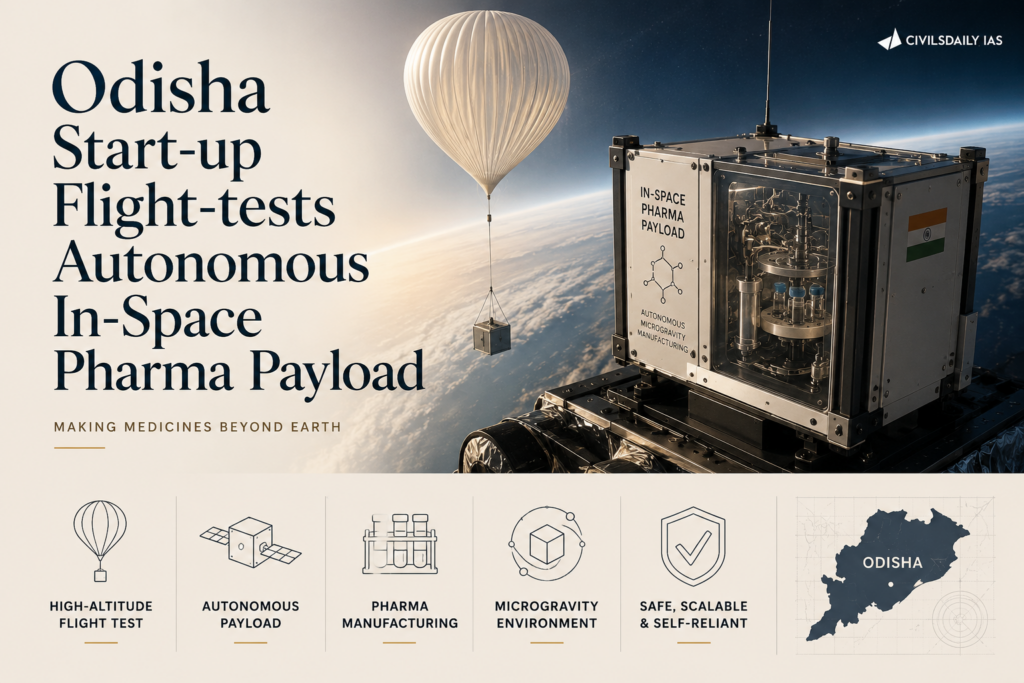
Why in the News
A Bhubaneswar-based start-up, Serendipity Space, has flight-tested a prototype satellite carrying Alchemy, an autonomous pharmaceutical manufacturing payload, using a high-altitude balloon at the TIFR facility in Hyderabad. The technology aims to manufacture pharmaceutical products in microgravity without human supervision.
How does it work?
- Microgravity: Near-weightlessness reduces sedimentation, buoyancy and convection.
- Crystal growth: Crystals can form differently and potentially with greater uniformity than on Earth.
- Autonomous processing: The satellite carries reagents and hardware and executes the manufacturing sequence independently.
- Recovery: Processed material is returned to Earth using a re-entry system and heatshield.
What is LEO?
- Low Earth Orbit (LEO) extends roughly up to 2,000 km above Earth.
- The proposed system is intended for an altitude of about 400 to 500 km.
What did the balloon test demonstrate?
- Tested the satellite prototype under near-space conditions.
- Validated avionics, heatshield and Alchemy payload.
- Demonstrated autonomous operation.
- Tested controlled return to Earth.
- Serves as a relatively low-cost step before orbital deployment.
How is it different from earlier space-based drug research?
- Earlier experiments on platforms such as the ISS generally required crew involvement. The distinguishing feature here is a dedicated free-flying satellite designed for autonomous pharmaceutical manufacturing.
- International examples include Varda Space Industries, Redwire and experiments aboard China’s Tiangong station.
Why is it important for India?
- Promotes private-sector space innovation.
- Expands India’s space ecosystem beyond Bengaluru to cities such as Bhubaneswar, Pune and Ahmedabad.
- Creates opportunities in pharma, biotechnology, space engineering and advanced manufacturing.
- Demonstrates potential convergence of space technology + biotechnology + pharmaceuticals.
Laws, Treaties and Rules Governing Space Activities
- Outer Space Treaty, 1967: Bars national appropriation of outer space and makes States internationally responsible for national activities, including those of private entities.
- Liability Convention, 1972: Makes the launching State absolutely liable for damage caused on the surface of the Earth or to aircraft in flight.
- Registration Convention, 1975: Requires launching States to maintain a registry of objects launched into outer space and to furnish details to the United Nations.
- Rescue Agreement, 1968: Obliges States to assist astronauts in distress and to return space objects to the launching State.
- Indian Space Policy, 2023: Defines the roles of ISRO, IN-SPACe and NSIL and permits private entities across the full value chain from launch to satellite operations.
- Space Activities Bill, 2017: Proposed a licensing and liability framework for private Indian space activity but lapsed without enactment.
- Norms, Guidelines and Procedures issued by IN-SPACe: Prescribe the authorisation route, safety requirements and liability sharing for non governmental entities operating from India.
- Telecommunications Act, 2023 and allied spectrum rules: Govern satellite spectrum assignment and the licensing of satellite based communication services.
Indian National Space Promotion and Authorisation Centre
- What it is: IN-SPACe is the single window autonomous agency that authorises, promotes and supervises space activities by non governmental entities in India.
- Year established: Announced in 2020 as part of the space sector reforms and made operational in 2022.
- Parent department: It functions as an autonomous body under the Department of Space.
- Headquarters: Ahmedabad, Gujarat.
- Jurisdiction: It authorises private launches, satellite establishment and operation, ground station creation and the dissemination of space based data.
- Enabling role: It permits private entities to use ISRO facilities and to access ISRO technologies through transfer agreements.
- Distinction from NSIL: IN-SPACe regulates and promotes, while NewSpace India Limited is the commercial arm that contracts launches and technology transfers.
“[2026] Consider the following statements about involvement of private entities in India’s space programme:
1. IN-SPACe is an autonomous agency formed to facilitate participation of private entities.
2. Agnikul Cosmos launched the world’s first flight using 3D-printed rocket engine.
3. Skyroot Aerospace has developed liquid fuel for GSLV.
(a) 1 only
(b) 2 and 3 only
(c) 1 and 2 only
(d) 1, 2 and 3
