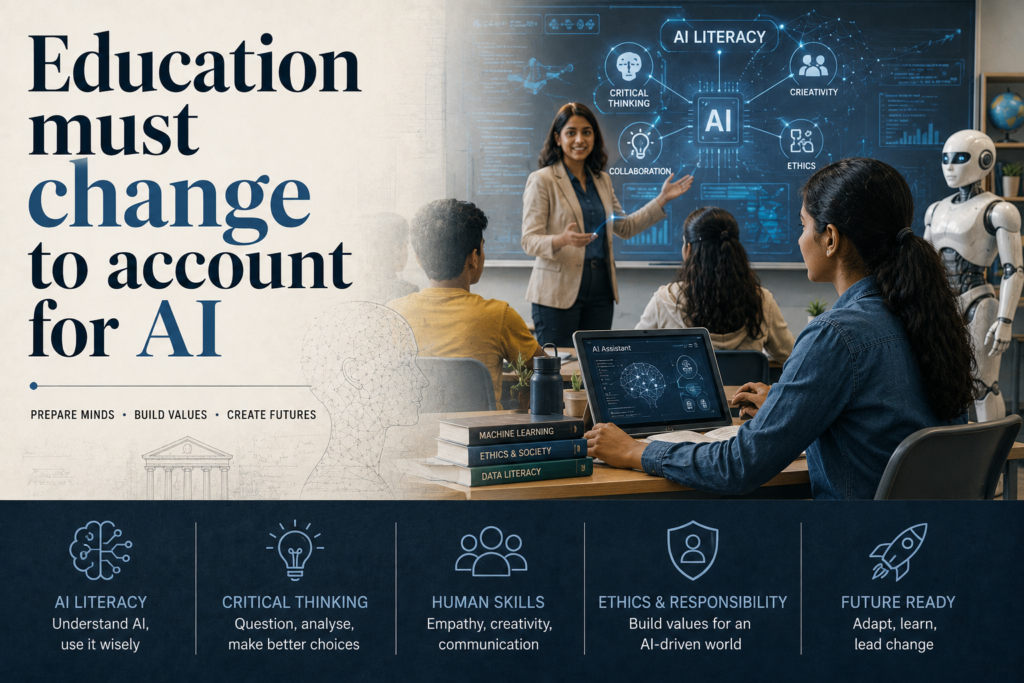
| Question (2023, GS3): “Introduce the concept of Artificial Intelligence (AI). How does AI help clinical diagnosis? Do you perceive any threat to privacy of the individual in the use of AI in healthcare? Linkage: This is the foundational question on AI awareness. Adapting education to AI requires first understanding its core concepts and cross-sectoral applications, which are now being integrated into school and higher education curricula. |
Mentor Comment:
Artificial Intelligence (AI) is reshaping work in the sectors where India holds comparative advantage, including generic drugs, biosimilars and vaccine manufacture, and will eliminate a large share of entry level positions while leaving deep domain expertise in demand. This exposes a conflict between an education system built to load ever more content before entry into the workforce and an economy that now requires selection, synthesis, judgement and adaptation instead.
What is the National Education Policy’s four year undergraduate structure?
- What it is: The National Education Policy, 2020 replaced the three year undergraduate degree with a flexible four year undergraduate programme offering multiple entry and exit points.
- Exit ladder: A certificate after one year, a diploma after two years, a bachelor’s degree after three years and a bachelor’s degree with research after four years.
- The research pathway: The fourth year is designed as a research pathway in which a student undertakes a supervised project rather than additional taught coursework.
- Credit portability: Credits earned at each exit point are deposited in the Academic Bank of Credits, allowing a student to re-enter and complete the degree later.
- Why it matters here: The four year structure with a research final year is the closest institutional equivalent to apprenticeship that the system already possesses.
What is vibe coding?
- What it is: Vibe coding is the practice of producing working software by describing the desired outcome in natural language to an AI system, which generates and iterates on the code, rather than by writing the code line by line.
- Effect on work: It removes the routine coding task that has historically been the entry level rung in software employment.
What are biosimilars?
- What they are: Biosimilars are biological medicines highly similar to an already approved reference biologic, with no clinically meaningful difference in safety, purity or potency.
- Why they differ from generics: A biosimilar is produced in living cells and cannot be copied exactly, so approval requires comparative analytical, non clinical and clinical evidence rather than simple bioequivalence.
What is an automated fill finish line?
- What it is: A fill finish line is the final stage of pharmaceutical manufacture in which the bulk drug substance is filled into vials or syringes, stoppered, sealed, inspected and labelled under sterile conditions.
- Effect of automation: Robotic and isolator based fill finish removes human presence from the sterile core, which raises throughput and sterility assurance while eliminating operator roles.
How is AI changing the nature of work itself?
- Change is rapid and unpredictable: The nature of work is changing at every level, and the direction of that change cannot be forecast with confidence.
- Routine work is the first casualty: Vibe coding threatens to render much routine coding obsolete, which removes the task that entry level employees have traditionally performed.
- Important work also becomes routine: With wisely configured agents and other tools, even important work can be made routine, so the change is not confined to low skill tasks.
- Employment shifts to oversight: Fewer employees remain, and their function becomes careful oversight of systems rather than execution of the task.
- No settled timeline: Assessments of when superintelligence arrives range from a few years to many years, so institutions cannot plan against a fixed date.
How will AI reshape the sectors of Indian strength?
- Generic drugs and biosimilars: AI is reshaping molecule screening and formulation in generic drugs and biosimilars.
- Synthesis and quality control: Robotics and machine vision will increasingly handle synthesis and quality control in the same sectors.
- Vaccine design: AI can help design antigens and predict immune responses, changing the research stage of vaccine development.
- Vaccine manufacture: Robotic bioreactors, automated fill finish lines and AI managed logistics will make production faster, cleaner and more precise.
- Corporate adaptation is assumed: Indian industry will pivot to meet these changes and companies may survive and prosper, so the disruption falls on employment rather than on firms.
Why does the disappearance of entry level jobs create a skills paradox?
- Two requirements point in opposite directions: Employers will still need people with deep domain expertise, and the entry level positions through which such expertise was historically acquired will disappear.
- Expertise cannot be front loaded: Deep domain expertise cannot be acquired at the point of entry, so it cannot simply be added to a degree programme as more coursework.
- Employee profiles change, not employer demand: Companies will prosper while their employee profiles change dramatically, so the market signal to students is ambiguous rather than absent.
- Oversight requires the expertise it displaces: The remaining employees must supervise systems whose outputs only an expert can evaluate, so the skill required is higher precisely where the training ladder has been removed.
- The gap is institutional, not individual: No individual can resolve a missing apprenticeship rung by studying harder, which is why the response has to come from the design of education.
Why has the strategy of extending years of education run out of road?
- The historical pattern: Earlier technological revolutions were met by extending education, from basic literacy to primary school, then high school, then college, and increasingly professional master’s degrees.
- What each transition demanded: Every transition asked people to acquire and retain more knowledge before entering the workforce.
- Why the pattern breaks now: As AI systems advance, the comparative advantage no longer lies in humans storing ever more information in their heads.
- What replaces storage: The requirement is to know what must be understood deeply, what can be retrieved when needed, and how to learn quickly in unfamiliar situations.
- Adding material makes it worse: A future that cannot be predicted cannot be prepared for by adding ever more material to the curriculum.
What kind of rigour must replace content coverage?
- Two apparently contradictory tasks: Education must thin out what it teaches while providing far more opportunities to learn on the fly.
- Not less rigour: The objective is a different kind of rigour rather than a reduction of it.
- The four capacities named: That rigour consists of selection, synthesis, judgement and adaptation.
- How it is built: Students need repeated experience of confronting problems whose answers are not in the syllabus, finding the relevant knowledge and applying it with judgement.
- The system’s starting condition: India’s higher education system contains isolated pockets of excellence embedded in a large undifferentiated mass that is difficult to reform as a whole.
How can the four year undergraduate structure deliver apprenticeship at scale?
- The ideal model and its limit: The ideal way to train an expert is apprenticeship, one student working closely with one teacher or practitioner, and that model cannot be provided at scale at present.
- The available substitute: The National Education Policy’s four year undergraduate structure already provides a research pathway in the final year, the closest institutional equivalent available.
- What blocks it in practice: Residual coursework crowds out the immersion the policy intends, so the final year reverts to taught classes.
- The proposed fix: Universities should allow any remaining essential coursework to be completed online, freeing the year for immersion.
- Where students should be placed: Students should spend that year embedded in industry, university laboratories or national laboratories.
- What the placement teaches: Working alongside people solving real problems lets students encounter uncertainty and learn to acquire knowledge as it becomes necessary.
Challenges to reorienting education for AI
- Faculty shortage and capacity: Immersion requires supervisors who themselves work on live problems, and Indian universities carry large vacancies in teaching posts, e.g. central universities have reported vacancy levels around one third of sanctioned teaching positions.
- Absence of industry placement capacity: There are not enough laboratories and firms willing to host a full cohort for a year, e.g. the National Apprenticeship Promotion Scheme has consistently engaged far fewer apprentices than its annual targets.
- Regulatory rigidity on credits: University statutes tie degrees to classroom contact hours, which blocks substitution of a year of placement for taught credits, e.g. many State universities still require minimum attendance percentages that a workplace year cannot satisfy.
- Assessment mismatch: Examination systems reward recall, which is the exact capacity AI has made least valuable, e.g. the majority of Indian undergraduate examinations remain terminal written papers rather than project defences.
- Digital access inequality: Moving residual coursework online assumes reliable connectivity and devices, which a large share of students lack, e.g. only about 57 percent of women have independent internet access against 72 percent of men.
- Employability and credential signalling: Employers screen on degree names and marks rather than on demonstrated judgement, so students resist a less legible qualification, e.g. campus recruitment for information technology services has long been anchored to aggregate marks thresholds.
- Uneven institutional quality: Reform designed for research capable institutions cannot be transplanted into colleges with no research infrastructure, e.g. a large majority of Indian undergraduate students study in affiliated colleges rather than in universities.
- Financing the transition: Placement years, laboratory access and supervision cost money that public institutions do not currently receive, e.g. public expenditure on education remains near 4.6 percent of gross domestic product against the National Education Policy’s 6 percent target.
Conclusion
The core problem is not that AI will destroy work but that it removes the entry level rung through which deep expertise was formed, while continuing to demand that expertise. Adding more content to the curriculum cannot answer this, and the response is to thin the syllabus and use the National Education Policy’s four year structure to place students inside industry and laboratories for a full year. That requires moving residual coursework online and treating immersion, not coursework, as the final year’s substance.
