| Question (2022, GS2): “How will I2U2 (India, Israel, UAE and USA) grouping transform India’s position in global politics?” Linkage: This question explores how India integrates into new regional frameworks that include Gulf states (UAE) and Israel, illustrating the evolving security and economic partnerships in West Asia. |
Mentor Comment
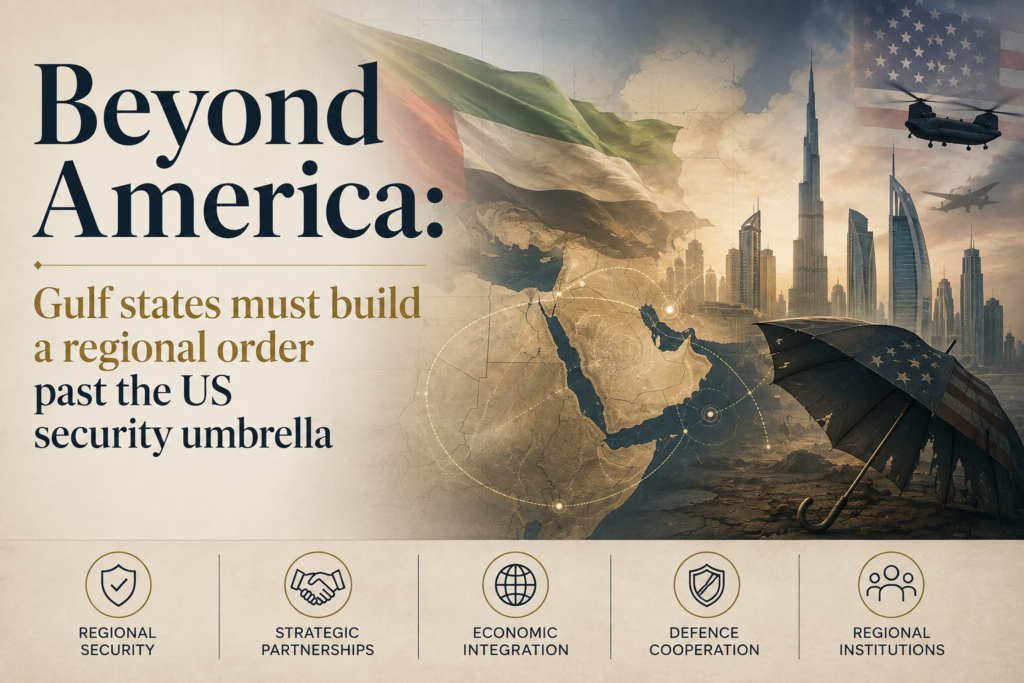
The United States President has threatened, for the second time, to bomb Oman, a long standing American ally that hosted talks between Washington and Tehran before the war was launched on 28 February. The threat against an ally exposes a conflict between an American security architecture built on bases across the Persian Gulf and a war in which those bases have become the principal liability of the states that host them.
What is the American security umbrella in the Persian Gulf?
- What it is: The American security umbrella is the arrangement under which the United States guarantees the external security of the Persian Gulf monarchies through forward deployed forces, basing agreements and arms sales, in exchange for regional access and stable energy flows.
- Physical form: Over the years the United States built military bases across the Persian Gulf, hosting naval, air and command elements on the territory of partner states.
- Strategic premise: The arrangement rested on the assumption that an American presence deters Iran and that hosting American forces raises rather than lowers a host state’s security.
- Companion policy: It was paired with a decades old policy of containing Iran through sanctions, isolation and force posture.
- What the war has done to it: The foundations of this security architecture have been shaken, since American bases have turned out to be a liability in the hour of need.
What is the Strait of Hormuz?
- What it is: The Strait of Hormuz is the narrow waterway connecting the Persian Gulf to the Gulf of Oman and the Arabian Sea, bordered by Iran to the north and Oman and the United Arab Emirates to the south.
- Why it matters: One fifth of the world’s seaborne oil passed through the Strait before the war, which makes its closure a global energy event rather than a regional one.
What is the Fifth Fleet?
- What it is: The United States Fifth Fleet is the naval formation responsible for the Persian Gulf, the Red Sea, the Arabian Sea and parts of the Indian Ocean, headquartered in Bahrain.
- Why its damage matters: Its headquarters is the command node of the American naval presence in the region, so damage to it is a loss of command capacity and not only of infrastructure.
What is a cold peace?
- What it is: A cold peace is a settlement in which former adversaries stop fighting and maintain functional diplomatic and economic contact without reconciling their underlying political differences or building trust.
- Why it is proposed here: It is the achievable objective between the Arab states and Iran, since containment has failed and full normalisation is not available.
What triggered the threat against Oman?
- Oman’s original role: Oman hosted the talks between Washington and Tehran before the war was launched on 28 February, making it the diplomatic venue rather than a party to the conflict.
- Oman’s continuing role: Since the failed escalation, Oman, under American influence, has been talking to Iran seeking a settlement.
- Why the effort stalled: Iran, having survived two rounds of American bombings, refused to offer major concessions.
- The consequence for Oman: American frustration deepened with Oman precisely because Muscat could not deliver an Iranian concession it never had the power to extract.
- The nature of the threat: This is the second time the American leader has threatened to attack Oman, and the threat now falls on an ally for failing to produce a face saving deal.
- What the threat reveals: Instead of reassuring allies whose territory has been struck, Washington is threatening them, which is the clearest signal of declining influence in the region.
Why has the Strait of Hormuz not reopened?
- Who closed it: Iran closed the Strait after it was attacked, making closure a retaliatory instrument rather than a negotiating opening position.
- The claimed breakthrough: When the American leader backed down from a threatened escalation after 13 days of bombing on Iran in July, he said the two sides were close to a deal on reopening the Strait.
- Iran’s position: Iran never said that it had agreed to any deal with the United States over the Strait.
- Iran’s stated preconditions: Iran issued several demands as preconditions for any agreement, including releasing frozen funds and issuing sanctions relief.
- The claim against the traffic data: The American President has repeatedly claimed the Strait was open, while traffic through the waterway is nowhere near pre war levels.
- Scale of what is blocked: The waterway carried one fifth of the world’s seaborne oil before the war, so the gap between claimed and actual traffic is a measurable global supply loss.
What has the war done to America’s regional military position?
- Bases damaged or destroyed: At least 15 American bases are either damaged or destroyed.
- The command node hit: The damaged facilities include the Fifth Fleet Headquarters in Bahrain.
- Net effect on presence: The damage has substantially reduced America’s strategic presence in the region.
- How Iran achieved it: Tehran turned the American basing network into a liability by repeatedly striking the bases and their host countries.
- Iran’s own survival: Iran survived two rounds of American bombings and remained able to refuse major concessions afterwards.
- Failure of coercive signalling: From day one of the war, American threats and rhetoric did little to advance Washington’s strategic goals or to deter Iran.
Why has the presence meant to protect Gulf states become the source of their danger?
- Both propositions held simultaneously: The bases were the guarantee of Gulf security and the reason Gulf territory was struck, and the war has resolved that ambiguity against the hosts.
- Iran’s targeting logic: By striking the bases and the host countries together, Tehran converted the guarantee into a cost borne by the host rather than by the guarantor.
- The guarantor’s response: Washington neither restored deterrence nor reassured the hosts, and has instead threatened one of them with bombing.
- The asymmetry of exposure: The host state’s territory, population and economy absorb the retaliation while the guarantor’s homeland does not.
- Why the old bargain cannot simply be repaired: Reassurance would require a demonstrated capacity to deter Iranian strikes, which two rounds of bombing failed to establish.
- The unresolved dependence: Gulf states have no alternative security provider of comparable capability, so recognising the failure of the arrangement does not by itself produce a substitute.
Why has the containment of Iran failed?
- The record of the war: Iran absorbed two rounds of American bombing and emerged able to hold the Strait closed and to set preconditions for talks.
- Coercion produced no concession: Threats and rhetoric from the first day of the war neither advanced American goals nor deterred Iranian action.
- The cost fell on third parties: Containment’s enforcement damaged the host states of American bases rather than the target of the policy.
- Diplomacy was subordinated to pressure: Oman’s mediation was conducted under American influence rather than as an independent regional initiative, which limited what it could offer Tehran.
- The policy’s own premise collapsed: A decades old policy of isolating Iran cannot be sustained when the isolating power’s regional presence has been substantially reduced.
What would a new regional order require?
- Recognition of the strategic reality: Countries in the region confront a new strategic reality in which the foundations of the old security architecture have been shaken.
- Abandoning containment: Gulf states must recognise that the decades old policy of containing Iran has failed.
- Looking past the umbrella: To ensure their own security and regional stability, the Persian Gulf countries need to look beyond the American security umbrella.
- The organising principle: The new order must be founded on a cold peace between the Arab states and Iran, not on reconciliation or on alliance.
- Regional rather than external authorship: The foundations have to be laid by the regional states themselves, since the external guarantor has demonstrated both limited capability and limited commitment.
How does the Gulf’s shifting security order affect India’s interests?
- Energy dependence: India imports over 85 percent of its crude oil, and a large share of West Asian supply transits the Strait of Hormuz, so a closed Strait raises both price and freight and insurance costs.
- Diaspora exposure: About 90 lakh Indians live and work in the Gulf Cooperation Council states, the largest concentration of Indians anywhere outside India.
- Remittance dependence: The Gulf accounts for a substantial share of India’s annual remittance inflows, which exceeded $125 billion in recent years and are the country’s most stable external receipt.
- Trade and connectivity stakes: The India Middle East Europe Economic Corridor and India’s trade agreement with the United Arab Emirates both assume a stable and navigable Gulf.
- Balancing act with Iran: India’s Chabahar port investment and its connectivity route to Central Asia through Iran sit alongside its deepening partnerships with the Gulf monarchies and Israel.
- Strategic preference: A cold peace between the Arab states and Iran serves India better than either containment or open conflict, since India maintains working relationships across all three blocs.
Challenges to building a new Persian Gulf regional order
- Absence of a regional security institution: The Gulf has no inclusive security organisation covering both the Arab states and Iran, e.g. the Gulf Cooperation Council formed in 1981 explicitly excludes Iran and Iraq.
- Sectarian and dynastic rivalry: Competition between Riyadh and Tehran runs through proxy conflicts that outlast any bilateral thaw, e.g. the Yemen conflict continued despite the Saudi Iran normalisation agreement brokered in Beijing in March 2023.
- Capability dependence on external suppliers: Gulf militaries are built on American platforms, training and sustainment, so autonomy is limited by the equipment they already own, e.g. Patriot and THAAD air defence systems in Saudi Arabia and the United Arab Emirates depend on American logistics chains.
- Intra Gulf divergence: The Gulf Cooperation Council states do not share a single position toward Iran, e.g. the blockade of Qatar between 2017 and 2021 was driven partly by differing approaches to Tehran.
- Nuclear file unresolved: No verification framework governs Iran’s nuclear programme after the collapse of the earlier agreement, e.g. the Joint Comprehensive Plan of Action of 2015 ceased to constrain enrichment after the American withdrawal in 2018.
- Energy chokepoint vulnerability: Any settlement leaves the Strait of Hormuz physically controllable by one party, e.g. one fifth of the world’s seaborne oil transited the Strait before Iran closed it.
- External power competition: China and Russia have expanding interests in the region and no shared framework with the United States, e.g. China brokered the Saudi Iran agreement of 2023 without American involvement.
- Domestic legitimacy constraints: Gulf rulers face internal opposition to accommodation with Iran and to visible dependence on foreign forces, e.g. Bahrain’s own political fault lines were exposed during the unrest of 2011.
Conclusion
The war has produced a result the Gulf states cannot reverse: at least 15 American bases damaged or destroyed including the Fifth Fleet Headquarters in Bahrain, the Strait of Hormuz still functionally closed, and an American guarantor now threatening an ally rather than reassuring it. The decades old policy of containing Iran has failed, and no external power is positioned to replace the security architecture that failure has hollowed out. What remains unresolved is whether the Persian Gulf states can construct a regional order on a cold peace with Iran while their own militaries, economies and rivalries still run through the arrangement they must replace.
