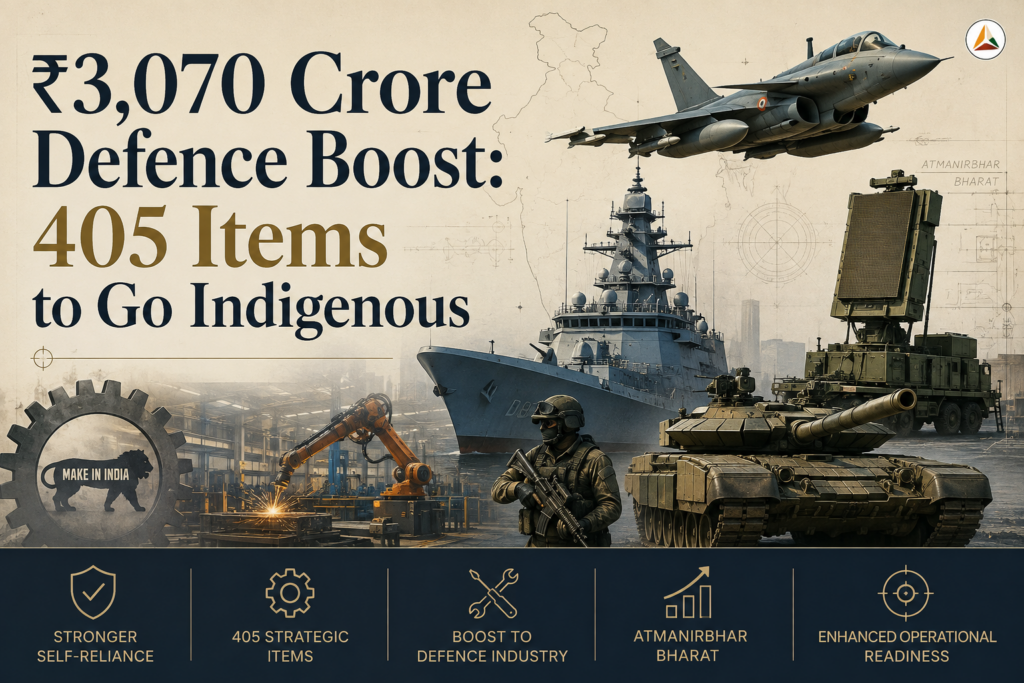
Why in the News
The Department of Defence Production notified the sixth Positive Indigenisation List, covering 405 strategically important defence items with an estimated business potential of Rs 3,070 crore. The list moves the import ban from whole platforms down to the spares, sub-assemblies and raw materials layer that keeps imported fleets flying and floating.
What is the Positive Indigenisation List?
- Definition: A Positive Indigenisation List (PIL) is a notified list of defence items that can be procured only from Indian industry after a stated deadline passes.
- Legal effect: The listed item stays importable until its deadline. After that date, procurement is exclusively domestic.
- Issuing authority: The Department of Defence Production (DDP) under the Ministry of Defence notifies the list.
- Two families of lists: One family covers capital acquisition platforms for the armed forces. The second family covers line replaceable units, sub-systems, sub-assemblies, spares, components and raw materials of Defence Public Sector Undertakings (DPSUs), which is the family the sixth list belongs to.
- Policy anchor: The Ministry placed the sixth list within the Aatmanirbhar Bharat initiative for self reliance in defence manufacturing.
What is a Line Replaceable Unit?
- Definition: A Line Replaceable Unit (LRU) is a self contained module on a platform that a technician can swap out at the operating unit itself, without sending the platform to a depot.
- Why it matters: LRU import dependence decides fleet availability, since an aircraft grounded for one imported module is as unusable as an aircraft never bought.
What is the SRIJAN Defence Portal?
- Definition: The SRIJAN Defence Portal is the Ministry of Defence’s online indigenisation platform on which DPSUs and the Services publish items they currently import and invite Indian vendors to develop them.
- Use in this case: The detailed sixth list has been uploaded on the portal, so vendors can see item level specifications rather than only the headline count.
Components of the sixth list, by lifecycle stage
The release’s own categorisation phrase is “line replaceable units, sub-systems, sub-assemblies, spares, components and raw materials”. The table below keeps that official grouping and maps each element to the stage of the platform lifecycle it sits at.
| Official category (lifecycle stage) | Platforms and systems covered | Official figures | Primary stakeholder |
|---|---|---|---|
| Raw materials (input stage) | Feedstock for the listed platforms and systems | No separate figure given in the release | Indian industry, particularly MSMEs |
| Components and spares (production stage) | Armoured platforms T-72, T-90 and BMP-II, and warships | No separate figure given in the release | DPSUs with MSME participation |
| Sub-assemblies and sub-systems (assembly stage) | Advanced Light Helicopter, Light Utility Helicopter, Chetak and Cheetah helicopters, Su-30MKI, Jaguar, MiG-29, the Light Combat Aircraft and the AL-31FP engine | No separate figure given in the release | DPSUs, in house development route |
| Line replaceable units (sustainment stage) | Missile systems Konkurs-M, Invar and MRSAM, defence electronics covering radars, sonars, fire control systems and satellite communication systems, and High Explosive Anti-Tank ammunition | Part of the 405 items worth Rs 3,070 crore | 16 items for the Indian Coast Guard, 389 items for DPSUs |
| Exclusive domestic procurement (offtake stage) | All 405 listed items | Deadlines running up to December 2031 | Indian industry as the sole permitted source |
Why does the list target spares and sub-systems rather than whole platforms?
- Sustainment is where imports survive: A platform built in India under licence still draws imported modules through its service life, so a platform level ban leaves the recurring import bill untouched.
- Legacy Russian and Western fleets stay in service: The Su-30MKI, MiG-29, Jaguar, T-72, T-90, BMP-II, Konkurs-M and Invar are all of foreign origin and remain in front line use, so their spares are the standing demand.
- MSMEs can enter at this scale: The Ministry stated that DPSUs and the Indian Coast Guard will indigenise through several routes including in house development, with participation from industry and particularly MSMEs.
- Deadlines create assured demand: Once an item is developed locally, it will be procured exclusively from Indian industry, which converts a technical goal into a guaranteed order.
- Stated economic objective: The Ministry expects the list to expand opportunities for Indian industry, strengthen the domestic defence manufacturing ecosystem, promote investment and innovation, and reduce import dependence.
What does the record of the previous five lists show?
- Cumulative coverage: The last five positive indigenisation lists together comprised 5,012 critical items of DPSUs.
- Delivery so far: 3,200 of those items have already been indigenised.
- Value realised: The indigenised items carry an import substitution value of over Rs 3,900 crore.
- Completion gap: 1,812 items from the earlier five lists remain to be indigenised even before the sixth list’s 405 are added.
- Scale of the new tranche: The sixth list’s Rs 3,070 crore business potential is close to the entire import substitution value the previous five lists have delivered so far.
Challenges to the Positive Indigenisation List
- Design authority remains abroad: Reverse engineering a spare does not transfer the original equipment manufacturer’s design data, so upgrades and configuration changes still need foreign clearance, e.g. Su-30MKI serviceability fell sharply when Russian spares supply was disrupted after February 2022.
- Certification is the real bottleneck: A developed item still needs airworthiness or seaworthiness clearance before induction, and that queue is longer than the development itself, e.g. clearances from the Centre for Military Airworthiness and Certification for a single aviation grade module routinely run into years.
- An import ban does not create capability: Prohibiting an import without a working domestic alternative simply postpones the requirement, e.g. the Kaveri engine programme began in 1989 and the Light Combat Aircraft still flies on the imported GE F404.
- Working capital stress for small vendors: An MSME must fund development, tooling and inventory ahead of an order it may receive years later, e.g. procurement cycles under the Defence Acquisition Procedure, 2020 routinely run beyond 100 weeks from acceptance of necessity to contract.
- Quality escapes damage the case for domestic sourcing: A defective indigenous item costs more credibility than an imported one, e.g. the Comptroller and Auditor General’s 2019 report on ammunition management flagged defective ammunition from Ordnance Factory Board units causing accidents and monetary loss.
- Import substitution is not export competitiveness: Substituting an import for the home market does not make the product globally saleable, e.g. India stayed among the world’s largest arms importers through 2020 to 2024 even after five lists had been notified.
Conclusion
The sixth Positive Indigenisation List stands notified, with 405 items worth Rs 3,070 crore, split as 16 Indian Coast Guard items and 389 DPSU items, and uploaded on the SRIJAN Defence Portal. The next milestone is item wise indigenisation within the notified timeframes, with the outer deadlines running to December 2031, after which the listed items may be procured only from Indian industry.
