Why in the News
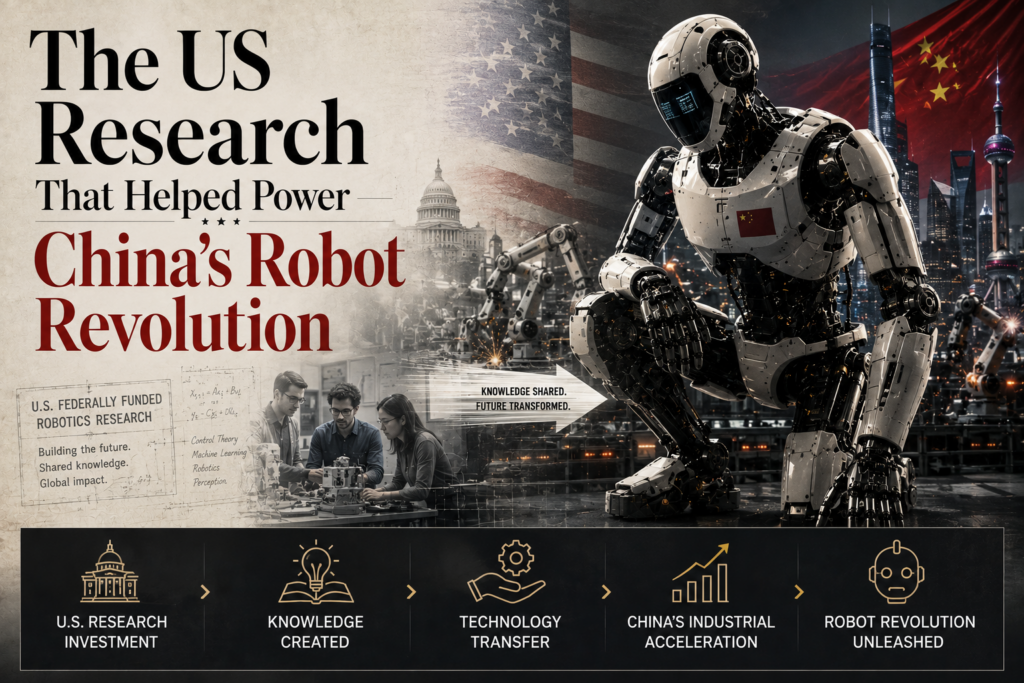
China’s Unitree Robotics based the designs of its most successful quadruped robots on breakthroughs financed by the United States Army Research Laboratory, according to a former United States defence technology official and three researchers involved in the programme. The findings were published openly to advance the field, and the country that funded them has no mass producer of such robots, while the company that scaled them is now on the Pentagon’s list of Chinese military companies.
What is the Robotics Collaborative Technology Alliance?
- What it was: The Robotics Collaborative Technology Alliance (RCTA) was a United States Army funded research consortium that ran from 2010 to 2020.
- Funding body: It was financed by the DEVCOM Army Research Laboratory (ARL) alongside other military programmes.
- Participants: It gathered government, academic and industry researchers from the University of Pennsylvania, the Massachusetts Institute of Technology (MIT), Boston Dynamics and NASA’s Jet Propulsion Laboratory, among other research institutions.
- Lead commercial partner: General Dynamics Land Systems, the Michigan based defence manufacturer that builds Abrams M1 tanks.
- Publication practice: The programme’s findings were published openly to stimulate progress in the field, which is common practice in publicly funded research.
What is an actuator?
- Definition: An actuator is the component that converts electrical power into the movement of a robot’s joint, combining a motor, a gearbox and control electronics.
- Why it decides the design: Actuator torque, weight and cost set what a legged robot can do and what it costs, which is why an actuator design published in detail is effectively a manufacturing blueprint.
What is DARPA?
- Definition: The Defense Advanced Research Projects Agency (DARPA) is the United States Department of Defense agency that funds high risk, early stage technology research with potential military application.
- Role here: DARPA financed the MIT laboratory work on which the later Army funded University of Pennsylvania advances were built.
How did Army funded research travel from the laboratory to a Chinese manufacturer?
- 2016, motors moved into the legs: University of Pennsylvania researchers eliminated heavy central gearboxes and placed motors in the robots’ legs, which improved the machine’s ability to sense and respond to terrain.
- Built on DARPA funded work: That advance built on the MIT laboratory’s earlier work financed by DARPA.
- 2019, the Mini Cheetah: The MIT laboratory presented the Mini Cheetah, adding strength and the ability to perform backflips to the University of Pennsylvania features.
- The thesis that carried the design: Months earlier, an MIT researcher published a master’s thesis detailing the Mini Cheetah’s actuators.
- Copies within six months: Chinese firms were manufacturing actuator copies purchasable on the online retailer AliExpress within six months of that publication.
- Dimensional match: The dimensions of Unitree’s popular Go series were almost identical to the millimetre to the Mini Cheetah, per the MIT researcher involved in developing it.
- The scale product: The Army funded project became the first Unitree robot that had any kind of scale, per a former University of Pennsylvania researcher on the programme.
- 2023, the price point: Unitree’s $1,600 Go2 model, launched in 2023, let the company rapidly dominate the global quadruped robot market. Unitree was founded in 2016, three years before the Mini Cheetah was presented.
What does the scale gap look like in numbers?
- Unitree’s volumes: The company sold more than 5,500 humanoids and 18,000 quadrupeds last year, per company filings.
- Valuation: Unitree is valued at about $9 billion ahead of its stock market debut, and its Shanghai initial public offering drew frenzied demand.
- United States output: No United States company has mass produced such robots, including Tesla, which has displayed prototypes of its Optimus humanoid for years.
- A different technology base: Boston Dynamics’ 2019 canine robot Spot used different technology from the Army funded line.
- The domestic commercialiser: Ghost Robotics commercialised the United States breakthroughs and supplies United States special forces with ruggedised robots, but its production is small and costly compared with Unitree’s.
Why did the United States not capture the market it created?
- Capital preference: United States venture capital prefers high return software startups, which a robotics analyst described as a dropped ball on commercialising domestic research.
- Missing industrial inputs: The United States excels in innovation and software development but needs the capital, industrial base, highly skilled workforce and parts supply chains to scale up breakthroughs, per the dean of Penn Engineering.
- No production support after the research ended: The Army funded project kick-started the United States quadruped industry, but without support for large scale production Unitree consumed that space, per the former Army Research Laboratory director who oversaw it.
- Price competition threatens incumbents: Boston Dynamics argued in a Congressional hearing that China’s low pricing would drive United States firms out of the market.
- Asymmetry of actors: The contest is between private United States companies and a coordinated Chinese national strategy, per the founder of Ghost Robotics.
What structural advantages does China’s manufacturing model carry?
- A stated ten year industrial plan: In 2015, China’s leadership set out a ten year plan to lead industries including green energy, electric vehicles and robotics.
- Tolerance for losses: Capital has since been channelled into risky bets on low margin advanced manufacturing.
- Critical minerals dominance: Rapid reverse engineering draws on China’s dominance in refining the critical minerals needed for magnets in robotics applications.
- Supplier density: Motors, gears and the artificial muscles known as actuators are supplied by a dense cluster of firms near Unitree’s base in Hangzhou.
- The pattern is not new: Backed by subsidies and component factory clusters, Chinese firms have already seized market share in solar panels, drones, electric vehicles and quantum communications, many of them first developed in the United States with government or military backing.
How have United States authorities responded?
- June, Pentagon listing: The Pentagon added Unitree to its list of Chinese military companies, calling it a contributor to the Chinese defence industrial base.
- Effect of the listing: The designation falls short of a sanction but limits the United States military’s future use of Unitree technology.
- July, import ban: The Federal Communications Commission (FCC) banned imports of future models of foreign made humanoid and quadruped robots, including those from Unitree.
- Chinese response: China has threatened to retaliate against the FCC ban, and its Washington embassy accused the United States of abusing administrative power and of market distortion and unilateral bullying.
- Company position: Unitree has said its robots are for civilian use, and one Unitree robot has been shown on Chinese state television armed and accompanying People’s Liberation Army troops on an exercise.
Should publicly funded research be published openly when a rival scales it faster?
- Nothing was taken improperly: Unitree did nothing underhanded in using the Army research, since the programme’s findings were published openly by design.
- The funder’s own defence: The Army Research Laboratory stated the research strengthened the broader United States robotics ecosystem and informed subsequent work across government and the private sector.
- Researchers reject secrecy: None of the United States robotics researchers involved advocated keeping such government financed research secret, arguing publication is important to scientific and technological advancement.
- Their alternative prescription: Policymakers should focus on enabling companies to commercialise such advances quickly enough to compete.
- Trade barriers are insufficient: Most experts supported the import ban but said the policy alone cannot build an industry capable of catching up, since it would take more than trade barriers to boost robotics manufacturing.
Challenges to commercialising publicly funded robotics research
- Open publication transfers advantage immediately: A detailed design published for scientific benefit is also a manufacturing specification, e.g. actuator copies drawn from the Mini Cheetah thesis were on sale within six months.
- Hardware startups cannot match software returns: Venture funding avoids capital heavy, low margin manufacturing, e.g. Ghost Robotics supplies United States special forces but produces at small volume and high cost.
- No domestic component cluster: Motors, gears and actuators must be sourced abroad when no local supplier base exists, e.g. the supplier density around Hangzhou has no United States equivalent.
- Critical mineral chokepoint: Magnet grade rare earths are refined almost entirely in one country, e.g. China’s April 2025 export controls on rare earth magnets disrupted automotive and electronics production worldwide.
- Trade restrictions do not create capacity: A ban removes a supplier without creating a substitute, e.g. the FCC July ban covers future imported models while no United States firm mass produces quadrupeds.
- Dual use ambiguity complicates policy: A civilian product can appear in a military role without the manufacturer changing its position, e.g. an armed Unitree robot appeared with People’s Liberation Army troops on state television while the company maintains its robots are civilian.
- Price competition ends domestic production: Cheaper imports remove the volume a domestic manufacturer needs to survive, e.g. Boston Dynamics warned a Congressional hearing that China’s pricing would drive United States firms out.
Conclusion
Publicly funded, openly published United States military robotics research became the design basis for the world’s largest quadruped robot manufacturer, based in China. The failure was not in the research or in its disclosure but in the absence of capital, supplier depth and skilled manufacturing capacity to commercialise it domestically. Export bans and military company listings restrict a competitor’s access without supplying any of those three, so the structural gap remains open.
Question (2024, GS2): “The West is fostering India as an alternative to reduce dependence on China’s supply chain and as a strategic ally to counter China’s political and economic dominance. Explain this statement with examples.
Linkage: This touches upon the global strategic response to China’s “revolution” in manufacturing and technology, highlighting the shift to move away from Chinese-dominated supply chains.
