Why in the News
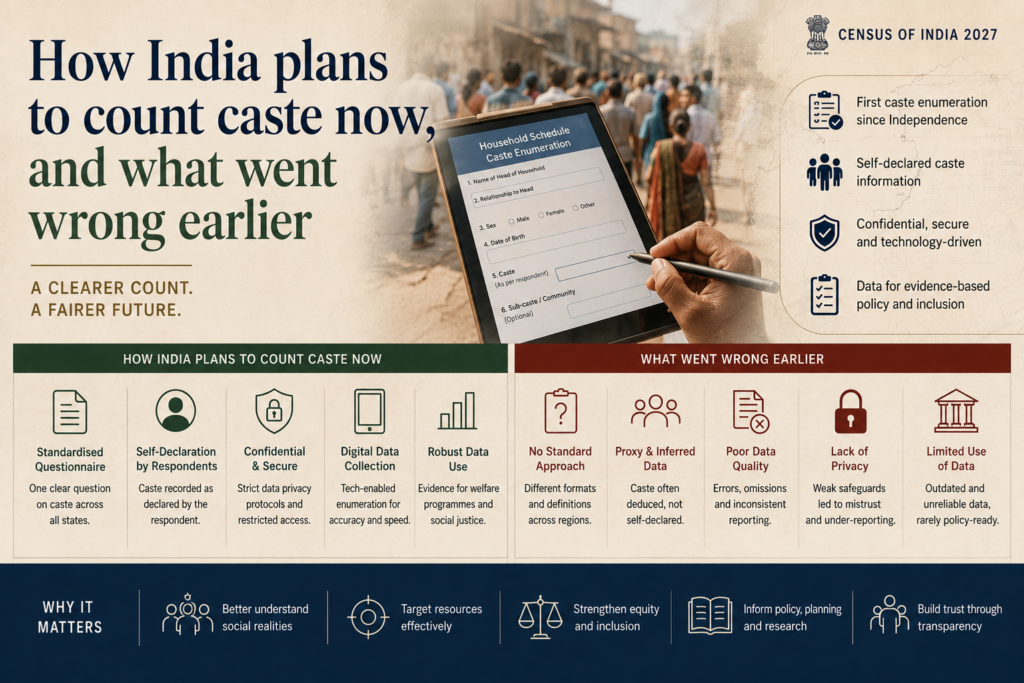
The Registrar General of India has settled on an open ended question on caste for the ongoing Census, with no predetermined list of castes supplied to the enumerator. The same method in 2011 returned nearly 46.7 lakh distinct caste names and produced no usable table, which places the design of the question, rather than the decision to count, at the centre of the exercise.
What is an open ended caste question?
- How it works: The respondent states a caste in their own words and the enumerator records that answer as given, with no dropdown list or code frame to select from.
- No verification step: The enumerator is duty bound to enter what is stated, including a surname offered in place of a caste name.
- Errors become data: A misspelling of the stated name becomes an entry in the caste column in its own right.
- The colonial precedent: The same open method was used until the 1931 Census, the last census whose caste data were released.
Why does an open ended question produce unusable data?
- Interchangeable names for one group: Rajput, Thakur, Singh and Kshatriya may be used interchangeably by the same respondent for the same identity.
- The same name meaning different groups: Rajput in the Bundelkhand region cutting across Uttar Pradesh and Madhya Pradesh may also refer to the Other Backward Class Lodh community.
- Surnames that cross categories: Singh is a surname running across castes and across reservation categories, so it identifies nothing on its own.
- Volume without structure: The result is a very large number of entries that may all belong to a single caste, with no rule for collapsing them afterwards.
- The 2011 outcome: The open method returned nearly 46.7 lakh distinct caste names, against the 4,147 castes recorded in the last comprehensive caste census of 1931.
What did the 1931 Census reveal about counting caste?
- Caste as a subjective category: The 1931 Census report itself recorded the difficulty of enumerating caste once respondents were free to name their own.
- New identities appearing between rounds: Sections of the leather working caste among Dalits in Punjab assumed a new religious identity as Aad Dharmis, meaning people of the original, pre Aryan religion of India.
- The scale of that shift: 418,789 persons enumerated themselves as Aad Dharmis, roughly the same number as Christians in Punjab at that time, in a category that did not exist in 1921.
- The pattern was not local: Similar names appeared in other regions, including Adi Dravida, Adi Andhras and Adi Karnatakas.
- Consolidation to bolster numbers: The report recorded grazier castes combining under the term “Yadava” the Ahirs, Goalas, Gopis, Idaiyans and other milkmen castes, a movement already effective in 1921.
- What both moves show: Caste counts respond to claims of new social status and to the arithmetic advantage of a larger group, not only to who people are.
How did caste enumeration lapse after 1931?
- 1941: Caste details were collected but caste was dropped from the final tabulation.
- 1951: The government led by the first Prime Minister decided there would be no caste enumeration, in a newly independent India shaped by the ideals of equality and secularism.
- 2011: The Socio Economic and Caste Census conducted under the then government failed to produce usable caste data because of open ended enumeration.
- The data withheld: The Union government eventually withheld the raw caste data from the 2011 exercise.
What did the Bihar caste survey show about using a list?
- The exercise: A statewide caste survey was ordered by the then Chief Minister of Bihar in 2023.
- The administrative choice made: State officials compiled a list of castes for the purpose, on the view that enumerating without a list would create an administrative nightmare.
- The contest that followed: Questions were raised after the data were released about how the lists were prepared and about the methodology used.
- What it establishes: A list makes tabulation possible and simultaneously makes the list itself the contested object, since inclusion and placement decide entitlement.
What alternative design do experts propose?
- A predetermined list: A former chairman of the Indian Council of Social Science Research, who was a member of the expert committee on Telangana’s caste data, holds that a predetermined list is necessary.
- Building on lists that already exist: Scheduled Caste, Scheduled Tribe and Other Backward Class lists are already recognised by the government, so only a similar list of castes in the general category is needed for the list to be exhaustive.
- The error trade off: Such a list may still carry a margin of error of about 2 to 3 percent, which is smaller than the error produced by open ended enumeration.
- Columns for non identification: Separate columns for “no caste” and “no religion” are needed for people who do not identify with either.
- Separate questionnaires by group: Distinct questionnaires are proposed for Scheduled Castes and Scheduled Tribes, because the exclusion each faces differs, untouchability related for the former and physical and geographical isolation for the latter.
- No separate schedule for Other Backward Classes: A separate questionnaire is held to be unnecessary for OBCs, since social and educational backwardness would be captured by the Census exercise anyway.
- Questions on internal hierarchy: A Valmiki community activist campaigning for sub categorisation holds that the schedule must ask about hierarchies and exclusions within the Scheduled Castes and Scheduled Tribes, since some castes within them are more deprived than others.
How many caste groups does the state already recognise?
- Scheduled Castes: The Ministry of Social Justice and Empowerment lists 1,208 Scheduled Castes, with different castes appearing in the category in different States.
- Scheduled Tribes: A Press Information Bureau year end release of 2022 lists exactly 730 Scheduled Tribes.
- What the two lists prove: A workable, State specific enumeration frame already exists for the reserved categories, which is why the general category is the only gap in a list based design.
- The residual problem: The lists are State specific, so a single national code frame still has to reconcile the same caste appearing in different categories across States.
Challenges to caste enumeration in the Census
- Self declaration cannot be verified: No enumerator can test a stated caste against any record, so the count is a record of claims. e.g. the 1931 appearance of 418,789 Aad Dharmis in Punjab was a reclassification, not a demographic change.
- Category and caste are conflated: Respondents answer with a reservation category rather than a caste, which destroys the disaggregation the exercise exists to produce. e.g. an entry of “OBC” or “General” tells the statistical office nothing about the specific community.
- State specific lists break national aggregation: The same caste name sits in different categories in different States. e.g. a community listed as OBC in one State appears in the general category in a neighbouring one, so a national total is not additive.
- Political stakes shape the answer: Enumeration takes place while reservation and sub categorisation demands are live, which gives groups a reason to consolidate. e.g. the Yadava consolidation of Ahirs, Goalas, Gopis and Idaiyans recorded in 1931 combined several castes into one larger head.
- Enumerator discretion at the point of entry: With no code frame, spelling, phrasing and abbreviation decisions rest with the field functionary. e.g. a misspelt surname entered as a caste becomes a distinct caste in the final dataset.
- Publication risk: Caste tables invite legal and political contest, which creates an incentive to withhold rather than release. e.g. the raw caste data of the 2011 exercise were never published.
- Sub caste invisibility: A single caste head hides sharp deprivation differences within it. e.g. sub categorisation demands within the Scheduled Castes rest on the claim that a few communities capture most of the benefit.
Conclusion
The choice of an open ended caste question repeats the design that failed in 2011 and that the 1931 report had already flagged as unstable. A predetermined list built on the existing Scheduled Caste, Scheduled Tribe and Other Backward Class rolls, extended to the general category, is the correction experts have placed on record, along with separate questionnaires for Scheduled Castes and Scheduled Tribes and questions on internal hierarchy. The self enumeration window is currently open, so the question design is close to being frozen. Whether the exercise yields a usable caste table will be settled by the code frame, not by the decision to count.
“[2009] Consider the following statements:
1. Between Census 1951 and Census 2001, the density of the population of India has increased more than three times.
2. Between Census 1951 and Census 2001, the annual growth rate (exponential) of the population of India has doubled.
Which of the statements given above is/are correct?
(a) 1 only
(b) 2 only
(c) Both 1 and 2
(d) Neither 1 nor 2
