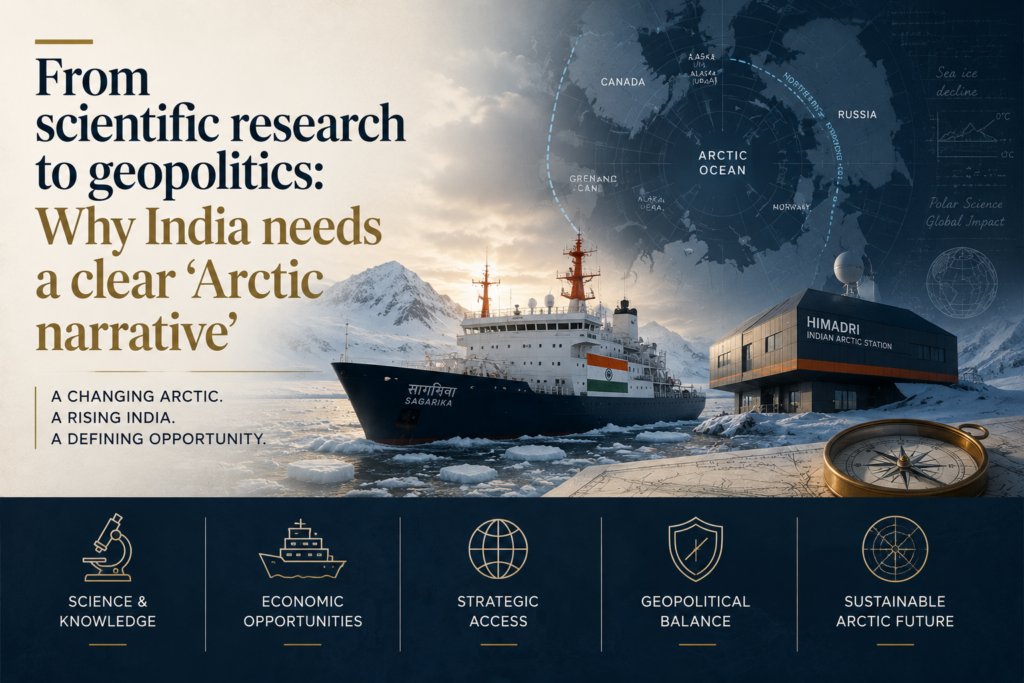
Why in the News
A report of the Parliamentary Standing Committee on External Affairs, titled “India’s Role and Presence in the Arctic and Antarctic Regions”, asks what India’s narrative on the Arctic actually is. The tension it exposes is that India holds a 1920 treaty entitlement, a permanent research station and a national Arctic Policy, yet funds Arctic activity at a level that contradicts every one of those claims.
What is the Svalbard Treaty of 1920 and what does it give India?
- The instrument: The Svalbard Treaty of 1920 recognises Norwegian sovereignty over the Svalbard archipelago while granting all signatory states equal rights of access and economic activity there.
- India’s standing: India, then part of the British Dominion, was among the original 14 signatories of the Treaty.
- The practical entitlement: The Treaty entitles an Indian to visit Svalbard, an archipelago located between mainland Norway and the North Pole, without a visa and to engage in commercial ventures.
- What India built on it: India remains one of only two developing countries with a permanent scientific presence in the region, through the Himadri research station at Ny-Alesund in Svalbard.
What is India’s Arctic Policy of 2022?
- The framework: India notified an Arctic Policy in 2022, setting out its objectives across science, climate and environmental protection, economic and human development, transportation and connectivity, governance and international cooperation, and capacity building.
- The gap it left: The Policy provided the framework but India still lacks a dedicated senior official responsible for Arctic affairs.
What is the Arctic and Indian monsoon teleconnection?
- The mechanism: Rapid Arctic warming and declining sea ice alter atmospheric circulation patterns, and those altered patterns influence monsoon behaviour across South Asia.
- What it affects: The chain runs from Arctic ice loss to rainfall patterns, agricultural productivity, food security and economic growth in India.
Why does the Arctic matter to India’s climate security?
- Monsoon dependence is structural: India’s dependence on the monsoon remains profound, with nearly 70 percent of India’s annual rainfall coming from the southwest monsoon.
- The economic base at risk: Agriculture still accounts for roughly 18 percent of India’s gross domestic product and supports more than half of its population.
- The scientific link is now established: Scientific studies increasingly point to an Arctic and Indian monsoon teleconnection, so Arctic ice loss is a direct input into Indian rainfall variability.
- Sea-level rise is the second pillar: The Arctic is a major contributor to global sea-level rise, and on current trends entire low-lying island states such as the Maldives face existential threats.
- The regional exposure: Large parts of Bangladesh and significant stretches of India’s coastline could experience recurrent flooding and displacement, with more than 250 million people in vulnerable coastal regions of South Asia affected by mid-century.
- The security consequence: Large-scale climate-induced migration from neighbouring regions would create humanitarian, social and security challenges of an unprecedented order, which moves the Arctic out of the environmental file and into the security file.
Why has the Arctic become a geopolitical arena rather than only a scientific one?
- India’s partners are Arctic states: Two of India’s closest strategic partners, the United States and Russia, are Arctic nations, so Arctic policy is inseparable from India’s core bilateral relationships.
- The adversary is already inside: China, described as India’s principal long-term adversary, has invested heavily in Arctic infrastructure, research and shipping despite being an extra-regional state.
- The convergence of stakes: The Arctic is emerging as a battleground for major powers, with maritime access, energy security and critical mineral supply chains intersecting in the same space.
- India’s existing goodwill: India maintains friendly relations with other Arctic nations, evident in the recent India-Nordic Summit.
- The unanswered question: The open issue is whether India is prepared to engage at a scale commensurate with the interests it has declared.
What does China’s polar build-up show about the scale India is not matching?
- China, acquisition then indigenisation: China acquired a second-hand icebreaker from Ukraine and then developed indigenous icebreaker building capability from it.
- China, current fleet: China today operates several polar-capable vessels, giving it access to the wider Arctic Ocean that India lacks.
- China, the next tier: China is the second country after Russia to be building a nuclear icebreaker, which is the class of asset that permits sustained independent high-latitude operations.
- China, non-vessel presence: China has invested heavily in Arctic infrastructure, research and shipping despite having no Arctic coastline of its own.
- Russia and the United States, incumbency: Both are Arctic littoral states and therefore hold rights in the region by geography rather than by treaty accession, which is the position India can never occupy.
What structural gaps does the Committee identify in India’s Arctic engagement?
- Fragmented ownership: Responsibility for Arctic affairs is fragmented across multiple divisions of the Ministry of External Affairs, with Arctic states and Arctic Council matters handled by four different territorial and functional divisions.
- No single point of accountability: The fragmentation makes a coherent whole-of-government Arctic engagement difficult, and India still lacks a dedicated senior official responsible for Arctic affairs despite having had an Arctic Policy since 2022.
- No ice-class vessel: Without an ice-class research vessel, India’s scientific footprint in the Arctic remains largely confined to Svalbard.
- Dependence on others for access: Access to the wider Arctic Ocean depends on collaboration with foreign partners and on the availability of chartered vessels.
- The vessel that never arrived: An indigenous Polar Research Vessel (PRV), a dedicated ice-capable ship required for meaningful pan-Arctic research, was sanctioned in 2014 and is expected to be delivered only towards the end of this decade.
Why does the funding figure undercut the stated policy?
- The headline number: India spent just Rs 17.53 crore on Arctic activities in 2024-25.
- The internal comparison: That is less than one-tenth of India’s expenditure on Antarctica, despite the Arctic carrying the monsoon and sea-level linkages.
- The external comparison: It is less than the cost of building a single kilometre of a flyover.
- The exposure it is set against: The same region affects sea-level rise along India’s 11,098 km coastline and is simultaneously a climate and a geopolitical hotspot.
- The contradiction stated: If the Arctic warrants a national policy, a dedicated parliamentary study and repeated diplomatic engagement with Arctic states, the budgetary commitment suggests the opposite conclusion.
Conclusion
India’s Arctic problem is not an absence of standing but an absence of capability matched to that standing. A 1920 treaty entitlement, a permanent station at Ny-Alesund and a 2022 Arctic Policy establish the claim, while four scattered ministry divisions, no dedicated official, no ice-class vessel and Rs 17.53 crore a year establish the limit. The Parliamentary panel has identified the gaps, and the outstanding task is the conversion of policy into capability.
“[2018, GS1, 10 marks] Why is India taking keen interest in resources of Arctic Region?”
