Why in the News
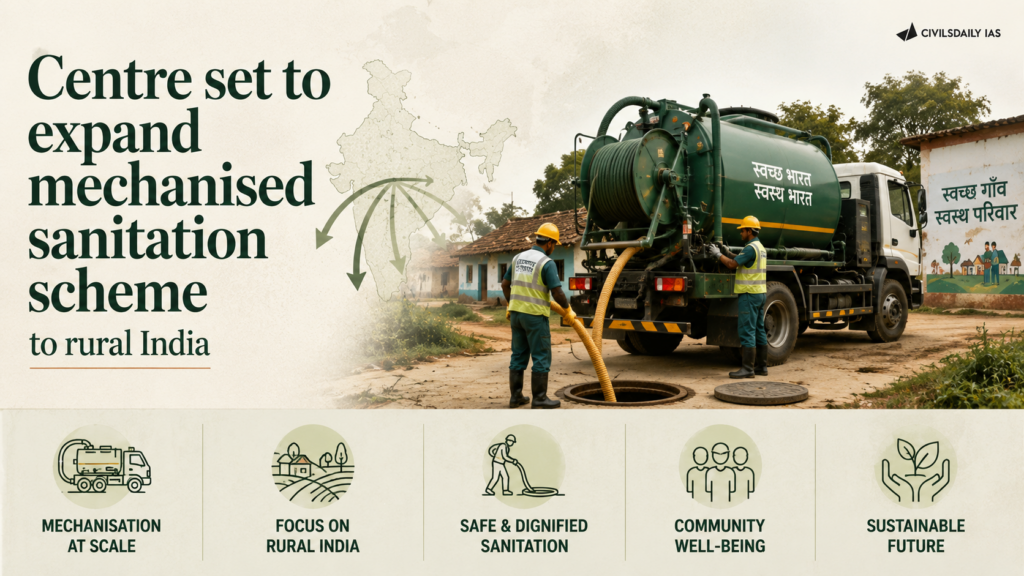
The Social Justice Ministry has moved a proposal to extend the National Action for Mechanised Sanitation Ecosystem scheme from towns and cities to rural parts of the country. The scheme profiles sewer and septic tank workers as the route to its benefits, and coverage is being widened ahead of a delivery channel that approves capital subsidy for a small fraction of those profiled.
Components of NAMASTE
- Profiling and identification: Sanitation workers are enumerated at camps run by urban local bodies, and that profile is the entry point to every other component of the scheme.
- Occupational safety: Profiled workers are given safety training and personal protective equipment for the work they already perform.
- Capital subsidy for self employment: A profiled worker or a Private Sanitation Service Organisation may apply for a capital subsidy to buy mechanised equipment and set up a sanitation enterprise.
- Emergency Response Sanitation Units: Urban local bodies are supported to set up standing units equipped with suction and jetting machines, so that a sewer or septic tank is cleaned by machine instead of by human entry.
What is manual scavenging?
- Manual scavenging: Manual scavenging is the manual handling, carrying or disposing of human excreta from an insanitary latrine, an open drain, a pit or a railway track. The Prohibition of Employment as Manual Scavengers and their Rehabilitation Act, 2013 prohibits both the practice and the employment of any person for it.
Who is a sewer and septic tank worker (SSW)?
- Sewer and septic tank worker: A sewer and septic tank worker (SSW) is a person engaged in cleaning sewer lines, manholes and septic tanks, whether employed directly or engaged through a contractor. The category is distinct from manual scavenging in law, since the work is lawful when performed with mechanised equipment and prescribed safety gear.
What is a Private Sanitation Service Organisation (PSSO)?
- Private Sanitation Service Organisation: A Private Sanitation Service Organisation (PSSO) is a private entity providing mechanised sanitation services that can propose projects for capital subsidy under the scheme. It is one of two proposal routes, the other being an application by an individual worker.
What is the Safai Udyami Yojana?
- Safai Udyami Yojana: The Safai Udyami Yojana is the self employment component under which sewer and septic tank workers receive capital subsidy to set up their own sanitation enterprise. It is one of the two self employment routes in which the National Commission for Scheduled Castes has flagged rejections.
What does the proposed expansion change?
- Geographic extension: The proposal takes the scheme’s scope from towns and cities to rural parts of the country for the first time.
- New worker categories: Coverage will be widened to include drain cleaners, and workers in sewage treatment plants and faecal sludge treatment plants.
- Outlay and horizon: The Ministry has proposed around ₹498.73 crore for the expanded scheme, to be spent from this fiscal year to 2030-31.
- Second widening of scope: The scheme initially covered only sewer and septic tank workers and was first expanded to include waste pickers, so the rural extension is the second enlargement.
- Original aim retained: The scheme was started in 2023-24 with the aim of eradicating sewer and septic tank deaths, and the expansion does not alter that objective.
Why has the scheme’s delivery record become the central concern?
- Profiling against approval: 90,915 sewer and septic tank workers have been profiled across the country, and only 810 have been approved for capital subsidies.
- Approval against disbursal: Of the 810 approved, 147 had actually received their funds as on 31 March 2026.
- Subsidy covers only part of the cost: The capital subsidy meets up to 50 per cent of total project cost, so an approved worker still has to raise the balance before the enterprise can start.
- Manual scavengers identified: Only 2,652 projects have been approved against the 58,000 manual scavengers identified under the scheme.
- Both routes inside the count: The 2,652 approvals include projects proposed by Private Sanitation Service Organisations as well as by individuals, so the figure is not a count of individual entrepreneurs alone.
- Waste picker coverage: 1.3 lakh waste pickers have been profiled alongside the sewer and septic tank workers, per the Ministry’s annual report for 2025-26.
What has the National Commission for Scheduled Castes flagged?
- Repeated correspondence: The Commission has written repeatedly to the Social Justice Ministry since last year on the continued rejection of applications under the self employment and capital subsidy components.
- Rejections identified as the cause: It has held that one reason for the low number of approved projects is the high rate of rejections.
- Rejections across every part: It has noted rejections under each part of the capital subsidy component, and asked that these be examined.
- The August 2025 letter: That letter flagged rejections in the self employment components, both in the Safai Udyami Yojana and in the component for Private Sanitation Service Organisations.
- Source of the mandate: The Commission acts under Article 338, which empowers it to investigate and monitor safeguards for the Scheduled Castes and to inquire into specific complaints.
Why do sewer and septic tank deaths persist under a statutory prohibition?
- Deaths on record: 498 people died across the country while engaged in the hazardous cleaning of sewers and septic tanks from 2019 to June 2026, per the Social Justice Ministry’s reply to Parliament in August 2026.
- Enforcement rests with the employer: The Prohibition of Employment as Manual Scavengers and their Rehabilitation Act, 2013 bars hazardous cleaning without protective gear, and the duty to enforce falls on local authorities who are frequently the employers themselves.
- Contracting layer: Sewer cleaning is routinely outsourced, which separates the municipal principal from the worker who enters the tank.
- Rehabilitation lag: A worker whose capital subsidy application is rejected returns to the same work, so profiling without disbursal leaves the occupational risk untouched.
- Rural gap unmeasured: Rural areas have been outside the scheme until this proposal, so deaths in village septic tanks have had no dedicated scheme response.
Challenges to NAMASTE
- Rejection concentrated in the subsidy pipeline: The bottleneck sits between profiling and approval rather than between approval and identification. Eg. The National Commission for Scheduled Castes has recorded rejections under every part of the capital subsidy component and has asked the Ministry to explain them.
- Balance financing after subsidy: The worker must raise the uncovered share of project cost as a loan against negligible collateral. Eg. National Safai Karamcharis Finance and Development Corporation term loans routed through State channelising agencies have carried low utilisation and weak recovery.
- Urban local body capacity: Emergency Response Sanitation Units need trained crews and maintained machines, which small municipalities cannot sustain. Eg. The Safaimitra Suraksha Challenge launched in 2020 enrolled 246 cities to become sewer death free, and participation was concentrated in large municipal corporations rather than small towns.
- Contractor liability gap: Outsourcing lets the principal employer distance itself from a death inside a manhole. Eg. In Delhi Jal Board v National Campaign for Dignity and Rights of Sewerage and Allied Workers (2011), the Supreme Court held that the principal employer cannot escape liability by engaging contractors for sewer cleaning.
- No rural delivery cadre: Rural sanitation is administered by gram panchayats, which have no wing equivalent to an urban local body’s sanitation department. Eg. Faecal sludge emptying in villages is done by informal private operators outside any municipal register, which leaves no employer to profile a worker against.
- Monitoring by profiling count: Progress is reported as workers profiled rather than as workers rehabilitated, so the headline number rises without entitlement delivery following it. Eg. The Ministry’s annual report for 2025-26 leads with profiling totals for sewer and septic tank workers and waste pickers, and not with the count of workers placed in an alternative livelihood.
Conclusion
The Social Justice Ministry has proposed extending the National Action for Mechanised Sanitation Ecosystem scheme to rural India, to drain cleaners and to treatment plant workers. The proposal is at the stage of a Ministry submission and has not yet been notified, and the next milestone is approval of the expanded scheme and its outlay. The delivery record it inherits is a profiling count far ahead of the number of capital subsidy cases funded, alongside 498 sewer and septic tank deaths between 2019 and June 2026.
“[2016] ‘Rashtriya Garima Abhiyaan’ is a national campaign to
(a) rehabilitate the homeless and destitute persons and provide them with suitable sources of livelihood
(b) release the sex workers from their practice and provide them with alternative sources of livelihood
(c) eradicate the practice of manual scavenging and rehabilitate the manual scavengers
(d) release the bonded labourers from their bondage and rehabilitate them
