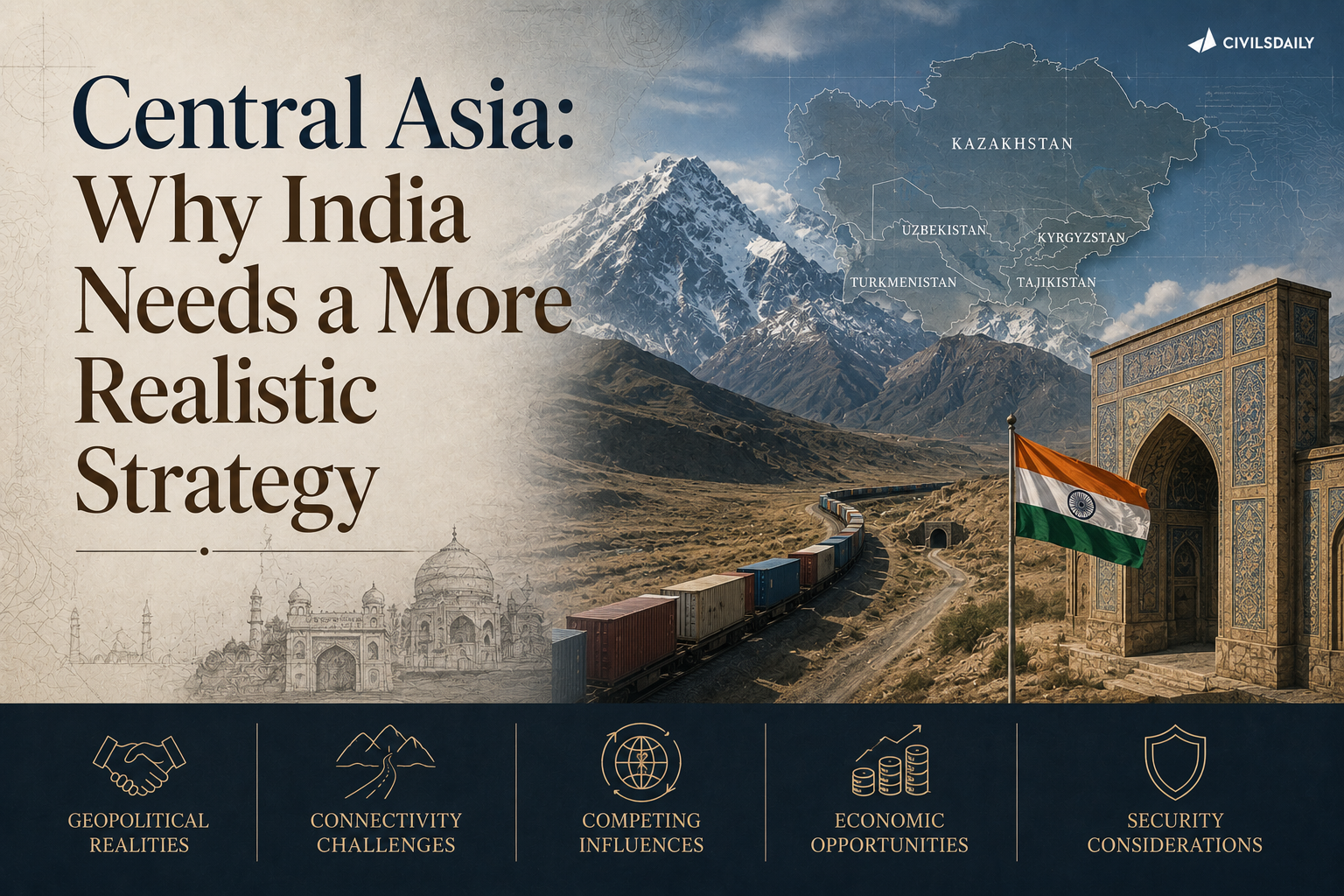
Why in the News
Prime Minister Modi visits Uzbekistan and the SCO summit in Kyrgyzstan this week, entering a Central Asia that bears little resemblance to the region he toured in 2015. Central Asia has gained independent geopolitical agency and diversified its great-power relationships, exposing the gap between India’s ambition for strategic reconnection and its actual capacity for access and investment.
How has Central Asia’s regional coherence altered its position between competing powers?
- Central Asian Five consolidation: Since 2018 the five states have met regularly at summit level and signed a friendship treaty, moving toward organisational substance as a Central Asian community.
- C-6 expansion: The Central Asian Five invited Azerbaijan to form the C-6, linking the region more closely to the Caucasus and Türkiye.
- Fergana Valley settlement: Uzbekistan, Kyrgyzstan and Tajikistan settled long-running border disputes in the Fergana Valley, removing a structural source of intra-regional friction.
- Intra-regional trade growth: Rising intra-regional trade has reinforced political cooperation, converting Central Asia into a region in its own right rather than the sum of five post-Soviet republics.
What do recent institutional realignments show about Central Asia’s shift toward the Greater Middle East and the West?
- Kazakhstan–Abraham Accords: Kazakhstan announced accession to the Abraham Accords at the Washington summit with the US in November 2025.
- Board of Peace charter: Azerbaijan, Kazakhstan and Uzbekistan signed the charter of Trump’s Board of Peace at Davos in January 2026.
- Organisation of Turkic States: Türkiye converted the OTS from a cultural forum into an instrument for political, economic and defence cooperation across Central Asia.
- US bureau reorganisation: Washington restructured the State Department in 2006 to group Central Asia with Afghanistan and the Subcontinent, an earlier connectivity bet that Afghan instability defeated.
What geographic constraints continue to block India’s direct access to Central Asia?
- Land route blockage: Pakistan blocks India’s overland route, and Afghan instability rules out an alternate land corridor.
- Chabahar disruption: The Iran–US conflict has complicated Chabahar and the International North-South Transport Corridor, leaving India’s one built connectivity node idle.
- Emerging unaddressed issues: Central Asian states have moved toward pragmatic engagement with the Taliban, but new problems like Amu Darya water-sharing are arising in areas where India has no established role.
Why can India not replicate other external powers’ approaches in Central Asia?
- Diplomatic precondition unmet: Delhi has not resolved whether to extend diplomatic flexibility toward Pakistan, Türkiye and Azerbaijan, flexibility that would expand its room for manoeuvre.
- Capability gap: India cannot match China’s infrastructure spending, Russia’s geographic advantages, Europe’s financial resources, or Türkiye’s Caspian access.
- Multi-vector environment: Central Asian states engage all major powers and commit exclusively to none, closing off the option of an exclusive partnership regardless of capability.
Conclusion
India’s Central Asia policy should replace romantic historical framing with a realistic assessment of its access constraints and capabilities, and build engagement incrementally from that assessment rather than from renewed aspiration.
Back2Basics
- Central Asian Republics (CARs): The five states that emerged from the dissolution of the Soviet Union in 1991: Kazakhstan, Kyrgyzstan, Tajikistan, Turkmenistan, and Uzbekistan, sharing historic trade and cultural links with India through the Silk Route.
“[2024, GS2, 10 marks] Critically analyse India’s evolving diplomatic, economic and strategic relations with the Central Asian Republics (CARs) highlighting their increasing significance in regional and global geopolitics.”
