Why in the News
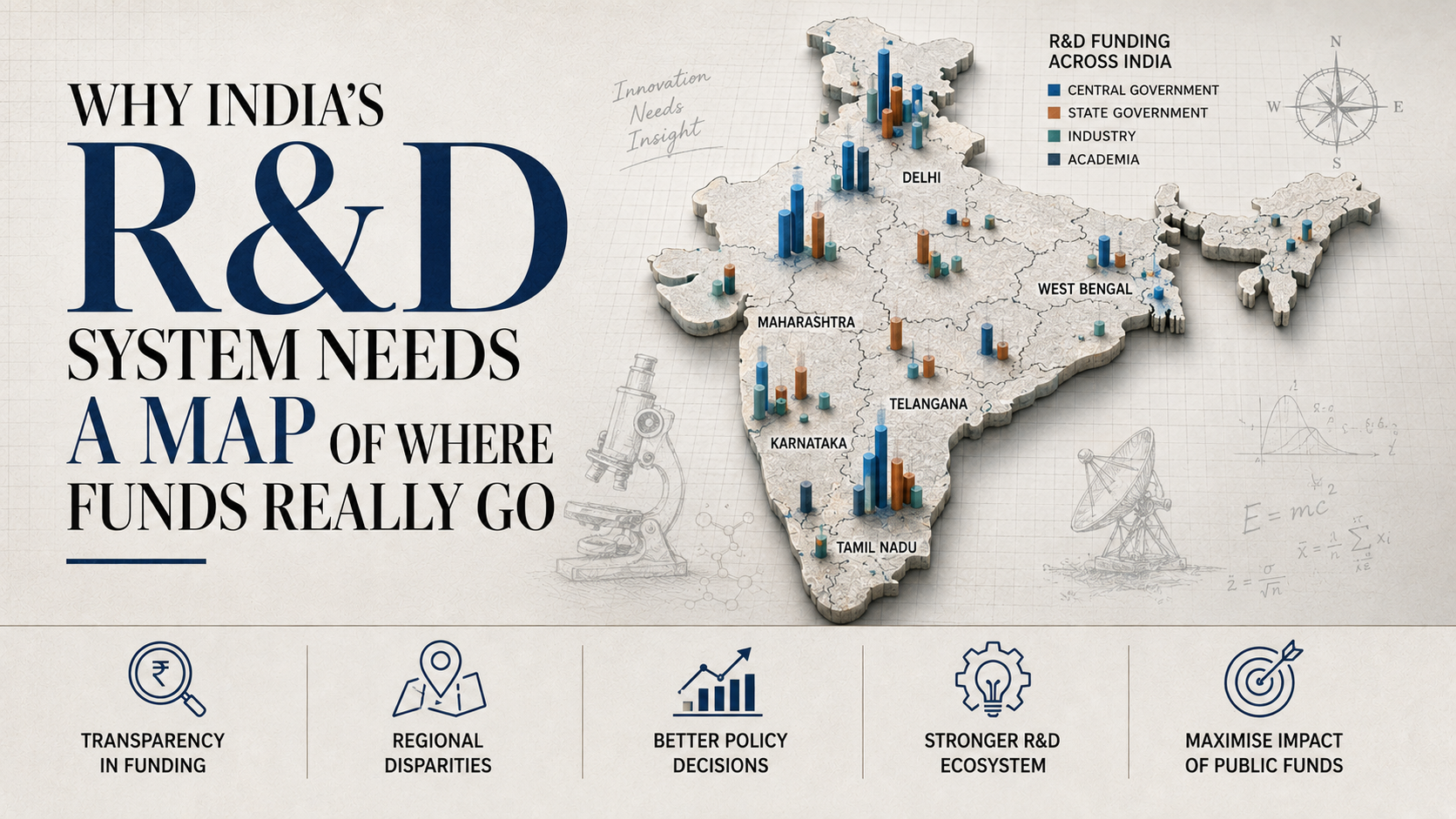
A NITI Aayog report, ‘Ease of Doing R&D in India’, drawing on a survey of over 400 institutional leaders and 850 scientists, has found that close to 80% of funding under the Anusandhan National Research Foundation (ANRF, India’s apex research funding body, whose governing board is headed by the Prime Minister and which is mandated to draw much of its funding from non-governmental sources alongside Central contributions) is concentrated in the IITs, despite ANRF’s own mandate to support a wider base of universities and research bodies. The report also flagged that multiple central agencies may be funding overlapping research areas, leading to what it calls “inefficient” use of public money. NITI Aayog’s proposed response is the Unified Project Management System (UPMS), meant to streamline planning, funding, monitoring and evaluation of public R&D projects across ministries. The article argues that UPMS does not by itself fix the deeper gap it is meant to solve: India has no system that can tell funders, researchers or the public who is being funded, by whom, for what, and whether that funding has already been given elsewhere.
What is a persistent digital identifier (PID), and why does India’s R&D funding lack one?
- Persistent digital identifier (PID): A permanent, unique, machine-readable identifier attached to every research grant, comparable to how a PAN number identifies a taxpayer or an IMEI number identifies a phone.
- Attached metadata: Each PID is meant to carry a standard set of details, which agency gave the money, to which institution, to which named researcher, what amount, over what period, and in which field, linked so officials can track outcomes when the PID is cited in a published paper.
- Scattered and inconsistent records today: This information already exists inside Indian funding agencies, but scattered across dozens of separate databases, in inconsistent formats, often as free text. Eg. A researcher’s name may appear as “IISc, Bangalore” in one dataset and “Indian Institute of Science, Bengaluru” in another, enough for an automated system to fail to recognise them as the same institution.
What does the NITI Aayog report reveal about India’s R&D funding?
- Concentration in a few institutions: Close to 80% of ANRF funding is concentrated in the IITs, despite ANRF’s mandate to support a wider base of universities and research bodies than the traditional funding model has managed.
- Possible duplication across agencies: Multiple Central agencies are possibly funding similar research areas, resulting in overlap and “inefficient” use of public money, per the report’s survey of over 400 institutional leaders and 850 scientists.
- The underlying gap: Both findings point to the same root cause, the absence of a system that can tell funders, researchers or the public who is funded, by whom, for what, and whether that funding has already been given elsewhere.
How have other countries solved this identifier problem?
- Crossref’s Grant Linking System (global, non-profit): Built by the open digital infrastructure organisation Crossref, this system now has more than 2 lakh grants registered worldwide from funders seeking to track duplication and concentration.
- Research Organisation Registry (ROR) and ORCID: A funder ID identifies the funding agency down to the division or department; a ROR ID identifies the receiving institution; an ORCID identifier, already familiar to Indian researchers since most journals require it, identifies the individual researcher so funding can be aggregated per person.
- Grant DOI, since 2020: Crossref extended its system to a permanent identifier for the grant itself, which can be linked to whatever the grant produces, papers, patents or data.
- Government-owned national portals compatible with the global standard: The U.K.’s “Gateway to Research” portal and the European Union’s CORDIS and OpenAIRE infrastructure run their own government-owned single points of entry for funding agencies, while generating identifiers fully compatible with the Crossref/ROR/ORCID standards, giving national governments ownership without breaking compatibility with the global dataset.
- Documented scale of the problem elsewhere: A 2013 analysis of U.S. federal grant applications using automated text-matching estimated duplicate or overlapping funding may have cost the U.S. nearly $70 million; a 2020 analysis of nearly 20,000 competitive grants in Denmark found funds concentrated among a small group of researchers and a narrow set of topics, a pattern the article says mirrors what NITI Aayog flagged for India.
What are India’s options going forward?
- Build a sovereign national registry: India could develop and maintain its own India-specific grant registry from the ground up, giving it full control and the ability to tailor the system to its own agencies, federal structure and State research schemes.
- Join the existing global infrastructure: India’s funding agencies could become members of the Crossref ecosystem directly, which can be implemented faster since the technical standards and governance already exist internationally.
- A hybrid middle path: India could build a single national portal, the NITI Aayog’s own proposed UPMS, that internally mints Crossref-compatible grant DOIs and links every record to ROR and ORCID identifiers, following the model of the U.K.’s Gateway to Research and the EU’s CORDIS/OpenAIRE.
Challenges to the Unified Project Management System (UPMS)
- Legacy data inconsistency: Migrating scattered, free-text agency records into a structured PID system requires resolving years of inconsistent naming across agencies before the system can produce reliable data. Eg. The same institution recorded as “IISc, Bangalore” in one dataset and “Indian Institute of Science, Bengaluru” in another. Fix. Mandate a common institutional and researcher master list, cross-validated against existing ORCID and ROR records, before agencies are required to report through UPMS.
- Compliance is not self-enforcing: A national portal only produces reliable data if every Central and State funding agency consistently deposits data into it; a voluntary or partially adopted system reproduces the same blind spots the report identifies. Fix. Make UPMS reporting a precondition for releasing funds under any Central research scheme, so compliance is enforced through the funding process itself.
Conclusion
NITI Aayog’s Unified Project Management System addresses the process of streamlining India’s R&D funding, but by itself does not supply the persistent digital identifier and metadata infrastructure that would let funders, researchers and the public actually see where public research money goes and whether it has already gone somewhere else. The next milestone is whether UPMS is designed to mint Crossref-compatible identifiers and how many agencies are made to report through it.
“[2024, GS2, 15 marks] What are the aims and objects of the recently passed and enforced, The Public Examination (Prevention of Unfair Means) Act, 2024? Whether University/State Education Board examinations, too, are covered under the Act?”
