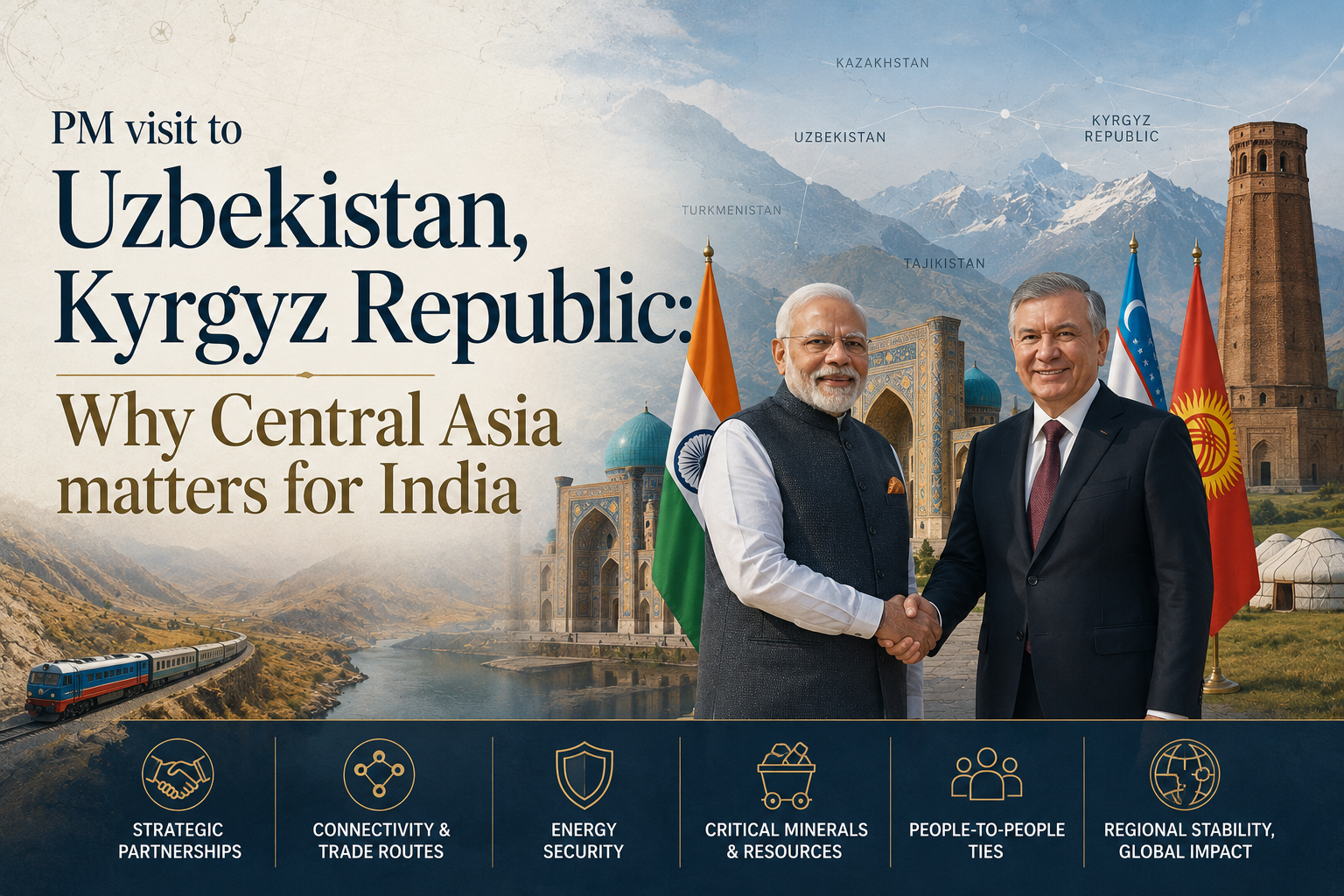
Why in the News
Prime Minister Narendra Modi is visiting Uzbekistan from August 29 to 30 on a bilateral visit, followed by the Kyrgyz Republic for the 26th Shanghai Cooperation Organisation (SCO) Summit from August 31 to September 1. The visit continues India’s focused Central Asia engagement, which began in 2012 with the “Connect Central Asia” policy and was reinforced when Modi became the first Indian Prime Minister to visit all five Central Asian countries in July 2015.
What resources make Central Asia strategically valuable?
- Kazakhstan holds major mineral wealth: Kazakhstan has one of the world’s biggest uranium reserves along with substantial deposits of coal, lead, zinc, gold and iron ore.
- The Kyrgyz Republic offers gold and hydropower: The Kyrgyz Republic’s economy is built significantly around gold mining and hydropower generation potential.
- Turkmenistan holds vast natural gas reserves: Turkmenistan has one of the world’s largest natural gas reserves, a resource base central to regional pipeline politics.
- Tajikistan and Uzbekistan add hydropower, gold and uranium: Tajikistan has substantial hydropower potential, while Uzbekistan holds gold, uranium and natural gas reserves of its own.
Why is India competing for strategic space in Central Asia?
- Countering China’s regional investments: China’s President Xi Jinping visited four of the five Central Asian countries in September 2022, his first overseas trip after the Covid-19 disruption, and China has made major investments in the region through its Belt and Road Initiative, which India does not want to see capture the post-Soviet space unchallenged.
- Security concerns following the Taliban takeover: India’s engagement is driven partly by the need for security cooperation in the wake of the Taliban’s return to power in Afghanistan, since Central Asia borders Afghanistan directly.
- Energy and connectivity needs: India’s interest includes Kazakhstan’s uranium reserves, Turkmenistan’s role in the proposed Turkmenistan-Afghanistan-Pakistan-India gas pipeline, and connectivity plans built around the International North-South Transport Corridor.
- A cultural outreach signal in 2022: India invited Central Asian leaders to the Republic Day celebrations in January 2022, an early diplomatic signal of the outreach it has since built on.
What challenges constrain India’s Central Asia engagement?
- No overland access through Pakistan: Pakistan blocks India’s direct overland transport access to Central Asia, forcing India to route connectivity plans through the International North-South Transport Corridor and the Chabahar port in Iran instead. Eg. India’s push to integrate the Corridor with Chabahar exists specifically because the shorter, direct land route through Pakistan is closed to it. Fix. Prioritise completion of the Chabahar-linked rail and road segments of the Corridor on a fixed timeline, since it is the only viable alternative connectivity route available to India.
- Radicalisation risk along the Taliban-adjacent frontier: Central Asia is widely seen as the northern boundary of the Islamic world, and the Taliban’s ascent next door raises the risk of radicalism and a possible regrouping of the Islamic State within the region. Eg. Central Asian governments have flagged the security implications of Afghanistan’s instability spilling across shared borders. Fix. Expand India’s existing counter-terrorism training and intelligence-sharing arrangements with Central Asian states as a standing component of the engagement, not an occasional add-on.
- Russia-Ukraine spillover creating local churn: The Russia-Ukraine conflict has pushed some Russians with money and skills, but unable to move to the West, toward these Central Asian countries, which could bring inflows of talent and funds alongside social tension. Eg. Reports point to a rising Russian presence in Central Asian cities since the conflict began, altering local economic and social dynamics.
What civilisational and trade links does India draw on?
- Deep historic ties with Uzbekistan: The only known Buddhist monastery in Central Asia is at Kara Tepa in Termez, Uzbekistan, an important centre during the Kushana era when Buddhist influence spread into the region, and close to 3,000 words are shared between Hindi and Uzbek.
- Shared cuisine as a marker of the connection: Similarities exist across Indian and Central Asian food traditions, including ghee and sariyok, samosa and samsa, naan and non, and pulao and pilaf.
- A meaningful trade relationship with Uzbekistan: India is among Uzbekistan’s top 10 trading partners, with bilateral trade in 2025-26 close to $1 billion.
What is the SCO summit’s composition and agenda?
- A ten-member grouping with wide partner networks: The SCO comprises 10 member states, India, Belarus, China, Iran, Kazakhstan, Kyrgyzstan, Pakistan, Russia, Tajikistan and Uzbekistan, alongside 15 Dialogue Partners including Kuwait, Saudi Arabia, the UAE and Turkiye, and two Observers, Mongolia and Afghanistan.
- India joined the grouping in 2017: India has been a full SCO member since 2017, and this year’s summit also marks the third edition of the SCO+ format, expected to bring in additional states and bodies such as the United Nations and the Collective Security Treaty Organization.
Conclusion
Modi’s back-to-back Uzbekistan visit and SCO summit attendance extend a Central Asia policy that dates to 2012, aimed at securing energy access, countering Chinese influence and building connectivity around Pakistan’s blockage of overland routes. The next milestone is the Bishkek summit itself, from August 31 to September 1, and whatever bilateral outcomes emerge from the Uzbekistan leg beforehand.
Back2Basics: What is the International North-South Transport Corridor (INSTC)?
- A multimodal route bypassing Pakistan: The International North-South Transport Corridor is a multimodal transport link connecting India to Russia and Europe via Iran, Azerbaijan and Central Asia, designed to move goods by ship, rail and road, and it is the route India relies on to reach Central Asia given the absence of direct overland access through Pakistan.
[2025] India is one of the founding members of the International North-South Transport Corridor (INSTC), a multimodal transportation corridor, which will connect
[A] India to Central Asia to Europe via Iran
[B] India to Central Asia via China
[C] India to South-East Asia through Bangladesh and Myanmar
[D] India to Europe through Azerbaijan (2017, same Microtheme).
