Why in the News
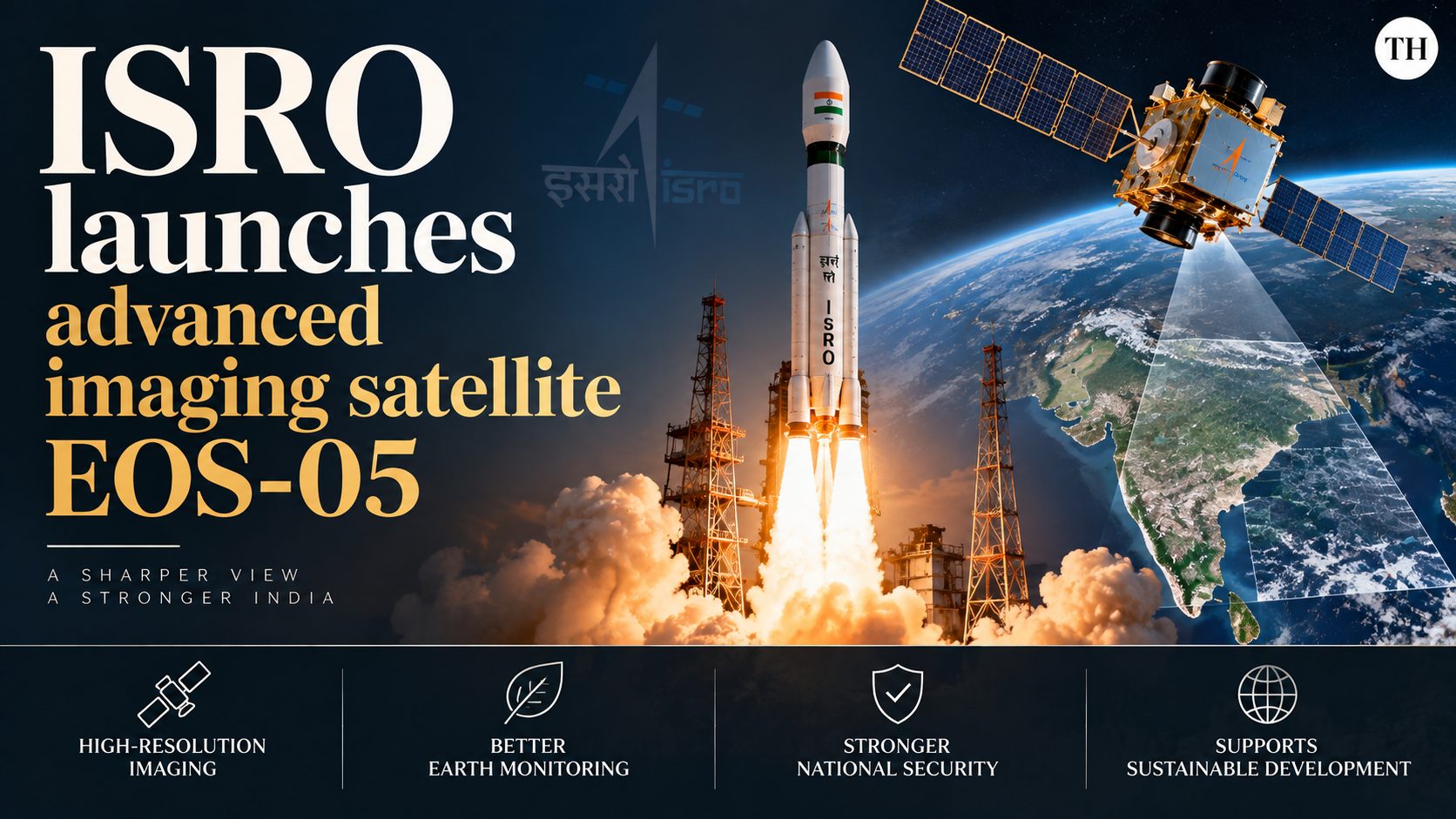
The Indian Space Research Organisation (ISRO) has launched the advanced earth observation satellite EOS-05 aboard the Geosynchronous Satellite Launch Vehicle (GSLV-F17).
What is EOS-05?
- What makes it a first: It is India’s first dedicated imaging satellite operating from geosynchronous orbit, where a satellite’s orbital period matches the earth’s rotation so it holds position over the same region.
- What it carries: The satellite has multi band operating capabilities and an operational life of nine years.
- What it replaces: It takes the place of EOS-03, lost in the unsuccessful GSLV-F10 mission of August 2021.
- Where it is now: ISRO has confirmed that the valves are operating, the solar panel is deployed and the satellite’s health is intact, and the orbit will be raised over the coming days to place it on the geo platform.
Why does imaging from geosynchronous orbit matter?
- It removes the revisit gap: A low earth orbit imaging satellite passes over a given area only periodically, while a geosynchronous platform holds the same region in view continuously.
- The applications are time sensitive: Near real time imagery serves agriculture, environment monitoring and disaster management, where the value of an image collapses if it arrives days after the event.
- The data is described as strategic: ISRO has stated that the platform will supply important strategic data supporting “national activities”, which is the standard formulation for defence and security use.
- The trade off is resolution: Ground resolution falls as orbital distance rises, so a geosynchronous imager buys persistence at the cost of the fine detail a low orbit satellite returns.
What does the mission say about the launch vehicle?
- It was the heaviest payload the vehicle has carried: The 2,367 kg satellite is the heaviest ISRO has injected using this launch vehicle.
- The growth is measurable against the first flight: The first GSLV flight, GSLV-D1, carried a payload of 1,536 kg.
- The gain came from two specific changes: ISRO has attributed the improvement to optimising the vehicle’s structural mass and improving its propulsion systems.
- The vehicle configuration: The GSLV is a three stage, 51.7 metre vehicle with a lift off mass of 420.5 tonnes, and its third stage is cryogenic (using propellants stored as liquids at extremely low temperatures, which yields higher efficiency than conventional stages).
- The mission count: This was the 19th GSLV mission and the 107th launch from Sriharikota.
Why had ISRO stopped launching?
- Two consecutive vehicle failures: The PSLV-C61 mission failed on 18 May 2025, and the PSLV-C62 mission carrying the EOS-N1 earth observation satellite failed on 12 January 2026.
- The response was a deliberate halt: ISRO adopted a cautious approach after the back to back failures and refrained from carrying out further launches.
- The cost was an entire quarter: Seven missions, including this one, had been scheduled for the first quarter of 2026, and no satellite was launched during the period.
Challenges to India’s earth observation programme
- Launch cadence lags the manifest: A single quarter of stood down launches pushes an entire year’s schedule, and satellites waiting for a slot age against their design windows. Eg. Seven missions planned for the first quarter of 2026 were carried forward without a single flight.
The Fix: Move routine earth observation payloads onto the Small Satellite Launch Vehicle and commercial providers, so a review of one vehicle does not freeze the whole manifest. - The cryogenic stage remains the vehicle’s hardest element: The GSLV’s performance depends on a stage that took India close to two decades to prove. Eg. The first fully successful flight of the indigenous cryogenic upper stage came only with GSLV-D5 in January 2014.
The Fix: Sustain a parallel production line and ground test cadence for cryogenic stages, so a flight failure does not idle the vehicle for want of a qualified replacement stage. - Optical imaging fails when it is needed most: An optical imager cannot see through cloud, and India’s worst flood and landslide events occur during the monsoon under continuous cloud cover. Eg. Disaster response during the monsoon depends on radar imaging satellites such as EOS-04 rather than on optical payloads.
The Fix: Pair the geosynchronous optical platform with a scheduled radar imaging constellation, so persistent coverage survives the cloud season. - Imagery is only as useful as its downstream users: Data value depends on agencies and states being able to ingest and act on it rather than on the satellite alone. Eg. Access to national imagery is routed through the Bhuvan platform and the National Remote Sensing Centre, and uptake varies sharply across state departments.
The Fix: Fund state level remote sensing application centres with standing analyst posts, so imagery reaches district administrations as advisories rather than as raw files.
Conclusion
The satellite is in a transfer orbit and not yet at its station, so the mission’s outcome is settled only once orbit raising is complete and the platform is commissioned. The capability it brings is persistence over one region rather than sharper pictures, which suits warning and monitoring more than reconnaissance. The launch pause has ended on the vehicle that had the weaker record, which is the more demanding of the two returns to flight. What to watch is whether the remaining missions deferred from the first quarter of 2026 now fly on schedule, since a single successful launch does not by itself restore a cadence.
“[2018] With reference to India’s satellite launch vehicles, consider the following statements :
1.PSLVs launch the satellites useful for Earth resources monitoring whereas GSLVs are designed mainly to launch communication satellites.
2.Satellites launched by PSLV appear to remain permanently fixed in the same position in the sky, as viewed from a particular location on Earth.
3.GSLV Mk III is a four-stage launch vehicle with the first and third stages using solid rocket motors, and the second and fourth stages using liquid rocket engines.
Which of the statements given above is/are correct?
(a) 1 only
(b) 2 and 3
(c) 1 and 2
(d) 3 only
