Why in News
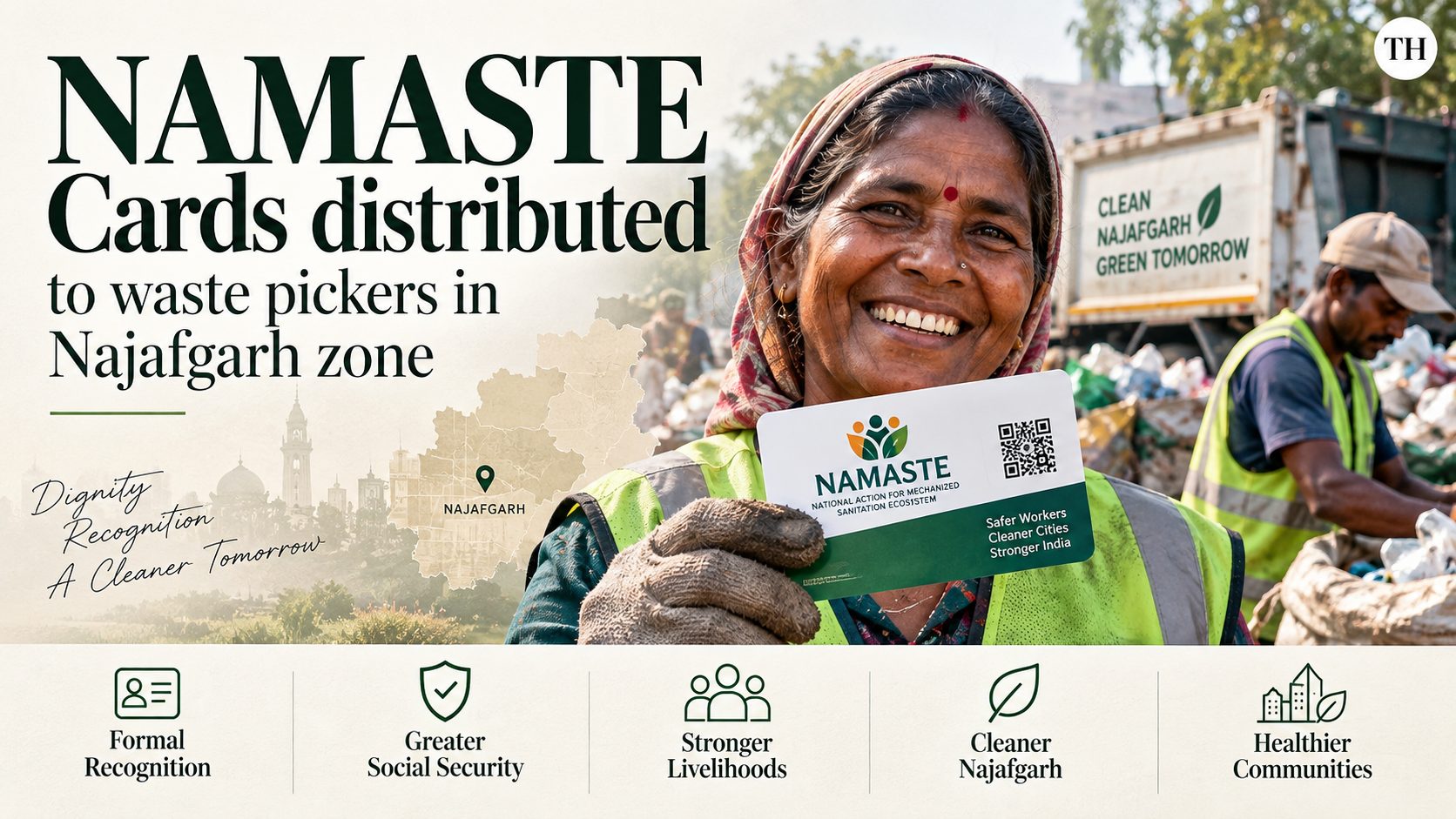
The Ministry of Social Justice and Empowerment (MoSJE) inaugurated distribution of NAMASTE Cards to waste pickers in the Municipal Corporation of Delhi (MCD) Najafgarh Zone on 4 September 2026.
Core facts
- Scheme name: NAMASTE stands for National Action for Mechanised Sanitation Ecosystem. It is a central scheme for the safety and dignity of sanitation workers.
- Implementing bodies: The scheme is run jointly by the MoSJE and the Ministry of Housing and Urban Affairs (MoHUA).
- Event substance: Profiled waste pickers received NAMASTE identity cards. The cards formally recognise the worker and link the worker to scheme benefits.
- Officeholder: The distribution was inaugurated by the Union Minister of State for Social Justice and Empowerment. The individual identity is not material to the policy content.
Static Context
- Objective: NAMASTE targets zero fatalities in sanitation work in India. It seeks to end direct human contact with faecal matter in sewer and septic tank cleaning.
- Coverage expansion: NAMASTE originally covered sewer and septic tank workers (SSWs). The scheme was later extended to enumerate and cover waste pickers. A national digital application for profiling waste pickers was launched on World Environment Day 2025.
- Benefits design: The scheme provides occupational profiling, Personal Protective Equipment (PPE) kits, Ayushman Bharat health cover, and a capital subsidy for sanitation related livelihoods.
- Predecessor: NAMASTE subsumed the earlier Self Employment Scheme for Rehabilitation of Manual Scavengers (SRMS).
- Governing law: Manual scavenging is prohibited under the Prohibition of Employment as Manual Scavengers and their Rehabilitation Act, 2013.
Prelims angle
- Scheme full form and nodal ministries: NAMASTE is run by the MoSJE with the MoHUA. Expect a purpose or ministry match question.
- Beneficiary categories: Sewer and septic tank workers, and waste pickers. The waste picker inclusion is the newest hook.
- Benefit bundle: PPE, Ayushman Bharat health cover, capital subsidy, occupational profiling.
- Predecessor scheme: SRMS. Governing Act: Manual Scavengers Act, 2013.
Mains angle
GS Paper 2, welfare schemes for vulnerable sections. A question can frame the shift from a rehabilitation model (SRMS) to a mechanisation and formalisation model (NAMASTE), and ask whether profiling and card based inclusion secures the rights of informal sanitation workers.
“[2016] Rashtriya Garima Abhiyaan’ is a national campaign to
(a) rehabilitate the homeless and destitute persons and provide them with suitable sources of livelihood
(b) release the sex workers from their practice and provide them with alternative sources of livelihood
(c) eradicate the practice of manual scavenging and rehabilitate the manual scavengers
(d) release the bonded labourers from their bondage and rehabilitate them.
