Why in the News
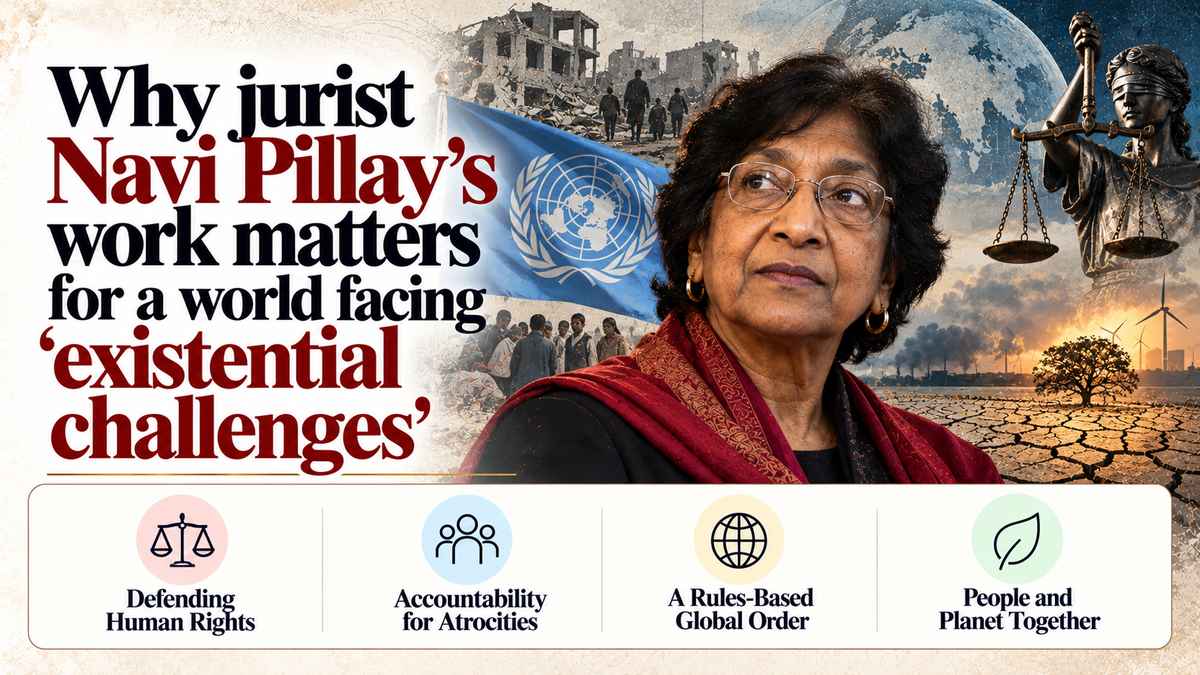
The Nobel Peace Prize, which seldom goes to jurists, has this year honoured the rule of law itself as the foundation of peace. The 2026 prize went to South African jurist Navanethem “Navi” Pillay, 85, “for her efforts to promote peace, international law”, amid widening war.
Why did the Committee honour a jurist?
- The citation: The Nobel Committee cited her “exceptional courage and integrity”, holding that the rule of law, national and international, underpins the system for keeping peace.
- Peace requires justice: The Committee’s line “Peace requires justice” means a settlement lasts only when grave crimes are punished, much as courts, not revenge, keep order within a country.
- Prosecuting atrocities: It credited her with ensuring that war crimes, crimes against humanity and genocide are prosecuted.
- Nuremberg inspiration: The post war Nuremberg Trials showed her how law, through judicial power backed by punishment, could tackle state sponsored violence.
- The takeaway: Honouring a judge signals that international law is itself an instrument of peace, not a backdrop to diplomacy.
How did apartheid shape her career?
- Indentured roots: Her Indian Tamil grandparents went to Africa as indentured labourers (workers bound by contract to years of labour abroad), and she grew up under racially discriminatory laws.
- Harvard doctorate: She became the first South African to earn a doctorate in law from Harvard University.
- Firsts in Natal: She was the first Black woman to start a law practice in Natal Province and the first to serve in its High Court, nominated by Nelson Mandela.
- Defending prisoners: She defended Mandela, the 1993 Nobel Peace laureate, in court and fought for anti apartheid prisoners’ rights such as access to lawyers.
What did the Rwanda tribunal establish?
- ICTR: She served eight years as a judge of the International Criminal Tribunal for Rwanda (ICTR), which tried crimes of the 1994 Rwandan genocide.
- Scale of killing: The genocide killed about 800,000 people in 100 days.
- First genocide judgment: The ICTR was the first international tribunal to enter a judgment for genocide, interpreting it under the Geneva Conventions against war crimes.
- Rape as genocide: It defined the crime of rape in international law and recognised it as a means of perpetrating genocide.
- Propaganda: It was the first to recognise the role of propaganda in aiding genocide, and held members of the media responsible.
Where does her work stand today?
- ICJ ad hoc judge: She is an ad hoc judge (appointed by a party for one case) at the International Court of Justice (ICJ) in The Gambia v. Myanmar, a genocide case over Myanmar’s Rohingya Muslims.
- Gaza inquiry: From 2021 to 2025 she chaired the United Nations (UN) Independent International Commission of Inquiry on the Occupied Palestinian Territory. It found Israeli forces deliberately targeted Palestinian children “resulting in genocide” in Gaza.
- Existential challenges: Amid “existential challenges” and more wars than in a long time, the Committee called international law an “absolute necessity”. Critics call the UN and ICJ powerless to stop violence.
- Call to states: Pillay says justice after conflict is still new and needs support from states, which should “care and act collectively”.
Challenges
- No enforcement arm: International courts depend on states to arrest suspects and carry out rulings.
- Great power resistance: Powerful states reject findings or penalise courts. Eg. The US sanctioned the International Criminal Court hours after the prize.
- Slow proceedings: Genocide cases take years to decide, delaying redress for victims.
Way Forward
- State cooperation: States should execute arrest warrants and comply with the rulings of international courts.
- Protected tribunals: Fund international tribunals adequately and shield their judges and staff from sanctions.
- Domestic prosecution: Countries should enact laws on genocide and crimes against humanity so national courts can try such crimes.
Conclusion
The prize rests on a wager that law, not force, can still restrain states in a period of widening war. That wager will be tested by whether governments comply with genocide rulings and protect international courts from political pressure.
Back2Basics: International Court of Justice
- Status: The principal judicial organ of the UN, often called the “World Court”, based at The Hague, Netherlands.
- Origin: The UN Charter established it in 1945, and it began work in 1946, succeeding the Permanent Court of International Justice.
- Bench: Its 15 judges are elected for nine year terms by the UN General Assembly and the Security Council.
- Jurisdiction: It settles disputes between states through binding rulings and gives non-binding advisory opinions to authorised UN bodies.
Matching Previous Year Question
“[2026] ‘X’, born in the UK, was conferred the Nobel Prize in 2025. He was a professor in an American university when the prize was announced. Identify ‘X’: (a) Michel H. Devoret (b) Richard Robson (c) John Clarke (d) Joel Mokyr ANSWER: C”