Why in the News
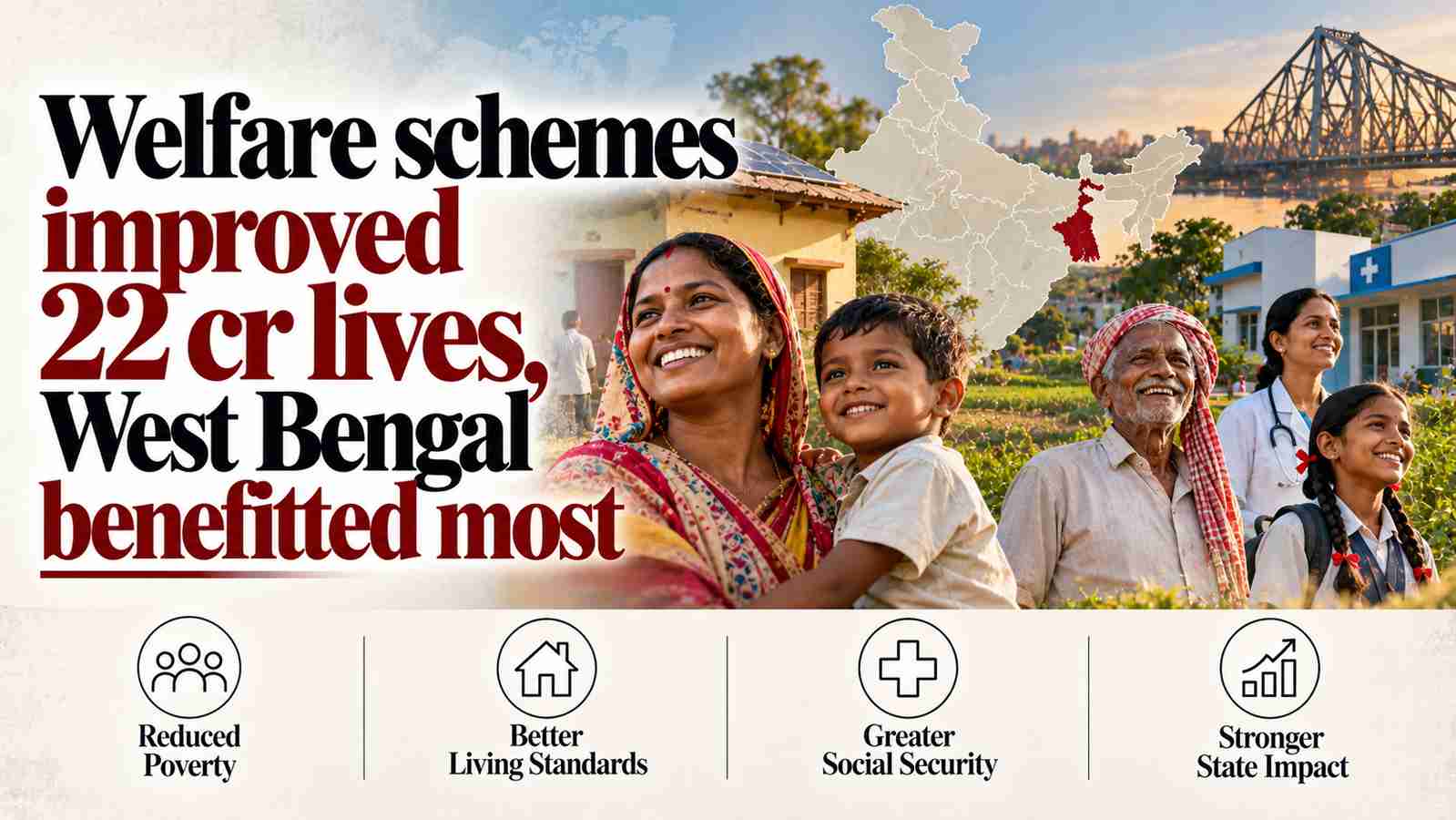
India’s consumption data has measured a household’s level of living by what it spends, leaving out the free food, bicycles and laptops the state gives it. Counting those in-kind social transfers lifts about 22 crore people into a higher consumption class, a staff paper by statisticians of the Ministry of Statistics and Programme Implementation (MoSPI) has found.
What are in-kind transfers, and how did the paper measure them?
- What it is: An in-kind transfer is a benefit given as goods, not cash, such as free foodgrains or a school uniform. Like a meal coupon, it raises what a family consumes without passing through its wallet.
- Why it is missed: Consumption surveys value what a household pays for. Goods received free or at a subsidised price show up at little or no cost, so the household looks poorer than it lives.
- The survey used: The paper drew on unit level data from the Household Consumption Expenditure Survey (HCES) 2022-23, the National Statistics Office’s nationwide survey of household spending on food and non-food items.
- The method: The paper ranked households by Monthly Per Capita Consumption Expenditure (MPCE), what a household spends per member each month, into fractile classes, ranked slices of the population. It then added an estimated value for free or subsidised goods and checked which households moved up a class. Eg. Foodgrains, laptops, bicycles and school uniforms.
- The takeaway: Welfare goods raise the real level of living of crores of Indians, which spending based data alone does not show.
Which States gained the most?
- West Bengal leads: Four in every ten people in West Bengal moved into a higher consumption class because of welfare schemes. At 40.5%, this is the highest share of any major State.
- Runners up: The next highest shares were in:
- Chhattisgarh, 29.2%;
- Assam, 29%;
- Karnataka, 28.4%.
- Wide spread across States: West Bengal sits more than 11 percentage points above the second placed State, so the reach of in-kind schemes differs sharply from one State to another.
Why does counting in-kind transfers matter?
- Truer welfare picture: Poverty and inequality estimates built on spending alone understate the living standards of households that depend on the Public Distribution System (PDS), the network of ration shops selling subsidised grain.
- Food at the core: Free foodgrains are the largest in-kind transfer. Under the Pradhan Mantri Garib Kalyan Anna Yojana (PMGKAY), the Department of Food and Public Distribution gives free grain to about 81 crore people covered by the National Food Security Act, 2013.
- States as providers: Bicycles, laptops and uniforms come largely from State schemes. Eg. West Bengal’s Sabooj Sathi scheme gives bicycles to school students.
- Judging schemes by results: Matching each benefit to household data shows which transfers actually lift families into a higher class, not only how much the state spent on them.
Challenges
- Valuing free goods: The result depends on the price assigned to each item, and a different price changes who crosses a class boundary.
- One time goods: A laptop or bicycle is received once, so its effect on monthly consumption depends on how its value is spread over time.
- Staff paper status: A staff paper carries its authors’ analysis, not an official MoSPI estimate, so its figures await wider review.
- Gains that can be withdrawn: Transfers raise what a household consumes but not what it earns, so the gain disappears if a scheme is cut.
- Targeting errors: When benefits miss eligible households or reach ineligible ones, both the welfare delivered and the measured gain are distorted. Eg. Ration denials after failed Aadhaar authentication.
Way Forward
- Publish the imputation method: MoSPI should release item wise imputed values so that other researchers can test the result.
- Report both measures: Every HCES release should present MPCE with and without imputed transfers, side by side.
- Cost against impact: The Development Monitoring and Evaluation Office (DMEO) of NITI Aayog should use the State wise gains to compare what each scheme costs with what it delivers.
- Pair transfers with livelihoods: States should link in-kind support to skilling and livelihood programmes, so households can sustain the gain on their own.
Conclusion
Counting what the state gives, and not only what households buy, shows welfare schemes lifting the level of living of a large share of Indians, unevenly across States. Whether MoSPI builds this imputation into official poverty and inequality estimates is what to watch.
Matching Previous Year Question
“[2016] There has been a persistent deficit budget year after year. Which action/actions of the following can be taken by the Government to reduce the deficit? 1. Reducing revenue expenditure 2. Introducing new welfare schemes 3. Rationalizing subsidies 4. Reducing import duty Select the correct answer using the code given below. (a) 1 only (b) 2 and 3 only (c) 1 and 3 only (d) 1, 2, 3 and 4 ANSWER: (c)”
