Why in the News
China’s Ministry of Commerce and General Administration of Customs have placed tunnel boring machines (TBMs), walking excavators and high-altitude wet shotcrete machines on an export control list. The move reveals a blind spot in India’s supply chain diversification (buying from several countries instead of one), because India is one of the world’s largest TBM importers.
What is a TBM, and why does China’s grip matter?
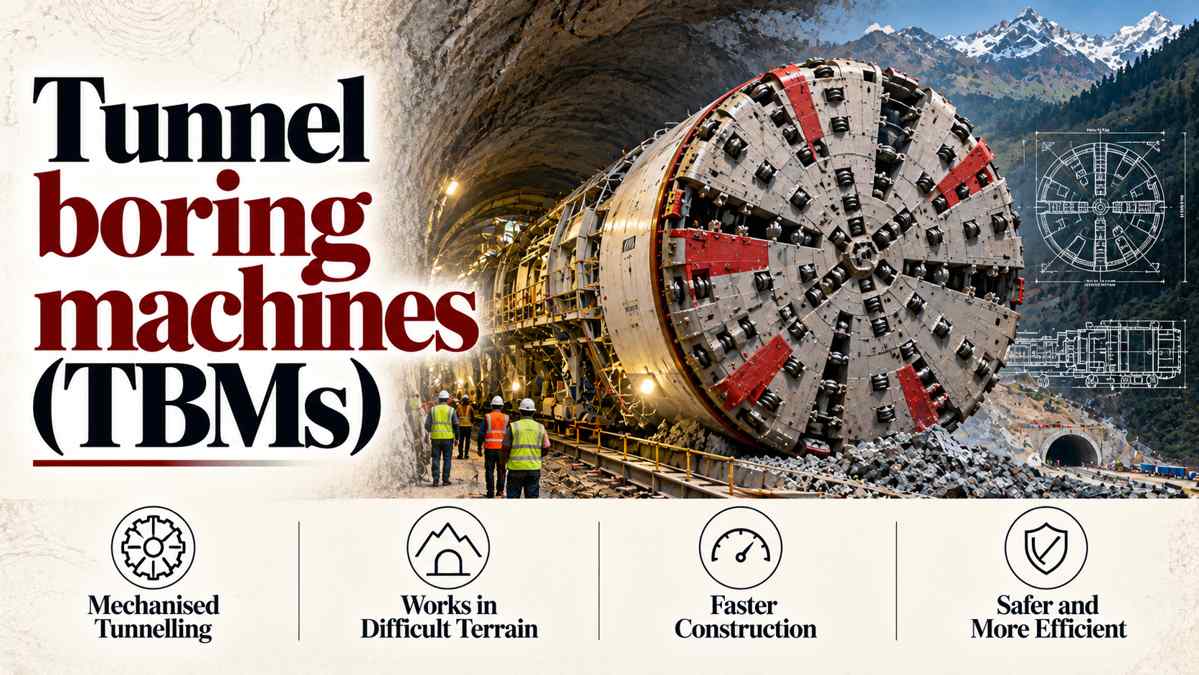
- What it is: A TBM is a large machine that cuts a tunnel through rock and soil as it moves forward. It works like a giant drill built for one project’s ground.
- Complex build: Each TBM must be configured to the geology of its project site and perform numerous tasks, so it is hard to build.
- Dual use: A suitable TBM can serve civilian or military purposes, which makes it a dual-use item.
- Market share: China has cornered about 70% of the global TBM market. Western makers also source many components from China to cut costs.
- The takeaway: Even a machine bought from a Western firm can rest on Chinese parts, so switching suppliers alone does not remove the exposure.
How will China’s export controls work?
- Sensitive destinations: From November 18, a shipment meant for a country or region China deems sensitive because of ongoing disputes will need an export licence from its commerce authorities.
- Other destinations: Exporters to other countries must register, obtain an export certificate and submit end-use declarations that the equipment will not be re-routed to sensitive locations.
- India’s experience: India has faced TBM hold-ups with China for at least two years. Eg. The Mumbai-Ahmedabad high-speed rail project.
Why can India not simply make every TBM at home?
- Production economics: A new TBM plant pays off only with a minimum number of orders. It also needs local industry able to design, make and repair specialised components.
- Existing base: Germany’s Herrenknecht AG set up an assembling and refurbishing facility in Chennai in 2007-08.
- Cost of full self-reliance: Making every sophisticated machine in India would send public infrastructure costs soaring.
- Costlier alternatives: If China holds back machines meant for India, India may have to buy from plants in Germany or Japan at a higher capital cost.
- BEML lesson: The experience of BEML Limited, the public sector heavy equipment maker, shows that manufacturing partnerships can fail without secure licensing and sustained demand.
What is Beijing’s wider aim?
- Pattern of controls: Beijing is systematically picking sectors where it commands large global capacity and placing export controls on them. It uses these controls to answer Western curbs on technology, such as those on advanced semiconductors.
- Compounding risk: Any critical infrastructure sector relying on Chinese supply lines faces geopolitical risk that grows with each new control Beijing adds.
Challenges
- Project delays: Tunnel-heavy metro, rail and hydropower projects slip and cost more when a machine is held up.
- Widening controls: China’s list can extend to other inputs India’s projects need. Eg. Chinese curbs on rare earth magnets in 2025.
- Testing gap: TBM makers and their suppliers lack common testing and precision manufacturing facilities in India.
- Uncertain demand: Tunnel orders come in irregular bursts, so a domestic plant may not secure the minimum order book it needs.
Way Forward
- Make with partners: Make equipment in India under agreements with established foreign firms.
- Shared facilities: Build common testing and precision manufacturing infrastructure for TBM makers and suppliers, instead of backing single “national champions”.
- Secure terms and orders: Write secure licensing terms into partnerships and give them a steady pipeline of public orders.
- Map exposure: Identify every critical infrastructure sector that relies on Chinese supply lines and line up alternative sources.
Conclusion
TBM controls show that India’s diversification effort has missed specialised infrastructure equipment where China dominates. The test is whether India can build a domestic base with foreign partners before Beijing’s controls reach other machines its projects need.
Back2Basics: Export controls on dual-use items
- What they are: Licensing rules that let a government restrict exports of goods and technology with both civilian and military uses.
- China’s framework: China’s Export Control Law took effect in December 2020. China has since curbed exports of critical minerals such as gallium and germanium.
- India’s list: India controls such items through its SCOMET list (Special Chemicals, Organisms, Materials, Equipment and Technologies), set under the Foreign Trade (Development and Regulation) Act, 1992. The Directorate General of Foreign Trade administers it.
- Export control regimes: India joined the Missile Technology Control Regime, the Wassenaar Arrangement and the Australia Group between 2016 and 2018.
Matching Previous Year Question
“[2011] With reference to India, consider the following Central Acts: 1. Import and Export (Control) Act, 1947 2. Mining and Mineral Development (Regulation) Act, 1957 3. Customs Act, 1962 4. Indian Forest Act, 1927 Which of the above Acts have relevance to/bearing on the biodiversity conservation in the country? (a) 1 and 3 only (b) 2, 3 and 4 only (c) 1, 2, 3 and 4 (d) None of the above Acts ANSWER: (c)”
