HOW TO ATTEMPT ANSWERS IN DAILY ANSWER WRITING ENHANCEMENT(AWE)?
Daily 4 questions from General studies 1, 2, 3, and 4 will be provided to you.
A Mentor’s Comment will be available for all answers. This can be used as a guidance tool but we encourage you to write original answers.
You can write your answer on an A4 sheet and scan/click pictures of the same.
Upload the scanned answer in the comment section of the same question.
Along with the scanned answer, please share your Razor payment ID, so that paid members are given priority.
If you upload the answer on the same day like the answer of 11th February is uploaded on 11th February then your answer will be checked within 72 hours. Also, reviews will be in the order of submission- First come first serve basis
If you are writing answers late, for example, 11th February is uploaded on 13th February , then these answers will be evaluated as per the mentor’s schedule.
We encourage you to write answers on the same day. However, if you are uploading an answer late then tag the mentor like @Staff so that the mentor is notified about your answer.
*In case your answer is not reviewed, reply to your answer saying *NOT CHECKED*.
Civilsdaily Hall Of Fame: UPSC-CSE 2021 Top Rankers
Hi Guys, You mustn’t wait for the opportunity, you should create it.
After making gruesome achievements in UPSC 2021 on the internet, Civilsdaily now started an offline foundation batch to make the next success story in UPSC history. Yes, this is the all-dimensional extension of CD. Whether it is online or offline, It’s a distinction without a difference.
Acknowledging the need to ensure removing difficulties, the OFFLINE students face, some more seats in our classroom have been offered as per students’ request. So, if you wish to get your name on the 2023 merit list, you have a final call of admission to the much-coveted ‘UPSC-CSE Foundation Program-2023 Offline Classroom Batch led by Serving bureaucrats, toppers & toppers’ mentors.
CD’s Offline Classroom where Toppers used to enter
With the focus on overall development, Civilsdaily’s dedicated offline mentor teachers group stands by all UPSC aspirants without a second thought.
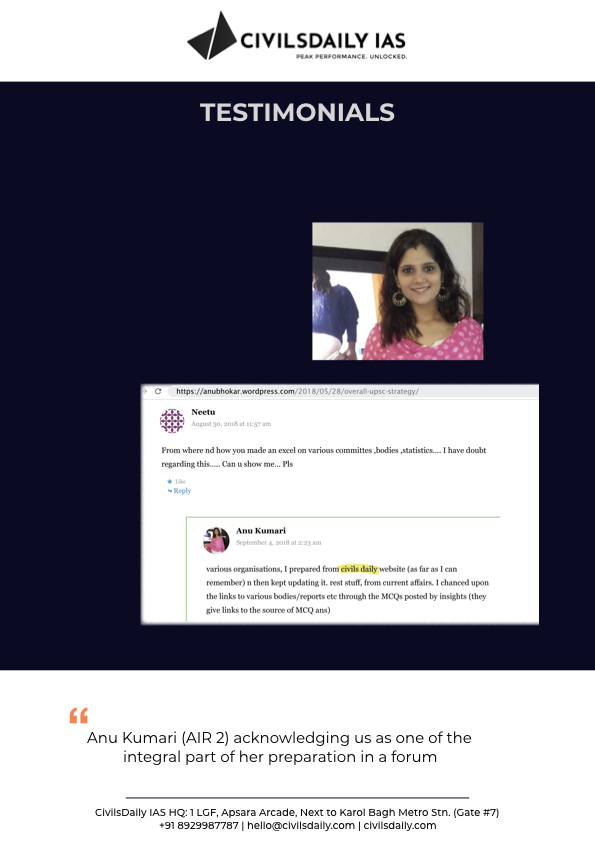
WHAT 2021 TOPPERS HAVE TO SAY ABOUT CIVILSDAILY?
Mukesh Kumar after his success, with his guru and mentor
The Hindu has solemnly acknowledged Civilsdaily’s high rated mentorship program.
EMI Facility Available@ No Extra Cost!
No Cost EMI Facility for Students enrolling in Civilsdaily’s Foundation Course 2023. This is ensure that financial burden has not remain a concern for your preparation.
Please note that there will be no processing fee involved and no hidden costs when you avail the EMI facility.
Civilsdaily’s Mentorship is clearly one brand which sets us apart from any other institute in this Domain.
Civilsdaily mentorship helps you in 6 key components of your preparation-
Direction– Civilsdaily’s mentors are highly qualified, with at least one year of mentorship experience and two UPSC CSE Interviews under their belts. They are well-versed in themany stages of preparation. These mentors will assist you in developing both a comprehensive and micro schedule. They’ll put together a weekly programme for you, complete with mentorship calls. This schedule will be created based on a thorough examination of the importance of subjects as well as the interconnection of topics to make it easier for students to grasp the material.
Discipline– The student will be held accountable to the mentor since he or she will be required to complete a weekly target set by the mentor.
Consistency– Students can retain consistency in their preparation by having their mentor monitor them constantly and giving them regular tests. Furthermore, rational scheduling aids pupils in adopting an integrated approach to preparation..
Value addition– Mentors also assist students with their questions and resources. Students become perplexed as to which resources to follow due to the abundance of content available on the market. Mentors can assist you in locating and referring to the most appropriate materials. This aids students in consolidating their resources and avoiding content overload. Mentors will also offer video assistance.Remember- the mantra to clear UPSC is MINIMUM RESOURCES, MAXIMUM REVISIONS.
Evaluation– The UAP/foundation curriculum also contains a prelims and mains testseries, as well as weekly 10 mains questions from Samachar Manthan (SM). Your mentor will go through each test with you and help you figure out your strengths and shortcomings. So, if you devote yourself to this programme, you will receive one-on-one assistance for more than 40 mains tests (including SM) and more than 30 prelims tests. Furthermore, each test will be examined twice by professional evaluators, with a mentor evaluating the results later.
Motivation– When you’re feeling down or don’t feel like studying, you can reach out to your mentor, have a conversation, get motivated, and restart your studies. Mentor-recommended relaxation techniques can assist you in learning more effectively.
Key Features about UPSC-CSE Foundation Program 2023 Offline Classroom Batch
Integrated Prelims, Mains and Essay Test Series along with Current Affairs and Personalized Mentorship.
UAP & Master Classes: Full coverage for GS prelims & mains.
Differentiators- Mentorship
Watch the lectures unlimited times
Combination of offline learning and in depth mentoring which gives students proper guidance throughout the preparation journey.
Pre cum mains offline foundation program contains every General Studies subject. Syllabus Wise each and every point will be covered in Prelims as well as in mains.
Post classes support of individual mentor
Notes and study materials: all necessary materials of static and current will be provided through hard copies.
A look at the programs in Our Foundation course
PRELIMS TS
40 PRELIMS MOCK TESTS (36 PAPER 1, 4 CSAT)
DEDICATED MONTHLY CA TEST
ALL INDIA RANKINGS
DETAILED EXPLANATIONS
MONTHLY CA MAGAZINES (NEWS, OP-ED, PIB, GOVT.REPORTS)
SAMACHAR MANTHAN
WEEKLY NEWS ANALYSIS (VIDEO + NOTES)
MAINS LEVEL Q&A EVALUATION TO COMPLIMENT THE LECTURES
CHECKED COPY DISCUSSION ON PHONE/ IN-PERSON
MAINS TS
12 SECTIONAL + 12 FLTS
MODEL ANSWER SOLUTIONS
CHECKED COPY DISCUSSION ON PHONE/ IN-PERSON
ESSAY TS
14 TESTS (28 ESSAYS) ON 8 BROAD UPSC TRENDS SINCE 2010
Sajal Singh: Sajal sir is known to make Economics and IR as easy as a cakewalk. He scored one of the highest marks in GS in the 2017 UPSC exam. Under his guidance, more than 80 percent of Students qualified for UPSC interview 2020 in Smash mains Program.
Sudhanshu Mishra: Prior to benchmarking himself as Polity teacher at Civilsdaily, Sudhanshu Sir has served in the Defense Ministry for 10 years. He has a keen interest in regional and global geopolitics which do not only substantially reflect in his lectures but also had come in handy in several stages of his UPSC & PSCs exams.
He is also an MBA candidate Co’23 from IIM Kozhikode.
Sukanya Rana: Our Civilsdaily Mains Program Head Mrs. Sukanya Rana has been mentoring students across multiple stages from prelims to mains to interview. She is part of Smash Mains as Ethics Mentor ans helped Civilsdaily topper to achieve their dream. Interview in 2016.
Graduate from Miranda house in Geography and done MA from JNU in Geography. She is also a qualified Net JRF in Geography.
Other Senior Bureaucrats and toppers will also be joining for various lectures and guest session.
Shri V.P. Singh Sir, IRPS
Virendra Pratap Singh did is B.Tech from IIT Kharagpur in 2003. He joined the services with immense experience in the Private Sector working across domains in high profile companies like Tata Steel, Maruti Suzuki India Ltd, and Tata Motors. He has consistently scored very high marks in interviews. His 2009 score of 213/300 was among the toppers.
Himanshu Arora
Himanshu sir has a wide experience in the field of both academics and policy-making. He has earlier taught Economics at both under-graduate and Post-Graduate level in Delhi University. Currently, he is working at the Prime Minister economic advisory council. He also writes columns regularly in prestigious newspapers like The Hindu, Indian Express and Millenium post.
SD Singh
Dr. S D Singh sir, Retd IFoS, 1988 Batch, Uttarakhand Cadre. He is currently employed with MoEF as a senior consultant. He has 33 years of experience in forestry, environment, wildlife and biodiversity conservation.
Join our inaugural session:
Date:Will be announced soon
Address: 1 LGF, Apsara Arcade, Pusa Rd Next to Gate No.7 Karol Bagh, Metro, North Extn Area, Rajinder Nagar, New Delhi, Delhi 110060
Finally, Teachers Open The Doors, But You Must Enter By Yourself. Now, both the ways lie before you. If you like learning in a traditional classroom way, we are waiting for you at Rajendra Nagar. And if you prefer learning by staying at your home, we appear on the internet anytime you fit. All the best.
HOW TO ATTEMPT ANSWERS IN DAILY ANSWER WRITING ENHANCEMENT(AWE)?
Daily 4 questions from General studies 1, 2, 3, and 4 will be provided to you.
A Mentor’s Comment will be available for all answers. This can be used as a guidance tool but we encourage you to write original answers.
You can write your answer on an A4 sheet and scan/click pictures of the same.
Upload the scanned answer in the comment section of the same question.
Along with the scanned answer, please share your Razor payment ID, so that paid members are given priority.
If you upload the answer on the same day like the answer of 11th February is uploaded on 11th February then your answer will be checked within 72 hours. Also, reviews will be in the order of submission- First come first serve basis
If you are writing answers late, for example, 11th February is uploaded on 13th February , then these answers will be evaluated as per the mentor’s schedule.
We encourage you to write answers on the same day. However, if you are uploading an answer late then tag the mentor like @Staff so that the mentor is notified about your answer.
*In case your answer is not reviewed, reply to your answer saying *NOT CHECKED*.
The World Trade Organization (WTO) is the principal forum for setting the rules of international trade.
For the past two and a half decades, it has helped reduce barriers to trade in both goods and services and created a dispute resolution system that supporters say reduced the threat of trade wars.
However, with negotiations on a comprehensive development agenda due to disagreements, the WTO is under considerable pressure to achieve meaningful results.
Why in news?
Recently, member countries of the World Trade Organization (WTO) wrapped up the Ministerial Conference’s twelfth outing (MC12).
About World Trade Organization (WTO)
The WTO is an intergovernmental organization that is concerned with the regulation of international trade between nations.
The WTO officially commenced on 1 January 1995 under the Marrakesh Agreement, signed by 123 nations on 15 April 1994.
It replaced the General Agreement on Tariffs and Trade (GATT), which commenced in 1948.
It is the largest international economic organization in the world.
Functions of WTO
The WTO deals with the regulation of trade in goods, services and intellectual property between participating countries.
It provides a framework for negotiating trade agreements and a dispute resolution process aimed at enforcing participants’ adherence to WTO agreements, which are signed by representatives of member governments and ratified by their parliaments.
Working Principles of the WTO
The WTO establishes a framework for trade policies; it does not define or specify outcomes. That is, it is concerned with setting the rules of “trade policy.” Five principles are of particular importance in understanding both the pre-1994 GATT and the WTO:
Non-discrimination: It has two major components: the most favored nation (MFN) rule and the national treatment policy. The MFN rule requires that a WTO member must apply the same conditions on all trade with other WTO members. National treatment means that imported goods should be treated no less favorably than domestically produced goods.
Reciprocity: It reflects both a desire to limit the scope of free-riding that may arise because of the MFN rule and a desire to obtain better access to foreign markets.
Binding and enforceable commitments: The tariff commitments made by WTO members in multilateral trade negotiation and on accession are enumerated in a schedule (list) of concessions. These schedules establish “ceiling bindings”: a country can change its bindings, but only after negotiating with its trading partners.
Transparency: The WTO members are required to publish their trade regulations, to maintain institutions allowing for the review of administrative decisions affecting trade, to respond to requests for information by other members, and to notify changes in trade policies to the WTO.
Safety values: In specific circumstances, governments are able to restrict trade. The WTO’s agreements permit members to take measures to protect not only the environment but also public health, animal health and plant health
What is the WTO’s Ministerial Conference?
The MC is at the very top of WTO’s organizational chart.
It meets once every two years and can take decisions on all matters under any multilateral trade agreement.
Unlike other organizations, such as the International Monetary Fund or World Bank, WTO does not delegate power to a board of directors or an organizational chief.
All decisions at the WTO are made collectively and through consensus among member countries at varied councils and committees.
This year’s conference took place in Geneva, Switzerland.
Key outcomes of MC12: “Geneva Package”
The conference has secured key agreements on
Relaxing patent regulations to achieve global vaccine equity
Ensuring food security
According subsidies to the fisheries sector
Continuing moratoriums relevant to e-commerce
Together they constitute what WTO Director-General is referred to as the “Geneva Package.”
India saw some successes at the MC12 with respect to the above-mentioned sectors.
Major debates at the MC12
(1) Agriculture
India is a significant contributor to the World Food Programme (WFP).
India had earlier stated that it had never imposed export restrictions for procurement under the programme.
It put forth that a blanket exemption could constrain its work in ensuring food security back home.
In such a situation, it would have to keep its WFP commitments irrespective of its domestic needs.
Negotiators could not reach agreements on issues such as permissible public stockholding threshold for domestic food security, domestic support to agriculture, cotton, and market access.
(2) Fisheries
India successfully managed to carve out an agreement on ELIMINATING subsidiesto those engaged in illegal, unreported and unregulated fishing.
The only exception for continuing subsidies for the overfished stock is when they are deemed essential to rebuild them to a biologically sustainable level.
Overfishing refers to exploiting fishes at a pace faster than they could replenish themselves — currently standing at 34% as per the UN Food and Agriculture Organization (FAO).
Declining fish stocks threaten to worsen poverty and endanger communities that rely on aquatic creatures for their livelihood and food security.
Further, the agreements hold that there would be no limitation on subsidies by developing or least-developed countries for fishing within their exclusive economic zones (EEZ).
(3) Patent relaxations
Member countries agreed on authorizing the use of a patent for producing COVID-19 vaccines by a member country, without the consent of the rights holder.
Further, it asks member countries to waive requirements, including export restrictions, set forth by WTO regulations to supply domestic markets and member countries with any number of vaccines.
The agreement, however, comes too little, too late for economically poorer countries.
India and WTO
Ever since the inception of this organization, India has been an active participant in its affairs and policies and played a crucial role in raising the concerns and demands of developing countries.
Reforms Agent: India always worked towards a multilateral trading system that offers a fair, open, transparent and balanced level playing field in the interests of the developing and least developing countries.
Leadership: India’s role right from the inception of the institution has always been that of a leader of the South, trying to ensure that fair play is brought into a rule-based system of global trade. It has retained this role till now, given that many smaller developing countries rely on it.
Issues with WTO
(1) Persistent North-South divisions
WTO talks are mainly seen as a showdown between the North and the South.
This is particularly so with the growth in strength of the developing countries and their regional and continental groupings.
(2) Farm Subsidies
The tussle between developed and developing economies over farm subsidies also continues, with rich countries reserving the right to spend billions of dollars on supporting their farmers.
The livelihood issues raised by India, on the other hand, are considered only grudgingly, while the “peace” clause, allowing a 10 percent subsidy on public stockholding of foodgrains, was extracted after many negotiations.
(3) Developed vs. Developing Countries
Since the WTO allows countries to unilaterally classify themselves as “developing”, many countries have been happy to make use of this freedom.
So, as many as two-thirds of the 164 members of the WTO have classified themselves as developing countries.
(4) Decision-making process
In WTO decision-making is through consensus. This has translated into making the WTO decision-making long and subject to external manipulation.
Most of the time political and ideological differences come in a way of reaching a consensus.
(5) Implementation problem
This relates basically to the difficulties that mainly developing countries face in meeting their obligations under the WTO agreements.
The two main areas that have affected implementation by developing countries have been the TRIPS and the Sanitary and Phytosanitary (SPS) measures agreements.
(6) Not all countries joined
With an increasingly global trading system, member countries do not operate in isolation and trade with WTO member countries only.
Not all world countries have joined it makes it a less effective organization. Countries such as Iran, Iraq, Lebanon, and Uzbekistan has not joined WTO yet.
(7) Strong influence of Corporate
The WTO essentially protects multinational corporations based in the North.
It is often accused to be acted as a tool of rich and powerful countries – notably the US, the EU, Japan, and Canada.
(8) Protectionism Vs Free Trade
There is a trade war between US and China despite both being a member of WTO.
This negates the core non-discriminatory principle of the WTO
(9) Dispute settlement mechanism
While WTO’s dispute settling mechanism allows aggrieved parties to file cases against member-states, some of the cases and issues have remained unresolved for a long time
The U.S. has systematically blocked the appointment of new Appellate Body members (“judges”) and de facto impeded the work of the WTO appeal mechanism.
Further, the dispute resolution mechanism of the WTO, which can pass judgments on disputes, lacks the powers to enforce them as the enforcement of decisions is left to individual member states.
Criticisms of WTO
Although tariffs and other trade barriers have been significantly reduced thanks to GATT and WTO, the promise that free trade will accelerate economic growth, reduce poverty, and increase people’s incomes has been questioned by many critics.
Pro-rich: New countries actively reduce trade barriers only after becoming significantly rich. Each of the 164 members has their own protectionist agendas.
Western-Hijack: The general perception is that dominant economic powers like the United States and Europe have hijacked the system.
Failure in poverty alleviation: Trade liberalization does not guarantee economic growth and certainly not poverty alleviation.
No mutual benefits: Critics also put forward the view that the benefits derived from WTO facilitated free trade are not shared equally.
Rich-poor countries rift: The gap between the rich and the poor continues to widen, especially in China and India, where economic inequality is growing even though economic growth is very high.
Competition: Trade liberalization that is too early without any prominent domestic barriers is feared to trap the developing economies in the primary sector, which often does not require skilled labor.
A matter of perception
The developing countries do not believe that the WTO works for their benefit.
The WTO activities seem like wastage of taxpayer’s money. They only hold expensive conferences at exotic locations each year. There is no outcome from these conferences.
It is often accused that the WTO is turning into an inefficient and useless international bureaucracy.
Governments use it as a forum to bestow economic benefits on their allies and penalties on their political rivals.
The success of the WTO
The WTO is the world’s only international organization that supervises 95% of the world’s global trade.
The WTO has not only enhanced the value and quantity of trade but has also helped in eradicating trade and non-trade barriers.
WTO has also broadened the trade governance scope to trade in investment, services and intellectual property.
It has expanded the agenda by including developmental policies which further helped in the settlement of disputes and improved monitoring by introducing the Trade Policy Review and the World Trade Report.
WTO also encouraged sustainable trade developments. As trade expands in volume, in the numbers of products traded, and in the numbers of countries and companies trading, there is a greater chance that disputes will arise.
The fact that there is a single set of rules applying to all members greatly simplifies the entire trade regime. The WTO cannot claim to make all countries equal. But it does reduce some inequalities, giving smaller countries more voice.
The WTO is still the single most effective international agency after the United Nation.
Way forward
Currently, the WTO trumps all other international agreements. To sum it up, there is no real consensus on the success or failure of WTO.
However, there is a need for structural reform in the WTO functioning as a multilateral trading system. They can be summed up as:
Decision-making within the organization based on rational and non-partisan principles
Streamline reforms related to its dispute settlement system.
Implement development-oriented policies in an effective manner.
Facilitate global trade liberalization in agriculture and textiles.
Encourage NGOs to become an important part of world trade governance.
Devise ways to increase staff and resources to ensure effective regulation.
Despite WTO being a democratic organization, there is a need to make it more effective in protecting the interests of small nations against stronger countries.
WTO needs to strengthen the dispute settlement mechanism as there are issues in the appointment of judges in the new appellate body
Lastly, WTO needs to enhance the discussion mechanism by introducing wider consultations.
HOW TO ATTEMPT ANSWERS IN DAILY ANSWER WRITING ENHANCEMENT(AWE)?
Daily 4 questions from General studies 1, 2, 3, and 4 will be provided to you.
A Mentor’s Comment will be available for all answers. This can be used as a guidance tool but we encourage you to write original answers.
You can write your answer on an A4 sheet and scan/click pictures of the same.
Upload the scanned answer in the comment section of the same question.
Along with the scanned answer, please share your Razor payment ID, so that paid members are given priority.
If you upload the answer on the same day like the answer of 11th February is uploaded on 11th February then your answer will be checked within 72 hours. Also, reviews will be in the order of submission- First come first serve basis
If you are writing answers late, for example, 11th February is uploaded on 13th February , then these answers will be evaluated as per the mentor’s schedule.
We encourage you to write answers on the same day. However, if you are uploading an answer late then tag the mentor like @Staff so that the mentor is notified about your answer.
*In case your answer is not reviewed, reply to your answer saying *NOT CHECKED*.
The debate surrounding the comments by some political spokespersons has put the spotlight on the need for anti-blasphemy law which deals with criticism of or insults to religion.
Presently India does not have a formal legal framework for dealing with hate speech concerning any particular religion.
What is Blasphemy?
Blasphemy is one of the world’s most abused law when it comes to suppressing the voices of communities, rationalists as well as at many times scientists.
It is often regarded as a reasonable restriction over the freedom of speech and expression.
It many a times is also regarded as a hindrance in the development of a scientific temper among people.
It also a methodology of imposing the religious beliefs and virtues of one community over other.
A backgrounder
Being a society with mostly Hindu population, India never saw a legislation against blasphemy till 1927.
Prior to independence, in the fog of communal tensions, a Pamphlet was published by Mahashay Rajpal.
It sparked controversy, with the members of Muslim community seeking punishment for Rajpal as it was a violent attack over the religious sentiments of Muslims.
Eventually Rajpal was acquitted because of the lack of any blasphemy law in India, only to be murdered in 1929.
Beginning of legislation
The British colonial government eventually in the time of need, amended the Indian Penal Code, 1860 and added the Section 295(A) in the year 1927.
The Section even after the partition of India, is present in the Indian Penal Code, 1860, as well as in Pakistan and Bangladesh.
What is Section 295A of the Indian Penal Code (IPC)?
Section 295A, define the contours of free speech and its limitations with respect to offences relating to religion.
It prescribes punishment for deliberate and malicious acts, intended to outrage religious feelings of any class by insulting its religion or religious beliefs.
It calls for imprisonment of either description for a term which may extend to [three years], or with fine, or with both.
It has been invoked on a wide range of issues from penalizing political satire and seeking bans on or withdrawal of booksto even political critique on social media.
Chapters to penalize religious offenses
Section 295A is one of the key provisions in the IPC chapter to penalize religious offenses. The same chapter includes offenses to penalize:
Damage or defilement of a place of worship with intent to insult the religion (Section 295)
Trespassing in a place of sepulture (burial) (Section 297)
Uttering, words, etc, with deliberate intent to wound the religious feelings of any person (Section 298) and
Disturbing a religious assembly (Section 296)
Frequency of use
The state often invokes Section 295A along with 153A of the IPC, which penalises promoting enmity between different groups on grounds of religion, race, place of birth, residence, language, etc.
It acts prejudicial to the maintenance of harmony and Section 505 of the IPC punishes statements conducing to public mischief.
What about online hate speech?
In cases where such speech is online, Section 66A of the Information Technology Act was invoked.
However, in a landmark verdict in 2015, the Supreme Court struck down Section 66A as unconstitutional on the ground that the provision was “vague” and a “violation of free speech”.
However, the provision continues to be invoked.
Issues with such laws
The broad, vague terms in the laws are often invoked in its misuse.
Lower conviction rates for these provisions indicate that the process — where a police officer can arrest without a warrant — is often the punishment.
Critics have pointed out that these laws are intended for the state to step in and restore “public order” rather than protect free speech.
Voice for Anti-Blasphemy Laws
(1) Sacrosanctity of Religions
Most of the religions establish in the mind of people, the sacrosanctity of God as well as the religion itself.
Scholars in the past have held that the God is above and beyond the scope of any question or doubt.
Acts such as impunity, apostasy and blasphemy have been held to be grievous offense, penalty of which at many times can be death.
(2) Enforcement of Religious Sanctions
For example in Afghanistan the Constitution declares Islam to be the official “religion of the state”.
It goes on to stating that no law can be contrary to the beliefs and provisions of the sacred religion.
For issues on which the Constitution and Penal Code are silent (including conversion and blasphemy), courts rely on Shari’a.
(3) Stable Governance
Sometimes religion is not a purely personal affair but is the foundation of the state, a vector of spiritual civilization affecting not only the feeling and thoughts, but also the actions of human beings.
Hereby it can be understood that Religion affects the actions of human beings, thus requires a protection legally as a moral & social value that drives a human, leading to a stable society and better governance.
The responsibility to protect religious sentiments of others later transforms into a legal duty when the state recognizes the Right to Religion.
(4) Reasonable Restriction for Harmony
Most of the countries implement Blasphemy laws as a reasonable restriction for the maintenance of communal harmony.
Not to forget the fact that the Section 295(A) was introduced in the IPC, 1860 to put a hold on a series of communal violence provoked by the use of blasphemous statements.
Thus the British governments’ aim of introducing 295(A) was to put the reasonable restriction of the freedom of speech for the maintenance of order in the society.
Issues with Anti-Blasphemy Law
Throughout the world there have been numerous oppositions against blasphemy laws which at points have succeeded at points have not.
(1) Lack of a definition for term Religion
Blasphemy has been described as irreverence towards God or Religion, however the term Religion itself lacks a proper definition for itself.
Belief in God which may unite Judaism, Islam and Christianity, is clearly insufficient as a definition, because some religions, such as Hinduism are arguably, Polytheistic.
Definition that depends upon a belief on God or Gods would similarly fail to include Buddhism, as it doesn’t include belief in a God.
(2) Freedom of Religion
Many jurisdictions have tried to define the term religion through commentaries or judgments.
The Universal Declaration of Human Rights in its article 18 also protects Atheistic and Non- Theistic views in order to broaden the term Religion.
If the term Religion is broadened enough to include Atheism, then it also comes under the purview of Freedom of Religion and the practicing Atheism may fall under the category of Blasphemy at many instances.
Apart from Atheism, many religions also come a lot of time in conflict with other religions, at many times which may lead to blasphemy.
(3) Curb on freedom of speech and expression
Freedom of Speech and expression is a fundamental right in the constitution of various countries including India and also is a Human Right.
The International Covenant on Civil and Political Rights in its article 19 states that everyone shall have the right to freedom of expression.
This right shall include freedom to seek, receive and impart information and ideas of all kinds, regardless of frontiers, either orally, in writing or in print, in the form of art, or through any other media of his choice and the right to hold
(4) A Tool for Oppression
Blasphemy for a very long time has been seen as a tool for the majority to oppress the minority. One of the best example for it is in Pakistan and the Saudis.
Their laws puts immense restrictions on non-Muslims and slightest defiance invites sentences such as beheadings.
The ratio of Muslims to non-Muslims among blasphemy defendants illustrates the extent to which these laws are used to persecute religious minorities.
(5) Promotes Violence
The allegations of blasphemy at multiple occasions leads to violence and extremism and have been used by vigilante groups and non-state actors to justify and instigate incidents of interreligious violence.
The Constitutional Court review of Blasphemy laws in Indonesia led to mass protests with hard lined groups threatening the petitioners.
The petitioners had asserted that the law had played an instrumental role in creating sectarian tensions and religious conflict rather than preventing them.
This has been the umbrella under which various militant groups attack, burn and destroy others.
(6) Hurdle in development of scientific temper
A large number of incidents have taken place across the world where a rationalist has faced a threat for questioning religious doctrines and has been persecuted under the blasphemy laws.
It is to be noted that astrologer Galileo Galilei was put under house arrest for supporting Heliocentrism as opposed to Geocentrism in the Bible.
These were some of the arguments against Blasphemy laws in various countries, which may or may not applicable in other countries as well.
India’s considerations for such laws
(1) Nature of the State and Society
It is not the business of the government to supress real or imaginary attacks upon a particular religious doctrine.
India is a secular state by the virtue of its constitution. A secular state is neither a supporter of religion nor irreligion.
However the imposition of a penal provision that acts as an anti- blasphemy law is a biasness against the irreligious, as discussed earlier the practice and propagation of irreligion may amount to blasphemy for few religions.
(2) Violation of Freedom of Speech and Expression
Throughout the history of Independent India, the section has been defined as a reasonable restriction over freedom of speech to secure public order.
In the Ramji Lal Modi case the court had held that the Constitution in Article 19(2) permits the state to restrict freedom of speech and expression in interests of public order.
In the light of above state case laws, Free speech gets a wider scope.
However, in practical approach, the idea of an imminent lawless action makes it very difficult in the case of Blasphemous acts.
It is quite unpredictable as to what statement containing elements of blasphemy has the capability to spark off violence.
(3) Promotion of Violence & Victimhood
The IPC sections also incite the display of wounded feelings. More than this, the law encourages or generates specifically violent displays of wounded feelings.
The provisions main objective was to prevent violence.
Say, a ban on a book under Section 295(a) requires a strategy and being violent is the first part of it as it is the clearest proof that the sentiments of a class of citizens of India has been outranged.
(4) India’s International Responsibility
As stated earlier, the International Covenant for civil and political rights in its article 19 makes it a duty of every country to ensure its citizen’s right to freedom of Speech and expression.
It also states that any sort of blasphemy law is a clear violation of the Article 19.
Hence, since India has ratified the above mentioned Covenant it is its duty to abolish any such laws
(5) Question of Malice
The section 295 (A) has put emphasis only on those act which are done with an element of malice in it, punishable.
However what is to be looked into is the fact that, when it comes to the malice, proving it is a complex and difficult issue, and in India the disposal rate of cases are very slow.
Most of the times, such cases take a very long time & surpass the duration of the punishment itself.
The element of Malice was added to make sure that any necessary or constructive criticism doesn’t get restricted.
Way forward
Laws should be made with an objective to punish miscreants and curb their objective and not to protect the religion from them.
One and only one sustainable solution to this is to make the society tolerable, and for that education is the key.
This will provide for a society which will respect the right to express thoughts and right to speech and at the same time, respecting all religions, minorities and their beliefs also.
It has to be kept into mind that the concept of blasphemy was a concept developed and fit for a pre-modern society, led by a government that is not secular and democratic.
Conclusion
To conclude, these words by Ludwig Feuerbach are appropriate, “God is not liable to offence; and even if he were offended, He would not under any circumstances wish the punishment of his offenders.”
Public order only can be censored. Hereby the only incitement that has to be there is an incitement of violence. This is where the laws of Blasphemy and hate speech differs.
However, blasphemous statements are that doesn’t contain elements of hate or violence is left at the level of tolerance for a section of society.
This becomes even weaker due to the presence of Blasphemy laws.
HOW TO ATTEMPT ANSWERS IN DAILY ANSWER WRITING ENHANCEMENT(AWE)?
Daily 4 questions from General studies 1, 2, 3, and 4 will be provided to you.
A Mentor’s Comment will be available for all answers. This can be used as a guidance tool but we encourage you to write original answers.
You can write your answer on an A4 sheet and scan/click pictures of the same.
Upload the scanned answer in the comment section of the same question.
Along with the scanned answer, please share your Razor payment ID, so that paid members are given priority.
If you upload the answer on the same day like the answer of 11th February is uploaded on 11th February then your answer will be checked within 72 hours. Also, reviews will be in the order of submission- First come first serve basis
If you are writing answers late, for example, 11th February is uploaded on 13th February , then these answers will be evaluated as per the mentor’s schedule.
We encourage you to write answers on the same day. However, if you are uploading an answer late then tag the mentor like @Staff so that the mentor is notified about your answer.
*In case your answer is not reviewed, reply to your answer saying *NOT CHECKED*.
GS-2 Welfare schemes for vulnerable sections of the population by the Centre and States and the performance of these schemes; mechanisms, laws, institutions and Bodies constituted for the protection and betterment of these vulnerable sections.
GS-3 Government Budgeting
GS-4 Aptitude and foundational values for Civil Service, integrity, impartiality and non-partisanship, objectivity, dedication to public service, empathy, tolerance and compassion towards the weaker sections.
HOW TO ATTEMPT ANSWERS IN DAILY ANSWER WRITING ENHANCEMENT(AWE)?
Daily 4 questions from General studies 1, 2, 3, and 4 will be provided to you.
A Mentor’s Comment will be available for all answers. This can be used as a guidance tool but we encourage you to write original answers.
You can write your answer on an A4 sheet and scan/click pictures of the same.
Upload the scanned answer in the comment section of the same question.
Along with the scanned answer, please share your Razor payment ID, so that paid members are given priority.
If you upload the answer on the same day like the answer of 11th February is uploaded on 11th February then your answer will be checked within 72 hours. Also, reviews will be in the order of submission- First come first serve basis
If you are writing answers late, for example, 11th February is uploaded on 13th February , then these answers will be evaluated as per the mentor’s schedule.
We encourage you to write answers on the same day. However, if you are uploading an answer late then tag the mentor like @Staff so that the mentor is notified about your answer.
*In case your answer is not reviewed, reply to your answer saying *NOT CHECKED*.
GS-1 Salient features of Indian society, Diversity of India
GS-2 Bilateral, regional and global groupings and agreements involving India.
GS-3 PDS, Buffer Stock and Food Security, Indian Economy
GS-4 Aptitude and foundational values for Civil Service, integrity, impartiality and non-partisanship, objectivity, dedication to public service, empathy, tolerance and compassion towards the weaker sections.
HOW TO ATTEMPT ANSWERS IN DAILY ANSWER WRITING ENHANCEMENT(AWE)?
Daily 4 questions from General studies 1, 2, 3, and 4 will be provided to you.
A Mentor’s Comment will be available for all answers. This can be used as a guidance tool but we encourage you to write original answers.
You can write your answer on an A4 sheet and scan/click pictures of the same.
Upload the scanned answer in the comment section of the same question.
Along with the scanned answer, please share your Razor payment ID, so that paid members are given priority.
If you upload the answer on the same day like the answer of 11th February is uploaded on 11th February then your answer will be checked within 72 hours. Also, reviews will be in the order of submission- First come first serve basis
If you are writing answers late, for example, 11th February is uploaded on 13th February , then these answers will be evaluated as per the mentor’s schedule.
We encourage you to write answers on the same day. However, if you are uploading an answer late then tag the mentor like @Staff so that the mentor is notified about your answer.
*In case your answer is not reviewed, reply to your answer saying *NOT CHECKED*.
HOW TO ATTEMPT ANSWERS IN DAILY ANSWER WRITING ENHANCEMENT(AWE)?
Daily 4 questions from General studies 1, 2, 3, and 4 will be provided to you.
A Mentor’s Comment will be available for all answers. This can be used as a guidance tool but we encourage you to write original answers.
You can write your answer on an A4 sheet and scan/click pictures of the same.
Upload the scanned answer in the comment section of the same question.
Along with the scanned answer, please share your Razor payment ID, so that paid members are given priority.
If you upload the answer on the same day like the answer of 11th February is uploaded on 11th February then your answer will be checked within 72 hours. Also, reviews will be in the order of submission- First come first serve basis
If you are writing answers late, for example, 11th February is uploaded on 13th February , then these answers will be evaluated as per the mentor’s schedule.
We encourage you to write answers on the same day. However, if you are uploading an answer late then tag the mentor like @Staff so that the mentor is notified about your answer.
*In case your answer is not reviewed, reply to your answer saying *NOT CHECKED*.