💥Join UPSC 2027,2028 Mentorship (August Batch) + XFactor Notes & Microthemes PDF

Category: Ranker Webinars

  • [Prelims Spotlight] Mountain Ranges in the World

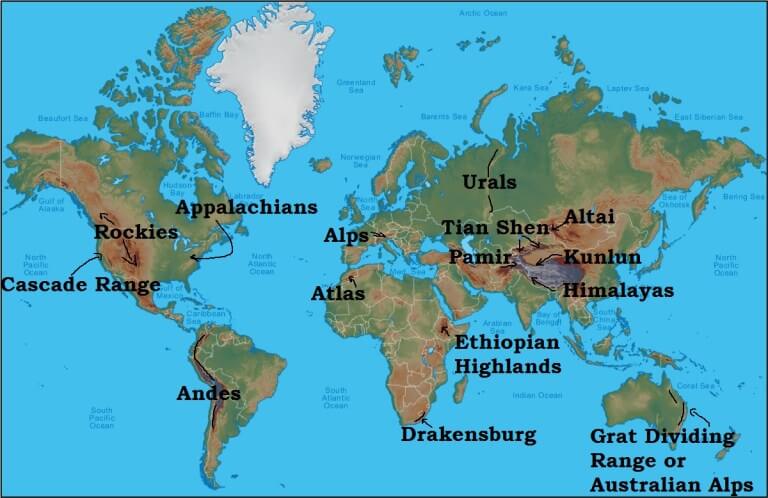
    Mountain Ranges

    Sr. No. Mountain Range Important/Highest Peaks Location Description
    1 Rocky Mountains Mt. Elbert (highest peak in the Rockies) North America It is one of the longest fold mountains in the world and extends from Canada to Western US (New Mexico State)
    2 Appalachian Mountains Mt. Mitchell, North Carolina, US (highest peak of Appalachian Mountains) North America It is a fold mountain with rich in mineral resources
    3 Alps Mont Blanc (French –Italian border) Europe It is a folded mountain and source for rivers like Danube, Rhine, etc.
    4 Sierra Nevada Mt. Whitney California, USA Habitat for many Red Indian tribes
    5 Alaska Range Mt. McKinley North America Mt. McKinley highest peak in North America
    6 Altai Mountains Belukha mountain Central Asia Young folded mountain which extends from Kazakhstan to northern China.
    7 Andes Mountains Mt. Aconcagua South America Longest mountain chain in the world
    8 Atlas Mountains Mt. Toubkal Northwestern Africa Young fold mountain spreading over Morocco and Tunisia.
    9 Drakensberg Mountains Mt. Lesotho South Africa Young folded mountain
    10. Caucasus Mountain Mt. Elbrus Europe Located between the Black Sea and the Caspian Sea
    11. Ural Mountains Mt. Narodnaya Russia This mountain range act as a boundary between Europe and Asia.
    12. Hindukush Mountains Mt. Trich Mir Pakistan and Afghanistan Folded mountain with rugged topography which makes it difficult for transportation.
    13. Himalayas Mt. Everest Asia Young fold mountains in Asia which separates Indian sub-continent from Asian plains
    14. Arakan Yoma Mt. Kennedy peak Myanmar It extends from north to south direction. Shifting cultivation is practised.
    15. Kunlun Mountains Mt. Muztag North of Tibetan plateau and western China It is one of the young folded mountains.
    16. Vosges Mt. Grand Ballon Eastern France, Europe Famous for the cultivation of grapes and manufacture of wines.
    17. Great Dividing Range Mt. Kosciuszko Australia This range is the source for the rivers Darling and Murray.


    Mountains-in-the-world

  • SAMANVAYA: Students Preparing for UPSC 2020 > get awesome !

    SAMANVAYA: Students Preparing for UPSC 2020 > get awesome !

    Dear Students, 

    After numerous conversations with you all, we have started understanding your problems better and also standardizing solutions for the most generic problems that you might face. 

    These are being incorporated in our Samanvaya program. It is these practices that will make the program more effective.

    At the core of Samanvaya lies the fact that each one of you will have a unique journey while preparing for the exam. Some will get through on the first attempt without much effort while others will take both more time and more effort. We want to understand you better to help you optimize your journey so you can focus on the right things and not waste time on the wrong ones. We are asking you to tap into the valuable experiences of mentors who underwent the same grind and realize the pitfalls and understand the shortcuts to make it.

    Samanvaya program involves the following –

    1. Identifying your weaknesses

    Over 80% of students who claimed to have revised NCERTs were unable to answer basic questions. Many were not comfortable with at least 1 GS subject and Optional. Many struggled with ‘What went wrong’ after 2-3 years of hard work.

    Our mentors will help you assess your preparedness and suggest accurate strategies.

    2. Strategy and study plan discussions

    Over 90% of students couldn’t stick to a plan. Study plans and strategies are iterative in nature and we want to help you with that. Many are unable to perform in tests despite preparing hard. This could be due to a variety of factors – lack of adequate prep, jitters in the exam hall, inadequate revision, lack of practice of test series or just a bad day at work. Tell us what you think went wrong and we’ll figure out a way to get you over the line next time.

    3. Helping you understand the exam better

    Which books to read, different approaches, etc. Over 60% of students we talked to did not find NCERTs relevant and saw no point in being thorough with them.

    4. Lack of motivation

    We have all had those days when it’s been hard to motivate ourselves to hit the books and just study. It happens to the best of us sometimes and for some of us, it happens more frequently. And it is understandable, Civil Service preparation is a long and often lonely process. Every aspirant, from toppers to those who have quit have been overwhelmed by this process at some point in time. Working alone is monotonous and Help you keep motivated by ensuring you are actively and passively studying every day. Focused telegram groups to foster discussions.

    Samanvaya Code of Conduct

    • Be honest with your mentors about your preparation levels and stage.
    • Follow their advice and participate in tests and assignments that they set for you
    • Stay active in the telegram groups, ask doubts, don’t hold yourself back.
    • Don’t expect spoonfeeding. You have to drive the initiative.

    Click here to fill the form and get a kickstart. 

    Here’s the feedback that we got from some of our students:


    Click here to fill the form and get a kickstart. 

  • [Prelims Spotlight] Important International Relations terms


    APC Network: Association for Progressive Communications comprises more than 20,000 subscribers to electronic listservers in 95 countries, and have recently been very much involved in agitating for global development and democratization of the United Nations

    Balance of payments: net flow of goods, services and financial transactions that takes into account outflows and inflows of money from a state

    Balance of payments deficit: a state spends more than it receives from other countries

    Balance of payments surplus: a state receives more than it spends in other countries

    Balance of power: a condition in which the distribution of military and political forces among nations means no one state is sufficiently strong to dominate all the others. It may be global, regional or local in scope

    Bargaining power: the general capacity of a state to control the behaviour of others, power to cause another actor to do an action (also see structural power)

    Biodiversity: two kinds: species and genetic diversity, species diversity refers to the differences between species, while genetic diversity refers to differences within species

    Brezhnev Doctrine: reinforced the right of the Soviets to ntervene where Moscow deemed socialism was threatened by ‘counter-revolutionary forces’

    Brundtland Commission Report: published 1987, commissioned 1983 with Gro Harlem Brundtland, Prime Minister of Norway, as commissioner, mandate was to look into the alarming rate at which environmental resources were being consumed, a the levels of their waste, particularly in the case of development, at the ways in which developing countries were falling further and further behind the industrialized world in their standards of living, coined term ‘sustainable development’

    Cold War: The period in world affairs from c.1947-1990, marked by ideological, economic and political hostility and competition between the US and the Soviet Union, and drawing in other powers at various levels of involvement

    Common unit of exchange: a currency in which international economic exchanges are valued

    Comparative advantage: Doctrine says that states should 1) produce and export whatever they can produce most efficiently relative to other states i.e., whatever they have a comparative advantage in; and they should 2) import those things they can’t produce as efficiently from states that can

    Concert of Europe: the informal system of consultation set up by the Great Powers (Austria, Britain, France, Prussia and Russia) to manage the balance of power at the end of the Congress system

    Conflict: perceived rival and incompatible claims over some desired “good”

    Congress of Vienna: meeting of the four main victors over Napoleon and France: Austria, Britain, Prussia and Russia.

    Containment: policy pursued by the US toward the Soviet Union c. 1947-1989, the aim of which was to deny Moscow opportunities to expand its political influence abroad, to draw a line and contain the Soviets within their borders, (also see Truman Doctrine )

    CSCE: Conference on Security and Cooperation in Europe, from 1973-75 all European states (except Albania) plus the US and Canada met to discuss regional security (now the Organization on Security and Cooperation in Europe, and one of the central security organizations in Europe

    D5: denuclearization, demilitarization, dealignment, democratization, and development, five main goals of peace and social movements

    Defence strategy: involves the assumption that war will be fought with three aims in mind: 1. to punish the aggressor 2. to deny territorial gains 3. to limit the damage to oneself (also see deterrence)

    Deterrence: efforts of an actor to dissuade the opponent from doing something considered against the actor’s interests by making the costs of action outweigh the benefits with threat of punishment, the implicit or explicit purpose of this strategy was to avoid actually fighting war (also see defence)

    Doctrine of Flexible Response: a nuclear utilization strategy which legitimized the notion of limited nuclear war, involved two dimensions: limited targetting (‘counterforce strategy’) and the use of battlefield nuclear weapons (also see MAD)

    Dollar overhang: the amount of US dollars overseas exceeded US reserves of gold, undermining dollar convertibility to gold

    Ethnic group: a group of people who define themselves as distinct from other groups because of cultural differences

    Eurodollar markets: free market where buyers and sellers exchange currencies outside of their country of origin

    Exchange rate: value at which one currency is traded for another

    Fixed exchange rate: the rate of exchange of a currency or currency is set by agreement between governments or by government policy (see also gold standard)

    Floating exchange rate: the rate of exchange of currencies is permitted to rise and fall with supply and demand on the international private market


    Free trade: means the buying or selling of goods and services across international borders with few or no restrictions (see also protectionism)

    Fungibility: the extent to which one form of power can be converted into another

    GATT: General Agreement on Tariffs and Trade, drawn up in 1947 to codify the rules of conduct in trade for its members, in the GATT, states agreed to negotiate “reciprocal and mutually advantageous arrangements directed to the substantial reduction of tariffs and other barriers to trade” and to increase free and fair trade

    Glasnost: ‘openness’, a term introduced by Mikhail Gorbachev about his post-1985 opening of Soviet society to dissidents, public criticism and limited admission of past Soviet mistakes (also see perestroika)

    Gold standard: the value of a currency is fixed relative to an amount of gold, can be converted to gold at a fixed rate (see also fixed exchange rates)

    GSP: Generalized System of Preferences: early 1970’s nineteen advanced industrial states agreed to eliminate tariffs on manufactured and semimanufactured goods exported by 140 LDCs unilaterally for ten years, renewed during 1980s for another decade (see UNCTAD, IPC)

    Holy Roman Emperor: the supreme secular authority in Medieval Europe

    Hugo Grotius (1583-1645): the ‘father’ of international law, a Dutch jurist, humanist and diplomat His great work ‘On the Law of War and Peace’ is widely regarded as a landmark in the development of international law

    HYV’s: high-yielding varieties of agricultural plants, genetically designed to produce higher quantities of product with the aid of fertilizer, pesticides, and mechanized agricultural methods

    ICBM’s: inter-continental ballistic missiles

    IPC: Integrated Programme for Commodities, concerted attempt to control price fluctuations in commodities on which LDC’s depended for foreign exchange income (see UNCTAD, GSP)

    LDC: Less Developed Country

    MAD: Mutually Assured Destruction, strategic doctrine which guarantees that each side in a nuclear exchange would survive a first strike by its opponent with enough arms intact to launch a second-strike sufficient to destroy the aggressor (also see Doctrine of Flexible Response)

    massive retaliation: a a nuclear strategy which calls for a nuclear response to any aggressive action

    MFN: Most Favoured Nation: every member is treated as well as the “most favoured one”: ie: if U.S. offers low tariff to Canada on ice cubes: every other GATT member is entitled to the same treatment (see also free trade, GATT)

    MIRV’S: multiple independently targetted re-entry vehicles (see also ICBM’S)

    monetarism: a policy of manipulating the money supply (inflating or deflating a currency) to influence economic growth

    monoculture: refers to the use of one genetic strain of plant or animal to replace a diversity of strains

    Multiple-sum game: both actors can mutually gain (also see zero-sum game)

    Natural law: the idea there existed rights and duties attached to human beings as such that existed in all times and all places, that could be discovered by reason, and that should be applied in the relations between groups

    Negative peace: the absence of war and physical (direct) violence (also see positive peace)

    Netwar: the primary objective of “netwar” is to use computer networks and databases to inflict cultural and political damage to the international image of the opponent.

    News values: the criteria for determining what kinds of stories are reported; used to identify, define and present a story

    NIEO: United Nations Resolution of May 1974 for a New International Economic Order to address concerns of LDC’s

    Non-Aligned Movement: loose organization of Third World countries which dealt with statements on a wide variety of issues from nuclear proliferation to trade and development, first meeting: Bandung, Indonesia, 1955, led by a few relatively strong, independent personalities: Tito, Nehru, and Nasser (Yugoslavia, India, Egypt) (see also UNCTAD, NIEO)

    Non-governmental organization (NGO): any private organization involved in activities that have transnational implications
    GO TO TOP

    Nuclear fusion: relies on forcing two hydrogen atoms together, and in the process destroying some extra matter that is converted into energy (called H-bomb)

    NWIO: New World Information and Communication Order, begun in the 1970s around the same time as the Group of 77 launched its drive for a NIEO, called for a more balanced flow of communications globally, development of communication infrastructure in LDC’s, control or elimination of information monopolies, and respect for each people’s cultural identity

    OECD: Organization for Economic Cooperation and Development, organization of 29 industrialized countries

    OPEC: Organization of Petroleum Exporting Companies: cartel of oil producers formed to control the price and supply of oil on world markets

    Perestroika: ‘restructuring’, a term used by Mikhail Gorbachev to describe his plans to reform, modernize and partly decentralize the Soviet economy (also see glasnost)

    Positive peace: the absence of structural violence as well as direct violence (see also negative peace)

    Protectionism: protecting your economy from the international economy by imposing various restrictions on flow of imports or exports of goods or services into or out of your country (see also free trade)

    Reserve currency: a currency that countries hold in reserve because of its strength and stability

    Security dilemma: a situation in which states’ actions taken to assure their own security, tend to threaten the security of other states

    Self-help: necessity to rely on a states’ own resources and capabilities

    SLBM’s: submarine-launched ballistic missiles

    specie money: solid money (gold or silver, traditionally)

    spheres of influence: an area declared by a Great Power to be its exclusive area of interest, where it acts to defend its dominance and to exclude other Great Powers.

    SOP’s: standard operating procedures

    Sovereignty: means a government has the right, at least in principle, to do whatever it liks in its own territory (also see state)

    Structural power: the power to change the rules of the game for others, the power to structure the choices of other actors

    Structural violence: latent or hidden forms of social conflict

    Stockholm Conference: UN Conference on the Human Environment, held 1972, was first worldwide environmental conference in history

    Sustainable development: term coined by Brundtland Commission Report 1987, defined as development which can “ensure that it meets the needs of the present without compromising the ability of future generations to meet their own needs”

    Terms of trade: the ratio in prices between a country’s exports and its imports

    Truman Doctrine: a promise of US aid to all ‘free peoples who are resisting attempted subjugation by armed minorities or by outside powers” (also see Brezhnev Doctrine)

    UNCED: United Nations Conference on Environment and Development, also known as the Earth Summit, held in Rio 1992. Effort by the int. Community to reach consensus on principles and a long-term workplan for global sustainable development, major output was Agenda 21 (referring to the Twenty-First Century), a global plan of action containing 294 pages encompassing every sectoral environmental issues as well as international policies affecting both environment and development and the full range of domestic social and economic policies.

    UNCTAD: United Nations Conference on Trade and Development: formed 1964: first Secretary General Raul Prebisch: called for reform of system of international trade based on liberalism and comparative advantage, in order to assist development of poor countries, included calls for a GSP and IPC (see also NIEO)

    War: legitimate use of organized violence or force to achieve “goods” (also see conflict)

    zero-sum game: one actors’ gain is another’s loss

  • Gear up for This week’s Samachar Manthan lecture on 19th May Sunday

    Dear students,

    We understand that the UPSC exam is a generalist exam. It’s more important to cover more issues than to cover one issue in more depth. Hence, through Samachar Manthan, we are trying to maintain a fine balance of covering many important news items and having a detailed discussion on selected topics which require the same. On daily basis a news gets repeated multiple times. Scattered knowledge is not adequately useful when you have to write a 200 words answer within 6-7 minutes. To handle this, Samachar manthan covers such issues in a comprehensive and consolidated manner which is the smart strategy.

    Benefits of Samachar Manthan

    • Packed 3 – 3.5 hours Weekly videos will focus on news and its importance from both prelims and mains perspective.
    • This program will also help you understand how to utilize current affairs in all your prelims and mains papers.
    • This ideology makes this course the best utilization of your time.
    • Detailed coverage would mean analysis from all the angles like background or history, features, significance, challenges and way forward. Also, multiple sources like epw, diplomat magazine etc will be referred to in the video lectures.
    • Such an approach will help in writing multidimensional answers.
    • Also which part of the topic is important from mains and prelims perspective will also be discussed.
    • Audio Visual Learning is more impactful than simply glancing through the material. So that you are able to retain information for long also interlink with any new information you get.
    • 4 stage structure of Video->Notes->testing->review to perfect your preparation
    • The sequence of video->Notes->testing->review is the best way to ensure maximum retention and a rock solid preparation. Each component of the program has been meticulously crafted.

    For example this week, we will be covering the following issues;

    This Week’s Hottest Stories
    Climate Change Impact on India and World- International Reports, Key Observations, etc. (5 Newscards)
    Wildlife Conservation Efforts (3 Newscards)
    Electoral Reforms In India (3 Newscards)
    Indian Navy Updates (2 Newscards)
    Judiciary Institutional Issues (2 Newscards)
    Foreign Policy Watch: India-United States (2 Newscards)
    Health Sector – UHC, National Health Policy, Family Planning, Health Insurance, etc. (2 Newscards)

    Economics
    [op-ed snap] Resolving India’s banking crisis
    Lakshadweep recruits Barn Owls to fight rodent menace

    Enviro & Biodiversity
    UK has become the first country to declare a ‘climate emergency’
    Global Assessment Report by IPBES
    Grizzled Giant Squirrel
    Purple frog set to be crowned Kerala’s state amphibian
    [op-ed snap] One million species face extinction: Why biodiversity report matters
    How China, followed by India, has led greening efforts across world
    [op-ed snap] From Idai to Fani

    Governance
    [op-ed snap] No courts for women
    Home Ministry terminates ‘Black List’ of Indian-origin people
    WHO for eliminating industrially produced trans fats by 2023
    India facing critical shortage of healthcare providers: WHO

    International Relations
    [op-ed snap] The quest for a military footprint
    India re-elected as observer to Arctic Council
    [op-ed snap] Taking tensions seriously
    [op-ed snap] Loud and clear
    [op-ed snap] Endless war
    [op-ed snap] A fraught moment: U.S.-China trade war
    [op-ed snap] Gulf warning
    Commonwealth Secretariat Arbitrary Tribunal

    Polity
    Zero Pendency Courts Project
    Sub-categorization of OBCs
    Supreme Court pushes for ‘full’ strength of 31

    Science Tech
    Sand, a global sustainability challenge: UN report
    [op-ed snap] Surveillance wars in space
    Indian scientists discover how serotonin helps brain cells cope with stress
    NASA spacecraft to hit an asteroid in 2022

    Security Issues
    Fourth Scorpene-class submarine INS Vela launched
    IAF gets first Apache Guardian attack helicopter
    Exercise Group Sail

    Arts and culture
    Thailand’s cultural roots with India
    Genetic Study on people of Lakshadweep Islands


    And these issues will be covered in detail

    • Surveilance war in space
    • Global report on extinction of species
    • Zero pendency court project
    • US china Trade War
    • Instability in Gulf
    • Gender disparity in Courts

    So to be thorough in your preparation and to have an integrated approach, join Samachar Manthan here.


  • [Prelims Spotlight] Monuments and architecture

    State Monument Place Built by


    Bihar


    Golghar Patna British Govt.
    Pathar Ki Masjid Patna Pervez Shah
    Sher Shah’s Tomb Sasaram Sher Shah’s son
    Vishnupad Temple Gaya Rani Ahilyabai


    Delhi


    Feroz Shah Kotla Delhi Ferozshan Tughlaq
    Hauz Khas Delhi Alauddin Khilji
    Humayun Tomb Delhi Empress Bega Begum
    Jama Masjid Delhi Shahjahan
    Jantar-Mantar Delhi Sawai Jai Singh
    Khirki Masjid Delhi Ghyasuddin Tughlaq
    Lakshmi Narayan Temple Delhi Birla Family
    Moti Masjid Delhi Aurangzeb
    President House Delhi British Govt.
    Purana Qila Delhi Sher Shah Suri
    Qutub Minar Delhi Qutubuddin Aibak
    Red Fort Delhi Shahjahan
    Safdarjung Tomb Delhi Shuja-ud-daula
    Gujarat Sabarmati Ashram Ahmadabad Mahatma Gandhi


    Jammu and Kashmir


    Charar-E- Sharif Budgam Zainul Abedin
    Nishat Garden Srinagar Asaf Ali
    Shalimar Garden Srinagar Jahangir
    Karnataka Lal Bagh Bangaluru Hyder Ali


    Maharashtra


    Ajanta- Ellora Caves Aurangabad Gupta rulers
    Bibi Ka Maqbara Aurangabad Aurangzeb
    Elephanta Cave Mumbai Rashtrakuta rulers
    Gateway Of India Mumbai British Govt.
    Kanheri Fort Mumbai Buddhists
     

    Odisha

    Jagannath Temple Puri Anantavarman Ganga
    Sun Temple Konark Narasimhadeva I
    Punjab Golden Temple Amritsar Guru Ramdas


    Rajasthan


    Adhai Din Ka Jhonpra Ajmer Qutubuddin Aibak
    Bharatpur Fort Bharatpur Raja Surajmal Singh
    Ajmer Sharif Dargah Ajmer Sultan Shyasuddin
    Dilwara Jain Temple Mount Abu Siddharaja
    Hawa Mahal Jaipur Maharaja Pratap Singh
    Jaigarh Fort Jaipur Sawai Jai Singh
    Jodhpur Fort Jodhpur Rao Jodha
    Nahargarh Fort Jaipur Sawai Jai Singh
    Vijaya Stambha Chittorgarh Maharana Kumbha
    Tamil Nadu Saint George Fort Chennai East India Company
     

    Telegana


    Char- Minar Hyderabad Quli Qutub Shah
    Makka Masjid Hyderabad Quli Qutub Shah


    Uttar Pradesh


    Agra Fort Agra Akbar
    Akbar Rsquo Tomb Sikandra Akbar
    Anand Bhawan Allahabad Motilal Nehru
    Aram Bagh Agra Babur
    Bada Imambara Lucknow Asaf-ud-daula
    Chhota Imambara Lucknow Muhammad Ali Shah
    Deewan-E- Khas Agra Fort Shahjahan
    Fatehpur Sikri Agra Akbar
    Tomb of Itmad-Ud-Daula Agra Nurjahan
    Jama Masjid Agra Shahjahan
    Moti Masjid Agra Shahjahan
    Sati Burj Mathura Raja Bhagwan Das
    Shish Mahal Agra Shahjahan
    Taj Mahal Agra Shahjahan
    Uttarakhand Jim Corbett Park Nainital Sir Malcolm Hailey


    West Bengal


    Shantiniketan West Bengal Rabindranath Tagore
    Belur Math Kolkata Swami Vivekananda
    Victoria Memorial Kolkata British Govt.
  • [Prelims Spotlight] Defence Exercises

    Name of the Exercise

    PartnerCountry/Countries

    Details

    Surya Kiran XIII Nepal  

    • This exercise was aimed at training on jungle warfare, anti-terrorism combat and disaster response activities.
    Lamitye VIII Seychelles  

    • The focus of the exercise was to conduct counter-insurgency and counter-terrorist operations.
    Shakti IV France  

    • The focus was on high degree of physical fitness, tactical drills, techniques and procedure.
    Vinbax 1 Vietnam  

    • The focus was on cooperation in the maritime domain.
    Hamesha Vijayee Southern Command  

    • It aimed at fine tuning surveillance and destruction mechanisms to support precision strikes and manoeuvres by network enabled forces.
    Ajeya Warrior UK  

    • The aim of the exercise was to build and promote bilateral relations and enhance interoperability.
    Malabar The USA and Japan
    • It’s a joint naval exercise.
    AUSINDEX Australia
    • It’s a joint naval exercise.
    SIMBEX Singapore
    • It’s a joint naval exercise.
    IND–INDO CORPAT Indonesia
    • It’s a joint naval exercise.
    Varuna France
    • It’s a joint naval exercise.
    Nomadic Elephant Mongolia
    • It’s a joint exercise between two armies.
    Surya Kiran Nepal
    • It’s a joint exercise between two armies.
    Al-Nagah Oman
    • It’s a joint army exercise.
    EKUVERIN Maldives
    • It’s a joint military exercise.
    INDRA Russia
    • It refers to joint exercises conducted between army, navy and airforce.
    KONKAN United Kingdom
    • It’s a joint naval exercise.
    Hand in Hand China
    • It’s a joint military exercise.
    SAMPRITI Bangladesh
    • It’s a joint military exercise.
    Mitra Shakti Sri Lanka
    • It’s a joint military exercise.
    Yudh Abhyas The USA
    • It’s a joint military exercise.
     PRABAL DOSTYK Kazakhstan
    • It’s a joint military exercise.
    Maitree Thailand
    • It’s a joint military exercise..
    RIPMAC Around 25 nations, including the USA, the UK, China and France.
    • It’s the world’s largest international maritime exercise.
    Desert Eagle United Arab Emirates
    • It’s a joint air combat exercise.
    Garuda Shakti Indonesia
    • It’s a joint military exercise.
    Lamitye Seychelles
    • It’s a joint military exercise.
    IBSAMAR South Africa and Brazil
    • It’s a joint naval exercise.
    Sahyog-Kaijin Japan
    • It’s a joint exercise between the coast guards of two countries.
    SHAKTI France
    • It’s a joint military exercise.
    SLINEX Sri Lanka
    • It’s a joint military exercise.
    Indradhanush The United Kingdom
    • It’s a bilateral air exercise.
  • Civilsdaily’s Faculty’s article published in Hindu Business Line. A must-read for Civil Services Aspirants.

    Economics is one of the primary Pillars of UPSC preparation. It has substantial weightage in Prelims and also in  GS 3rd paper of mains. To ensure that students build  a strong foundation and  a strong hold over the subject, we at Civilsdaily, have the best and most trusted faculty, Himanshu Arora Sir.

    Credentials of Himanshu Sir-

    • MPhil Economics (JNU)
    • Works at Prime Minister Economic Advisory Council
    • Writes regularly in various famous Indian and international weeklies like Millenium post and Huffington Post.
    • Worked as Assistant Professor in Delhi University.

    Here is the article by Himanshu Sir  that was published today in  Business Line;

    US sanctions have rarely worked

    Instead of punishing ‘errant’ countries, sanctions inflict serious economic damage on other nations

    The US has refused to extend the oil sanction waivers previously extended to seven countries — China, India, Japan, South Korea, Italy, Greece and Turkey — after Donald Trump pulled the US out of the Iran nuclear deal.

    The oil waivers were granted as a short-term measure to substitute oil with alternative energy sources and to avoid a global oil shock.

    The nuclear deal aka Joint Comprehensive Plan of Action (JCPOA), signed in 2015, mandated Iran to reduce its uranium stockpile by 97 per cent, to limit enrichment of uranium only up to 3.67 per cent.

    In return, Iran was supposed to receive relief from the economic sanctions imposed on it. The failure of JCPOA and the subsequent imposition of sanctions on Iran and other countries raise an important question — do sanctions work?

    History of sanctions

    Sanctions were first used in ancient Greece with Pericles Megarian decree of 432 BC in response to the kidnapping of three Aspasian women. Ancient Greece also imposed them during the Peloponnesian War (431-404 BC). However, they failed to have an impact and the Spartans won the Peloponnesian War.

    The US first imposed sanctions on Iran in 1979 in response to the Iranian hostage crisis. The second round of sanctions were imposed in 1983, when an Iranian terrorist group bombed US Marine Corps in Lebanon. The US imposed restrictions on trade particularly oil to weaken Iran’s oil industry and hence its ability to fund terrorists.

    The third round of sanctions was in response to Iran’s nuclear proliferation activities. Iran’s nuclear power programmes to weaponise its army have resulted in the passage of Iran and Libya Sanction Act (ILSA) 1996. Along with other trade and financial restrictions, the ILSA prohibits foreign companies to undertake oilfields investment in Iran.

    But do sanctions fulfil their purpose of dissuading the target countries from taking a particular action?

    To answer that question, we must first understand what sanctions are and how they work. Sanctions are economic instruments that cut off the target country’s economy from rest of the world.

    The US regards sanctions as an important weapon in the geopolitical game and President Woodrow Wilson was the first to impose them.

    The opponents

    But opponents question the efficacy of sanctions especially when imposed unilaterally by a single country. They argue that target countries often shield themselves from the harsh impact and that the costs inflicted on other countries indirectly affected by such sanctions are greater than the benefits derived.

    For example, by unilaterally imposing sanctions on Iran, the US is hurting the economies of India, China, Turkey, South Korea and Japan. These sanctions are likely to increase the global crude oil prices affecting the oil importing countries negatively.

    Evidence supporting the success of sanctions are few as they have mostly failed to alter the behaviour of the targeted country. The US imposed sanctions on Turkey when it invaded Cyprus in 1974. But Turkish troops remained in Cyprus for more than 30 years despite sanctions. When USSR invaded Afghanistan in 1979, the Carter administration imposed sanctions and a food embargo on it. But the sanctions failed as the Soviet troops remained in Afghanistan till 1989. The sanctions imposed on Saddam Hussein tell a similar story.

    Also the US along with Canada, France and Russia had frequently used sanctions in 1970s and 1980s to deter non-nuclear countries from developing nuclear capabilities and force them to comply with nuclear non-proliferation.

    In 1974, Canada imposed sanctions on India and Pakistan to deter them from further nuclear explosions, to apply striker nuclear safeguards and forgo reprocessing capability of nuclear fuel that can be used in developing weapons. The US did the same with South Korea and applied financial sanctions to forestall the purchase of a nuclear reprocessing plant.

    In the subsequent years, the US imposed sanctions on shipments of nuclear fuel and technology to South Africa, imposed sanctions on Brazil, Argentina, India and Pakistan to make them adhere to nuclear safeguards, multilateral surveillance for nuclear facilities and to prevent the acquisition of nuclear technologies. But these sanctions failed to dissuade South Africa, Brazil, India and Pakistan from becoming nuclear powers.

    Multiple episodes of imposition of US sanctions across the world clearly reflect that unilateral sanctions do not really work. Therefore, in the light of historical evidence, the US should rethink its policy of imposing sanctions on Iran given the economic damage it can inflict on nations like India, China, Turkey, South Korea and Japan.


    Here is the link of the original Article

    https://www.thehindubusinessline.com/opinion/us-sanctions-have-rarely-worked/article27119264.ece

  • Foundation 2020 – Study Plan & Time-Table Released

    Foundation 2020 – Study Plan & Time-Table Released

    Download PDF for better visibility – Foundation 2020 Master Time Table

    Note4Students

    • This post will be followed by Day-wise subject specific plans.
    • The topics given in the time-table are indicative. The list is not exhaustive. students are expected to refer to books for more detail.

    https://youtu.be/r4qG08aBbrs


    Dear students,

    As you are aware, UPSC has an exceptionally vast syllabus. And it is a very complex task to come up with a study-plan/time-time table that harmonizes every element and takes into consideration the return on investment on certain topics.

    We are hell-bent on simplifying things for you. Hence, we have come up with a plan that you will instantly connect with you and give you a vibe that yes you can do it!

    1. Integrated Approach

    Preparation for Prelims and Mains is harmonized. You study a subject, attempt prelims tests and then attempt mains tests for the same. This leads to a solid preparation.

    Many institutes our there will not able to present an integrated approach. They offer separate timetables for prelims and mains confusing the students further. That’s not the case with us!

    2. Simplified Approach

    Our Time-table is the easiest to remember and follow. All tests prelims, mains and Samachar Manthan will be held on the weekend.

    • Prelims Tests are held on the 1st and 3rd Saturday of every month.
    • Monthly Current Affairs Tests are held on the last Saturday of every month.
    • Mains Tests are held on the 1st and 3rd Sunday of every month after the subject is complete.
    • Essay Tests are held on the 2nd Sunday of every month.

    3. Priority-wise Coverage of subjects

    We are starting with the most important subjects from the exam perspective first. These are very predictable + have a very high return on investment. They need to be mastered if one has to have a shot at the exam. Polity, Modern History, and Economics. The lower priority ones follow afterward.

    4. Logical Division of Topics

    Subjects have been divided into topics that logically fit together. Eg. for Polity we ask you to prepare in 2 parts – first, till Central Government and second, from State Government and beyond. This division is not ad-hoc and does not break the flow of your studies.

    5. Base and Advanced Sources

    We have divided the sources into 2 parts, Base Sources, and Advanced Sources. Base sources are those which you have to master. You should come to advanced sources only when you are thorough with the Base Sources.

    Download PDF for better visibility – Foundation 2020 Master Time Table

    We at Civilsdaily are committed to helping you in the process of figuring out your learning personalities and creating the best time table and suggesting most relevant strategies for your IAS Prep. Please take 5 minutes to fill up this Samanvaya Form. We will arrange a mentor call for you once this is done.

  • [Prelims Spotlight] Acts and schemes related to Marginalised Sector

    1Nai Manzil Scheme

    OBJECTIVES –

    • To address educational and livelihood needs of minority communities lagging behind in terms of educational attainments.
    • It aims to provide educational intervention by giving the bridge courses to the trainees and getting them Certificates for Class XII and X from distance medium educational system.
    • It seeks to provide trade basis skill training in four courses at the same time of formal education, in field of (i) Manufacturing (ii) Engineering (iii) Services (iv) Soft skills. It intends to cover people in between 17 to 35 age group from all minority communities as well as Madrasa students.
    • Nodal Ministry –The Union Ministry of Minority Affairs

    2. Nai Roshni

    OBJECTIVES –

    • Empower and install confidence in women of minority communities by equipping them with knowledge, tools and techniques to interact with government systems, banks and intermediaries
    • Nodal Ministry –The Union Ministry of Minority Affairs

    3. USTAAD Scheme

    OBJECTIVES –

    • The scheme aims at preserving and promoting the rich heritage of the traditional arts & crafts of the Minority communities. 2.In the light of globalisation & competitive market, these crafts have gradually lost their employability. 3.It also envisages at boosting the skill of craftsmen, weavers and artisans who are already engaged in the traditional ancestral work.
    • Nodal Ministry –The Union Ministry of Minority Affairs

    4. Hunar Haat

    OBJECTIVES –

    • It is aimed at promoting and supporting artisans from Minority communities and providing them domestic as well as international market for display and sell their products.
    • The Hunar Haat exhibition has been organised by the National Minorities Development & Finance Corporation (NMDFC) under “USTTAD” scheme In it about 184 master artisans from across the country are showcasing their traditional art and skills at about 100 stalls at the international platform.
    • It seeks to provide an excellent platform to artisans belonging to Minority communities from across nation to display their art and skills before domestic and international visitors.
    • Nodal Ministry –The Union Ministry of Minority Affairs

    5.Stanapan Suraksha Scheme

    OBJECTIVES –

    • To promote breastfeeding and keep a tab on “inappropriate” promotion of baby food items. Stanpan Suraksha is first-of-its-kind app deveopled for promoting breastfeeding and baby food promotion reporting mechanism.
    • Using it any person can click a photograph of inappropriate baby food promotion around them and related equipment and send it to BPNI.
    • The app also has a city-wise database of trained breastfeeding counsellor to educate and provide assistance to mothers during antenatal and postnatal period. It has sign up option for mothers who wish to become a breastfeeding counsellor, pledging for petition and donation.
    • Nodal Ministry –Ministry of Tribal Affairs

    6.Eklavya Model Residential Schools

    • Eklavya Model Residential School Scheme was started in 1998
    • First school was started in the year 2000 in Maharashtra.
    • EMRSs have been functioning as institutions of excellence for tribal students.
    • In order to further educational opportunities for more ST children, Government has sought to extend the facility of EMRSs in all the 672 Blocks where ST population is more than 50% of the total population in a span of next five years.
    • Funds for establishing the school are arranged by both Centre and State government together.
    • Nodal Ministry –Ministry of Tribal Affairs

    7. Pre-Matric Scholarship Scheme

    OBJECTIVES –

    • To decrease the dropout rate in the transition from elementary to secondary stage.Given for Class 9th and 10th.
    • Nodal Ministry –Ministry of Social Justice & Empowerment

    8. Babu Jagjivan Ram Chhatrawas Yojana

    OBJECTIVES –

    • Educational empowerment of Scheduled castes.
    • Central assistance is provided to the implementing agencies viz. State Governments/UT Administrations/ Central and State Universities/ Non-Governmental Organisations/Deemed Universities in private sector, for construction of fresh hostels/expansion of existing hostel facilities for Scheduled Castes students.
    • Nodal Ministry –Ministry of Social Justice & Empowerment

    9.National Overseas Scholarship Scheme.

    OBJECTIVES –

    • Financial support to SC and ST students pursuing Master’s level courses and PhD/Post-Doctoral courses abroad.
    • Nodal Ministry –Ministry of Social Justice & Empowerment

    10.Scheme for upgradation of merit of SC students.

    OBJECTIVES –

    • Upgrade the merit of SC students by providing them remedial and special coaching in classes IX to XII.
    • Income Ceiling: Rs. 3.00 Lakh per annum .
    • Nodal Ministry –Ministry of Social Justice & Empowerment

    11.Self Employment Scheme for Rehabilitation of Manual Scavengers (SRMS)

    OBJECTIVES –

    • To rehabilitate all the remaining manual scavengers and their dependents in alternative occupations.The main features of the Scheme include one-time cash assistance, training with stipend and concessional loans with subsidy for taking up alternative occupations.
    • Nodal Ministry –Ministry of Social Justice & Empowerment

    12. Sugmay Bharat abhiyaan.

    OBJECTIVES –

    • The target of this scheme is to make at least fifty government buildings disabled friendly under the campaign in each of the state till end of 2016 and make 25 per cent of the public transport vehicles under government as disabled friendly till mid 2017.
    • A remarkable feature of the scheme is that a website will also be made where the people can put their views on the accessibility of any building.
    • The international airports in the country and railway stations which come under A1, A and B categories will be made fully disabled-friendly.
    • Special set-top boxes will be made available to make watching TV more convenient for the visually impaired. In the next 5 years, almost 200 persons will be trained to speak in sign languages on government TV channels. Government websites will also be made friendlier by using text to speech option.
    • Under the scheme, the Ministry of Social Justice and Empowerment will give free motorized tricycles to persons with 70-90% disability.
    • A Sugamya Bharat mobile app which can provide information on disabled-friendly public facilities in a city, will be launched under the scheme.
    • For awareness, a team of experts will conduct workshops for sensitizing the main parties including builders and activists.
    • Nodal Ministry – Ministry of Social Justice & Empowerment

    13.Disha

    OBJECTIVES –

    • Early Intervention and School Readiness Scheme.
    • This is an early intervention and school readiness scheme for children upto 10 years with the disabilities covered under the National Trust Act.
    • Nodal Ministry –Ministry of Social Justice & Empowerment

    14. VIKAASDay Care

    OBJECTIVES –

    • A day care scheme for persons with autism, cerebral palsy, mental retardation and multiple disabilities, above 10 years for enhancing interpersonal and vocational skills.
    • Nodal Ministry –Ministry of Social Justice & Empowerment

    15. SAMARTH Respite Care

    OBJECTIVES –

    • A scheme to provide respite home for orphans, families in crisis, Persons with Disabilities (PwD) from BPL, LIG families with at least one of the four disabilities covered under the National Trust Act.
    • Nodal Ministry –Ministry of Social Justice & Empowerment

    16.GHARAUNDA

    OBJECTIVES –

    • Group Home for Adults.
    • This scheme provides housing and care services throughout the life of the person with Autism, Cerebral Palsy, Mental Retardation and Multiple Disabilities.
    • Nodal Ministry –Ministry of Social Justice & Empowerment

    17.NIRMAYA Health Insurance Scheme.

    OBJECTIVES –

    • This scheme is to provide affordable Health Insurance to persons with Autism, Cerebral Palsy, Mental Retardation and Multiple Disabilities.
    • Nodal Ministry –Ministry of Social Justice & Empowerment

    18. SAHYOGI Caregiver training scheme

    OBJECTIVES –

    • A scheme to set up Caregiver Cells (CGCs) for training and creating skilled workforce of caregivers to care for Person with Disabilities (PwD) and their families.
    • Nodal Ministry –Ministry of Social Justice & Empowerment

    19.GYAN PRABHA Educational support

    OBJECTIVES –

    • Scheme to encourage people with Autism, Cerebral Palsy, Mental Retardation and Multiple Disabilities for pursuing educational/ vocational courses.
    • Nodal Ministry –Ministry of Social Justice & Empowerment

    20.PRERNA Marketing Assistance.

    OBJECTIVES –

    • A marketing scheme to create viable & wide spread channels for sale of products and services produced by persons with autism, cerebral palsy, mental retardation and multiple disabilities
    • Nodal Ministry – Ministry of Social Justice & Empowerment