💥Join UPSC 2027,2028 Mentorship (July Batch) + XFactor Notes & Microthemes PDF

Category: Ranker Webinars

  • [Prelims Spotlight] Indian Paintings and Handicrafts

    Indian Paintings

    Prehistoric Cave Paintings 

    • Painted rock shelters by prehistoric cave dwellers
    • Notable example →  Bhimbetka caves in the Kaimur Range, MP (biggest prehistoric art depositoryin India)


    Genres of Indian Painting 

    • Indian paintings can be broadly classified as murals and miniatures.
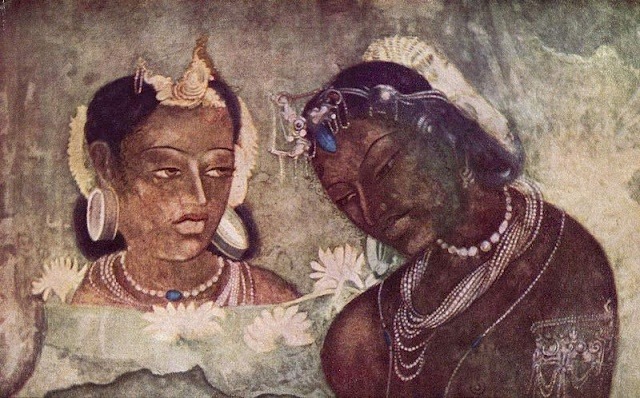
    • Murals are large works executed on the walls of solid structures directly, as in the Ajanta Caves & Kailash temple (Ellora)
    • Miniature paintings are executed on a very small scale for books or albums on perishable material such as paper and cloth.


    Mural Paintings

    • Mural is the only form of painting that is truly three-dimensional, since it modifies and partakes of a given space.
    • Mural paintings are applied on dry wall with the major use of egg, yolk, oil, etc.

    Mural Paintings

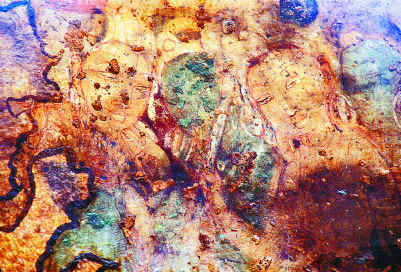
    • Notable examples → Ajanta Caves, Bagh Caves, Sittanavasal Caves, Armamalai Cave (Tamil Nadu), Kailasa temple (Ellora Caves)
    • Murals from this period depict mainly religious themes of Buddhist, Jain and Hindu

    Ajanta Murals Paintings 

    • Depict a large number of incidents from the life of the Buddha (Jataka Tales)
    • Exclusively Buddhist, excepting decorative patterns on the ceilings and the pillars.


    Ellora Murals Paintings 

    • Painted in rectangular panels with thick borders with following
    • Prominent features →  Sharp twist of the head + painted angular bents of the arms + sharp projected nose + long drawn open eyes + concave curve of the close limbs


    Badami Mural Paintings 

    • A cave site in Karnataka, patronized by chalukya king, Manglesha
    • Depictions in the caves show Vaishnava affiliation, Therefore, the cave is popularly known as Vishnu cave.

    Badami Mural Paintings

    Murals under the Pallava, Pandava and Cholas 

    • Paintings at the Kanchipuram temple were patronised by Pallava king, Rajsimha
    • Paintings at Tirumalaipuram caves & Jaina caves at Sittanvasal were patronised by Padayas
    • Paintings at Nartamalai & Brihadeswara temple were patronized by Cholas

    Murals under the Pallava, Pandava and Cholas

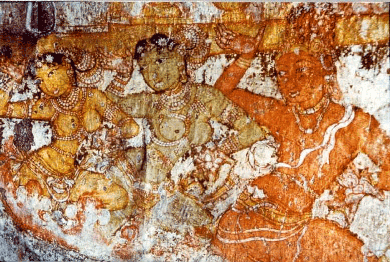
    Vijayanagara murals (13th century) 

    • Paintings at Virupaksha temple (Hamphi) & Lepakshi temple (Andhra Pradesh) were patronised by Vijayanagara Kings

    Vijayanagara murals


    Miniature Paintings

    • The Palas of Bengal were the pioneers of miniature painting in India.
    • The art of miniature painting reached its glory during the Mughal period.

    The Pala School (11th – 12th century)

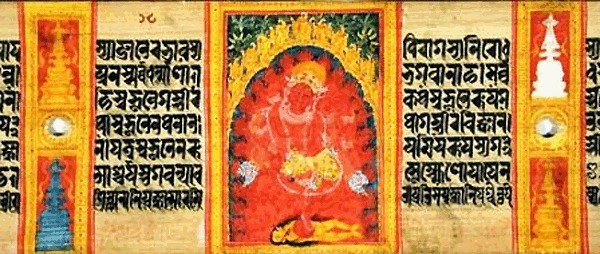
    • Exist in the form of illustrations to the religious texts on Buddhism executed under the Palas of the eastern India & the Jain texts executed in western India
    • The Buddhist monasteries of Nalanda, Odantapuri, Vikramsila & Somarupa were great centers of Buddhist learning and art.
    • A large number of manuscripts on palm-leaf relating to the Buddhist themes were written, illustrated with the images of Buddhist deities at these centers

    Pala School

    • The Pala painting is characterized by sinuous line and subdued tones of colour


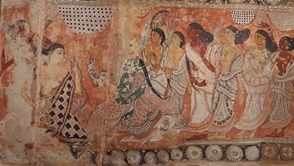
    Western Indian School of Painting 

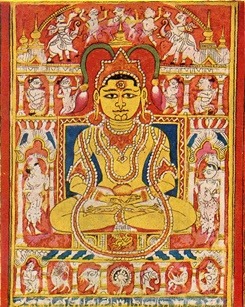
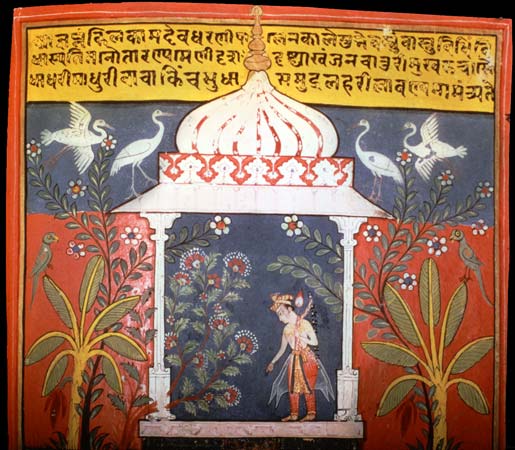
    • Also called Jaina Painting, largely devoted to the illustration of Jaina religious texts of the 12th–16th century
    • Notable sites → Gujrat, Uttar Pradesh, Central India & Orissa
    • Characterized by simple, bright colours, highly conventionalized figures, and wiry, angular drawing

    Western Indian School of Painting


    Mughal Paintings (16th – 19th century) 

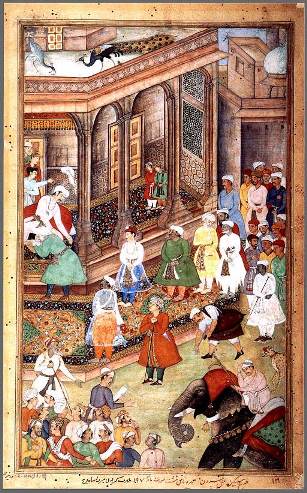
    • Mainly confined to miniature illustrations on the books or as single works to be kept in an album
    • Mughal paintings were a unique blend of Indian, Persian (Safavi) and Islamic styles
    • Marked by supple naturalism →  Primarily aristocratic and secular
    • Tried to paint the classical ragas and Seasons or baramasa
    • Tuti-nama – first art work of the Mughal School.
    • Akbar’s reign (1556–1605) ushered a new era in Indian miniature painting.
    • At Zenith under Jahangir who himself was a famous painter
    • Jahangir encouraged artists to paint portraits and durbar scenes.
    • Shah Jahan (1627–1658) continued the patronage of painting.
    • Aurangzeb had no taste for fine arts.


    Mughal Paintings

    • Most significant are Hamza Nama, Razm-Nama or “The Book of War”, Akbar Nama
    • Finest example of this school includes Hamzanama series, started in 1567 & completed in 1582
    • Hamzanama →  Stories of Amir Hamza, illustrated by Mir Sayyid Ali
    • 1200 paintings on themes of Changeznama, Zafarnama Ramayana
    • The paintings of the Hamzanama are of large size, 20” x 27″ and were painted on cloth.
    • They are in the Persian safavi style with dominating colours being red, blue and green
    • Indian tones appear in later work, when Indian artists were employed 


    Rajput Painting (16th – 19th century)

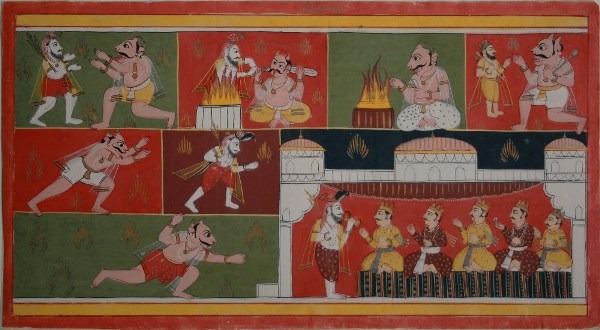
    • the art of the independent Hindu feudal states in India
    • Unlike Mughal paintings which were contemporary in style, Rajput paintings were traditional & romantic
    • Rajput painting is further divided into Rajasthani painting and Pahari painting (art of the Himalayan kingdoms)


    Central Indian and Rajasthani Schools (17th – 19th Century) 
    • Deeply rooted in the Indian traditions, taking inspiration from Indian epics, Puranas, love poems & Indian folk-lore
    • Mughal artists of inferior merit who were no longer required by the Mughal Emperors, migrated to Rajasthan


    Malwa paintings (17th century) 
    • Centred largely in Malwa and Bundelkhand (MP); sometimes referred as Central Indian painting due to its geographical distribution.

    Malwa paintings

    • This school’s most appealing features is its primitive charm & a simple childlike vision


    Kishangarh paintings (18th century) 
    • Distinguished by its individualistic facial type and its religious intensity
    • Developed under the patronage of Raja Savant Singh (1748-1757 AD) by master artist Nihal Chand

    Kishangarh paintings


    Mewar (Udaipur) Paintings (17th – 18th century) 
    • Characterized by bold bright contrasting colours and direct emotional appeal
    • The earliest-dated examples come from Ragmala (musical modes) series painted in 1605

    Mewar Paintings

    • Reflects portraiture & life of the ruler, along with religious themes
    Marwar (Jodhpur) Paintings 
    • Executed in a primitive and vigorous folk style
    • Completely uninfluenced by the Mughal style.
    • Portrays court scenes, series of Ragamala & Baramasa


    Bundi paintings (Late 17th century) 
    • Very close to the Mewar style, but the former excels the latter in quality
    • Prominent features → Rich and glowing colours, the rising sun in golden colour, crimson-red horizon, border in brilliant red colour (in Rasikpriya series)
    • Notable examples → Bhairavi Ragini (Allahabad Museum), illustrated manuscript of the Bhagawata Purana (Kota Museum) & a series of the Rasikapriya (National Museum, Delhi)


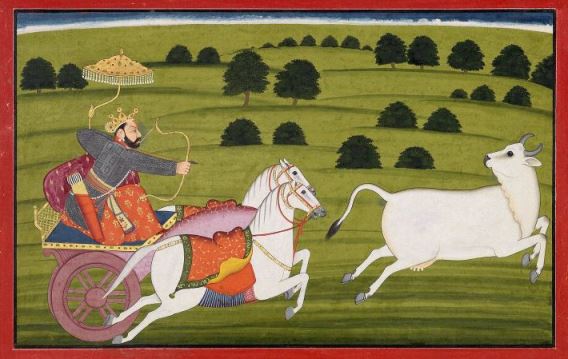
    Kota paintings (18th – 19th century) 
    • Very similar to Bundi style of paintings
    • Themes of tiger and bear hunt were popular
    • Most of the space in painting is occupied by the hilly jungle


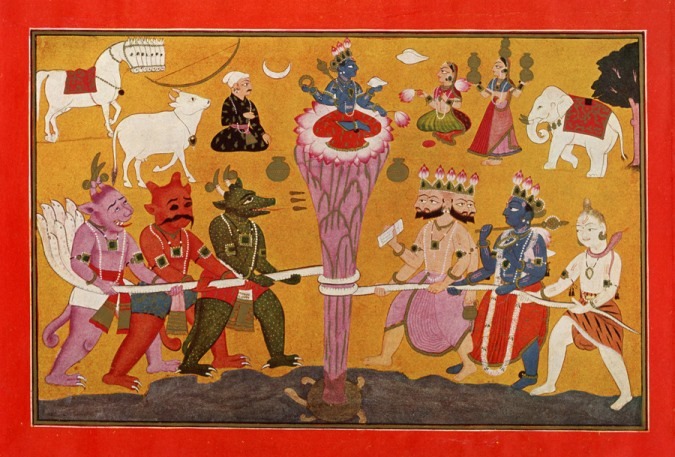
    The Pahari Schools (17th – 19th Century) 

    Comprises the present State of Himachal Pradesh, some adjoining areas of the Punjab, the area of Jammu, & Garhwal in Uttarakhand

    Basohli Paintings (17th – 18th century) 
    • known for its bold vitality of colour, lines & red borders
    • Emotional scenes from a text called “Rasamanjari” →  Krishna legend
    • Favoured oblong format, with the picture space usually delineated by architectural detail, which often breaks into the characteristic red borders
    • Stylized facial type, shown in profile, is dominated by the large, intense eyes

    Basohli Paintings


    Guler painting (Jammu) 
    • Mainly consisting of portraits of Raja Balwant Singh of Jasrota (Jammu) designed by Nainsukh
    • Colours used are soft and cool unlike Basohli school

    Guler painting

    • Style appears to have been inspired by the naturalistic style of the Mughal painting


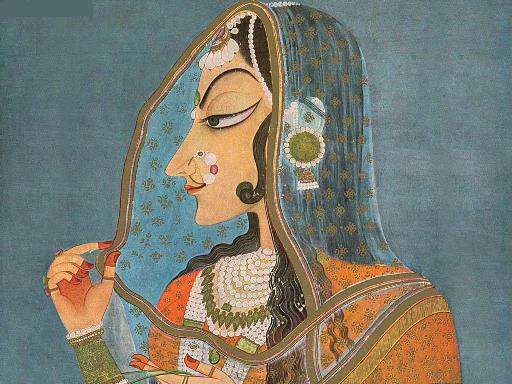
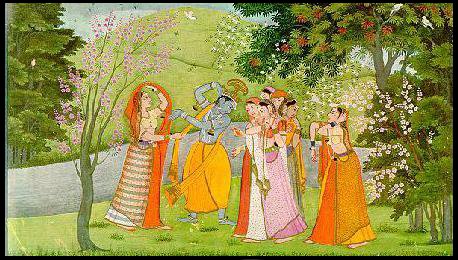
    Kangra painting (Late 18th century) 
    • The Kangra style is developed out of the Guler style & possesses its main characteristics, like the delicacy of drawing & naturalism
    • The Kangra style continued to flourish at various places namely Kangra, GuIer, Basohli, Chamba, Jammu, Nurpur and Garhwal etc.
    • However, Named as Kangra style as they are identical in style to the portraits of Raja Sansar Chand of Kangra
    • In these paintings, the faces of women in profile have the nose almost in line with the forehead, the eyes are long & narrow, & chin is sharp.

    Kangra painting

    • There is, however, no modelling of figures and hair is treated as a flat mass.
    • Paintings of the Kangra style are attributed mainly to the Nainsukh family.


    Kullu – Mandi painting 
    • A folk style of painting in the Kulu-Mandi area, mainly inspired by the local tradition
    • The style is marked by bold drawing and the use of dark and dull colours


    Independent Paintings

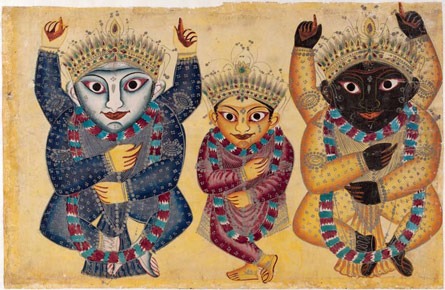
    Kalighat Paintings (Kolkata – 19th century)

    • Patua painters from rural Bengal came and settled in Kalighat to make images of gods and goddesses in the early 19th century
    • They evolved a quick method of painting on mill-made paper
    • Used brush and ink from the lampblack

    Kalighat Paintings


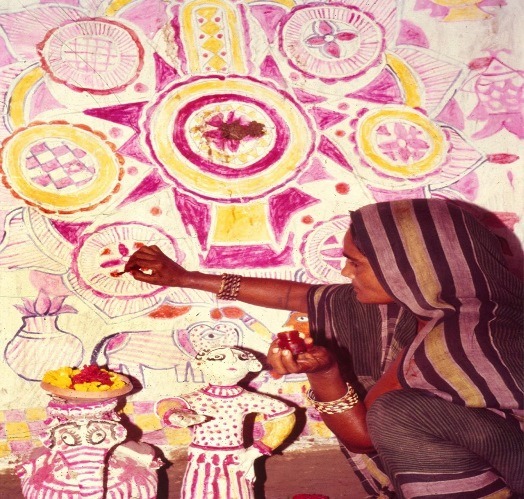
    Madhubani Paintings (Mithila – Bihar) 

    • Colorful auspicious images on the interior walls of homes on the occasion of rituals & festivity → painted by women
    • This ancient tradition, especially elaborated for marriages, continues today.
    • Used to paint the walls of room, known as KOHBAR GHAR in which the newly wedded couple meets for the first time
    • Very conceptual, first, the painter thinks & then “draws her thought”

    Madhubani Paintings


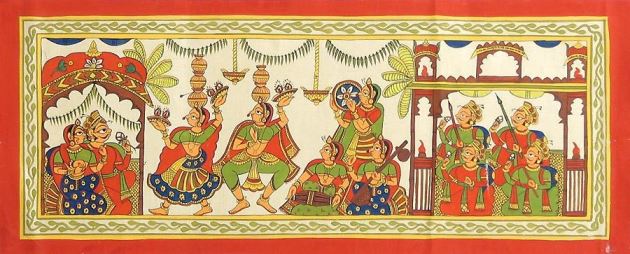
    Phad paintings (Bhilwada, Rajasthan) 

    • Phad is a painted scroll, which depicts stories of epic dimensions about local deities and legendary heroes.
    • Bhopas (local priests) carry these scrolls on their shoulders from village to village for a performance

    Phad paintings

    • Represents the moving shrine of the deity and is an object of worship
    • Most popular & largest Phad – local deities Devnarayanji and Pabuji


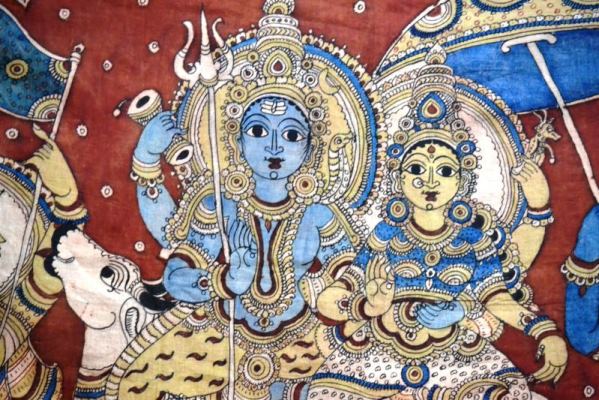
    Kalamkari Paintings (Andhra Pradesh) 

    • Literal meaning is painting done by kalam (pen) , Mainly in Andhra Pradesh (developed under Vijaynagar rulers)
    • Stories from the epics Ramayana, Mahabharata and the Puranas are painted as continuous narratives
    • Mainly to decorate temple interiors with painted cloth panels scene after scene; Every scene is surrounded by floral decorative patterns
      Kalamkari Paintings


    Warli painting

    • Practiced in tribal regions of Maharashtra with subjects, predominantly religious
    • decorative paintings on floors & walls of ‘gond’ and ‘kol’ tribes homes and places of worship
    • made in a geometric patterns like squares, triangles, and circles
    • Unlike other tribal art forms, Warli paintings do not employ religious iconography and is a more secular art form.

    Handicrafts

    Kashmir Embroidered shawls, carpets, namdar silk and walnut wood furniture
    Rajasthan precious stone and jems + tie & dye (Bandhani) fabric + minakari work
    Andhra Pradesh Bidri work and Pochampad saris
    Tamil Nadu bronze sculpture and Kajeevaram silk saris
    Mysore silk, sandalwood items
    Kerala ivory carvings and rosewood furniture
    Assam cane furniture
    Bengal Bankura terracotta modelling and handloom items
    Benaras Brocade & silk saris
    Madhya Pradesh Chanderi and kosa silk
    Lucknow chikan work  (Zardozi Embroidery – Muslims in Lucknow)
    Punjab Phulkari embroidery
    Bengal Kantha embroidery
    Orissa Patola embroidery
    Budhhists Thangka painting
  • How To Approach the IAS Prelims – Last 10 weeks


    Prelims is almost here. Preparation would be at full swing. It goes without saying, you have to best utilize these ten weeks to maximize your score in prelims and crack it without any hiccups. As time is of essence, I would not waste any more time on introduction and niceties and come straight to the task at hand. And the task is how to best utilize these last 10 weeks and how to approach prelims paper.

    This blog is primarily based on a talk delivered at Visionias. Here I would add to those points and give more examples to drive home the essence of the entire talk.

    First thing first, nobody can afford to flunk CSAT paper. There is simply no excuse for flunking that paper. To make sure, you don’t flunk the paper, just solve last 4 years UPSC CSAT papers, match your answers with official answer keys and if you score >90 <24 marks cushion over cutoff to discount for a tough paper and bad day> in all 4 papers, you need not touch CSAT.

    If you are scoring <80, you need to do some work. You can decide for yourself what needs to be done if you score b/w 80-90.

    With CSAT out of the way and whole game being based on general studies, our task in these last 10 weeks is to organize our studies in such a way that examination feels like an extension of our daily routine and we can score maximum marks.

    By now, most of you would already have done at least one reading of all the standard books <NCERTs plus Laxmikant, any one book for modern India, G.C Leong, climatology part, Highlights of budget and Eco survey, Current affairs at least from jan to may and later june>. If not, don’t waste any time and finish these books first.

    Before moving forward, I take it that basic books are done.

    Now some Do’s and Don’ts

    Prioritize – Don’t spend disproportionate time on one or two particular subjects or topics <often aspirants spend too much time on art and culture and Environment and ecology with very poor return on your invested time>. Please remember it’s okay to leave a few questions. No body gets all 100 correct and all the questions are of equal marks. So, if you get easy questions wrong and difficult ones correct, it’s not gonna help you.

    For instance, You can not get this question incorrect

    To uphold and protect the Sovereignty, Unity and Integrity of India” is a provision made in the

    (a) Preamble of the Constitution
    (b) Directive Principles of State Policy
    (c) Fundamental Rights
    (d) Fundamental Duties

    Or This

    Which one of the following is the best description of the term ‘ecosystem’?

    (a) A community of organisms interacting with one another.
    (b) That part of the Earth which is inhabited by living organisms.
    (c) A community of organisms together with the environment in which they live
    (d) The flora and fauna of a geographical area

    Or Fortaleza declaration or non plan expenditure, repo rate, Basel Committee, Cabinet Mission Plan, Rowlatt Satyagraha etc.

    Marking them incorrect is simply criminal and punishment is 1 year rigorous jail term

    But it’s okay if you got this wrong

    Kalamkari painting refers to

    (a) a hand-painted cotton textile in South India
    (b) a handmade drawing on bamboo handicrafts in North-East India
    (c) a block-painted woollen cloth in Western Himalayan region of India
    (d) a hand-painted decorative silk cloth in North-Western India

    Or This

    Which of the following has/have been accorded ‘Geographical  Indication’ status?

    1. Banaras Brocades and Sarees
    2. Rajasthani Daal-Bati-Churma
    3. Tirupathi Laddu

    Select the correct answer using the code given below.

    (a)  1 only
    (b) 2 and  3 only
    (c) 1 only 3 only
    (d) 1, 2 and 3

    You just can not remember all the things that have been accorded GI tag. If your guess turn out to be right, well and good, if not, don’t be too livid on yourself.

    Always remember not all questions are doable, your 1st aim should be to mark all doable questions correctly.

    2. Solving Question papers– Solve at least 2 papers every week till last Sunday of UPSC <1 test series paper and 1 past year UPSC paper>.  There’s no harm in solving 4 papers every week either. You know where to get papers from <you know all about copyrights law enforcement in India, I am not getting paid by coaching industry, wasn’t paid by vision either, no conflict of interest>

    Analysis of paper -But just solving isn’t enough. Analyse the paper. Analyse your mistakes. Jot them down in your notebook <doesn’t matter if you have to jot down 80 mistakes>.  You would soon realize there’s pattern to your mistakes. Rectify the though process which makes you commit those mistakes.

    Go back to standard books and read the topics which you find yourself weak at and improve upon them.

    Demolish the myth of negative marking holding you back– In the question paper itself, mark those questions which you are not 100% or even 80% sure <this 100%, 80% is subjective, we all know> and see if marking them benefits you or harm you. Also you would get the knack of marking dicey options correctly.  <this exercise is very important, as many of the questions which we solve by calculated guesses turn out to be correct but we attribute them to our knowledge while all the wrong ones are attributed to guesses and then we trash this whole exercise of calculated/ informed guessing>

    Practice elimination method and informed guessing

    For instance, if the question is-

    • Which of the following country is not a member of Mercosur
    • Options are – Argentina, Brazil, Venezuela, Mexico

    Now even if you don’t remember much about Mercosur but could recall reading about it in an article about trading blocks at CD, you would be able to vaguely remember that it had members from South America and Mexico is in central America or North but not in South so this could be the answer.

    Very conservatives among you would not mark such options but IMHO, one should definitely mark such options. It’s not tukka, it’s not cheating. It’s calculated/ informed guessing.

    But in exam you may develop cold feet while marking such options, hence it;s important you apply this in test papers, see the benefits for yourself and become confident.

    Similarly sometimes you would be able to eliminate two options, it’s advisable to mark a tukka b/w the two options <You can do the math of probablity for CSAT>

    Consider this question (Pre 2015)

    Consider the following statements

    1. The Executive Power of the Union of India is vested in the Prime Minister.
    2. The Prime Minister is the ex officio Chairman of the Civil Services Board.
    Which of the statements given above is / are correct?

    (a) 1 only
    (b) 2 only
    (c) Both 1 and 2

    (d) Neither 1 nor 2

    • Everyone should know that 1st statement is incorrect <if you don’t know this, no need to do PHD in art and culture but immediately go back to Laxmikant>
    • Statement 2 even if you don’t know IMO, you should mark either b or d after doing akkad bakkad bambe bo <you can do the math of probability>

    What if you are able to eliminate one option?

    You should mark based on your preparation and risk appetite

    For instance this question ( Pre 2015)

    In the ‘Index of Eight Core Industries’, which one of the following is given the highest weight?

    (a) Coal production
    (b) Electricity generation
    (c) Fertilizer production
    (d) Steel production

    Anyone with slightest knowledge, commonsense and logic can easily eliminate fertilizer <agriculture’s contribution to GDP <18%, fertilizer ka kitna hoga> with  more logic you can reach to electricity, I applied but reached to steel and my answer turned out to be incorrect <don’t mark in 1/3 if you feel you are comfortable in prelims, no point in going for glory>

    In tests as also in exam, read every question and every option carefully. Don’t leave a question even if you don’t have much idea about without reading the options. Apply all your previous knowledge and all the logic at your disposal to see if you can arrive at correct answer or if you can eliminate at least two options.

    For instance this question (prelims 2015)

    Which one of the following best describes the main objective of ‘Seed Village Concept’?

    (a) Encouraging the farmers to use their own farm seeds and discouraging them to buy the seeds from others
    (b) Involving the farmers for training in quality seed production and thereby to make available quality seeds to others at appropriate time and affordable cost
    (c) Earmarking  some villages exclusively for the production of certified seeds
    (d) Identifying the entrepreneurs in village and providing them technology and finance to set up seed companies

    Many of you would leave this question just after reading seed village concept. I didn’t have any idea either. But let’s read the options

    • 1st options seems like a BS option. Why should anyone discourage farmers from buying seeds from others if they are of good quality
    • 3rd option, is it even possible to earmark some villages exclusively for seed production i.e leave your animal husbandry, farming, other activities just produce seeds.
    • Now you can choose from b and d. In the exam I chose d which was incorrect but the point I am trying to make is don’t move without reading all the options

    Some important red flags which should alert you to the possibility of statement being wrong. In such situations, you should pause and think about that possibility. I am not saying that statement with red flags would always be incorrect, what I am saying is you should pause and think about that possibility.

    Such red flags are

    • Broad sweeping statements – all, always, only
    • Unnecessary negative sentence which seems odd or seems logically incorrect
    • Too much over exaggeration

    Now I discuss such statements and questions asked in last year’s exam

    1. With reference to ‘Indian Ocean Rim Association for Regional Cooperation (IOR-ARC)’, consider the following statements:

    1. It was established very recently in response to incidents of piracy and accidents of oil spills.
    2. It is an alliance meant for maritime security only.
    Which of the statements given above is / are correct?

    (a) 1 only
    (b) 2 only
    (c) Both 1 and 2
    (d) Neither 1 nor 2

    Discussion- Look at the statement 2 –Maritime security only. You should observe this and think if it can be false. It’s actually false as this organization has noting to do with security <economy actually>. Also if it had to focus on maritime security only statement could have been, It is an alliance meant for maritime security.  <ye to nhi likha hoga naa that can’t talk about anything except security>

    Now look at the statement one – very recently <could it not be recently, it’s a very lame reason actually> but you should think, be skeptic, mark them right if you are sure they are right.

    Also statement 1 and 2 contradict each other. Accident of oil spills are not related to maritime security.

    Imp.- You should know that this organization is focused on economy and both the statements become incorrect automatically and no such tikdam required

    2. With reference to inflation in India, which of the following statements is correct?

    (a) Controlling the inflation in India is the responsibility of the Government of India only
    (b) The Reserve Bank of India has no role in controlling the inflation
    (c) Decreased money circulation helps in controlling the inflation
    (d) Increased money circulation helps in controlling the inflation

    • Option 1 only should make you think, <it’s logical that inflation would be the responsibility of both govt and RBI, yes primary responsibility of RBI but even only RBI would be incorrect>
    • Also if statement one is true, two has to be true and both can’t be true simultaneously <single choice answer>
    • Statement c and d are opposite so one has to be true unless money supply has no role in inflation

    Note– Very easy question, done your NCERT, solved all economy questions I solved for you in the forum, no need for any tikdam

    3. With reference to bio-toilets used by the Indian Railways, consider the following  statements:

    1.The decomposition of human waste in the bio-toilets is initiated by a fungal inoculum.
    2. Ammonia and water vapour are the only end products in this decomposition which are released into the atmosphere.

    Which of the statements given above is/are correct?

    (a) 1 only
    (b) 2 only
    (c) Both 1 and 2
    (d) Neither 1 nor 2

    Option 2- why only water vapour and NH3, why not CO2 and other gases. Stands to reason. Again it should make you think. You should not mark a statement incorrect just because you see only.

    Note- I don’t think anyone would remember all the gases which are released so this question is apt to be solved by our tikdam after thinking about the statement

    4. Which of the following statements is/are correct regarding National Innovation Foundation-India (NIF)?

    1. NIF is an autonomous body of the Department of Science and Technology under the Central Government.
    2. NIF is an initiative to strengthen the highly advanced scientific research in India’s premier scientific institutions in collaboration with highly advanced foreign scientific institutions.

    Look at the exaggeration in the statement 2. High advanced scientific research with highly advanced foreign institutions. This made me think and I recalled that NIF was actually for grass root level innovation. Again the point is I knew about NIF but I was still going with the flow and marked the option as correct until I focused on exaggeration. So, imp think is stopping and thinking

    NOTE- Knowing about NIF was imp. These tikdams work only when you are well prepared.

    5. With reference to ‘fly ash’ produced by the power plants using coal as fuel, which of the following statements is/are correct?

    1. Fly ash can be used in the production of bricks for building construction.
    2. Fly ash can be used as a replacement for some of the Portland cement concrete.
    3. Fly ash is made up of silicon dioxide and calcium oxide only, and does not contain any toxic elements.

    Look at the statement 3. Why can’t there be anything else in fly ash? I didn’t know much about that but I thought if that was the case, they should have written made up of silicon dioxide and calcium oxide, what was the need of silly only?

    6. With reference to ‘dugong’, a mammal found in India, which of the following statements is/an; correct?

    1. It is a herbivorous marine animal.
    2. It is found along the entire coast of India.
    3. It is given legal protection under Schedule I of the Wildlife (Protection) Act, 1972.

    Select the correct answer using the code given below.

    (a) 1 and 2
    (b) 2 only
    (c) 1 and 3
    (d) 3 only

    Look at the statement 2. It should at least make you think, at least 1 km stretch mein to nhi milta hoga. Now you can say what if the statement was deer is found everywhere in India?? Tikdam is only to stop you and make you consider the other possibility

    Some questions where logic can help you

    7. Which one of the following issues the ‘Global Economic Prospects’ report periodically?

    (a) The Asian Development Bank
    (b) The European Bank for Reconstruction and Development
    (c) The US Federal Reserve Bank
    (d) The World Bank

    Global report should be published by a global body, right. You can easily rule out Fed and European Bank. Asian bank can also be ruled out similarly <though there is a possibility of even regional institutions publishing global reports>

    8. With reference to the Indian Renewable Energy Development Agency Limited (IREDA), which of the following statements is/are correct?

    1. It is a Public Limited Government Company.
    2. It is a Non – Banking Financial Company.

    Select the correct answer using the code given below.

    (a) 1 only
    (b) 2 only
    (c) Both 1 and 2
    (d) Neither 1 or 2

    Option 1 you can mark correct by name of agency, option 2 if you know it’s function

    9. Kalamkari painting refers to

    (a) a hand-painted cotton textile in South India
    (b) a handmade drawing on bamboo handicrafts in North-East India
    (c) a block-painted woollen cloth in Western Himalayan region of India
    (d) a hand-painted decorative silk cloth in North-Western India

    Kalam means pen, option c is easily incorrect but if you don’t know difficult to mark in 1/3

    10. Consider the following statements :

    1 The Legislative Council of a State in India can be larger in size than half of the Legislative Assembly of that particular State
    2. The Governor of a State nominates the Chairman of Legislative Council of that particular State.

    Which of the statements given above is/are correct?

    (a) 1 only
    (b) 2 only
    (c) Both 1 and 2
    (d) Neither 1 nor 2

    If you don’t remember the exact provisions, think what would be the purpose of making a law if size could be more than half. If it can be more than half, it can be anything. Provisions are made to limit size (<15% size of CoM, <1/3 size of councils>

    Note- Again better to know exact provisions so that tikdam is needed only in difficult questions

    11. With reference to Indian economy, consider the following statements:

    1. The rate of growth of Real Gross Domestic Product has steadily increased in the last decade.
    2. The Gross Domestic Product at  market prices (in rupees) has steadily increased in the last
    decade.

    Which of the statements given above is/are correct?
    (a) 1 only
    (b) 2 only
    (c)  Both 1 and 2
    (d)  Neither 1 nor 2

    I don’t need to say anything about this question. Whether you know anything or not, this question can not be marked incorrect

    12. The term ‘IndARC’, sometimes seen in the news, is the name of

    (a) an indigenously developed radar system inducted into Indian Defence
    (b) India’s satellite to provide services to the countries of Indian Ocean Rim
    (c) a scientific establishment set up by India in Antarctic region
    (d) India’s underwater observatory to scientifically study the Arctic region

    Name se clear hai India and Arctic. option D

    13. The Genetic Engineering Appraisal Committee is constituted under the

    (a) Food Safety and Standards Act, 2006
    (b) Geographical Indications of Goods (Registration and Protection) Act, 1999
    (c) Environment (Protection) Act, 1986
    (d) Wildlife (Protection) Act, 1972

    Whenever Bt cotton or BT brinjal issue comes up, environment ministry pange karti so obviously EPA

    Note– This should be known so no need for tikdam

    14. With reference to the Union Government, consider the following  statements 

    1. The Department of  Revenue is responsible for the preparation of Union Budget that is presented to the Parliament.
    2. No amount can be withdrawn from the Consolidated Fund of India without the authorization from the Parliament of India.
    3.  All the disbursements made from Public Account also need the authorization from the Parliament of India.

    Which of the statements given above is / are correct?

    (a) 1 and 2 only
    (b) 2 and 3 only
    (c) 2 only
    (d) 1, 2 and 3

    Apply all and no principle, think. If you mark it incorrect without thinking, you would be wrong. If you stop and think you would realize statement 2 is correct, If you don’t know you would mark statement 3 also as correct which is a incorrect statement

    Moral of the story-  Red flags are to make you stop and think, not for marking indiscriminately

    15. With reference to Indian history, which of the following is/are the essential elements of the feudal system?

    1. A very strong centralized political authority and a very weak provincial or local political authority
    2. Emergence  of administrative structure based on control and possession of land
    3. Creation of lord-vassal relationship between the feudal lord and his overlord

    Select the correct answer using the code given below.

    (a) 1 and 2 only
    (b) 2 and 3 only
    (c)  3 only
    (d) 1, 2 and 3

    Statement 1, see the exaggeration. Very strong, very weak. It’s a red flag. Pause and think. If you think, you would realize it actually makes sense, correct statement but if you mark indiscriminately based on red flags only, you would be in trouble

    16. With reference to the art and archaeological history of India, which one among the following was made earliest?

    (a) Lingaraja Temple at Bhubneshwar
    (b) Rock-cut Elephant at Dhauli
    (c) Rock-cut Monuments at Mahabalipuram
    (d) varaha Image at Udayagiri

    Eliminate option 1, temple would not be constructed before rock cut architecture. This is the question, you can mark incorrect. No need to go after such questions. It’s important to focus on high yielding topics.

    Some questions from prelims 2014

    1. The scientific view is that the increase in global temperature should not exceed 2 °C above pre-industrial level. If the global temperature increases beyond 3 °C above the pre-industrial level, what can be its possible impact/impacts on the world?

    1. Terrestrial biosphere tends toward a net carbon source
    2. Widespread coral mortality will occur.
    3. All the global wetlands will permanently disappear.
    4. Cultivation of cereals will not be possible anywhere in the world.

    Look at option 3 and 4 <all, anywhere> Pause and think, obviously incorrect

    2. Consider the following countries:

    1. Denmark
    2. Japan
    3. Russian Federation
    4. United Kingdom
    5. United States of America

    Which of the above are the members of the ‘Arctic Council ‘?

    (a) 1, 2 and 3
    (b) 2, 3 and 4
    (c) 1, 4 and 5
    (d) 1, 3 and 5

    Everyone would know UK is incorrect. Choice b/w option a and d that is b/w USA and Japan. Even if you don’t know anything tukka laga do

    3. Which reference to Agni-IV Missile, which of the following statements is/are correct?

    1. It is a surface-to-surface missile.
    2. It is fueled by liquid propellant only.
    3. It can deliver one-tonne nuclear warheads about 7500 km away.

    Statement 2, pause and think, it could be correct also. actually it’s incorrect. Statement 3 is also incorrect <even Agni 5 does not have that much range>

    4. With reference to two non-conventional energy sources called ‘coal bed methane’ and ‘shale gas’, consider the following ‘statements:

    1. Coal bed methane is the pure methane gas extracted from coal seams, while shale gas is a mixture of propane and butane only that can be extracted from fine-grained sedimentary rocks.
    2. In India abundant coal bed methane sources exist, but so far no shale gas sources have been found

    Look at the statement 1 only, pause and think why only propane and butane. Actually mainly methane hota hai

    Similarly statement 2, no shale gas source, not even one? pause and think

    5. Consider the following international agreements:

    1. The International Treaty on Plant Genetic Resources for Food and Agriculture
    2. The United Nations Convention to Combat Desertification
    3. The World Heritage Convention

    Which of the above has / have a bearing on the biodiversity?

    (a) 1 and 2 only
    (b) 3 only
    (c) 1 and 3 only
    (d) 1, 2. and 3

    Common sense, all 3, statement 1 mentions genetic, statement 2 desert, statement 3 heritage, natural heritage sites

    6. What are the significance of a practical approach to sugarcane production known as ‘Sustainable Sugarcane Initiative’?

    1. Seed cost is very low in this compared to the conventional method of cultivation.
    2. Drip irrigation can be practiced very effectively in this.
    3. There is no application of chemical/ inorganic fertilizers at all in this.
    4. The scope for intercropping is more in this compared to the conventional method of cultivation.

    Select the correct answer using the code given below.

    1. 1 and 3 only
    2. 1, 2 and 4 only
    3. 2, 3 and 4 only
    4. 1, 2, 3 and 4

    Statement 3, no chemicals, none at all, pause and think, this could be true but read the question again practical method. <practical mein to thoda scope hoga hi chemicals ka>

    7. Other than poaching, what are the possible reasons for the decline in the population of Ganges River Dolphins?

    1. Construction of dams and barrages on rivers
    2. Increase in the population of crocodiles in rivers
    3. Getting trapped in fishing nets accidentally
    4. Use of synthetic fertilizers and other agricultural chemicals in crop-fields in the vicinity of rivers

    Select the correct answer using the code given below.

    (a) 1 and 2 only
    (b) 2 and 3 only
    (c) 1, 3 and 4 only
    (d) 1, 2, 3 and 4

    Look at option 2, pause and think, crocodile seriously?

    I think, with these examples it would be amply clear that one need to finish basic books, read questions and options carefully, pause and think when red flags so indicate, practice test papers, revise weaker topics etc. etc.

    What to do in Exam Hall

    1. Don’t go in the exam hall with any pre-conceived notion of number of questions to be attempted. Attempt as many as you know, make informed guesses, use elimination method, mark where you are able to eliminate two options
    2. Don’t speculate cut off in the exam hall itself. Your task is to maximize your score. 10 extra marks wouldn’t hurt you
    3. Don’t make mistakes in bubbling the circles <keep ample time for that>

    What not to do after Prelims 

    1. Don’t engage in futile speculation of cutoff
    2. Don’t try to correct your wrong answers by sending 100 URLs to your friends
    3. Take a few days break and start studying for mains

    My prelims marks 

    • 2015 – 142 + 182 <rank 20>
    • 2014 – 125 +157/ 175 <interview, back to square one>
    • 2013 – 118 +192 <interview, back to square one> <2013 and 2014 marks could be +- 2 either side>

    P.S. As I have clearly said, there’s no substitute for hard work and studying standard books. Once you are done with them, practicing papers help in knowing our weak areas and taking corrective steps. Red flags and tikdams are like check lists which enable us to pause and rethink and prevent us from making mistakes

    P.P.S.  Constructive criticism is welcome but please don’t get personal. Leave a comment if you appreciate the article. Too lazy to leave a comment, just order a pizza for me.

    Best Luck


    From Civilsdaily

    Be a regular on the Civilsdaily App (Free for Download) & read the monthly CivilsDigest magazine for handy revision. Click here to buy.

  • Last minute tips on how to Maximise your scores in Prelims

    This lecture is meant to help students relax and overcome anxious thoughts.

    Please note down the tips and make sure to practice them.


    https://www.youtube.com/watch?v=Ph59h_BZrzE


    We at Civilsdaily are committed to helping you in the process of figuring out your learning personalities and creating the best time table and suggesting most relevant strategies for your IAS Prep. Please take 5 minutes to fill up this Samanvaya Form. We will arrange a mentor call for you once this is done.

  • [Prelims Spotlight] Isro Missions

    1.RISAT-2B: An all-seeing radar imaging satellite

    • he PSLV-C46 is set to launch RISAT-2B from Satish Dhawan Space Centre in Sriharikota.

    RISAT Constellation

    • RISAT-2B, short for “Radar Imaging Satellite-2B”, is the second in a series of satellites used to observe weather conditions on Earth using radar imagery.
    • RISAT-2 was the first satellite in the series, launched for the purpose of surveillance. RISAT-1 was launched later, to become India’s first all-weather radar imaging satellite.
    • RISAT-2B is to be followed by RISAT-2BR1, 2BR2, RISAT-1A, 1B, 2A and so on.
    • ISRO orbited its first two radar satellites in 2009 & 2012 and it plans to deploy four or five of them in 2019 alone.
    • A constellation of such space-based radars means a comprehensive vigil over the country.
    • Once operational, the satellite will be capable of monitoring weather day and night, in all weather conditions.

    2.Phase 4 of Geosynchronous Satellite Launch Vehicle (GSLV)

    • The Union Cabinet has approved ongoing GSLV continuation programme Phase-4 consisting of five GSLV flights during the period 2021-2024.
    • The will enable the launch of 2 tonne class of satellites for Geo-imaging, Navigation, Data Relay Communication and Space Sciences.
    • It will meet the demand for the launch of satellites at a frequency up to two launches per year, with maximal participation by the Indian industry.

    About GSLV

    • GSLV Continuation Programme was initially sanctioned in 2003, and two phases have been completed and the third phase is in progress and expected to be completed by Q4 of 2020-21.
    • GSLV has enabled independent access to space for 2 tonne class of satellites to Geosynchronous Transfer Orbit (GTO).
    • One of the significant outcomes of the GSLV Continuation Programme is the mastering of the highly complex cryogenic propulsion technology, which is an essential technological capability to launch communication satellites to GTO.
    • This has also paved the way for the development of a high thrust Cryogenic engine & stage for the next generation launch vehicle i.e. GSLV Mk-lll.
    • With the recent successful launch of GSLV-F11 on 19th December 2018, GSLV has successfully orbited 10 national satellites.
    • GSLV with the indigenous Cryogenic Upper Stage has established itself as a reliable launch vehicle for communication, navigation and meteorological satellites and also to undertake future interplanetary missions.

    3.Mission Shakti (Anti-Satellite Missile Test)

    • In an incremental advance, India has successfully conducted an Anti-Satellite (ASAT) missile test, named Mission Shakti.
    • India becomes the fourth country in the world to demonstrate the capability to shoot down satellites in orbit.
    • So far, only the United States, Russia and China have this prowess.

    Mission Shakti

    • While Mission Shakti may have targeted an object in outer space, India has long developed the ability to intercept incoming missiles.
    • In 2011, a modified Prithvi missile mimicked the trajectory of a ballistic missile with a 600-km range.
    • The DRDO-developed Ballistic Missile Defence (BMD) Interceptor Missile successfully engaged an Indian orbiting target satellite in Low Earth Orbit (LEO) in a ‘Hit to Kill’ mode.
    • The interceptor missile was a three-stage missile with two solid rocket boosters.

    4.Young Scientist Programme (YUVIKA)

    Young Scientist Programme

    • ISRO has launched a special programme for School Children called “Young Scientist Programme” “YUva VIgyani KAryakram from this year.
    • The Program is primarily aimed at imparting basic knowledge on Space Technology, Space Science and Space Applications to the younger ones with the intent of arousing their interest in the emerging areas of Space activities.
    • The residential training programme will be of around two weeks duration during summer holidays and it is proposed to select 3 students each from each State/ UTs to participate in this programme covering state, CBSE, and ICSE syllabus.
    • Those who have just finished 9th standard (in the academic year 2018-19) and waiting to join 10th standard (or those who have started 10th Std just now) will be eligible for the programme.
    • The selection will be based on the 8th Std marks.
    • Students belonging to the rural area have been given special weightage in the selection criteria.

    5.PSLV-C45/ Emisat Mission

    • For the sheer number of ‘firsts’ to its credit, the scheduled PSLV-C45/Emisat mission scheduled will be a memorable one for the ISRO.

    PSLV-C45/Emisat

    • C-45, which is set for lift-off from the second launchpad at Sriharikota, will mark the 47th flight of the PSLV.
    • It is meant for electromagnetic spectrum measurements, according to the ISRO.
    • It will be released into an orbit at 749 km.
    • EMISAT is primarily based on on the famous Israeli spy satellite called SARAL or (Satellite with ARgos and ALtika), and inherits its SSB-2 bus protocol for conducting sharp electronic surveillance across the length and breadth of India.
    • The satellite would serve as the country’s roving device for detecting and gathering electronic intelligence from enemy radars across the borders as it circles the globe roughly pole to pole every 90 minutes or so.
    • For the third successive PSLV mission, the ISRO plans to reuse the rocket’s spent fourth stage or PS4 to host short experiments.

    6.ISRO, French agency to set up maritime surveillance system

    • ISRO and its French counterpart CNES has sealed an agreement to set up a joint maritime surveillance system in the country.
    • The two nations will explore putting up a constellation of low-Earth orbiting satellites.

    Oceansat-3-Argos Mission

    • The system will be augmented with the launch of Oceansat-3-Argos mission in 2020 along with a joint infrared Earth-observation satellite.
    • These will identify and track movement of ships globally – and in particular those moving in the Indian Ocean region where France has its Reunion Islands.
    • Before that, they will initially share data from their present space systems and develop new algorithms to analyse them, according to the Paris based National Centre for Space Studies.
    • They work together for the design and development of joint products and techniques, including those involving Automatic Identification System (AIS), to monitor and protect the assets in land and sea.

    7. Use of Space Technology in Agriculture Sector

    • The Ministry of Agriculture and Farmers Welfare, has been pro-active in using the space technology in agricultural sector. Take a look of various initiative in the aid of farmers:

    Various institutional measures

    1. The Department of Agriculture, Cooperation and Farmers Welfare established a Centre, called Mahalanobis National Crop Forecast Centre, in 2012.
    2. It works for operationalization of the space technology developed in the Indian Space Research Organization, for crop production forecasting.
    3. The Soil and Land Use Survey of India uses satellite data for soil resources mapping.

    8.India’s communication satellite GSAT-31 launched successfully

    GSAT-31

    1. It was launched in an elliptical Geosynchronous Transfer Orbit with a perigee (nearest point to Earth) of 250 km and an apogee (farthest point to Earth) of 35,850 km, inclined at an angle of 3.0 degree to the equator.
    2. With a lift-off mass of 2536 kg, GSAT-31 will augment the Ku-band transponder capacity in Geostationary Orbit.
    3. The satellite will provide continuity to operational services on some of the in-orbit satellites.
    4. GSAT-31 will provide DTH Television Services, connectivity to VSATs for ATM, Stock-exchange, Digital Satellite News Gathering (DSNG) and e-governance applications.
    5. The satellite will also be used for bulk data transfer for a host of emerging telecommunication applications.
    6. It is the India’s 40th communication satellite which is configured on ISRO’s enhanced ‘I-2K Bus’, utilising the maximum “bus capabilities” of this type.

    9.ISRO launches Human Space Flight Centre in Bengaluru

    Human Space Flight Centre (HSFC)

    1. The HSFC, the hub of ISRO’s future manned missions, was inaugurated at ISRO headquarters in Bengaluru.
    2. Announced on August 15 2018, the country’s first crewed mission is set to happen by 2022, the 75th year of Independence.
    3. HSFC shall be responsible for the implementation of Gaganyaan project — which involves mission planning, development of engineering systems for crew survival in space, crew selection and training and also pursue activities for sustained human space flight missions.
    4. HSFC will take the support of ISRO centres to implement the first developmental [crewed] flight.

    10.ISRO’s first mission of 2019 to put military satellite Microsat-R in space

    • ISRO’s first mission of 2019 will put into space a 130-kg military imaging satellite, Microsat-R.
    • C-44 will be launched from the older First Launch Pad at the Satish Dhawan Space Centre, Sriharikota.

     Details of Launch

    1. The satellite would be placed within 15 minutes after take-off in a polar orbit 274 km away from Earth.
    2. This is much lower than any of its civil Earth observation spacecraft, which fly pole to pole over the globe at between 400 km and 700 km.

    Payload Details

    Microsat-R

    1. Microsat-R and its payload come assembled from a handful of laboratories of the Defence Research and Development Organisation (DRDO).
    2. It is meant for military use.
    3. The satellite was assembled outside and ISRO only interfaced it” with its own systems and the launch vehicle, just as it treats any customer satellite.

    11.Unispace Nanosatellite Assembly & Training Programme of ISRO

    NNATI Programme

    1. It is a capacity building programme on Nanosatellite development.
    2. It is an initiative by ISRO to commemorate the 50th anniversary of the first United Nations conference on the exploration and peaceful uses of outer space (UNISPACE-50).
    3. The programme provides opportunities to the participating developing countries to strengthen in assembling, integrating and testing of Nanosatellite.
    4. UNNATI programme is planned to be conducted for 3 years by U.R. Rao Satellite Centre of ISRO in 3 batches and will target to benefit officials of 45 countries.

    About UNISPACE+50

    1. It is an event marking the 50th year of the first UN Conference on the Exploration and Peaceful Uses of Outer Space.
    2. It is an initiative of United Nations Office for Outer Space Affairs (UNOOSA).
    3. Three such conferences held earlier recognized the potential of space and laid the guidelines for human activities and international cooperation related to outer space.

    11.ISRO successfully launches hyperspectral imaging satellite HysIS

    HysIS

    1. HysIS stands for Hyper Spectral Imaging Satellite.
    2. The objective of the probe is to provide observations within the visible, near infrared and shortwave infrared bands of the electromagnetic spectrum.
    3. The imaging tools will help the HysIS satellite monitor atmospheric activity and climate change, while also assisting studies of Earth’s magnetic field.
    4. These observations will have a host of applications, prime among which relate to agriculture, forestry, water management, and coastal patterns.
    5. The satellite’s payload also consists of a 730W power backup, and a 64Ah Li-ion battery.
    6. It will continue to make observations till 2023, when the mission ends.
    7. After this launch, the next big event for the Indian space organisation will be its awaited mission to the moon – Chandrayaan-2 – in early 2019.

    12.GROWTH-India telescope’s first science observation

    GROWTH-India Telescope

    1. The GROWTH-India telescope was commissioned six months ago soon after which it saw first light, on the night of June 12.
    2. It is part of a multi-country collaborative initiative – known as the Global Relay of Observatories Watching Transients Happen (GROWTH) – to observe transient events in the universe.
    3. The fully robotic telescope is designed to capture cosmic events occurring over relatively shorter periods of the cosmological timescale: years, days and even hours.
    4. Universities and research institutes from the US, the UK, Japan, India, Germany, Taiwan and Israel are part of the initiative.
    5. Their primary research objective is time-domain astronomy, which entails the study of explosive transients and variable sources (of light and other radiation) in the universe.

    13.ISRO telemedicine nodes for soldiers in high-altitude areas

    Telemedicine Nodes by ISRO

    1. In a major effort to improve emergency medical support to soldiers posted in high-altitude areas, especially Siachen, the Integrated Defence Staff of the Defence Ministry and the ISRO signed a MoU to set up telemedicine nodes in critical places across the country.
    2. ISRO will establish 53 more nodes in the first phase over and above the existing 20, in various establishments of the Army, Navy and Air Force across the country.

    14.Chandrayaan-1 data confirms presence of ice on Moon: NASA

    NASA’s Moon Mineralogy Mapper (M3) is testimony

    1. M3, aboard the Chandrayaan-1 spacecraft, launched in 2008 by the Indian Space Research Organisation (ISRO), was uniquely equipped to confirm the presence of solid ice on the Moon.
    2. Scientists used data from NASA’s Moon Mineralogy Mapper (M3) instrument to identify three specific signatures that definitively prove there is water ice at the surface of the Moon.
    3. It collected data that not only picked up the reflective properties we would expect from ice, but was also able to directly measure the distinctive way its molecules absorb infrared light, so it can differentiate between liquid water or vapour and solid ice.
    4. Most of the new-found water ice lies in the shadows of craters near the poles, where the warmest temperatures never reach above minus 156 degrees Celsius.
    5. Due to the very small tilt of the Moon’s rotation axis, sunlight never reaches these regions.

    15.ISRO set to launch its TV channel

    1. The ISRO is all set for a year-long Vikram Sarabhai centenary celebration starting in August 2019 to honour the visionary scientist and its legendary founding father.
    2. In a few months’ time, it plans to roll out a dedicated ISRO TV channel showcasing space applications, developments and science issues, targeting young viewers and people in remote areas in their language.

    Satellite launches now open to public

    1. As it strengthens its public outreach, ISRO will shortly start allowing the public to watch satellite launches from its Sriharikota launch centre.
    2. Selected students of classes 8 to 10 will be the trained at ISRO for a month and taken to various laboratories and centres across the country.

    Vikram Sarabhai- the legend

    1. Sarabhai, the architect of the Indian space programme, the first ISRO chief and renowned cosmic ray scientist, was born on August 12, 1919.
    2. ISRO’s tributes to Sarabhai start with naming the first Indian moon landing spacecraft of the Chandrayaan-2 mission ‘Vikram’.
    3. Sarabhai was only 28 when he sowed the seeds of a space agency around the late 1940s and 1950s.

    16.Upgraded Vikas engine will soon boost ISRO’s rockets

    Adding more thrust

    1. The Vikas engine will improve the payload capability of PSLV, GSLV and GSLV Mk-III launch vehicles.
    2. The space agency has improved the thrust of the Vikas engine that powers all of them.

    Main beneficiary: GSLV Mk III

    1. The main beneficiary of the high-thrust Vikas engine is said to be the heavy-lifting GSLV-Mark III launcher, which ISRO expects will now put 4,000-kg satellites to space.
    2. This would be the third Mk-III and the first working one to be designated Mk III Mission-1 or M1.
    3. The first MkIII of June 2017 started with a 3,200-kg satellite and the second one is being readied for lifting a 3,500-kg spacecraft.
    4. The Vikas engine is used in the second stage of the light lifting PSLV; the second stage and the four add-on stages of the medium-lift GSLV; and the twin-engine core liquid stage of Mk-III.

    17.ISRO’s PRL scientists discover an ‘EPIC’ planet

    India in elite planet-spotting club

    1. A team from the Physical Research Laboratory, Ahmedabad, has spotted for the first time a distant planet six times bigger than Earth and revolving around a Sun-like star about 600 light years away.
    2. EPIC 211945201b (or K2-236b) is the name given to the planet by the discovery team. The host star is named EPIC 211945201 or K2-236.
    3. With this discovery India has joined a handful of countries which have discovered planets around stars,” PRL’s parent ISRO has announced.
    4. The discovery was made using a PRL-designed spectrograph, PARAS, to measure and confirm the mass of the new planet.

    About EPIC

    1. EPIC was found circling very close to the Sun-like star, going around it once in about 19.5 days and unlikely to be inhabitable because of its high surface temperature of around 600°C.
    2. The team found the planet to be smaller in size than Saturn and bigger than Neptune.
    3. Its mass is about 27 times Earth’s and six times that of Earth at radius.
    4. The scientists estimate that over 60% of its mass could be made up of heavy elements like ice, silicates and iron.


  • [Prelims Spotlight] Environment/ Science & Tech Schemes

    1.Phyto-Pharma Plant Mission

    Objectives

    • Rs 50 crore Mission aimed at conservation and cultivation of endangered and threatened endemic medicinal plants, and discovery of new botanical drugs for unmet medical needs using the rich traditional ethno-botanical knowledge and biodiversity of these states and at the same time also improve availability of authentic and quality botanical raw material on sustainable basis for a boom in the phyto-pharmaceutical industry
    • Nodal Ministry –Ministry of Science & Technology


    2.Brahmaputra Biodiversity and Biology Boat

    Objectives

    • B4 will establish a large barge on the river with a well-equipped laboratory for analysis of all components of the entire ecosystem of the river and surroundings. The B4 will link to all the local research institutions along the river, as well as national and international laboratories
    • Nodal Ministry –Ministry of Science & Technology


    3.Secure Himalaya

    Objectives

    • To Conserve Snow Leopard, Uplift Mountain Community Launched


    4.Namami Gange

    Objectives

    • Aims at Ganga Rejuvenation by combining the existing ongoing efforts and planning under it to create a concrete action plan for future. It is an ambitious Union Government Project which integrates the efforts to clean and protect the Ganga river in a comprehensive manner
    • Nodal Ministry –Ministry of Water resources


    5.INSPIRE (INNOVATION IN SCIENCE PURSUIT FOR INSPIRED RESEARCH)

    Objectives

    • To attract talent to Science.
    • To communicate to the youth of the country the excitements of creative pursuit of science, attract talent to the study of science at an early age and thus build the required critical human resource pool for strengthening and expanding the Science & Technology system and R&D base.
    • It does not believe in conducting competitive exams for identification of talent at any level.
    • It believes in and relies on the efficacy of the existing educational structure for identification of talent.
    • INSPIRE has three components:
    • i. Scheme for Early Attraction of Talent (SEATS)
    • ii. Scholarship for Higher Education (SHE)
    • iii. Assured Opportunity for Research Careers (AORC)
    • The Inspire Awards have been renamed as MANAK


    6.JIGYASA –

    Objectives

    • Student-Scientist Connect Programme
    • connecting school students and scientists so as to extend student’s classroom learning with that of a very well planned research laboratory based learning.
    • CSIR + Kendriya Kendriya Vidyalaya Sangathan (KVS)


    7.VAJRA

    Objectives –

    • The Government of India recently launched VAJRA (Visiting Advanced Joint Research) Faculty scheme by the Department of Science and Technology which enables NRIs and overseas scientific community to participate and contribute to research and development in India. The Science and Engineering Research Board (SERB), a Statutory body of the Department will implement the Scheme.
    • International Faculty / scientists/technologists including Non-resident Indians (NRI) and Persons of Indian Origin (PIO) / Overseas Citizen of India (OCI) are offered adjunct / visiting faculty positions in Indian Institutions / Universities for a period of 1-3 months under this scheme. The faculty can also undertake the role of teaching /mentoring apart from R&D.
    • Public funded institutions and national laboratories are allowed to host the VAJRA faculty.
    • Nodal Ministry –Ministry of Science & Technology

    7. National Initiative for Developing & Harnessing Innovation (NIDHI)

    Objectives

    A programme to address the complete chain of innovation ecosystem right from scouting to mentoring to scaling up innovations. launched by DST. Establishment of a research park at IIT Gandhinagar has been supported at a cost of Rs.90 cr.


    8.Surya Jyoti

    Objectives

    • In order to capture day light and concentrate the same inside a dark room, particularly in urban slum or rural areas which lack electricity supply, a low cost and energy efficient Micro Solar Dome (Surya Jyoti) has been tested and developed. -Potential users of this device are10 million households.
    • According to preliminary estimates, if this technology is adopted in 10 million households only, it has the potential of saving 1750 million units of energy.
    • It would also lead to an emission reduction of about 12.5 million ton of CO2 equivalent, hence giving a fillip to the mission of ‘Clean India, Green India’.
    • The manufacturing process, being labour-intensive, would also generate huge job opportunities in the economy.
    • Nodal Ministry – Department of Science & Technology.
  • [Prelims Spotlight] Wildlife/ forest Conservation Efforts

    1.Purple frog set to be crowned Kerala’s state amphibian

    Purple Frog

    • Quite similar to the lore of King Maveli, researchers have found that the Purple frog (Nasikabatrachus sahyadrensis), which lives almost its entire life in underground tunnels, comes out to the surface for a single day in a year to breed.
    • Once it lays it’s eggs, the bloated frogs characterized by a protruding snout and powerful hind legs return to the earth’s deepest layers.
    • This intriguing frog species is listed as Endangered on the red list of the International Union for Conservation of Nature (IUCN).
    • It feeds mostly on soil-mites, ants and termites using its fluted tongue.
    • The male and female frogs mate underground and once in a year, they come out on the surface to lay thousands of eggs near seasonal streams in the months of May-June.
    • How they time their emergence onto the surface along with the onset of early rains is a mystery that continues to baffle naturalists.

    Why is it so special?

    • It’s endemic to this part of the southern Western Ghats and cannot be found anywhere else.
    • Described for the first time in 2003 by two scientists in the jungles of Kerala, the species sparks feverish imagination among herpetologists worldwide for a number of reasons.
    • It’s evolutionary roots suggest it could have shared space with dinosaurs going back almost 70 million years ago.
    • This could help scientists understand how it’s population may have evolved and learned to overcome the challenges of shifting land masses.
    • A year after it was documented, the frog’s closest relatives were found in Seychelles, an island in the Indian Ocean off East Africa.
    • This discovery led many to ask whether the species could indeed be living proof of the theory of Gondwanaland.

    2.Despite objections, Bannerghatta National Park’s Eco-Sensitive Zone curtailed

    • Bannerghatta National Park’s Eco-Sensitive Zone (ESZ), which provides a regulated buffer zone around protected areas, will remain at 168.84 sqkm despite thousands of citizens formally objecting to the reduction of nearly 100 sq. km. as compared to the original proposal.
    • The new ESZ will range from 100 metres (towards Bengaluru) to 1 kilometre from the periphery of the protected area.

    3.Grizzled Giant Squirrel

    Grizzled Giant Squirrel

    • For the first time, researchers have sighted nests of the grizzled giant squirrel at Pakkamalai Reserve Forests near Gingee in the Eastern Ghats.
    • The grizzled giant squirrel is usually known to nest in the Western Ghats in Southern India ranging from Chinnar Wildlife sanctuary in Kerala to Anamalai Tiger Reserve and Palani hills in Tamil Nadu.
    • Owing to habitat loss and poaching, the species has been categorised as near threatened by the Red List and listed under Schedule II of CITES.
    • It is an endangered species listed under Schedule I of the Wildlife Protection Act, 1972
    • The grizzled giant squirrel is usually known to nest in the Western Ghats in Southern India ranging from Chinnar Wildlife sanctuary in Kerala to Anamalai Tiger Reserve and Palani hills in Tamil Nadu.

    4. Global Assessment Report by IPBES

    Global Assessment Report

    • It is compiled by 145 expert authors from 50 countries and is a cornerstone of an emerging body of research the Intergovernmental Science-Policy Platform on Biodiversity and Ecosystem Services (IPBES).
    • Known as the Global Assessment, the report found that up to one million of Earth’s estimated eight million plants, insect and animal species is at risk of extinction, many within decades.
    • It suggests the world may need to embrace a new “post-growth” form of economics if it is to avert the existential risks posed by the mutually-reinforcing consequences of pollution, habitat destruction and carbon emissions.

    About IPBES

    • The Intergovernmental Science-Policy Platform on Biodiversity and Ecosystem Services (IPBES) is an independent intergovernmental body, established by member States in 2012 under the auspices of UNEP.
    • The objective of IPBES is to strengthen the science-policy interface for biodiversity and ecosystem services for the conservation and sustainable use of biodiversity, long-term human well-being and sustainable development.
    • The IPBES secretariat is based in Bonn, Germany.

    5.Kashmir Stag (Hangul)

    • A massive decline in the population of Kashmir’s iconic wildlife species, the Hangul (Cervus hanglu hanglu), also known as the Kashmir stag, continues to be a big concern.

    Kashmir Stag (Hangul)

    • Hangul, the state animal of Jammu & Kashmir, is restricted to the Dachigam National Park some 15 km north-west of Jammu & Kashmir’s summer capital Srinagar.
    • The Hangul is placed under Schedule I of the Indian Wildlife (Protection) Act, 1972 and the J&K Wildlife Protection Act, 1978.
    • The Hangul was once widely distributed in the mountains of Kashmir and parts of Chamba district in neighbouring Himachal Pradesh.
    • The IUCN’s Red List has classified it as Critically Endangered and is similarly listed under the Species Recovery Programme of the Wildlife Institute of India (WII) and the Environmental Information System (ENVIS) of the MoEFCC.

    5. Asiatic Wild Dogs (Dhole)

    • A recent study has discovered a reduction in Dhole occupancy in Karnataka’s Western Ghats, from 62 percent in 2007 to 54 percent in 2015.

    Asiatic Wild Dogs (Dhole)

    • The dhole is on the IUCN Red List of Endangered Species and is protected under Schedule II of the Wildlife Protection Act, 1972 in India.
    • Globally, dholes have disappeared from approximately 82 percent of their former range.
    • The Western Ghats perhaps supports the largest dhole population in the world and is therefore a critical conservation landscape for the species.

    6. Hump-backed Mahseer

    • The hump-backed Mahseer, found in the waters of the Cauvery, has been added to the IUCN Red List with Critically Endangered Status.

    Hump-backed Mahseer

    • The hump-backed mahseer is a large freshwater fish also called the tiger of the water and found only in the Cauvery river basin including Kerala’s Pambar, Kabini and Bhavani rivers.
    • It is now “Critically Endangered”: more threatened than the tiger is, as per the IUCN’s Red List of Threatened Species.
    • The fish is one of the 229 species added to the Red List last November; this update also reveals that the threat status of 12 other Indian species, including great hornbills, has increased.
    • The inclusion was possible only once the fish got its scientific name last June—Tor remadevii.

    7. Parrotfish in Andaman

    • Coral cover protection along the existing protected marine areas in Andaman and Nicobar islands is necessary for conservation of the endangered Bumphead Parrotfish, a new study has suggested.

    Bumphead Parrotfish

    • Bumphead parrotfish, Bolbometopon muricatum, is an important component of coral reef ecosystem, but is highly endangered globally.
    • It is categorized as ‘vulnerable’ in the Red List of the International Union for Conservation of Nature (IUCN).
    • This fish is a highly prized resource, but is threatened due to limited knowledge about its distribution and abundance in Indian waters.
    • A research recently studied the distribution, abundance and dangers to this species in the waters of Andaman and Nicobar islands.

    8. Herbivore census in Gujarat’s Gir forest

    • Every summer, the Forest Department of Gujarat conducts an Herbivore Census in Gir forest.

    Herbivore Census

    • The Herbivore Census covers ungulates such as spotted deer, blue bulls (nilgais), sambars, Indian gazelles (chinkaras), four-horned antelopes (choshinga) and wild boars, as well as Indian langurs and peafowl.
    • This year’s exercise is of particular significance because it is the last Herbivore Census ahead of next year’s Lion Census, which is a once-in-five-years exercise.

    9.DNA database for Indian Rhino

    • The Environment Ministry has embarked on a project to create DNA profiles of all rhinos in the country.

    DNA Database of Indian Rhino

    • By 2021, the Indian rhino could be the first wild animal species in India to have all its members DNA-sequenced.
    • The project’s proponents include the World Wildlife Fund for Nature-India (WWF-India) and the Centre-funded Wildlife Institute of India (WII).
    • The exercise would be useful in curbing poaching and gathering evidence in wildlife crimes involving rhinos.
    • There are about 2,600 rhinos in India, with over 90% of the population concentrated in Assam’s Kaziranga National Park.
    • Around 60 samples of tissue have been collected so far from some rhinos living outside Kaziranga.

    10.India’s biodiversity-rich zones also ‘hotspots’ of human impacts

    • Human impacts on species occur across 84% of the earth’s surface, finds a study published in PLOS Biology, an international journal dedicated to biological science.

    Human Footprint Data

    • Southeast Asian tropical forests — including India’s biodiversity-rich Western Ghats, Himalaya and the north-east also fall in this category.
    • Malaysia ranks first among the countries with the highest number of impacted species (125).
    • India ranks 16th in such human impacts, with 35 species impacted on average.
    • The study mapped the distribution of eight human activities — including hunting and conversion of natural habitats for agriculture — in areas occupied by 5,457 threatened birds, mammals and amphibians worldwide.

    11.Sundarbans Wetlands

    Sundarbans Wetlands

    • This January 30th, the Indian Sundarban was accorded the status of ‘Wetland of International Importance’ under the Ramsar Convention.
    • It comprises hundreds of islands and a network of rivers, tributaries and creeks in the delta of the Ganga and the Brahmaputra at the mouth of the Bay of Bengal in India and Bangladesh.
    • Located on the southwestern part of the delta, the Indian Sundarban constitutes over 60% of the country’s total mangrove forest area.
    • It is the 27th Ramsar Site in India, and with an area of 4,23,000 hectares is now the largest protected wetland in the country.

    12. Greens in the red: Why Aravallis matter to National Capital Region

    • It was in 1900 that the then Government of Punjab enacted the Punjab Land Preservation Act (PLPA), aimed at “conservation of sub-soil water” and “prevention of erosion” by giving the state power to “regulate, restrict or prohibit” certain activities, including “clearing or breaking up” of land.
    • As a result, for the last 118 years, the Act provided notified tracts of land in the Aravallis protection against real estate construction, urbanisation and mining.

    13. Rhinos without borders is conservation credo

    • International boundaries will not come in the way of conservation of rhinos, said representatives of Asian countries where the one-horned herbivore thrives.

    New Delhi Declaration

    • The Declaration was recently adopted at the second meeting of the Asian rhino range countries.
    • It underscored trans-boundary collaboration among India, Nepal, and Bhutan for the conservation and protection of the greater one-horned rhino.

    Rhinos without Borders

    • There are no rhinos in Bhutan, but some from the Manas National Park in adjoining Assam or Buxa Tiger Reserve in West Bengal are known to cross over occasionally.
    • In Feb, the National Rhino Conservation Strategy for India called for active engagement between India and Nepal to protect the species.
    • The plan said the single population of rhinos in Sukla-Phanta (Nepal), Valmiki Tiger Reserve (India) and Chitwan National Park (Nepal) and Dudhwa (India) is separated by the political boundary between the two countries.

    14. 106 coastal sites picked for conservation

    • The Centre has identified over 100 coastal and marine sites as conservation reserves under its National Wildlife Action Plan for 2017-2031, says a biennial report released by the government.

    Highlights of the Report

    1. Under the National Wildlife Action Plan for the period 2017 to 2031, the government is working towards the conservation of coastal and marine ecosystems from the impacts of climate change.
    2. In the last four and a half years, India has not only been able to sustain but also increase its mangrove cover at a time when these ecosystems are disappearing at an alarming rate across the world.

    15. Centre announces mascot for COP-13 on conservation of migratory species

    • The Centre has announced that the Great Indian Bustard (GIB) will be its mascot for the 13th Conference of Parties (COP) of the UN Convention on the Conservation of Migratory Species (CMS) to be held in Gujarat in 2020.

    About CMS COP-13

    1. Representatives from 129 countries and eminent conservationists and international NGOs working in the field of wildlife conservation are expected to attend the COP-13, to be held in Gandhinagar.
    2. It will provide a global platform for deliberations on the conservation and sustainable use of migratory wild animals and their habitat.
    3. The CMS COP-13 would also bring together the states through which migratory animals pass.

    16. First Captive Elephant Survey

    • The details of the first survey of captive elephants in the country were submitted in an affidavit by the MoEFCC to the Supreme Court.
    • The affidavit comes in the wake of rising elephant deaths and human-elephant conflicts, particularly in Kerala and Assam.

    In Total

    1. According to the affidavit, there are 2,454 elephants in captivity, of which 560 are in possession with forest departments and 1,687 with private individuals.
    2. However, 664 of the total captive elephants in the country are without ownership certificate while there are 85 in zoos, 26 in circuses and 96 in temples.

    17. Sustainable Catchment Forest Management (SCATFORM) Project in Tripura

    • Tripura has launched a project for Sustainable Catchment Forest Management at Hatipara in West Tripura.

    Sustainable Catchment Forest Management (SCATFORM) Project

    1. The project is jointly funded by the Japan International Cooperation Agency (JICA) and Government of India.
    2. It aims to improve quality of forest in the catchment area by sustainable forest management, soil and moisture conservation and livelihood development.
    3. The Tripura Forest Department (TFD) is the Executing Agency of the Project.
    4. Eighty per cent of the project would be funded by JICA while Government of India would fund 20 per cent of the project value.

    18. Asian Waterbird Census (AWC)

    1. AWC, the largest such census in Asia, is organised by Wetlands International, is an international programme that focuses on monitoring the status of waterbirds and wetlands.
    2. The data collected each year is shared by Wetlands International with global conservation organisations such as IUCN and Ramsar Convention, while state coordinators share data with local wildlife departments to ensure conservation and sustainable management of wetlands in the region.
    3. It also aims to increase public awareness on issues related to wetland and waterbird conservation.
    4. The census is carried out each January as a voluntary activity at national and local level.
    5. The AWC is co-ordinated by Wetlands International as part of global programme, the “International Waterbird Census”.
    6. The AWC was started in 1987, and many birders were initiated into bird counting and monitoring through this project.
    7. To take part one simply has to visit a wetland and count the birds he/she see there.

    19.India submits sixth national report to Convention of Biological Diversity

    • India submitted its sixth national report (NR6) to the Convention on Biological Diversity (CBD) highlighting the progress it has made in achieving the 12 National Biodiversity Targets (NBT) set under the convention process.

    Highlights of the Report

    1. The report was submitted online to the CBD Secretariat during the inaugural session of the 13th National Meeting of the State Biodiversity Boards (SBBs).
    2. The report says that India had already exceeded two targets, it was on track to achieve another eight soon.
    3. The remaining two would be met by the stipulated time of 2020.

    20. Asiatic Lion Conservation Project

    Asiatic Lion Conservation Project

    1. The MoEFCC has launched the “Asiatic Lion Conservation Project” with an aim to protect and conserve the world’s last ranging free population of Asiatic Lion and its associated ecosystem.
    2. The project will be funded from the Centrally Sponsored Scheme- Development of Wildlife Habitat (CSS-DWH) with the contributing ratio being 60:40 of Central and State share.
    3. The conservation of Asiatic Lions has always been a priority of Government of India.
    4. The Ministry in the past has supported Asiatic Lion in Gujarat by including it in list of 21 critically endangered species under the species recovery component of CSS-DWH.

    21.India, Nepal, Bhutan plan joint task force to protect wildlife

    • The governments of India, Nepal and Bhutan are actively considering having a joint task force for allowing free movement of wildlife across political boundaries and checking smuggling of wildlife across the Kanchenjunga Landscape.

    About Kanchenjunga Landscape

    1. The Kanchenjunga Landscape is a trans-boundary region spread across Nepal, India and Bhutan.
    2. The landscape stretches along the southern side of Mount Kanchenjunga covers an area of 25,080 sq km spread across parts of eastern Nepal (21%), Sikkim and West Bengal (56%) and western and south-western parts of Bhutan (23%).
    3. Other than seven million people, the Kanchenjunga Landscape is also home to 169 species of mammals and 713 species of birds.
    4. The trio is setting up a joint task force in the road map on achieving the objectives of free movement of wildlife and checking smuggling of wildlife.

    22. SC directs Centre to declare area around national parks as Eco-sensitive

    Expand ESZ

    1. The Supreme Court has directed the Union Environment Ministry to declare 10 km area around 21 national parks and wildlife sanctuaries across the country as ‘eco-sensitive zones’.
    2. A Bench led by Justice Madan B. Lokur took the initiative after its amicus curiae informed the court that the State governments have taken no effort to protect the area around these sanctuaries and parks.
    3. The court recorded that the issue has been pending for the past 12 years.

    23. Country’s first owl festival organized in Pune

    Indian Owl Festival

    1. The Indian Owl Festival, the country’s first owl fest, will be held at Pingori village in Purandar taluka of Pune, Maharashtra.
    2. The two-day festival is organised by Ela Foundation, an NGO working towards nature education and conservation.
    3. It will give information on owl conservation and feature art forms like pictures, paintings, lanterns, lamp shades, posters, origami, stitched articles, poems and stories on owls.
    4. It is a first-of-its-kind festival in the country that is being organised with the intention of creating awareness about owl as a bird and debunking numerous superstitions associated with it.

    24. India gets UN Environment award for combating transboundary environmental crime

    • UN Environment has awarded Wildlife Crime Control Bureau (WCCB), Ministry of Environment with Asia Environment Enforcement Awards, 2018 for excellent work done in combating transboundary environmental crime.

    About the Award

    1. The Asia Environment Enforcement Awards publicly recognize and celebrate excellence in enforcement by government officials and institutions/teams combating transboundary environmental crime in Asia.
    2. The awards are given to outstanding individuals and/or government organizations/teams that demonstrate excellence and leadership in enforcement of national laws to combat transboundary environmental crime.
    3. The award was decided upon by a selection panel set up by the UN Environment and this is the second time in a row the awards are being given by UN Environment to India.

    25. Nature pushed to the brink by ‘runaway consumption’, says WWF


    Triggering another Mass Extinction

    1. Uncontrolled consumption has decimated global wildlife and has triggered a mass extinction and exhausted Earth’s capacity to accommodate humanity’s expanding appetites, warned WWF.
    2. From 1970 to 2014, 60% of all animals with a backbone — fish, birds, amphibians, reptiles and mammals — were wiped out by human activity.
    3. WWF said all this in its “Living Planet” report, based on an ongoing survey of more than 4,000 species spread over 16,700 populations scattered across the globe.
  • Prime Prelims Test Series 2020 Time Table Released

    Click here to download pdf for better visibility Prime Prelims Time Table-2020-Final. 

    Enroll now by clicking here. 

    Dear students,

    As you are aware, UPSC has an exceptionally vast syllabus. And it is a very complex task to come up with a study-plan/time-time table that harmonizes every element and takes into consideration the return on investment on certain topics.

    We are hell-bent on simplifying things for you. Hence, we have come up with a plan that you will instantly connect with you and give you a vibe that yes you can do it!

    1. Integrated Approach

    Preparation for Prelims and Mains is harmonized. You study a subject, attempt prelims tests and then attempt mains tests for the same. This leads to a solid preparation.

    Many institutes our there will not able to present an integrated approach. They offer separate timetables for prelims and mains confusing the students further. That’s not the case with us!

    2. Simplified Approach

    Our Time-table is the easiest to remember and follow. All tests prelims, mains and Samachar Manthan will be held on the weekend.

    • Prelims Tests are held on the 1st and 3rd Saturday of every month.
    • CA Tests are held on the last Saturday of every month.

    Simple enough? We thought so.

    3. Priority-wise Coverage of subjects

    We are starting with the most important subjects from the exam perspective first. These are very predictable + have a very high return on investment. They need to be mastered if one has to have a shot at the exam. Polity, Modern History, and Economics. The lower priority ones follow.

    4. Logical Division of Topics

    Subjects have been divided into topics that logically fit together. Eg. for Polity we ask you to prepare in 2 parts – first, till Central Government and second, from State Government and beyond. This division is not ad-hoc and does not break the flow of your studies.

    5. Base and Advanced Sources

    We have divided the sources into 2 parts, Base Sources, and Advanced Sources. Base sources are those which you have to master. You should come to advanced sources only when you are thorough with the Base Sources.

    Click here to download pdf for better visibility Prime Prelims Time Table-2020-Final

    Enroll now by clicking here. 

    We at Civilsdaily are committed to helping you in the process of figuring out your learning personalities and creating the best time table and suggesting most relevant strategies for your IAS Prep. Please take 5 minutes to fill up this Samanvaya Form. We will arrange a mentor call for you once this is done.


  • [Prelims Spotlight] Mountain Ranges in the World

    Mountain Ranges

    Sr. No. Mountain Range Important/Highest Peaks Location Description
    1 Rocky Mountains Mt. Elbert (highest peak in the Rockies) North America It is one of the longest fold mountains in the world and extends from Canada to Western US (New Mexico State)
    2 Appalachian Mountains Mt. Mitchell, North Carolina, US (highest peak of Appalachian Mountains) North America It is a fold mountain with rich in mineral resources
    3 Alps Mont Blanc (French –Italian border) Europe It is a folded mountain and source for rivers like Danube, Rhine, etc.
    4 Sierra Nevada Mt. Whitney California, USA Habitat for many Red Indian tribes
    5 Alaska Range Mt. McKinley North America Mt. McKinley highest peak in North America
    6 Altai Mountains Belukha mountain Central Asia Young folded mountain which extends from Kazakhstan to northern China.
    7 Andes Mountains Mt. Aconcagua South America Longest mountain chain in the world
    8 Atlas Mountains Mt. Toubkal Northwestern Africa Young fold mountain spreading over Morocco and Tunisia.
    9 Drakensberg Mountains Mt. Lesotho South Africa Young folded mountain
    10. Caucasus Mountain Mt. Elbrus Europe Located between the Black Sea and the Caspian Sea
    11. Ural Mountains Mt. Narodnaya Russia This mountain range act as a boundary between Europe and Asia.
    12. Hindukush Mountains Mt. Trich Mir Pakistan and Afghanistan Folded mountain with rugged topography which makes it difficult for transportation.
    13. Himalayas Mt. Everest Asia Young fold mountains in Asia which separates Indian sub-continent from Asian plains
    14. Arakan Yoma Mt. Kennedy peak Myanmar It extends from north to south direction. Shifting cultivation is practised.
    15. Kunlun Mountains Mt. Muztag North of Tibetan plateau and western China It is one of the young folded mountains.
    16. Vosges Mt. Grand Ballon Eastern France, Europe Famous for the cultivation of grapes and manufacture of wines.
    17. Great Dividing Range Mt. Kosciuszko Australia This range is the source for the rivers Darling and Murray.


    Mountains-in-the-world

  • SAMANVAYA: Students Preparing for UPSC 2020 > get awesome !

    SAMANVAYA: Students Preparing for UPSC 2020 > get awesome !

    Dear Students, 

    After numerous conversations with you all, we have started understanding your problems better and also standardizing solutions for the most generic problems that you might face. 

    These are being incorporated in our Samanvaya program. It is these practices that will make the program more effective.

    At the core of Samanvaya lies the fact that each one of you will have a unique journey while preparing for the exam. Some will get through on the first attempt without much effort while others will take both more time and more effort. We want to understand you better to help you optimize your journey so you can focus on the right things and not waste time on the wrong ones. We are asking you to tap into the valuable experiences of mentors who underwent the same grind and realize the pitfalls and understand the shortcuts to make it.

    Samanvaya program involves the following –

    1. Identifying your weaknesses

    Over 80% of students who claimed to have revised NCERTs were unable to answer basic questions. Many were not comfortable with at least 1 GS subject and Optional. Many struggled with ‘What went wrong’ after 2-3 years of hard work.

    Our mentors will help you assess your preparedness and suggest accurate strategies.

    2. Strategy and study plan discussions

    Over 90% of students couldn’t stick to a plan. Study plans and strategies are iterative in nature and we want to help you with that. Many are unable to perform in tests despite preparing hard. This could be due to a variety of factors – lack of adequate prep, jitters in the exam hall, inadequate revision, lack of practice of test series or just a bad day at work. Tell us what you think went wrong and we’ll figure out a way to get you over the line next time.

    3. Helping you understand the exam better

    Which books to read, different approaches, etc. Over 60% of students we talked to did not find NCERTs relevant and saw no point in being thorough with them.

    4. Lack of motivation

    We have all had those days when it’s been hard to motivate ourselves to hit the books and just study. It happens to the best of us sometimes and for some of us, it happens more frequently. And it is understandable, Civil Service preparation is a long and often lonely process. Every aspirant, from toppers to those who have quit have been overwhelmed by this process at some point in time. Working alone is monotonous and Help you keep motivated by ensuring you are actively and passively studying every day. Focused telegram groups to foster discussions.

    Samanvaya Code of Conduct

    • Be honest with your mentors about your preparation levels and stage.
    • Follow their advice and participate in tests and assignments that they set for you
    • Stay active in the telegram groups, ask doubts, don’t hold yourself back.
    • Don’t expect spoonfeeding. You have to drive the initiative.

    Click here to fill the form and get a kickstart. 

    Here’s the feedback that we got from some of our students:


    Click here to fill the form and get a kickstart. 

  • [Prelims Spotlight] Important International Relations terms


    APC Network: Association for Progressive Communications comprises more than 20,000 subscribers to electronic listservers in 95 countries, and have recently been very much involved in agitating for global development and democratization of the United Nations

    Balance of payments: net flow of goods, services and financial transactions that takes into account outflows and inflows of money from a state

    Balance of payments deficit: a state spends more than it receives from other countries

    Balance of payments surplus: a state receives more than it spends in other countries

    Balance of power: a condition in which the distribution of military and political forces among nations means no one state is sufficiently strong to dominate all the others. It may be global, regional or local in scope

    Bargaining power: the general capacity of a state to control the behaviour of others, power to cause another actor to do an action (also see structural power)

    Biodiversity: two kinds: species and genetic diversity, species diversity refers to the differences between species, while genetic diversity refers to differences within species

    Brezhnev Doctrine: reinforced the right of the Soviets to ntervene where Moscow deemed socialism was threatened by ‘counter-revolutionary forces’

    Brundtland Commission Report: published 1987, commissioned 1983 with Gro Harlem Brundtland, Prime Minister of Norway, as commissioner, mandate was to look into the alarming rate at which environmental resources were being consumed, a the levels of their waste, particularly in the case of development, at the ways in which developing countries were falling further and further behind the industrialized world in their standards of living, coined term ‘sustainable development’

    Cold War: The period in world affairs from c.1947-1990, marked by ideological, economic and political hostility and competition between the US and the Soviet Union, and drawing in other powers at various levels of involvement

    Common unit of exchange: a currency in which international economic exchanges are valued

    Comparative advantage: Doctrine says that states should 1) produce and export whatever they can produce most efficiently relative to other states i.e., whatever they have a comparative advantage in; and they should 2) import those things they can’t produce as efficiently from states that can

    Concert of Europe: the informal system of consultation set up by the Great Powers (Austria, Britain, France, Prussia and Russia) to manage the balance of power at the end of the Congress system

    Conflict: perceived rival and incompatible claims over some desired “good”

    Congress of Vienna: meeting of the four main victors over Napoleon and France: Austria, Britain, Prussia and Russia.

    Containment: policy pursued by the US toward the Soviet Union c. 1947-1989, the aim of which was to deny Moscow opportunities to expand its political influence abroad, to draw a line and contain the Soviets within their borders, (also see Truman Doctrine )

    CSCE: Conference on Security and Cooperation in Europe, from 1973-75 all European states (except Albania) plus the US and Canada met to discuss regional security (now the Organization on Security and Cooperation in Europe, and one of the central security organizations in Europe

    D5: denuclearization, demilitarization, dealignment, democratization, and development, five main goals of peace and social movements

    Defence strategy: involves the assumption that war will be fought with three aims in mind: 1. to punish the aggressor 2. to deny territorial gains 3. to limit the damage to oneself (also see deterrence)

    Deterrence: efforts of an actor to dissuade the opponent from doing something considered against the actor’s interests by making the costs of action outweigh the benefits with threat of punishment, the implicit or explicit purpose of this strategy was to avoid actually fighting war (also see defence)

    Doctrine of Flexible Response: a nuclear utilization strategy which legitimized the notion of limited nuclear war, involved two dimensions: limited targetting (‘counterforce strategy’) and the use of battlefield nuclear weapons (also see MAD)

    Dollar overhang: the amount of US dollars overseas exceeded US reserves of gold, undermining dollar convertibility to gold

    Ethnic group: a group of people who define themselves as distinct from other groups because of cultural differences

    Eurodollar markets: free market where buyers and sellers exchange currencies outside of their country of origin

    Exchange rate: value at which one currency is traded for another

    Fixed exchange rate: the rate of exchange of a currency or currency is set by agreement between governments or by government policy (see also gold standard)

    Floating exchange rate: the rate of exchange of currencies is permitted to rise and fall with supply and demand on the international private market


    Free trade: means the buying or selling of goods and services across international borders with few or no restrictions (see also protectionism)

    Fungibility: the extent to which one form of power can be converted into another

    GATT: General Agreement on Tariffs and Trade, drawn up in 1947 to codify the rules of conduct in trade for its members, in the GATT, states agreed to negotiate “reciprocal and mutually advantageous arrangements directed to the substantial reduction of tariffs and other barriers to trade” and to increase free and fair trade

    Glasnost: ‘openness’, a term introduced by Mikhail Gorbachev about his post-1985 opening of Soviet society to dissidents, public criticism and limited admission of past Soviet mistakes (also see perestroika)

    Gold standard: the value of a currency is fixed relative to an amount of gold, can be converted to gold at a fixed rate (see also fixed exchange rates)

    GSP: Generalized System of Preferences: early 1970’s nineteen advanced industrial states agreed to eliminate tariffs on manufactured and semimanufactured goods exported by 140 LDCs unilaterally for ten years, renewed during 1980s for another decade (see UNCTAD, IPC)

    Holy Roman Emperor: the supreme secular authority in Medieval Europe

    Hugo Grotius (1583-1645): the ‘father’ of international law, a Dutch jurist, humanist and diplomat His great work ‘On the Law of War and Peace’ is widely regarded as a landmark in the development of international law

    HYV’s: high-yielding varieties of agricultural plants, genetically designed to produce higher quantities of product with the aid of fertilizer, pesticides, and mechanized agricultural methods

    ICBM’s: inter-continental ballistic missiles

    IPC: Integrated Programme for Commodities, concerted attempt to control price fluctuations in commodities on which LDC’s depended for foreign exchange income (see UNCTAD, GSP)

    LDC: Less Developed Country

    MAD: Mutually Assured Destruction, strategic doctrine which guarantees that each side in a nuclear exchange would survive a first strike by its opponent with enough arms intact to launch a second-strike sufficient to destroy the aggressor (also see Doctrine of Flexible Response)

    massive retaliation: a a nuclear strategy which calls for a nuclear response to any aggressive action

    MFN: Most Favoured Nation: every member is treated as well as the “most favoured one”: ie: if U.S. offers low tariff to Canada on ice cubes: every other GATT member is entitled to the same treatment (see also free trade, GATT)

    MIRV’S: multiple independently targetted re-entry vehicles (see also ICBM’S)

    monetarism: a policy of manipulating the money supply (inflating or deflating a currency) to influence economic growth

    monoculture: refers to the use of one genetic strain of plant or animal to replace a diversity of strains

    Multiple-sum game: both actors can mutually gain (also see zero-sum game)

    Natural law: the idea there existed rights and duties attached to human beings as such that existed in all times and all places, that could be discovered by reason, and that should be applied in the relations between groups

    Negative peace: the absence of war and physical (direct) violence (also see positive peace)

    Netwar: the primary objective of “netwar” is to use computer networks and databases to inflict cultural and political damage to the international image of the opponent.

    News values: the criteria for determining what kinds of stories are reported; used to identify, define and present a story

    NIEO: United Nations Resolution of May 1974 for a New International Economic Order to address concerns of LDC’s

    Non-Aligned Movement: loose organization of Third World countries which dealt with statements on a wide variety of issues from nuclear proliferation to trade and development, first meeting: Bandung, Indonesia, 1955, led by a few relatively strong, independent personalities: Tito, Nehru, and Nasser (Yugoslavia, India, Egypt) (see also UNCTAD, NIEO)

    Non-governmental organization (NGO): any private organization involved in activities that have transnational implications
    GO TO TOP

    Nuclear fusion: relies on forcing two hydrogen atoms together, and in the process destroying some extra matter that is converted into energy (called H-bomb)

    NWIO: New World Information and Communication Order, begun in the 1970s around the same time as the Group of 77 launched its drive for a NIEO, called for a more balanced flow of communications globally, development of communication infrastructure in LDC’s, control or elimination of information monopolies, and respect for each people’s cultural identity

    OECD: Organization for Economic Cooperation and Development, organization of 29 industrialized countries

    OPEC: Organization of Petroleum Exporting Companies: cartel of oil producers formed to control the price and supply of oil on world markets

    Perestroika: ‘restructuring’, a term used by Mikhail Gorbachev to describe his plans to reform, modernize and partly decentralize the Soviet economy (also see glasnost)

    Positive peace: the absence of structural violence as well as direct violence (see also negative peace)

    Protectionism: protecting your economy from the international economy by imposing various restrictions on flow of imports or exports of goods or services into or out of your country (see also free trade)

    Reserve currency: a currency that countries hold in reserve because of its strength and stability

    Security dilemma: a situation in which states’ actions taken to assure their own security, tend to threaten the security of other states

    Self-help: necessity to rely on a states’ own resources and capabilities

    SLBM’s: submarine-launched ballistic missiles

    specie money: solid money (gold or silver, traditionally)

    spheres of influence: an area declared by a Great Power to be its exclusive area of interest, where it acts to defend its dominance and to exclude other Great Powers.

    SOP’s: standard operating procedures

    Sovereignty: means a government has the right, at least in principle, to do whatever it liks in its own territory (also see state)

    Structural power: the power to change the rules of the game for others, the power to structure the choices of other actors

    Structural violence: latent or hidden forms of social conflict

    Stockholm Conference: UN Conference on the Human Environment, held 1972, was first worldwide environmental conference in history

    Sustainable development: term coined by Brundtland Commission Report 1987, defined as development which can “ensure that it meets the needs of the present without compromising the ability of future generations to meet their own needs”

    Terms of trade: the ratio in prices between a country’s exports and its imports

    Truman Doctrine: a promise of US aid to all ‘free peoples who are resisting attempted subjugation by armed minorities or by outside powers” (also see Brezhnev Doctrine)

    UNCED: United Nations Conference on Environment and Development, also known as the Earth Summit, held in Rio 1992. Effort by the int. Community to reach consensus on principles and a long-term workplan for global sustainable development, major output was Agenda 21 (referring to the Twenty-First Century), a global plan of action containing 294 pages encompassing every sectoral environmental issues as well as international policies affecting both environment and development and the full range of domestic social and economic policies.

    UNCTAD: United Nations Conference on Trade and Development: formed 1964: first Secretary General Raul Prebisch: called for reform of system of international trade based on liberalism and comparative advantage, in order to assist development of poor countries, included calls for a GSP and IPC (see also NIEO)

    War: legitimate use of organized violence or force to achieve “goods” (also see conflict)

    zero-sum game: one actors’ gain is another’s loss