Mains Ready By December. Smash Mains & Smash PYQ Admissions Open

GS Paper: GS1-01.Indian Culture- Salient aspects of Art Forms, Literature and Architecture from ancient to modern times.

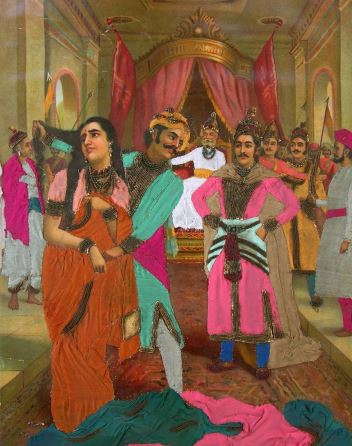
  • Raja Ravi Varma and his Arts

    Raja Rai Varma’s Draupadi Vastraharan is expected to fetch between Rs 15 and Rs 20 crore at an auction.

    Who was Raja Ravi Varma?

    • Raja Ravi Varma was born in April 1848 in Kilimanoor, Kerala, to a family which was very close to the royals of Travancore.
    • Often referred to as the father of modern Indian art, he is widely known for his realistic portrayal of Indian gods and goddesses.
    • While he majorly painted for the royalty, he is also credited for taking art to the masses with his prints and oleographs.
    • At a young age, he would draw animals and everyday scenes on the walls in indigenous colours made from natural materials such as leaves, flowers and soil.
    • His uncle, Raja Raja Varma, noticed this and encouraged his talent.
    • Patronised by Ayilyam Thirunal, the then ruler of Travancore, he learnt watercolour painting from the royal painter Ramaswamy Naidu, and later trained in oil painting from Dutch artist Theodore Jensen.

    How he became an artist of the royals?

    • Varma became a much sought-after artist for the aristocrats and was commissioned several portraits in late 19th century.
    • Arguably, at one point, he became so popular that the Kilimanoor Palace in Kerala opened a post office due to the sheer number of painting requests that would come in for him.
    • He travelled across India extensively, for work and inspiration.

    Fame as a notable painter

    • Following a portrait of Maharaja Sayajirao of Baroda, he was commissioned 14 Puranic paintings for the Durbar Hall of the new Lakshmi Vilas Palace at Baroda.
    • Depicting Indian culture, Varma borrowed from episodes of Mahabharata and Ramayana for the same.
    • He also received patronage from numerous other rulers, including the Maharaja of Mysore and Maharaja of Udaipur.
    • As his popularity soared, the artist won an award for an exhibition of his paintings at Vienna in 1873.
    • He was also awarded three gold medals at the World’s Columbian Exposition in Chicago in 1893.

    Nature of his artforms

    • Much of his celebrated art also borrows heavily from Indian mythology.
    • In fact, he is often credited with defining the images of Indian gods and goddesses through his relatable and more realistic portrayals often painted with humans as models.
    • The depictions include Lakshmi as the goddess of wealth, Saraswati as the goddess of knowledge and wisdom, and Lord Vishnu with his consorts, Maya and Lakshmi.

    How he took Indian art to the masses?

    • Raja Ravi Varma aspired to take his art to the masses and the intent led him to open a Lithographic Press in Bombay in 1894.
    • The idea, reportedly, came from Sir T Madhava Rao, former Dewan of Travancore and later Baroda, in a letter where he pointed out to Varma that since it was impossible for him to meet the large demand for his work, it would be ideal for him to send some of his select works to Europe and have them produced as oleographs.
    • Varma, instead, chose to establish a printing press of his own.
    • The first picture printed at Varma’s press was reportedly The Birth of Shakuntala, followed by numerous mythological figures and saints such as Adi Shankaracharya.

    Try this PYQ:

    Q. There are only two known examples of cave paintings of the Gupta period in ancient India. One of these is paintings of Ajanta caves. Where is the other surviving example of Gupta paintings?


    (a) Bagh caves

    (b) Ellora caves

    (c) Lomas Rishi cave

    (d) Nasik caves


    [wpdiscuz-feedback id=”x49cnsnw71″ question=”Please leave a feedback on this” opened=”1″]Post your answers here.[/wpdiscuz-feedback]


    UPSC 2022 countdown has begun! Get your personal guidance plan now! (Click here)

  • [pib] Festivals in news: Gudi Padwa

    The President of India has sent his greetings to fellow citizens on the eve of Chaitra Sukladi, Ugadi, Gudi Padwa, Cheti Chand, Navreh and Sajibu Cheiraoba.

    Gudi Padwa

    • Gudi Padwa is a spring-time festival that marks the traditional New Year for Marathi and Konkani Hindus, but is also celebrated by other Hindus as well.
    • It is celebrated in and around Maharashtra, Goa, and the union territory of Damaon on the first day of the Chaitra month, to mark the beginning of the New Year according to the luni-solar method of the Hindu calendar.
    • Padava or paadvo comes from the Sanskrit word pratipada, which is the first day of a lunar fortnight.
    • The spring festival is observed with colourful floor decorations called rangoli, a special Gudhi dvaja (flag garlanded with flowers, mango and neem leaves, topped with upturned silver or copper vessels), street processions, dancing& festive foods.

    Significance

    • Gudhi Padva signifies the arrival of spring and to the reaping of Rabi crops.
    • The festival is linked to the mythical day on which Hindu god Brahma created time and universe.
    • To some, it commemorates the coronation of Rama in Ayodhya after his victory over evil Ravana, or alternatively the start of Shalivahan calendar after he defeated the Huns invasion in the 1st century.

    State-wide celebrations

    • Bihu among the Assamese of Assam.
    • Cheti Chand among the Sindhi people
    • Navreh among the Kashmiri Pandits in Jammu and Kashmir.
    • Pahela Baishakh among the Bengalis in West Bengal and Bangladesh.
    • Puthandu among the Tamils in Tamil Nadu.
    • Samvatsar Padvo among Hindu Konkanis of Goa and Konkani diaspora in Kerala
    • Vaisakhi or Baisakhi among the Punjabis in Punjab.
    • Vishu or among the Malayalis in Kerala.
    • Ugadi among the south-Indian states of Karnataka, Andhra Pradesh and Telangana.
    • Sajibu Cheiraoba in Manipur


    UPSC 2022 countdown has begun! Get your personal guidance plan now! (Click here)

  • Art-form in news: Santhali Sohrai Murals

    Santhali communities of Odisha and Jharkhand are changing their ways of painting traditional Sohrai murals to modernity.

    What is Sohrai?

    • Sohrai is a harvest festival of the Indian states of Bihar, Jharkhand, Chhattisgarh, Odisha, and West Bengal.
    • It also called cattle festival. It is celebrated after harvest and coincide with festival of Diwali.

    What are Sohrai Murals?

    • Sohrai Mural is an indigenous art form is practised by the women of Santhal Community.
    • Ritualistic art is done on mud walls to welcome the harvest and to celebrate the cattle.
    • The women clean their houses and decorate their walls with murals of Sohrai arts.
    • This art form has continued since 10,000-4,000 BC. It was prevalent mostly in caves, but shifted to houses with mud walls.

    Features of this art

    • This Sohrai art form can be monochromatic or colorful.
    • The people coat the wall with a layer of white mud, and while the layer is still wet, they draw with their fingertips on it.
    • Their designs range from flowers and fruits to various other nature-inspired designs.
    • The cow dung that was earlier used to cake the walls of the house is used to add colour.
    • The dark outline is visible due to the previously applied contrasting white mud coat.
    • The artists are spontaneous in their drawing. The designs are usually drawn from the artist’s memory.
    • The personal experience of the artist and their interaction with nature are the biggest influence.


    UPSC 2022 countdown has begun! Get your personal guidance plan now! (Click here)

  • What is Agni Kandakarnan Theyyam?

    Ritual dance Agni Kandakarnan Theyyam performing at the Kaliyattam festival has begun in Kannur, Kerala.

    What is Theyyam?

    • Theyyam is a popular thousand-year-old ritual form of dance worship in Kerala and Karnataka, India.
    • The people of these districts consider Theyyam itself as a channel to a god and they thus seek blessings from Theyyam.
    • There are about 456 types of Theyyam.
    • Theyyam is performed by males, except the Devakoothu theyyam; the Devakoothu is the only Theyyam ritual performed by women.
    • It is performed only in the Thekkumbad Kulom temple.

    Major types of performances

    • Vishnumoorthi: It is the most popular Vaishnava Theyyam. This theyyam narrates and performs the story of Hiranyakashipu’s death by the Lord Vishnu in his avatar of Narasimham.
    • Sree Muthappan Theyyam: It consists of two divine figures is considered as the personification of two divine figures— the Thiruvappana or Valiya Muttapan (Vishnu) and the Vellatom or Cheriya Muttapan (Shiva).
    • Padikutti Amma: It is believed to be the mother of Muthapan. The Padikutti Amma Theyyam is performed in the Palaprath Temple in Kodallur near Parassini Kadavu in the Meenam (a Malayalam month)

    Thee

    UPSC 2022 countdown has begun! Get your personal guidance plan now! (Click here)

  • What is Perini Dance?

    A Perini dance performance by artistes in Hyderabad has left the audience awestruck.

    Perini Dance

    • Perini Sivathandavam is an ancient dance form, from Telangana, which has been revived in recent times.
    • It originated and prospered in Telangana, during the Kakatiya dynasty.
    • It is performed in honour of Lord Siva, the hindu god of destruction and it is believed that in ancient times this was performed before the soldiers set to war.
    • One can find evidence of this dance in the sculptures near Garbha Gudi (Sanctum Sanctorum) of the Ramappa Temple at Warangal.

    Performance details

    • The Perini siva Thandavam is a dance form usually performed by males.
    • It is called ‘Dance of Warriors’. Warriors before leaving to the battlefield enact this dance before the idol of Lord Śiva (Siva).
    • The dance form, Perini, reached its pinnacle during the rule of the ‘Kakatiyas’ who established their dynasty at Warangal and ruled for almost two centuries.
    • It is believed that this dance form invokes ‘Prerana’ (inspiration) and is dedicated to supreme dancer, Lord Siva.

    Answer this PYQ in the comment box:

    Q.Which one of the following was a very important seaport in the Kakatiya kingdom? (CSP 2017)

    (a) Kakinada

    (b) Motupalli

    (c) Machilipatnam (Masulipatnam)

    (d) Nelluru


    [wpdiscuz-feedback id=”ldahfg9evo” question=”Please leave a feedback on this” opened=”1″]Post your answers here.[/wpdiscuz-feedback]


    UPSC 2022 countdown has begun! Get your personal guidance plan now! (Click here)

  • Who was Lachit Borphukan?

    The Prime Minister has paid tribute to Lachit Borphukan on Lachit Diwas.

    Who was Lachit Borphukan?

    • The year was 1671 and the decisive Battle of Saraighat was fought on the raging waters of the Brahmaputra.
    • On one side was Mughal Emperor Aurangzeb’s army headed by Ram Singh of Amer (Jaipur) and on the other was the Ahom General Lachit Borphukan.
    • He was a commander in the Ahom kingdom, located in present-day Assam.
    • Ram Singh failed to make any advance against the Assamese army during the first phase of the war.
    • Lachit Borphukan emerged victorious in the war and the Mughals were forced to retreat from Guwahati.

    Lachit Diwas

    • On 24 November each year, Lachit Divas is celebrated state-wide in Assam to commemorate the heroism of Lachit Borphukan.
    • On this day, Borphukan has defeated the Mughal army on the banks of the Brahmaputra in the Battle of Saraighat in 1671.
    • The best passing out cadet of National Defence Academy has been conferred the Lachit gold medal every year since 1999 commemorating his valor.

    Try this PYQ:

    Q.What was the immediate cause for Ahmad Shah Abdali to invade and fight the Third Battle of Panipat?

    (a) He wanted to avenge the expulsion by Marathas of his viceroy Timur Shah from Lahore

    (b) The frustrated governor of Jullundhar Adina Beg khan invited him to invade Punjab

    (c) He wanted to punish Mughal administration for non-payment of the revenues of the Chahar Mahal (Gujrat Aurangabad, Sialkot and Pasrur)

    (d) He wanted to annex all the fertile plains of Punjab upto borders of Delhi to his kingdom


    [wpdiscuz-feedback id=”gfhjtcxbnt” question=”Please leave a feedback on this” opened=”1″]Post your answer here.[/wpdiscuz-feedback]


    UPSC 2022 countdown has begun! Get your personal guidance plan now! (Click here)

  • Who was Narsinh Mehta?

    Recently Junagadh University discovered a new species of spider and named it Narsinhmehtai in honour of Narsinh Mehta, the 15th-century poet who was a devotee of Lord Krishna.

    Narsinh Mehta

    • Mehta is believed to have been born in Talaja in present-day Bhavnagar district in 1410 and died in Junagadh in 1480s.
    • The family had its origin in Vadnagar in north Gujarat, and the caste name is believed to be Pandya but as members of the family were officers in kingdoms of those days.
    • They were called Mehta (one who keeps books of accounts) which later on became the family name.
    • His father died when Mehta was just 5 and it is believed that Mehta learnt to speak only when he was eight years old, after a holy man asked him to utter the name of Lord Krishna.
    • His elder brother Bansidhar and Bansidhar’s wife raised Mehta and arranged his marriage.

    Miracles in his life

    • Mehta used to spend time in Krishna-bhakti (devotion to Lord Krishna) even after his marriage to Manekba, paying little attention to family duties.
    • Mehta is believed to have run away from home and done tapashcharya at a Shiva temple in Talaja for seven days.
    • After that, Mehta relocated with his family to Junagadh.
    • Nonetheless, folklore has it that Lord Krishna, by impersonating as Mehta, helped the devout poet organise shraadhha (a ritual performed post death of a family member) of his father, marriage of his son Shamaldas etc.
    • One of his bhajans narrates how Ra Mandlik, the then ruler of Junagadh had imprisoned him, accusing the poet of not having seen Lord Krishna and yet claiming to have done so.

    His poetry

    • Mehta penned more than 750 poems, called padd in Gujarat.
    • They mainly deal with devotion to Lord Krishna, gyan (wisdom) vairagya (detachment from worldly affairs).
    • Others like Shalmshano Vivah, Kunvarbainu Mameru, Hundi and Harmala are believed to be autobiographical accounts of different occasions in his life.
    • Vaishanavajn to tene kahiye, Mahatma Gandhi’s favourite bhajan is Mehta’s creation.


    UPSC 2022 countdown has begun! Get your personal guidance plan now! (Click here)

  • Kodiyal Theru Festival

    The annual Kodiyal Theru car (chariot) festival has begun in Mangalore, Karnataka.

    Kodiyal Theru

    • It falls in late January or early February in the Hindu month of Magha.
    • It begins on Tritiya or the third day of the bright moon and ends on the seventh to be followed by Holi (Okuli) after the festival.
    • For these six days, the Car Festival rules in the Car Street in front of the Venkatramana Temple in Mangalore.
    • The Festival begins with the Dwajarohana or hoisting of the ‘flag’ – actually a framed picture of Garuda.
    • This is done ceremoniously on the first day of the festival amidst the clanging of bells and the reverberation of drumbeats.
    • The Garuda stays aloft for the rest of the festival until he is again lowered in an equally ceremonial manner on the day of the Holi and this is the concluding event of the festival.


    UPSC 2022 countdown has begun! Get your personal guidance plan now! (Click here)

  • President quotes Thirukkural while addressing Parliament

    President Ram Nath Kovind quoted a couplet from Thirukkural while addressing the joint Houses of Parliament for Budget Session.

    What did the President quote?

    • ‘Karka Kasadara Karpavai Kattrapin Nirka Atharku Thaka’ was the couplet chosen by him to reiterate the importance of the New Education Policy.
    • The couplet insists on thorough and flawless learning and adhering to what one has learnt.

    What is Thirukkural?

    • The Tirukkuṟaḷ (meaning ‘sacred verses’), or shortly the Kural, is a classic Tamil language text consisting of 1,330 short couplets, or kurals, of seven words each.
    • The text is divided into three books with aphoristic teachings on virtue (aram), wealth (porul) and love (inbam), respectively.
    • Considered one of the greatest works ever written on ethics and morality, it is known for its universality and secular nature.

    Three major parts of the book

    1. Aram : Book of Virtue (Dharma), dealing with moral values of an individual and essentials of yoga philosophy
    2. Porul : Book of Polity (Artha), dealing with socio-economic values, polity, society and administration
    3. Inbam: Book of Love (Kama), dealing with psychological values and love

    Who authored it and when?

    • Its authorship is traditionally attributed to Valluvar, also known in full as Thiruvalluvar.
    • The text has been dated variously from 300 BCE to 5th century CE.
    • The traditional accounts describe it as the last work of the third Sangam, but linguistic analysis suggests a later date of 450 to 500 CE and that it was composed after the Sangam period.

    Cultural significance of Thirukkural

    • The Kural is traditionally praised with epithets and alternative titles, including “the Tamil Veda” and “the Divine Book.”
    • Written on the foundations of ahimsa, it emphasizes non-violence and moral vegetarianism as virtues for an individual.
    • In addition, it highlights truthfulness, self-restraint, gratitude, hospitality, kindness, goodness, duty, giving, and so forth.
    • It covers a wide range of social and political topics such as king, ministers, taxes, justice, forts, war, greatness of army and soldier’s honor.
    • It emphasizes death sentence for the wicked, agriculture, education, abstinence from alcohol and intoxicants.
    • It also includes chapters on friendship, love, sexual unions, and domestic life.

    Read these quotes and bookmark them. They can be used in essays:

    1. Nothing is impossible for those who act after wise counsel and careful thought.
    2. Real kindness seeks no return.
    3. The only gift is giving to the poor; All else is exchange.
    4. Friendship with the wise gets better with time, as a good book gets better with age.
    5. Worthless are those who injure others vengefully, while those who stoically endure are like stored gold.
    6. Among a man’s many good possessions, A good command of speech has no equal. Prosperity and ruin issue from the power of the tongue. Therefore, guard yourself against thoughtless speech.
    7. A fortress is of no use to cowards.
    8. Even the ignorant may appear very worthy, If they keep silent before the learned.


    UPSC 2022 countdown has begun! Get your personal guidance plan now! (Click here)

  • [pib] Sacred Ensembles of the Hoysalas

    The Hoysala Temples of Belur, Halebid and Somnathapura in Karnataka have been finalized as India’s nomination for consideration as World Heritage for the year 2022-2023.

    Sacred Ensembles of the Hoysalas

    • The sacred ensembles of the Hoysalas are extraordinary expressions of spiritual purpose and vehicles of spiritual practice and attainment.
    • The sacred ensembles of the Hoysalas at Belur and Halebid are the finest, most exquisite, and most representative examples of the artistic genius and cultural accomplishments of the Hoysalas remaining today.

     [I] Belur: Chennakeshava Temple Complex

    • The Chennakeshava temple complex was at the center of the old walled town located on the banks of the Yagachi River.
    • The complex itself was walled in a rectangular campus with four rectilinear streets around it for ritual circumambulation of the deity.
    • Construction of the temple commenced in 1117 AD and took a 103 years to complete.
    • The temple was devoted to Vishnu.
    • The richly sculptured exterior of the temple narrate scenes from the life of Vishnu and his reincarnations and the epics, Ramayana, and Mahabharata.
    • However, some of the representations of Shiva are also included.
    • Consecrated on a sacred site, the temple has remained continuously worshipped since its establishment and remains until today as a site of pilgrimage for Vaishnavites.

    [II] Halebid: Hoysaleshwara Temple

    • At the zenith of the Hoysala empire, the capital was shifted from Belur to Halebid that was then known as Dorasamudhra.
    • The Hoysaleshwara temple at Halebidu is the most exemplary architectural ensemble of the Hoysalas extant today.
    • Built in 1121CE during the reign of the Hoysala King, Vishnuvardhana Hoysaleshwara.
    • The temple, dedicated to Shiva, was sponsored and built by wealthy citizens and merchants of Dorasamudra.
    • The temple is most well-known for the more than 240 wall sculptures that run all along the outer wall.
    • Halebid has a walled complex containing of three Jaina basadi (temples) of the Hoysala period as well as a stepped well.

    [III] Somnathpur: Kesava Temple

    • The Keshava temple at Somanathapura is another magnificent Hoysala monument, perhaps the last.
    • This is a breathtakingly beautiful Trikuta Temple dedicated to Lord Krishna in three forms – Janardhana, Keshava and Venugopala.
    • Unfortunately, the main Keshava idol is missing, and the Janardhana and Venugopala idols are damaged.
    • Still this temple is worth a visit just to soak in the artistry and sheer talent of the sculptors who created this magnificent monument to the Divine.


    UPSC 2022 countdown has begun! Get your personal guidance plan now! (Click here)