Mains Ready By December. Smash Mains & Smash PYQ Admissions Open

GS Paper: GS1-01.Indian Culture- Salient aspects of Art Forms, Literature and Architecture from ancient to modern times.

  • What is Beating Retreat Ceremony?

    There are 26 tunes that will be played at Beating Retreat this year on January 29 skipping the “Abide with Me” tune.

    What is the Beating Retreat function?

    • ‘Beating Retreat’ marks a centuries old military tradition, when the troops ceased fighting, sheathed their arms and withdrew from the battlefield and returned to the camps at sunset at the sounding of the Retreat.
    • The military tradition began in 17th century England, when King James II ordered his troops to beat drums, lower flags and organise a parade to announce the end of a day of combat.
    • The ceremony was then called ‘watch setting’ and took place at sunset after firing a single round from the evening gun.
    • The ceremony is currently held by Armed Forces in the UK, US, Canada, New Zealand, Australia, and India, among others.

    How did it begin in India?

    • Beating the Retreat’ has emerged as an event of national pride when the Colours and Standards are paraded.
    • The ceremony traces its origins to the early 1950s when Major Roberts of the Indian Army indigenously developed the unique ceremony of display by the massed bands.
    • Section D (Ceremonials) at the Ministry of Defence conducts the event.
    • The ceremony consists of musical performances by the bands, who each year play Indian and western tunes.


    UPSC 2022 countdown has begun! Get your personal guidance plan now! (Click here)

  • UNESCO tag sought for Living Root Bridges of Meghalaya

    The Zoological Survey of India (ZSI) has underlined some green rules for the living root bridges of Meghalaya to get the UNESCO World Heritage Site tag.

    Living Root Bridges

    • A living root bridge is a type of simple suspension bridge formed of living plant roots by tree shaping.
    • They are common in the southern part of the Northeast Indian state of Meghalaya. Such a bridge is locally called jingkieng jri.
    • They are handmade from the aerial roots of rubber fig trees (Ficus elastic) by the Khasi and Jaintia peoples of the mountainous terrain along the southern part of the Shillong Plateau.
    • Most of the bridges grow on steep slopes of subtropical moist broadleaf forest between 50m and 1150m above sea level.

    Why is it so unique?

    • As long as the tree from which it is formed remains healthy, the roots in the bridge can naturally grow thick and strengthen.
    • New roots can grow throughout the tree’s life and must be pruned or manipulated to strengthen the bridge.
    • Once mature some bridges can have as many as 50 or more people crossing, and have a lifespan of up to 150 years.


    UPSC 2022 countdown has begun! Get your personal guidance plan now! (Click here)

  • Who was Sri Ramanuja?

    Work is going apace on the 216-ft tall ‘Statue of Equality’ of the 11th century reformer and Vaishnavite saint, Sri Ramanuja, to be unveiled by PM Modi next month in Hyderabad.

    Statue of Equality

    • The ‘Statue of Equality’, as it is called, is being installed to mark the 1,000th birth anniversary of Sri Ramanuja.
    • It was built of panchaloha, a combination of gold, silver, copper, brass and zinc, by the Aerospun Corporation in China and shipped to India.
    • It is the second largest in the world in sitting position of the saint.
    • The monument will be surrounded by 108 “Divya Desams” of Sri Vaishnavite tradition (model temples) like Tirumala, Srirangam, Kanchi, Ahobhilam, Badrinath, Muktinath, Ayodhya, Brindavan, Kumbakonam and others.
    • The idols of deities and structures were constructed in the shape at the existing temples.

    Who was Sri Ramanuja?

    Ramanuja or Ramanujacharya (1017–1137 CE) was a philosopher, Hindu theologian, social reformer, and one of the most important exponents of Sri Vaishnavism tradition within Hinduism.

    • His philosophical foundations for devotionalism were influential to the Bhakti movement.

    His works

    • Ramanuja’s philosophical foundation was qualified monism and is called Vishishtadvaita in the Hindu tradition.
    • His ideas are one of three subschools in Vedanta, the other two are known as Adi Shankara’s Advaita (absolute monism) and Madhvacharya’s Dvaita (dualism)
    • Important writings include:
    1. Vedarthasangraha (literally, “Summary of the Vedas meaning”),
    2. Sri Bhashya (a review and commentary on the Brahma Sutras),
    3. Bhagavad Gita Bhashya (a review and commentary on the Bhagavad Gita), and
    • The minor works titled Vedantapida, Vedantasara, Gadya Trayam (which is a compilation of three texts called the Saranagati Gadyam, Sriranga Gadyam and the Srivaikunta Gadyam), and Nitya Grantham.


    UPSC 2022 countdown has begun! Get your personal guidance plan now! (Click here)

  • Amar Jawan Jyoti and its Relocation

    The iconic Amar Jawan Jyoti (AJJ) at India Gate was extinguished as a part of its merger with the flame at the National War Memorial (NWM). This has sparked a political controversy.

    What is the Amar Jawan Jyoti?

    • The eternal flame at the AJJ underneath India Gate in central Delhi was an iconic symbol of the nation’s tributes to the soldiers who have died for the country in various wars and conflicts since Independence.
    • Established in 1972, it was to mark India’s victory over Pakistan in the 1971 War, which resulted in the creation of Bangladesh.
    • The then PM Indira Gandhi had inaugurated it on Republic Day 1972, after India defeated Pakistan in December 1971.

    Description of the bust

    • The key elements of the Amar Jawan Jyoti included a black marble plinth, a cenotaph, which acted as a tomb of the Unknown Soldier.
    • The plinth had an inverted L1A1 self-loading rifle with a bayonet, on top of which was a soldier’s war helmet.

    How the eternal flame was kept burning?

    • For 50 years the eternal flame had been burning underneath India Gate, without being extinguished.
    • But on Friday, the flame was finally put off, as it was merged with another eternal flame at the National War Memorial.
    • Since 1972, when it was inaugurated, it used to be kept alive with the help of cylinders of liquefied petroleum gas, or LPG.
    • One cylinder could keep one burner alive for a day and a half.
    • In 2006 that was changed. Though a project that cost around Rs 6 lakh the fuel for the flames was changed from LPG to piped natural gas, or PNG.
    • It is through this piped gas that the flame marking the tribute to Indian soldiers had been kept alive eternally.

    Why was it placed at India Gate?

    • The India Gate, All India War Memorial, as it was known earlier, was built by the British in 1931.
    • It was erected as a memorial to around 90,000 Indian soldiers of the British Indian Army, who had died in several wars and campaigns till then.
    • Names of more than 13,000 dead soldiers are mentioned on the memorial commemorating them.
    • As it was a memorial for the Indian soldiers killed in wars, the Amar Jawan Jyoti was established underneath it by the government in 1972.

    Reasons for its relocation

    • The correct perspective is that the flame will not be extinguished, but just moved to be merged with the one at the National War Memorial.
    • The flame which paid homage to the soldiers killed in the 1971 War, does not even mention their name, and the India Gate is a “symbol of our colonial past”.
    • The names of all Indian martyrs from all the wars, including 1971 and wars before and after it are housed at the National War Memorial.
    • Hence it is a true tribute to have the flame paying tribute to martyrs there.
    • Further, it can also be seen as part of the government’s redevelopment of the entire Central Vista, of which India Gate, the AJJ and the National War Memorial are parts of.

    What else is planned with the extinguish?

    • The canopy next to the India Gate will get a statue of the Netaji Subhash Chandra Bose.
    • The new statue will be 28 feet high.
    • Till the statue is completed, a hologram statue of Bose will be placed under the canopy, which he will unveil on January 23.
    • The canopy used to have a statue of Kind George V, which was removed in 1968.

    Why Netaji?

    • January 23 this year marks his 125th birth anniversary.
    • From this year onwards, Republic Day celebrations will start on January 23, as opposed to the usual practice of starting it on January 24, to mark the birth anniversary of Bose.
    • It will end on January 30, the day Mahatma Gandhi was assassinated.
    • The government had earlier announced that Bose’s birth anniversary would be celebrated as Parakram Divas.

    What is the National War Memorial and when was it made?

    • The National War Memorial, which is around 400 meters from India Gate was inaugurated in February 2019, in an area of around 40 acres.
    • It was built to commemorate all the soldiers who have laid down their lives in the various battles, wars, operations and conflicts of Independent India.
    • There are many independent memorials for such soldiers, but no memorial existed commemorating them all at the national level.
    • Discussions to build such a memorial had been ongoing since 1961, but it did not come up.

    Its architecture

    • The architecture of the memorial is based on four concentric circles.
    • Largest is the Raksha Chakra or the Circle of Protection which is marked by a row of trees, each of which represent soldiers, who protect the country.
    • The Tyag Chakra, the Circle of Sacrifice, has circular concentric walls of honour based on the Chakravyuh.
    • The walls have independent granite tablets for each of the soldiers who have died for the country since Independence.
    • As of today, there are 26,466 names of such soldiers on these granite tablets etched in golden letters.
    • A tablet is added every time a soldier is killed in the line of duty.
    • The final is the Amar Chakra, the Circle of Immortality, which has an obelisk, and the Eternal Flame.
    • Busts of the 21 soldiers who have been conferred with the highest gallantry award of the country, Param Vir Chakra, are also installed at the memorial.


    UPSC 2022 countdown has begun! Get your personal guidance plan now! (Click here)

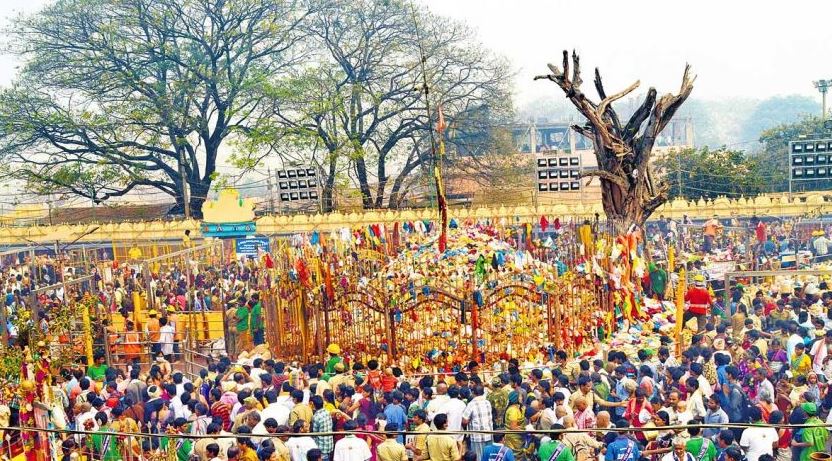
  • Telangana’s Tribal Fair: Sammakka-Sarakka Jatara

    Medaram, a tiny village in Telangana’s tribal heartland of Mulugu district, is getting ready to host the Sammakka-Sarakka jatara, billed as the country’s biggest tribal fair.

    Sammakka-Sarakka Jatara

    • The mega four-day jatara, scheduled to begin on February 16 in Medaram. It takes place once in two years.
    • It is perhaps the only tribal fair devoted to pay tribute to tribal warriors who made supreme sacrifices defending the rights of aboriginal tribal people.
    • It symbolises the traditions and heritage of the Koya tribal people.
    • The sacred site in Medaram and its surrounding Jampanna vagu, named after tribal martyr Jampanna, son of Sammakka, comes alive with lakhs of devotees during the four-day jatara.

    Why do tribals come to Medaram?

    • This festival commemorates a tribal revolt led by Sammakka and Saralamma, a mother-daughter duo, against levy of taxes on tribal people during drought conditions by the then Kakatiya rulers in the 12th century.
    • Tribals (and others) flock to Medaram during the jatara not just from Telangana and Andhra Pradesh but also from as far as Madhya Pradesh, Jharkhand, Chhattisgarh and Maharashtra.
    • Sammakka and Saralamma are revered by devotees as tribal goddesses, and devotees make offerings to propitiate them to bestow health and wealth.
    • All the rituals at the jatara site are held in tune with tribal traditions under the aegis of tribal priests.

    Features of the celebrations

    • One of the striking features of the tribal fair is the offering of jaggery to the tribal goddess at the altars (bamboo poles).
    • It encompasses common features of tribal fairs – die-hard devotees going into a trance, the sacrifice of fowls and goats, besides pulsating traditional drum beats accompanying folk songs.


    UPSC 2022 countdown has begun! Get your personal guidance plan now! (Click here)

  • In news: Ancient Tamil Civilization

    A reconnaissance survey in the sea off the coast of Korkai in Thoothukudi district where Tamiraparani River joins the sea, which finds mention in Sangam literature, will be undertaken by the Tamil Nadu Archaeology Department.

    About Tamiraparani River

    • The Thamirabarani or Tamraparni or Porunai is a perennial river that originates from the Agastyarkoodam peak of the Pothigai hills of the Western Ghats.
    • It flows through the Tirunelveli and Thoothukudi districts of the Tamil Nadu state of southern India into the Gulf of Mannar.
    • It was called the Tamraparni River in the pre-classical period, a name it lent to the island of Sri Lanka.
    • The old Tamil name of the river is Porunai.

    Its history

    • Its many name derivations of Tan Porunai include Tampraparani, Tamirabarni, Tamiravaruni.
    • Tan Porunai nathi finds mention by classical Tamil poets in ancient Sangam Tamil literature Purananuru.
    • Recognised as a holy river in Sanskrit literature Puranas, Mahabharata and Ramayana, the river was famed in the Early Pandyan Kingdom for its pearl and conch fisheries and trade.
    • The movement of people, including the faithful, trade merchants and toddy tapers from Tamraparni river to northwestern Sri Lanka led to the shared appellation of the name for the closely connected region.
    • One important historical document on the river is the treatise Tamraparni Mahatmyam.
    • It has many ancient temples along its banks. A hamlet known as Appankoil is located on the northern side of the river.

    Back2Basics: Keeladi Civilization

    • The Keeladi tale began to unravel in March 2015 when first round of excavation was undertaken by the Archaeological Survey of India (ASI).
    • It unearthed antiquities providing crucial evidence to understanding the missing links of the Iron Age [12th century BCE to 6th century BCE] to the Early Historic Period [6th century BCE to 4th century BCE].
    • Further excavations threw up strong clues about the existence of a Tamil Civilization that had trade links with other regions in the country and abroad.
    • This civilization has been described by Tamil poets belonging to the Sangam period.
    • Results of carbon dating of a few artifacts traced their existence to 2nd century BCE (the Sangam period).

    Key findings in excavations

    • These included brick structures, terracotta ring wells, fallen roofing with tiles, golden ornaments, broken parts of copper objects, iron implements, terracotta chess pieces, ear ornaments, spindle whorls, figurines.
    • It also had black and redware, rouletted ware and a few pieces of Arretine ware, besides beads made of glass, terracotta and semi-precious stones.


    UPSC 2022 countdown has begun! Get your personal guidance plan now! (Click here)
  • AP govt bans Chintamani Padya Natakam: A noted Telugu folk play

    The Andhra Pradesh government has brought the curtains down on the popular Telugu play ‘Chintamani Padya Natakam’, which has enthralled people for almost 100 years.

    Chintamani Padya Natakam

    • It is a stage play penned by social reformer, writer and poet Kallakuri Narayana Rao about 100 years ago.
    • In the play, the writer explains how people neglect their families by falling prey to certain social evils.
    • It was aimed to create awareness on the Devadasi system and how the flesh trade was ruining many families at that particular period.
    • Subbisetty, Chintamani, Bilvamangaludu, Bhavani Shankaram, and Srihari are some of the characters in the play.

    Its performance

    • The play is named after the main character, Chintamani, a woman born into a family involved in the flesh trade.
    • The play focuses on how she attained salvation after repentance.
    • Subbi Shetty, a character in the play, loses his wealth to Chintamani and his character is utilised in a way that engages the audience.
    • Chintamani play is popular across the state. It has been performed at thousands of places.
    • The play continues to engage the audience even today and has become a must stage play in villages during Dasara celebrations.

    Why it got banned?

    • Began as a social sermon, this play has been increasingly going vulgar.
    • Subbi Shetty, who resembles a person of a transgender community, is used to portray the social group in a bad way.
    • Obscene dialogues are added to the play in the name of creativity.


    UPSC 2022 countdown has begun! Get your personal guidance plan now! (Click here)

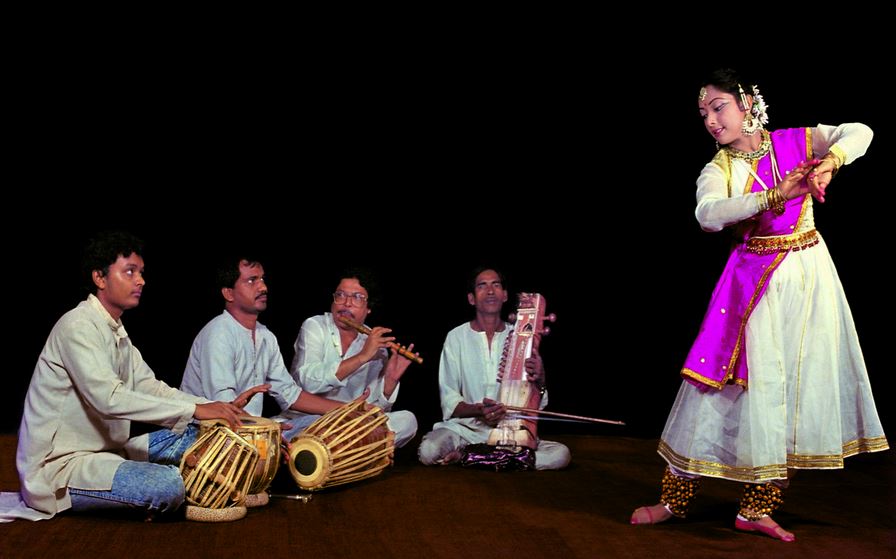
  • Art-form in news: Kathak

    Kathak legend Pandit Birju Maharaj has recently passed away.

    About Kathak

    • Kathak is one of the eight major forms of Indian classical dance.
    • The origin of Kathak is traditionally attributed to the traveling bards in of ancient northern India known as Kathakars or storytellers.
    • The term Kathak is derived from the Vedic Sanskrit word Katha which means “story”, and Kathakar which means “the one who tells a story”, or “to do with stories”.
    • Wandering Kathakars communicated stories from the great epics and ancient mythology through dance, songs and music.

    Its origin

    • Kathak dancers tell various stories through their hand movements and extensive footwork, their body movements and flexibility but most importantly through their facial expressions.
    • It evolved during the Bhakti movement, particularly by incorporating the childhood and stories of the Hindu god Krishna, as well as independently in the courts of north Indian kingdoms.
    • Kathak is unique in having both Hindu and Muslim gharanas and cultural elements of these gharanas.
    • Kathak performances include Urdu Ghazals and commonly used instruments brought during the Mughal period.

    Major gharanas

    • Kathak is found in three distinct forms, called “gharanas”, named after the cities where the Kathak dance tradition evolved – Jaipur, Banaras and Lucknow.
    • While the Jaipur gharana focuses more on the foot movements, the Banaras and Lucknow gharanas focus more on facial expressions and graceful hand movements.

    Performance details

    • It involves both Nritta (pure dance) and Nritya (expressive dance).
    • Stylistically, the Kathak dance form emphasizes rhythmic foot movements, adorned with small bells (Ghungroo) and the movement harmonized to the music.
    • The legs and torso are generally straight, and the story is told through a developed vocabulary based on the gestures of arms and upper body movement, facial expressions, neck movements, eyes and eyebrow movement, stage movements, bends and turns.
    • The main focus of the dance becomes the eyes and the foot movements.
    • The eyes work as a medium of communication of the story the dancer is trying to communicate. With the eyebrows the dancer gives various facial expressions.
    • A Kathak performance can be solo, duo or team. In a technical performance, the speed and energy the dancers exchange with the audience increases in multiples, that is the tempo doubles or quadruples.


    UPSC 2022 countdown has begun! Get your personal guidance plan now! (Click here)

  • [pib] Harvest Festivals in India

    The President has greeted the people of India on the occasion of Makar Sankranti and Pongal festivals.

    Makar Sankranti

    • Makar Sankranti or Uttarayan or Maghi or simply Sankranti is considered as the transition day of Sun into the Capricorn.
    • Now the sun moves northwards in the Hindu calendar.
    • Dedicated to the deity Surya, many native festivals are organized all over India.
    • It mostly falls at the end of Kharif harvests.

    Statewise festivals celebration

    • Pongal: In South India and particularly in Tamil Nadu, it’s the festival of Pongal which is being celebrated over 4 days at harvest time.
    • Lohri: It is celebrated in North India particularly in Punjab as a traditional winter folk festival or as a popular harvest festival of farmers.
    • Bhogi: In Andhra Pradesh, it is celebrated as a four day festival with a bonfire with logs of wood, other solid-fuels, and wooden furniture at home that are no longer useful.
    • Magha Bihu: In Assam and many parts of the North East, the festival of Magha Bihu is celebrated. It sees the first harvest of the season being offered to the gods along with prayers for peace and prosperity.
    • Uttarayan: Gujarat celebrates it in the form of the convivial kite festival of Uttarayan.
    • Saaji: In Shimla District of Himachal Pradesh, Makara Sankranti is known as Magha Saaji. Saaji is the Pahari word for Sankranti, start of the new month. Hence this day marks the start of the month of Magha.

    Try this question from our AWE initiative:

    Do we have cultural pockets of small India all over the nation? Elaborate with examples. (15 Marks)


    UPSC 2022 countdown has begun! Get your personal guidance plan now! (Click here)
  • Veer Baal Diwas to be observed on December 26

    Prime Minister has declared that December 26 shall henceforth be marked as Veer Baal Diwas to pay homage to the courage of the Sahibzades, four sons of Guru Gobind Singh, the last Sikh guru.

    What is the legend of Sahibzades?

    • The word “Sahibzada” means “son” in Punjabi and is a term commonly used to refer to the 4 sons of Guru Gobind Singh, the tenth Sikh Guru.
    • The week of 21 to 27 December is celebrated as the Sacrificial Week in memory of the four Sahibzadas who made sacrifices for the protection of Sikhism and Hinduism.
    • Sahibzada Ajit Singh, Jujhar Singh, Zorawar Singh and Fateh Singh got martyrdom while saving their religious faiths against forceful conversion.

    Their martyrdom: A backgrounder story

    • After the establishment of the Khalsa Panth, Guru Gobind Singh left the fort of Sri Anandpur Sahib with his family on 20-21 December 1704 to fight the invasion by Aurgangzeb.
    • The elder sahibzade Ajit Singh, Jujhar Singh stayed with Guru ji, while the younger sons Zorawar Singh and Fateh Singh were with Mata Gujri ji.
    • Subedar Wazir Khan of Sirhind arrested the two Sahibzades subsequently and lured them for religious conversion.
    • In the end, it was announced to get them elected in the living walls.
    • The rest two sahibzades got assassinated in the battle of Chamkaur (1705).

    Implications of their martyrdom

    • When the news of this reached Guruji, he wrote a zafarnama (letter of victory) to Aurangzeb, in which he warned Aurangzeb that the Khalsa Panth was ready to destroy your empire.
    • Baba Banda Singh Bahadur took revenge for the martyrdom of Guruji’s Sahibzadas.
    • He punished Wazir Khan for his deeds in Sirhind and established Sikh hegemony over the entire area.
    • The result of this sacrifice was that later a large Sikh empire emerged under the leadership of Maharaja Ranjit Singh.

    A historic event in Indian History

    • This event is an important part of Indian history and the occasion of their martyrdom is remembered and commemorated both with great vigor and sorrow.
    • The names of Sahibzades are reverently preserved and are recalled every time Ardas (prayer) of supplication is recited at a congregation or privately by an individual.


    UPSC 2022 countdown has begun! Get your personal guidance plan now! (Click here)